
Apple Intelligence has cleared a critical Chinese regulatory gate. On July 15–16, 2026, Apple’s AI service appeared on the Cyberspace Administration of China’s approved registration list, with Alibaba’s Qwen serving as the primary model layer and Baidu also contributing to the China rollout.[1][2][3] That is a real unlock for Apple’s consumer AI platform in China. It is not, by itself, an approval for medical AI.
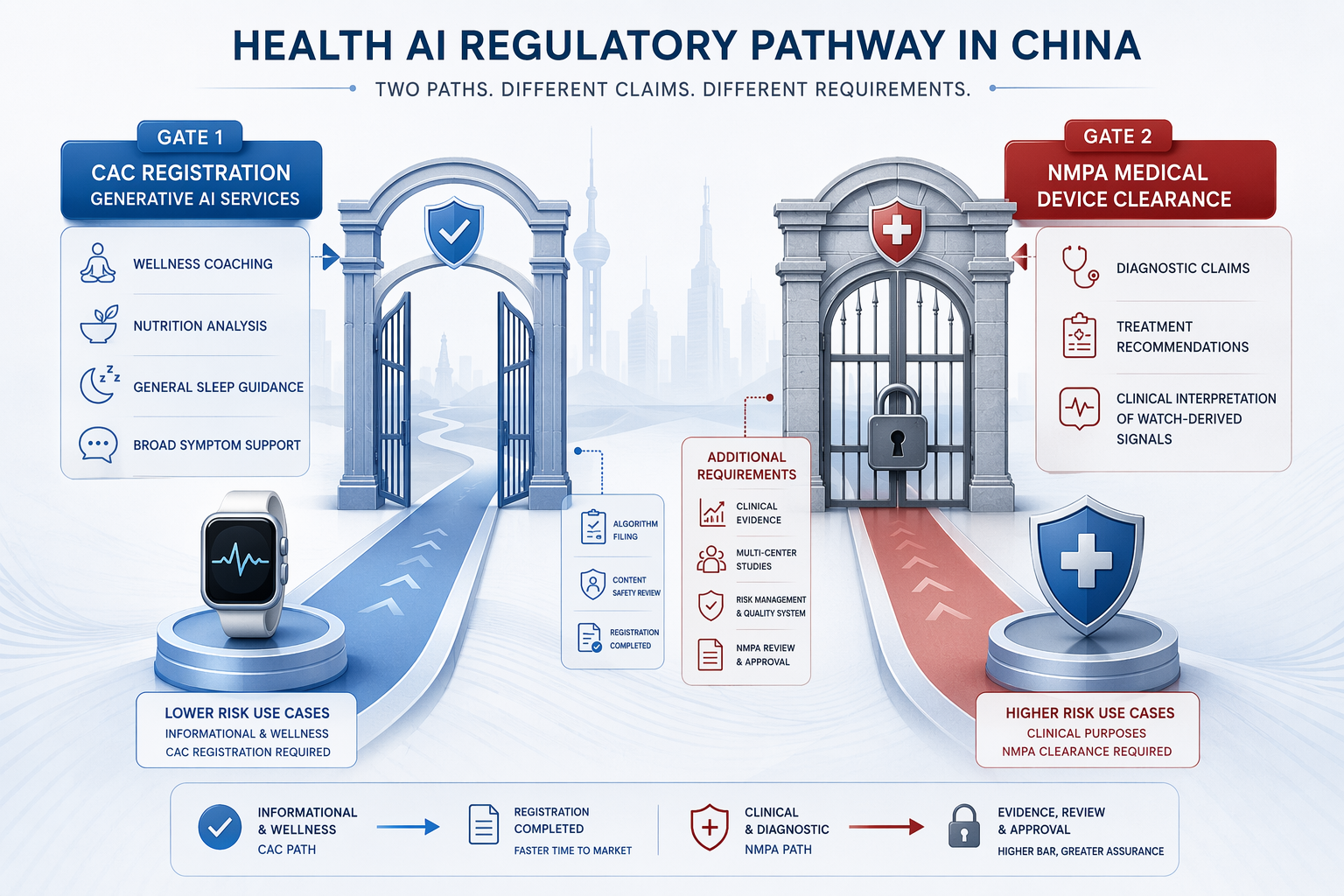
That distinction matters because Apple’s China AI partnership can easily compress several different regulatory questions into one attractive headline. A CAC-registered generative AI service may support health-adjacent answers, summarization, coaching, and user-facing explanations. A medical feature that interprets ECG, AFib burden, symptoms, sleep signals, nutrition data, or Apple Watch measurements in a clinically meaningful way falls into a different review pathway.
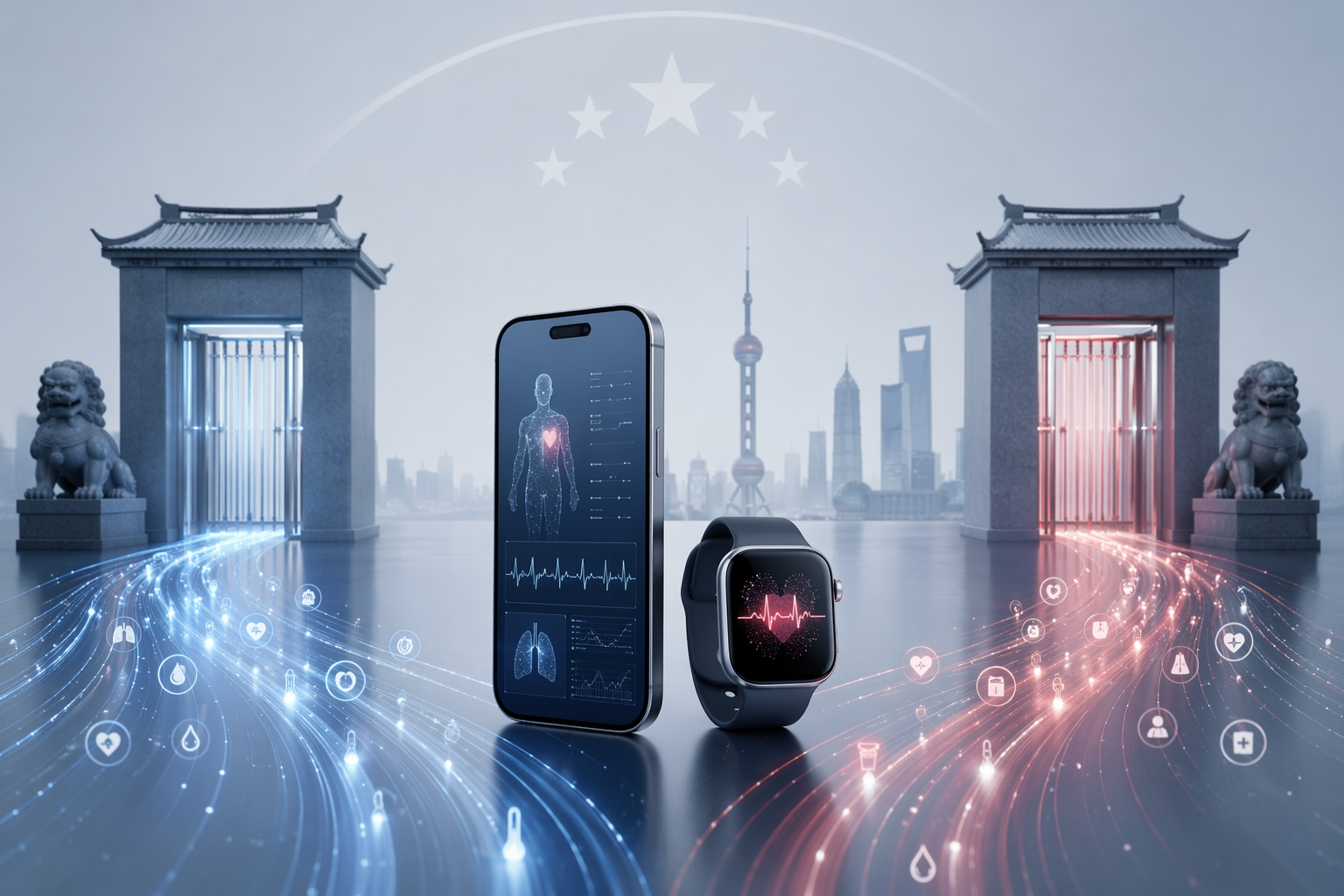
Apple has already crossed that medical-device pathway in China for specific Watch features. The Apple Watch ECG app received approval in China in June 2021, establishing that Apple can take a sensor-derived health function through the National Medical Products Administration when the claim requires it.[4] AFib History belongs in the same category of regulated device functionality. Those approvals are precedents, not blanket permission slips for a generative model to make new health claims.
The Three Layers That Should Not Be Collapsed
The cleanest way to read Apple’s China AI milestone is to separate the platform layer, the existing device layer, and any future health-AI claim layer. Most confusion starts when those layers are treated as one approval event.
| Layer | What Apple Has | What It Does Not Automatically Grant |
|---|---|---|
| CAC-registered generative AI service | Apple Intelligence registered in China using Alibaba Qwen as the primary model layer, with Baidu also involved.[1][2][3] | No automatic clearance to diagnose, recommend treatment, or interpret health signals as a medical device. |
| Existing Apple Watch medical features | NMPA precedent for specific cleared functions, including the ECG app approval in June 2021.[4] | No general authorization for new generative health features. |
| Future health AI features | A plausible software layer for wellness, general guidance, summarization, and user education. | Separate NMPA submissions and clinical evidence if the feature makes diagnostic, treatment-specific, or clinically interpretive claims. |
CAC registration is about allowing a generative AI service to operate inside China’s regulatory system. It addresses the availability of the model-backed service, not the clinical validity of each health conclusion that a product might produce. For a consumer platform, that distinction is not bureaucratic hair-splitting. It decides who is responsible when an answer stops being general support and starts functioning like clinical interpretation.
Apple’s prior NMPA approvals show that China does not treat all Apple health features as ordinary wellness software. When a Watch feature generates a regulated medical output, it moves through medical-device review. A future generative feature that says, in effect, “your rhythm pattern suggests X” or “based on these measurements, you should follow Y treatment path” would be much closer to that world than to a generic chatbot feature.
What Looks Plausible Under CAC Registration
The most plausible near-term health uses are the ones that do not need to become a diagnosis. Apple Intelligence could explain general health concepts in Chinese, summarize user-entered wellness notes, help structure questions for a physician, or translate broad sleep and activity patterns into plain-language coaching. The CAC registration makes that kind of generative layer more feasible inside China; it does not remove the need to police the claims.
Wellness coaching is the easier case. A user who asks how to build a more consistent bedtime routine, how to think about recovery after travel, or how to compare general nutrition labels is not necessarily receiving medical advice. The feature can stay in the territory of education, habit formation, and non-diagnostic support. The regulatory burden changes if the same assistant uses watch-derived signals to conclude that the user has a disorder, should change medication, or should delay clinical care.
Nutrition analysis sits in the middle. A feature that categorizes meals, explains macronutrients at a general level, or helps a user track stated dietary goals is plausibly a wellness tool. A feature that generates disease-specific dietary instructions for kidney disease, diabetes, pregnancy complications, or cardiovascular treatment moves closer to medical guidance. The line is not whether the answer sounds polished. The line is whether the output is being used to guide prevention, diagnosis, treatment, mitigation, or clinical management for a condition.
Sleep is similar. Explaining sleep hygiene, helping a user compare bedtime consistency across weeks, or describing why alcohol, light exposure, or irregular schedules can affect rest is general guidance. Interpreting watch-derived patterns as sleep apnea, depression, arrhythmia risk, or another clinical condition would be a different product claim. Apple already has a rich device surface for health data, but rich data does not automatically create medical clearance for a new AI interpretation layer.
Symptom guidance is the hardest category to keep tidy. A cautious assistant can help a user organize symptoms, suggest what information to bring to a clinician, and provide broad safety language. But symptom triage can quickly become clinical prioritization: go now, wait, treat at home, take this action, ignore that signal. In healthcare AI, that is where product copy and risk management often diverge. The more specific the recommendation, the more the product begins to look like a medical decision-support tool.
Where NMPA Review Would Become Hard to Avoid
A useful operational test is to ask what the feature claims to do with the user’s data. If Apple Intelligence answers a general question about sleep routines, that is one thing. If it analyzes Apple Watch signals and tells the user that a specific clinical condition is likely, that is another. If it recommends treatment, medication adjustment, disease-specific monitoring, or a care pathway, the medical-device question becomes unavoidable.
- Lower regulatory risk: general wellness education, habit coaching, nutrition explanation, sleep hygiene support, and preparation notes for a clinician visit.
- Higher regulatory risk: interpreting ECG, AFib History, heart-rate trends, sleep signals, symptoms, or nutrition data to identify a condition.
- Likely medical-device territory: diagnosis, treatment recommendation, disease-specific triage, medication guidance, or clinical interpretation of sensor-derived measurements.
This is why Apple’s existing ECG and AFib History clearances should be read narrowly. They show that the company can obtain Chinese medical-device approval for defined Watch functions. They do not mean a Qwen-powered assistant can begin explaining ECG strips, ranking stroke risk, or turning AFib trends into treatment advice without a separate regulatory argument and supporting evidence.
The distinction may feel conservative compared with the speed of consumer AI launches, but it is exactly where clinical safety teams earn their keep. A generative model can sound fluent while being wrong, overconfident, or insufficiently localized to the care setting. In medicine, the cost of that gap is not merely user dissatisfaction. It can be delayed care, unnecessary alarm, or inappropriate self-management.
The Engineering Path Is Credible, but Still Unannounced
The technical story is more interesting than a simple “Apple picked a Chinese model” headline. Apple’s China path reportedly uses Alibaba’s Qwen as the primary model layer, with Baidu contributing as well.[1][2][3] That gives Apple a domestic model basis for Chinese regulatory registration while preserving the broader Apple Intelligence idea: a consumer-facing AI layer tied closely to the device experience.
On-device execution is the elegant part. CNBC reported that PrismML compressed a 27-billion-parameter Qwen model from 54 GB to under 4 GB using hardware-aware distillation and mixed-sparsity quantization, making on-device inference feasible on iPhone 15 and newer devices.[3] That demonstration fits Apple’s privacy instincts and China’s data-localization pressures unusually well: keep more inference close to the device, reduce unnecessary data movement, and make the phone or watch feel like the health interface rather than a terminal pointed at a distant cloud.
Still, PrismML’s result is not an Apple deployment announcement. It is evidence that a compressed Qwen-based path can be technically plausible on recent iPhones, not evidence that Apple will ship a specific health AI feature in China. That caveat is worth keeping in the foreground because healthcare AI coverage often turns feasibility into intent and intent into a presumed product plan.
If Apple does use a device-native or hybrid architecture for health-related generative features, the product advantages are obvious. Health interfaces benefit when answers are immediate, contextual, and integrated with the data users already see. Apple is also better than most healthcare incumbents at making complicated information legible. But better interface design does not solve the evidence question. A locally running model can still make a regulated medical claim.
Apple’s Global Health AI Signals Are Real, but China-Specific Plans Are Not Confirmed
Apple’s broader direction gives the China registration more strategic weight. Bloomberg reported in March 2025 that Apple was preparing a major Health app revamp and an AI health coach trained on in-house physician data, described as part of a larger push around Health+ and iOS 19.[5] That report made it easier to imagine Apple Intelligence becoming more than a writing, summarization, and productivity layer.
The timing then became less certain. Newsweek reported in February 2026 that Apple pulled back on the planned AI-powered health coach service amid leadership changes, with Eddy Cue replacing Jeff Williams in oversight of the health effort.[6] That does not erase Apple’s health-AI direction, but it should temper any claim that China’s CAC registration means an imminent Chinese Health+ launch.
No Apple statement in the available record confirms China-specific health AI features tied to the Alibaba-Qwen arrangement. The better reading is narrower: Apple now has a necessary platform condition for Apple Intelligence in China, and that platform could support future health-related generative features if Apple chooses to design, localize, and regulate them appropriately.
Why the Pressure Is Rising Now
The business pressure is not subtle. Apple’s Greater China revenue reached US$20.5 billion in Q2 2026, up 28% year over year, and China shipments rose 24.4% year over year in the same quarter even before Apple Intelligence features were available to Chinese users.[2] AI availability is therefore not a theoretical add-on for Apple’s China device strategy. It arrives in a market where momentum is already visible.
The healthcare context is also expanding quickly. China’s AI healthcare market has been projected to grow from US$1.59 billion in 2023 to US$18.88 billion in 2030, a 42.5% compound annual growth rate.[7] Workforce constraints help explain why AI health tools attract attention: CKGSB has reported a ratio of one radiologist per 70,000 people in China, compared with one per 7,000 in the United States.[8]
China’s medical-device regulators are also seeing far more AI products. A 2026 JMIR Medical Informatics study reported that NMPA approvals of AI-enabled medical devices rose from 9 in 2020 to 154 as of June 2025, with 92 Class III AI-enabled devices by mid-2024.[9] That approval surge does not mean Apple can skip review. It means there is now a more developed regulatory lane for AI medical-device claims, and Apple would have to enter it if its feature crosses that line.
Apple has also been actively reminding Chinese consumers that the Watch is a health and safety device. In April 2026, its “Thankfully, I Was Wearing It” campaign in China highlighted Apple Watch health and rescue stories.[10] That campaign supports the consumer-health narrative around the device. It does not convert generative AI into a cleared medical function.
The Practical Boundary for Apple Health AI in China
For Apple, the attractive route is probably not to launch a diagnostic assistant first. The safer route is a China-localized wellness and general health layer that sits around existing Health and Watch experiences: explaining trends in ordinary language, helping users prepare for medical appointments, supporting behavior change, and keeping the output away from diagnosis or treatment-specific instruction.
That kind of product would still require careful localization. Chinese clinical pathways, health-system access, emergency instructions, pharmacy norms, and user expectations are not interchangeable with U.S. assumptions. A model that gives generic health language may be acceptable as consumer support; a model that appears to direct care needs a much higher level of validation, governance, and accountability.
Apple’s China AI registration therefore unlocks health-AI possibilities, especially for wellness coaching and general guidance on iPhone and Apple Watch. It does not create a shortcut into regulated medical AI. The key constraint is not whether Apple Intelligence can talk about health, but what role the product claims to play when it talks: once a feature moves from general support into clinical interpretation, diagnosis, or treatment guidance, the relevant approval is no longer just the CAC registration of the generative service.
References
- Apple Intelligence AI service registered with Chinese cyberspace regulator, Reuters, 2026-07-15
- Apple Intelligence approved for launch in China with Alibaba and Baidu, TechCrunch, 2026-07-16
- Alibaba stock rises after Apple inks deal to use Qwen AI models, CNBC, 2026-07-15
- Apple Watch ECG App Receives Approval in China, MacRumors, 2021-06-25
- Apple Health App Revamp, AI Doctor Coming in iOS 19, Bloomberg, 2025-03-30
- Apple Pulls Back on Planned AI-Powered Health Coach Service, Newsweek, 2026-02
- China's AI Healthcare Market (Part I): Growth Trends, APAC Comparison, China Briefing
- How China's medical industry is adopting AI, CKGSB Knowledge
- Approval of AI-Based Medical Devices in China From 2020 to 2025, JMIR Medical Informatics, 2026
- Apple Watch campaign highlights health and rescue stories in China, 9to5Mac, 2026-04-29
Comments
Join the discussion with an anonymous comment.