
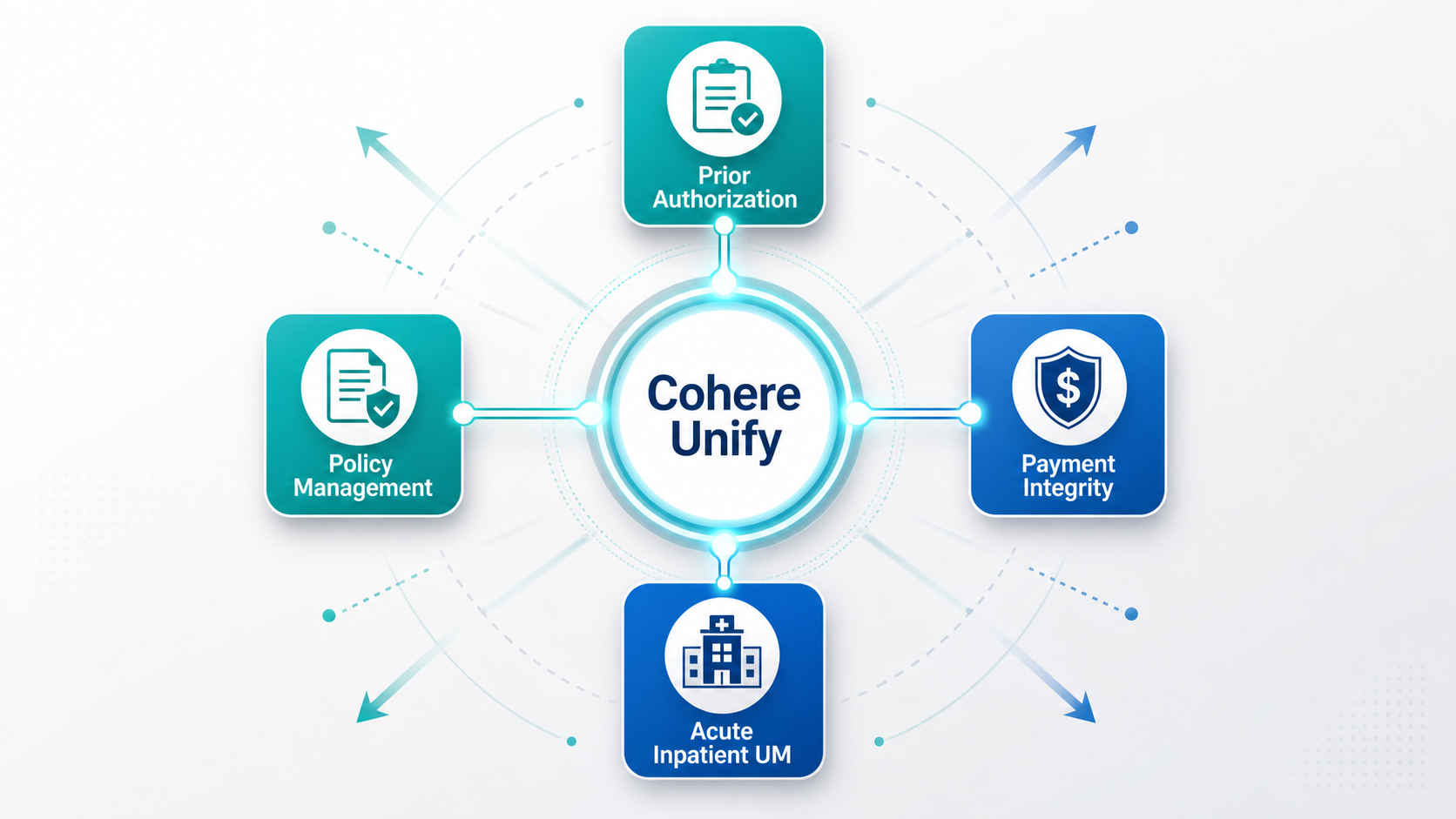
 Cohere Unify
For most of its history, Cohere Health has been understood as a prior authorization company — a highly effective one, but still a point solution operating in a single lane. That characterization no longer fits. Over the past eighteen months, the company has executed a deliberate, multi-vector expansion into acute inpatient utilization management, payment integrity, and clinical policy management, all powered by a shared AI engine called Cohere Unify. The September 2025 acquisition of ZignaAI was the most visible signal of this shift, but the underlying strategy — build a platform that health plans integrate once and then layer on capabilities — has been in motion longer. This analysis examines the expansion thesis, the performance data supporting it, and what it means for health plans evaluating whether to insource functions long outsourced to legacy vendors.
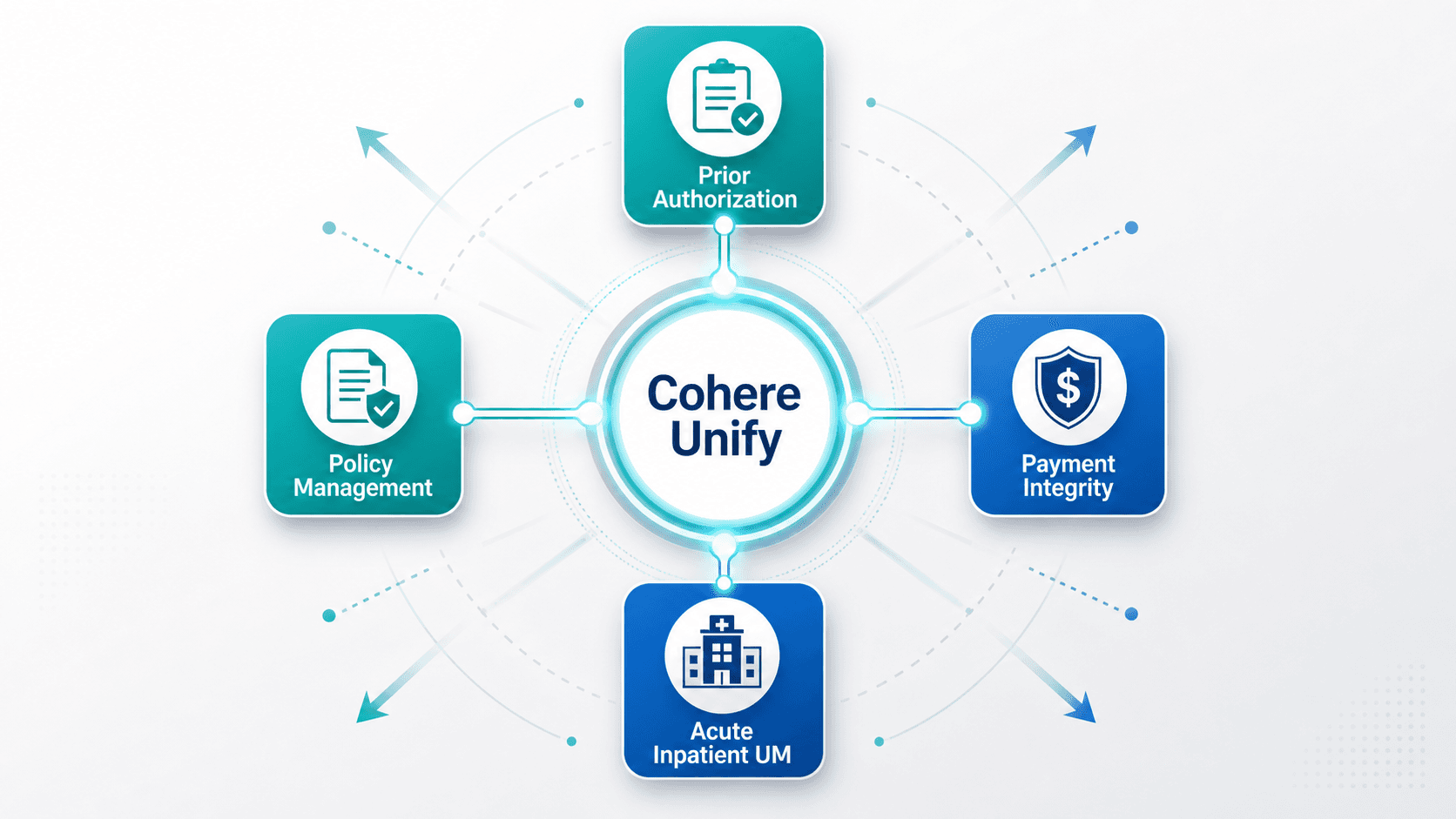
From Point Solution to Platform: The Cohere Unify Thesis
The conventional approach to utilization management and payment integrity in U.S. health plans involves stacking separate vendors — one for prior authorization, another for inpatient concurrent review, a third for claims auditing, and sometimes a fourth for policy administration. Each vendor brings its own data model, its own clinical rules engine, and its own integration burden. Cohere's counter-argument, embedded in the Cohere Unify platform, is that these functions share a common substrate: clinical guidelines, member data, provider networks, and the need to make coverage decisions against evidence-based criteria.
Cohere Unify is described as the foundation underneath every Cohere Health solution, with the same clinical AI, decision engines, and EHR integrations powering payment accuracy, appeals, and more. The platform has supported millions of transactions and is designed so health plans integrate once and add capabilities as needs evolve. It is HITRUST-certified, CMS-0057-F compliant, and integrates with Epic, Rhyme, Availity, and NaviNet.
The strategic logic is straightforward: a health plan that has already connected Cohere's prior authorization module to its EHR and claims systems can activate payment integrity or acute inpatient modules without a new integration project. The same clinical AI that evaluates a prior authorization request can also flag a mismatched DRG code or identify a sepsis case that warrants retrospective review. This shared-infrastructure approach is the core of the platform thesis, and it is what distinguishes Cohere from the point-solution vendors it competes with.
For readers needing the full company background — founding story, funding history, and core prior authorization metrics — the existing covers that ground. This article focuses on what comes next.
Expansion into Payment Integrity: The ZignaAI Acquisition and Payment Integrity Suite
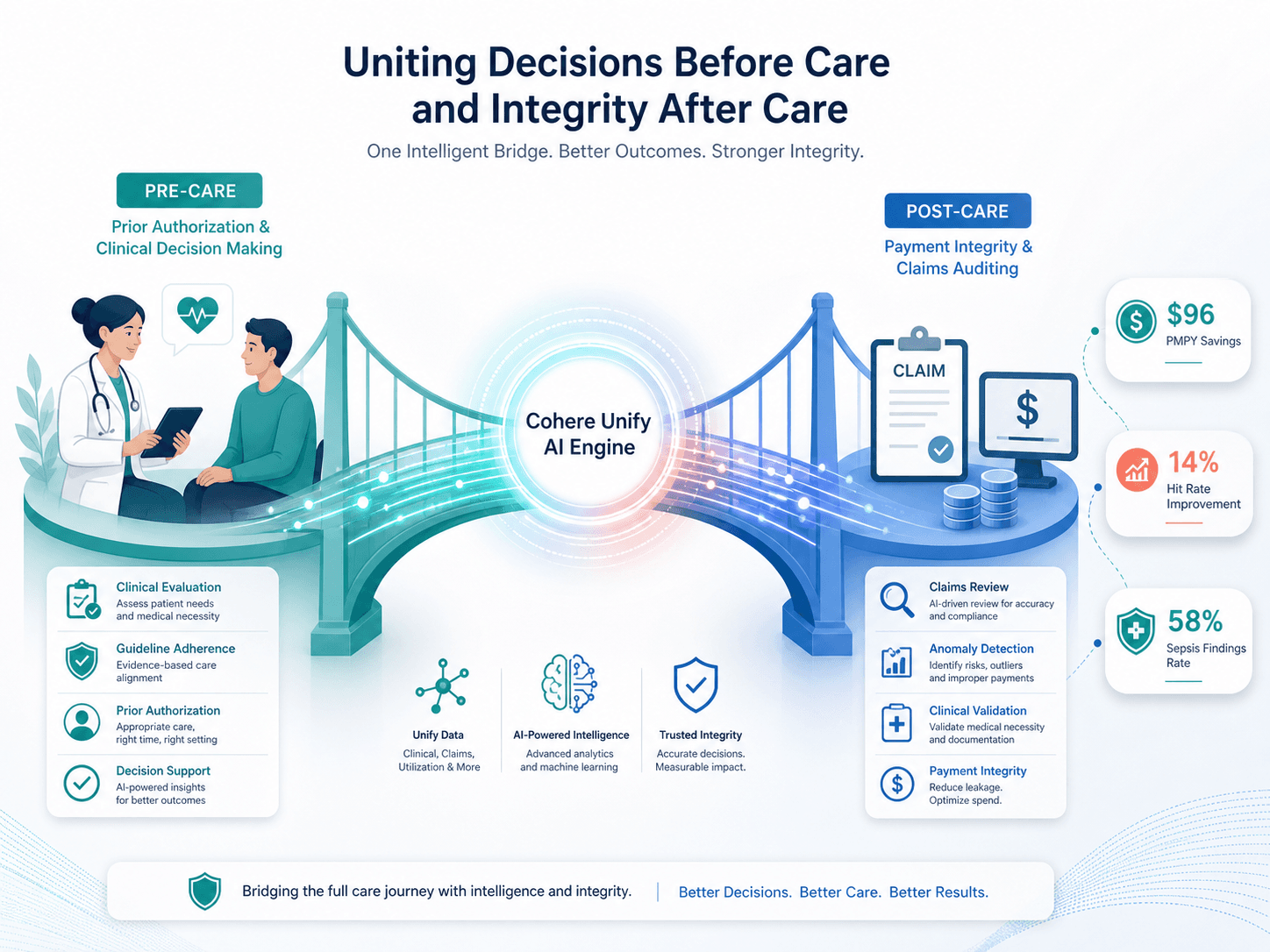
The most consequential move in Cohere's expansion came in September 2025 with the acquisition of ZignaAI, a company specializing in AI-driven payment integrity. The acquisition enabled the launch of a full Payment Integrity Suite, marking what CEO Siva Namasivayam described as a deliberate shift from pre-care (prior authorization) into post-care (claims payment and coding validation).
The suite comprises three products:
- Cohere Validate — An in-house audit solution that enables health plans to conduct automated, evidence-based claims review without relying on external audit vendors.
- Cohere Complete for PI — An outsourced audit service for plans that prefer to delegate retrospective review to Cohere's team, leveraging the same AI engine.
- Cohere Match — An authorization-to-payment reconciliation tool that closes the loop between what was approved pre-care and what was actually paid post-care.
Cohere's Chief Growth Officer Krishna Kottapalli framed the strategy as helping health plans move away from legacy models by reducing dependency on stacked audit vendors with transparent, evidence-based, automated in-house processes. The acquisition effectively bridges the gap between utilization management and payment integrity — two functions that have historically operated in silos within most health plans.
Performance Data in Payment Integrity: Validating the Expansion Thesis
Cohere has published a set of performance metrics for its payment integrity products that, if sustained in independent validation, represent a significant improvement over typical industry benchmarks. The headline figures are concentrated in Cohere Validate:
| Metric | Value | Context |
|---|---|---|
| Year-one savings | Up to $96 per member per year | Company-reported; applies to fully-insured commercial populations |
| Audit hit rate improvement | 14% | Compared to baseline manual audit processes |
| Auditor efficiency gain | Up to 30% | Reduction in time per claim reviewed |
| Return on investment | 8-9x | Cohere Validate; company-reported |
| Sepsis audit agent findings rate | 58% | Specialized AI agent for sepsis-related claims review |
The specialized sepsis audit agent achieving a 58% findings rate is particularly notable. Sepsis-related claims are a known area of high improper payment rates in Medicare and commercial populations, and a tool that can reliably identify miscoded or clinically unsupported sepsis diagnoses at scale would address a well-documented pain point. However, the 58% figure represents the rate at which the agent identifies a finding — not necessarily the rate at which those findings result in confirmed overpayments after human review. The distinction matters for ROI modeling.
Expansion into Acute Inpatient Care: Cohere Review Assist
Cohere's second expansion vector is acute inpatient utilization management, addressed through the Cohere Review Assist product. The value proposition is straightforward: clinical reviewers can complete acute inpatient authorization requests nearly 50% faster than with traditional manual processes. The product also claims 30% more accurate decisions, though the definition of accuracy in this context — alignment with clinical guidelines, inter-rater reliability, or both — is not specified in the company's public materials.
The acute inpatient market is structurally different from outpatient prior authorization. Inpatient reviews involve higher acuity, more complex clinical documentation, and tighter timeframes — often requiring decisions within 24-48 hours of admission. The workflows are also more labor-intensive, typically involving nurse reviewers and physician advisors reviewing charts against InterQual or MCG criteria. If Cohere Review Assist can meaningfully reduce the time per review while maintaining or improving accuracy, it addresses a cost center that health plans have struggled to automate.
Expansion into Policy Management: Cohere Policy Studio
The third expansion vector is Cohere Policy Studio, a module that enables health plans to digitize, manage, and version-control their clinical policies within the same platform that handles utilization management and payment integrity. Cohere reports that more than 4,000 policies have already been digitized on the platform.
Policy management may sound like a back-office function, but it is strategically important for two reasons. First, clinical policies are the rules that both UM and PI modules execute against — having them in the same system eliminates the translation errors that occur when policies are maintained in spreadsheets or document management systems and then manually coded into separate decision engines. Second, policy versioning and audit trails are becoming more important as regulators and accrediting bodies scrutinize the consistency of coverage decisions. A platform that can demonstrate that every UM and PI decision was made against the correct version of a policy has a compliance advantage over siloed systems.
Policy Studio also creates a natural upsell path: a health plan that starts with Cohere for prior authorization can add policy management to gain control over its clinical rule base, then layer on payment integrity using those same digitized policies as the audit criteria.
Platform Economics: One Integration, Modular Capabilities
The economic argument for Cohere's platform approach rests on a simple premise: health plans integrate once and add capabilities as needs evolve. Cohere's Connect APIs, built on FHIR standards, have supported more than 15 million prior authorization submissions. A plan that has already completed that integration can activate payment integrity, acute inpatient UM, or policy management modules without a new technical onboarding cycle.
The operational implications are significant:
- Reduced vendor management overhead — one relationship, one contract, one security review instead of three or four.
- Shared clinical data across modules — a prior authorization decision informs the payment integrity audit, and a policy change in Policy Studio propagates to both UM and PI workflows automatically.
- Consistent provider experience — providers interact with a single Cohere interface for both pre-care and post-care interactions, reducing the friction of navigating multiple vendor portals.
- Unified analytics and reporting — performance metrics across UM, PI, and policy management are visible in a single dashboard, enabling plans to identify patterns that siloed data would obscure.
This contrasts sharply with the legacy approach, where a health plan might contract with eviCore for prior authorization, a separate vendor for inpatient concurrent review, HMS or Cotiviti for payment integrity, and maintain clinical policies in a document management system that none of those vendors connect to. Each handoff between systems creates opportunities for data loss, misalignment, and delay.
Competitive Landscape: Legacy UM and PI Vendors vs. Cohere's Connected Approach
Cohere's expansion brings it into direct competition with two categories of incumbent vendors that have historically operated in separate lanes:
| Category | Legacy Vendors | Cohere's Differentiator |
|---|---|---|
| Utilization management | eviCore (Cigna), AIM Specialty Health (Anthem), Carelon (Elevance) | Single platform connecting UM to PI; shared AI engine across both functions |
| Payment integrity | HMS (Gainwell), Cotiviti, Zelis, nThrive | Pre-care context informs post-care audit; authorization-to-payment reconciliation via Cohere Match |
| Policy management | Spreadsheets, document management systems, McKesson InterQual modules | Digitized policies (4,000+) directly feed UM and PI decision engines on the same platform |
The key competitive argument is not that Cohere's AI is inherently better at any single task — it is that the connected architecture eliminates the inefficiencies of siloed systems. A legacy payment integrity vendor like Cotiviti may have deep expertise in claims auditing, but it does not have access to the prior authorization data that would tell it whether a service was pre-approved. Cohere's platform, by contrast, can reconcile what was authorized against what was paid as a native function, not as a post-hoc data integration.
For a broader view of how Cohere fits into the overall healthcare AI company landscape, see the , which maps the competitive field across multiple application areas.
Implications for Health Plan Strategy: Insourcing vs. Outsourcing UM and PI
Cohere's platform strategy creates a strategic option that many health plans have not had: the ability to insource utilization management and payment integrity functions that have been outsourced to legacy vendors for years. The traditional rationale for outsourcing was that no single vendor could handle all three functions well, and building internal capability was too expensive and slow. Cohere's argument is that a unified AI platform changes that calculus.
The trade-offs are real and should be evaluated carefully:
- Upfront integration investment: Moving from a legacy vendor stack to a unified platform requires a meaningful implementation project, even with FHIR-based APIs. Health plans must budget for data migration, workflow redesign, and staff training.
- Long-term savings: Cohere's reported 8-9x ROI on payment integrity and 1-3% inpatient medical expense savings in UM suggest that the payback period can be relatively short for plans with sufficient volume. However, these figures are company-reported and may vary based on population mix, baseline vendor costs, and implementation quality.
- Operational control: Insourcing gives health plans direct visibility into decision logic, policy adherence, and performance data — rather than relying on vendor reports. This can improve regulatory compliance and enable faster policy updates.
- Vendor lock-in risk: Consolidating UM, PI, and policy management on a single platform creates dependency on that vendor. Health plans should evaluate Cohere's data portability, contract terms, and exit provisions before committing to a full-platform strategy.
Outlook: Agentic AI, CMS Partnerships, and IPO Potential
Cohere's expansion trajectory raises three forward-looking questions for health plans and investors.
Agentic AI and workflow automation. CEO Siva Namasivayam has described Cohere's approach as an AI co-pilot that reduces physician review time from 40-50 minutes to 10 minutes. The next logical step is agentic AI — systems that not only recommend decisions but execute multi-step workflows autonomously within defined guardrails. Cohere's specialized sepsis audit agent, which achieved a 58% findings rate, is an early example of this direction. If the company can deploy agentic AI across its UM and PI modules, it could further reduce the labor intensity of clinical review and claims audit functions.
CMS-0057-F compliance and regulatory tailwinds. Cohere's platform is CMS-0057-F compliant, positioning it to serve Medicare Advantage plans that must meet new prior authorization timelines and electronic submission requirements. As CMS continues to tighten prior authorization rules — and as state-level legislation on AI in insurance decision-making advances — health plans will need platforms that can demonstrate audit-ready compliance. Cohere's unified policy management and decision logging capabilities give it a compliance advantage over legacy systems that lack transparent audit trails.
IPO potential and acquisition strategy. Cohere has raised substantial venture capital — including a $90 million Series C round — and Namasivayam has publicly stated interest in small strategic acquisitions to bolster subject matter expertise. The ZignaAI acquisition demonstrated that Cohere is willing to buy rather than build when it needs specialized capability. The company's growth trajectory, expanding addressable market, and platform economics make it a plausible IPO candidate in the 2027-2028 timeframe, though the timing will depend on public market conditions and the company's ability to demonstrate sustained revenue growth and expanding margins.
For health plan strategists and investors, the key question is whether Cohere can execute on the platform vision without losing the focus and execution discipline that made it successful in prior authorization. The expansion into payment integrity, acute inpatient care, and policy management increases the company's addressable market significantly — but it also increases execution risk. The next 12-18 months, as the ZignaAI integration matures and early payment integrity deployments produce real-world results, will be the critical test of whether the platform thesis holds.
Comments
Join the discussion with an anonymous comment.