
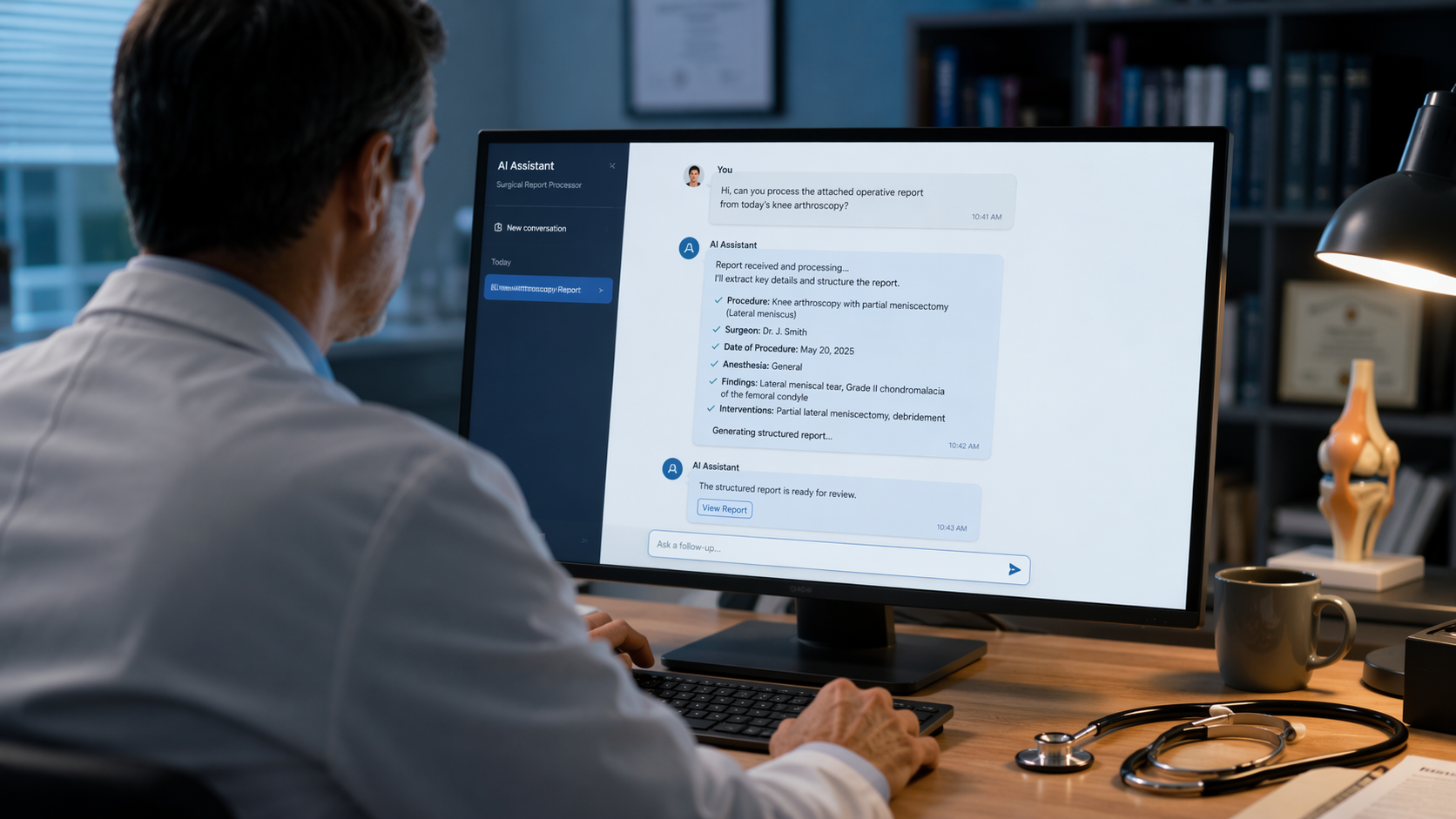
The MIMIT Health workflow that makes AI chatbots deployed in enterprise via Slack worth examining is not a chatbot answering a generic patient question. It is a surgeon finishing a case, sending a report into an existing Slack workflow, and approving or rejecting the next action with an emoji. Before the deployment, physicians at MIMIT were spending 20 to 30 minutes per case dictating surgery reports through phone transcription services. In the reported Slack-based workflow, Slack Workflow Builder uses approval triggers such as ✅ and ❌ to move the report through processing in under one minute.[1]
That is the kind of time reduction that matters because it removes a repetitive after-the-fact task from a physician’s day. It also gives a more useful picture of enterprise AI than a demo window does: the agent is sitting inside a messaging system, attached to routing, approvals, documentation movement, and access rules. The result is not simply “AI generated text.” It is a shorter administrative loop.
The necessary caveat comes early. The processing times, annual savings, and staff-capacity figures in this profile come from MIMIT’s published case materials and Slack’s customer story, with some deployment interpretation from Salesforce ecosystem partners. They should be read as organization-attributed outcomes, not as independently audited evidence that any healthcare group will reproduce the same results by turning on a chatbot.
What MIMIT Actually Deployed
MIMIT Health is a Chicago-based multi-specialty physician group that built its AI-agent deployment around Slack Enterprise Grid, Salesforce Agentforce, and Slack Workflow Builder. The important operational choice was not only the model or agent layer. It was the decision to place the automation inside the channels where physicians, referral staff, billing teams, and operations leads were already coordinating work.
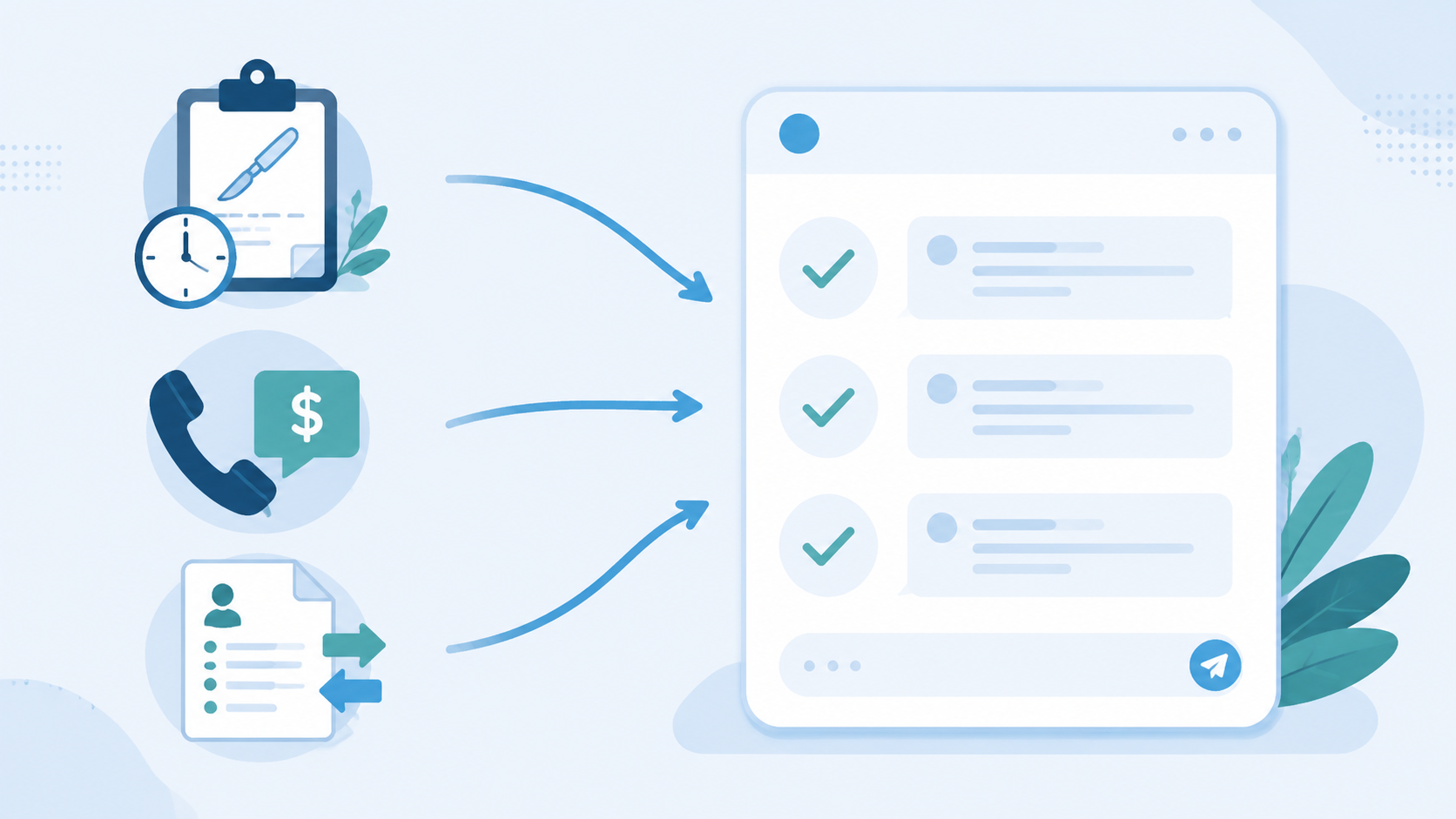
In the published MIMIT case, Agentforce handles administrative and clinical-adjacent workflows such as incoming referrals, appointment scheduling, surgery documentation, billing dispute coordination, physician onboarding, and AI transcription. Slack functions as the front door and work surface: a referral can create a private channel, an approval can be captured through a workflow trigger, and a disputed bill can be moved into a shared space where the care team and revenue cycle staff stop chasing one another across phone calls.[1]
This distinction matters for buyers. A conversational agent that lives outside daily operations often becomes one more portal. MIMIT’s reported gains come from embedding the agent into the coordination layer: who sees the request, who approves it, where the record of action lives, and how quickly the next person can act.
| Workflow | Before | Reported Slack-based change |
|---|---|---|
| Surgery documentation | Physicians dictated reports through phone transcription services, taking 20 to 30 minutes per case | Workflow Builder approval triggers process reports in under one minute |
| Billing disputes | Resolution took days or weeks and required phone tag between care teams and revenue cycle staff | Disputes are resolved in approximately 15 minutes through Slack-based coordination |
| Patient referrals | Manual lead management consumed hours of staff time per referral | Agentforce processes incoming referrals in seconds and routes work through Slack |
The Surgery Report Is the Cleanest Before-and-After
Surgery documentation is the clearest example because the old workflow is easy to recognize. A physician completes a case, then spends another 20 to 30 minutes dictating a report into a phone transcription service. The clinical work is done, but the documentation queue remains. MIMIT’s Slack workflow changes the administrative sequence: the report enters Slack, Workflow Builder presents an approval action, and the physician can approve or reject with emoji-based triggers. MIMIT reports that the processing time fell to under one minute.[1]
The practical value is not that an emoji is clever. It is that the approval action is lightweight enough to fit the physician’s actual work pattern. The physician is not being asked to open a separate system, find the right queue, authenticate again, and interpret a new interface. The action is reduced to a controlled decision point inside a channel-based workflow.
For a clinical operations leader, that is also where the evaluation should focus. The question is not whether the agent can draft a report in a lab setting. The question is whether the work item reaches the right physician, whether the approval event is captured, whether the report moves to the right downstream destination, and whether the old transcription and rework loop actually disappears rather than being handed to a coordinator.
Billing Disputes Show the Coordination Problem
The billing dispute example is less dramatic than the surgery report, but it may be more familiar to revenue cycle teams. MIMIT says disputes that previously took days or weeks, with phone tag between care teams and billing staff, are now resolved in approximately 15 minutes through Slack-based coordination.[1] Absyz’s deployment analysis describes the same pattern as a shift from fragmented follow-up to agent-supported collaboration in Slack.[2]
That improvement depends on cross-functional visibility. A billing question often cannot be resolved by the billing team alone. Someone may need clinical context, documentation clarification, coding support, or confirmation from the practice team. In a phone-and-inbox workflow, each handoff creates another waiting period. In a channel workflow, the relevant people can be assembled around the disputed item, and the record of discussion stays attached to the work.
The distinction is important because billing automation is easy to overstate. MIMIT’s materials support a narrower and more useful claim: for this organization, Slack-based coordination and Agentforce-supported workflow reduced the reported dispute-resolution cycle from days or weeks to about 15 minutes. That is an operational outcome, not evidence that the agent independently adjudicates billing correctness.
Referral Routing Moves From Lead Management to Channel Creation
Referral handling is where MIMIT’s Slack architecture looks most like a healthcare operations queue rather than a chatbot conversation. The published case describes Agentforce processing incoming referrals in seconds, replacing manual lead management that had consumed hours of staff time per referral.[1] Cloud for Good’s Agentforce for Health analysis also points to referral intake and routing as a healthcare use case for agentic automation.[3]
In MIMIT’s configuration, automated private channels are created for referrals, with access controls governing who can see the work. That matters because a referral is not just a message. It can contain protected health information, scheduling implications, specialty-specific routing, insurance context, and follow-up obligations. A seconds-level routing claim is only useful if the patient’s information lands in a controlled space where the right team can act.
The Compliance Configuration Is Not Optional
Slack’s healthcare viability in this case depends on Enterprise Grid with a signed Business Associate Agreement. Slack’s HIPAA documentation states that covered entities and business associates can use Slack to support HIPAA compliance only on Enterprise Grid with an executed BAA; Slack Pro and Business+ are not appropriate for protected health information.[4]
That plan-level distinction should not be treated as procurement fine print. If protected health information is moving through referral channels, documentation workflows, or billing discussions, the organization needs the contractual and technical controls that support HIPAA-aligned use. In MIMIT’s case, the reported setup uses private channels for PHI-bearing work, access controls, auditability, and workflow automation inside Slack Enterprise Grid.[1][4]
The Agentforce layer adds another set of controls. Absyz describes the deployment as using Salesforce’s Einstein Trust Layer, including encryption, zero data retention, and audit trails.[2] Those terms are worth checking during procurement, not merely repeating in a slide deck. A healthcare buyer should ask which data enters the agent layer, what is retained, how prompts and responses are logged, how access is enforced across Slack and Salesforce, and how audit evidence is produced when compliance or legal teams ask for it.
The safest reading is that MIMIT’s case is a HIPAA-conscious enterprise configuration, not proof that Slack in ordinary form is acceptable for clinical operations. The Slack environment, the BAA, the channel design, and the Salesforce trust controls are part of the deployment, not accessories around it.
What the Savings Claim Measures
MIMIT attributes more than $1 million in annual cost savings and approximately 25 full-time-equivalent positions worth of reclaimed administrative capacity to the Slack and Agentforce deployment.[1] Those figures are useful because they tie the deployment to operating capacity rather than novelty. They are also the figures that require the most caution because they are not presented as independently audited financial results.
A reclaimed-FTE claim does not necessarily mean 25 people were removed from payroll. In administrative automation, it often means staff hours were freed from manual routing, follow-up, transcription handling, dispute chasing, or intake work. That distinction matters for any organization building a business case. The finance team will ask whether the gain appears as avoided hiring, reduced overtime, faster collections, higher physician throughput, lower vendor spend, or simply less backlog pressure on the same staff.
Absyz also frames the economics of Agentforce by estimating about $2 per 24-hour conversation, compared with $600 per hour for physician time, $150 per hour for nursing time, and $30 per hour for contact center operator time.[2] That comparison is directionally helpful, but it is not an independent benchmark. It should be treated as deployment analysis, and it does not replace a local cost model that includes Salesforce licensing, Slack Enterprise Grid, implementation services, governance, integration maintenance, and compliance review.
Where This Fits in the Agentforce Market
MIMIT is not operating in a vacuum. Salesforce reported more than 18,500 Agentforce deals, including more than 9,500 paid deals, by Q3 fiscal 2026.[5] That number helps explain why enterprise buyers are seeing more agent-based workflow proposals, but it has a strict boundary: Salesforce does not present those deals as healthcare-only.
Healthcare-specific packaging is also developing. Cloud for Good notes that Agentforce for Health launched in February 2025 and expanded in March 2026 with six additional healthcare-specific agents.[3] That context makes MIMIT’s deployment less of a one-off curiosity, but it still does not turn one multi-specialty group’s outcomes into sector-wide evidence.
The more relevant comparison for healthcare IT leaders is not whether every vendor now has an agent story. It is whether the proposed agent can sit inside an auditable operational workflow. Organizations comparing platform approaches may also want to read How AWS Health AI Is Reshaping Clinical Documentation and Administrative Workflow Automation, which looks at a different route into the same administrative burden problem.
Procurement Questions MIMIT’s Case Raises
MIMIT’s published results make the strongest case when viewed as a deployment profile: a multi-specialty group connected Slack Enterprise Grid, Agentforce, and Workflow Builder to specific administrative queues, then reported shorter cycle times and meaningful reclaimed capacity. A buyer should not flatten that into “Slack chatbot saves $1 million.” The result depends on workflow design, integration depth, governance, and staff adoption.
- Which workflows have measurable pre-deployment baselines, such as minutes per surgery report or days per billing dispute?
- Where does the agent sit: in the staff’s existing channel, in a separate portal, or behind another ticketing layer?
- Which actions require human approval, and how are those approvals captured for audit?
- Does the Slack environment qualify for PHI handling through Enterprise Grid and a signed BAA?
- What work disappears, what work moves downstream, and who is responsible for exception handling?
- Are savings shown as avoided labor, redeployed capacity, faster collections, reduced vendor cost, or another financial category?
Those questions are less exciting than an agent demo, but they are where the operating value lives. The MIMIT case is persuasive because it describes approvals, private channels, routing, documentation processing, billing coordination, and compliance conditions. It is less persuasive if stripped of that configuration and presented as a general claim about healthcare chatbots.
The Limit on Generalizing From MIMIT
MIMIT is a single Chicago-based multi-specialty physician group. It is not a national hospital system, an academic medical center, or a small independent practice with minimal enterprise software infrastructure. Its reported results may depend on existing Salesforce investment, Slack Enterprise Grid adoption, operational discipline, leadership appetite, and the types of administrative bottlenecks present in its practice model.
The case also does not establish clinical efficacy. The strongest evidence here concerns administrative cycle time, coordination, and capacity. A surgery report moving faster through an approval workflow is valuable, but it is not the same as proving improved diagnostic accuracy, better outcomes, or reduced clinical risk. Those would require different evidence.
Read correctly, MIMIT’s deployment is one of the more concrete examples of enterprise conversational agents embedded in healthcare operations. Its reported reductions—from 20 to 30 minutes to under one minute for surgery report processing, from days or weeks to about 15 minutes for billing disputes, and from hours to seconds for referral handling—are substantial enough to warrant attention.[1][2] They should still be treated as MIMIT-attributed outcomes from a specific Slack Enterprise Grid and Salesforce Agentforce configuration, not as independently verified results that transfer automatically to every healthcare organization.
References
- MIMIT Health harnesses Agentforce in Slack to achieve over $1 million in annual cost savings, Slack
- Embedding Clinical Intelligence into Slack: Transforming Doctor Workflows with Agentforce in Healthcare, Absyz
- Salesforce Agentforce for Health: What It Is, What It Can Do, and Why It Matters Now, Cloud for Good
- HIPAA-compliant collaboration with Slack, Slack
- Salesforce Announces Third Quarter Fiscal 2026 Results, Salesforce, December 3, 2025
Comments
Join the discussion with an anonymous comment.