
Pancreatic cancer is exactly the kind of cause-of-death problem that makes earlier detection worth taking seriously. The mortality context is severe enough that a credible way to move diagnosis earlier would matter; readers who need the baseline survival and mortality framing can start with What pancreatic cancer mortality statistics actually show. But the procurement question is narrower than the disease burden: have peer-reviewed AI studies shown that earlier pancreatic cancer risk prediction or detection reduces mortality? As of Q3 2026, the answer is no.
That does not make the published work trivial. CancerRiskNet shows that disease trajectories can contain a pancreatic cancer risk signal years before diagnosis. Mayo Clinic’s REDMOD validation suggests that CT scans initially read as normal may contain visible pre-diagnostic signal months before clinical diagnosis. Those are important findings. They are also not the same as a prospective trial showing fewer deaths.
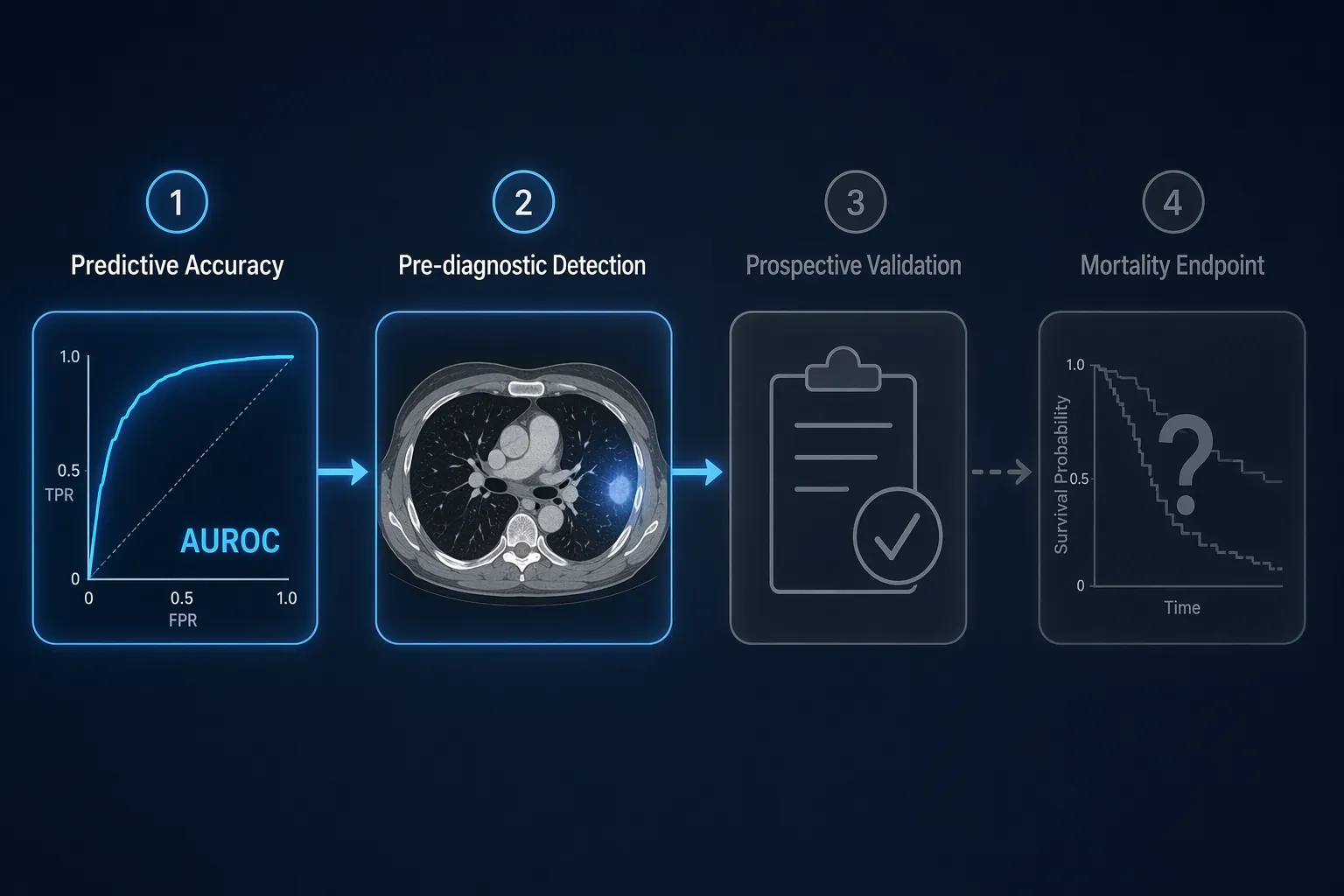
The Evidence Chain Has Two Strong Links, Then a Gap
The published AI evidence for pancreatic cancer early detection is strongest at the surrogate-signal end of the chain. It can show that a model ranked patients by future pancreatic cancer risk, or that an algorithm flagged CT images later associated with cancer. It can sometimes show impressive discrimination, enrichment of risk among top-ranked patients, or detection before routine clinical diagnosis.
The evidence becomes thinner when the question changes from “Can the model find signal earlier?” to “What happens when clinicians act on that signal?” It becomes thinner still when the endpoint is death from pancreatic cancer. That distinction matters because early detection can introduce lead-time effects, downstream testing, incidental findings, false reassurance, and procedure-related burdens. A model can be technically impressive and still not yet have evidence that it changes survival.
| Evidence Question | What Current Peer-Reviewed Work Supports | What It Does Not Yet Establish |
|---|---|---|
| Can AI identify higher-risk patients before diagnosis? | Yes, CancerRiskNet supports risk prediction from disease trajectories. | It does not prove that intervening on those risk rankings reduces mortality. |
| Can AI detect pre-diagnostic signal on CT scans? | Yes, REDMOD supports retrospective detection on scans originally read as normal. | It does not prove survival benefit from acting on those detections. |
| Has a prospective intervention pathway been tested? | An ongoing Mayo Clinic prospective study may address this. | Published results are not yet available in the provided evidence. |
| Has mortality reduction been measured? | No mortality endpoint has been reported in the two core studies. | Claims of proven mortality reduction remain unsupported. |
CancerRiskNet: The Promise and the Portability Warning Arrive Together
CancerRiskNet is the cleaner place to start because it was built for risk prediction rather than image detection. Placido and colleagues reported a deep learning algorithm trained on disease trajectories from 6 million Danish patients, including 24,000 pancreatic cancer cases. The study reported an AUROC of 0.88 for 36-month prediction and relative risk of 59 to 105 among the top 1,000 highest-risk patients, depending on the model configuration and prediction window described in the paper.[1]
Those numbers are not cosmetic. For a disease that is often diagnosed late, an EHR-based model that can enrich a small high-risk group is a plausible way to make downstream surveillance research more efficient. A health system trying to design a prospective study would rather begin with a risk-enriched cohort than screen indiscriminately.
But the same paper also contains the finding that should slow any procurement slide deck. When the model was cross-applied from Danish data to US Veterans Affairs data, the AUROC dropped from 0.88 to 0.71. Independent retraining on the US-VA data restored performance to 0.78.[1] That is not a footnote problem. It is a deployment problem.
A model that performs strongly in one national data environment and less strongly in another may still be valuable. It may also require local validation, recalibration, retraining, workflow redesign, and ongoing monitoring before it is safe to treat the output as clinically meaningful. The CancerRiskNet paper supports the idea that longitudinal diagnostic histories contain pancreatic cancer signal. It does not support the idea that one model can be lifted into any health system with its original headline performance intact.
For an AI governance committee, that portability result changes the buying question. The right question is not only whether the reported AUROC is high. It is whether the institution has access to comparable data, whether local performance has been tested, whether the intervention threshold is justified, and whether the downstream diagnostic pathway has been studied. CancerRiskNet gives a serious research signal. It does not give a mortality claim.
REDMOD: Earlier CT Signal Is Clinically Interesting, but Still a Surrogate
The Mayo Clinic REDMOD validation is the more arresting clinical story. According to Mayo Clinic’s April 2026 report of the Gut publication, the model evaluated approximately 2,000 CT scans that had originally been interpreted as normal and later identified pre-diagnostic pancreatic cancer in 73% of cases at a median of about 16 months before clinical diagnosis. Mayo also reported that this nearly doubled the unassisted specialist detection rate.[2]
This is the kind of result that deserves attention. It is not a vague claim that artificial intelligence will transform oncology. It is a concrete finding: scans that entered ordinary clinical workflow, were read as normal, and later contained AI-detected signal associated with pancreatic cancer before the clinical diagnosis was made.
The key phrase, however, is “pre-diagnostic detection.” It means the algorithm identified signal before the diagnosis that was eventually made. It does not mean that patients were prospectively recalled, evaluated, diagnosed at a more treatable stage, treated differently, and then shown to live longer. A median lead time before diagnosis is a reason to run the next study; it is not the endpoint of that study.
The REDMOD evidence is also narrower than a broad product claim would need to be. The available evidence describes the validation as a single-center cohort without independent replication. That does not invalidate the result. It does mean a hospital outside that environment should not assume the same detection rate, reader interaction, image-acquisition mix, patient population, or downstream yield without local evidence.
For readers looking for a broader CT-focused evidence discussion, the related ClinicalMind appraisal What the evidence says about AI pancreatic cancer detection on CT is the better place to compare imaging models across performance dimensions. The narrower question here is whether REDMOD proves mortality reduction. It does not.
Why “Earlier” Cannot Be Cashed Out as “Lives Saved” Yet
The tempting shortcut is easy to understand. Pancreatic cancer mortality is high. Late diagnosis is common. A model finds signal before ordinary diagnosis. Therefore, the model must save lives. Each clause feels reasonable, but the conclusion is not proven by the current studies.
A mortality claim requires more than detection before the clock date of diagnosis. It requires evidence that acting on the AI output changes a patient-important outcome. That usually means a prospective design in which the AI result triggers a defined clinical pathway, clinicians and patients experience the consequences of that pathway, and outcomes are measured against an appropriate comparator. For pancreatic cancer early detection, mortality language should wait for mortality data.
This is not a semantic objection. In a real deployment, someone has to decide what happens to a flagged patient. Does the patient receive repeat imaging, specialist referral, MRI, endoscopic ultrasound, laboratory testing, or watchful waiting? How are false positives handled? Who explains uncertain risk to the patient? What threshold justifies invasive workup? Which department owns follow-up? The published accuracy result does not answer those operational questions by itself.
Nor does an enriched-risk cohort automatically translate into net benefit. If a model identifies a small group with much higher relative risk, that may be excellent for research recruitment. It may still be unclear whether the absolute risk, the available diagnostic pathway, and the harms of additional workup justify routine clinical action. The evidence threshold for “promising study population” is lower than the threshold for “procurement-ready mortality benefit.”
The Prospective Study Is the Bridge, Not the Proof
The Mayo Clinic AI-PACED prospective study is important because it appears to move the evidence question in the right direction: from retrospective pre-diagnostic detection toward prospective evaluation. But the available evidence does not include published AI-PACED results, and it does not include a reported mortality endpoint. The study may eventually provide the kind of data that governance committees need. It cannot be treated as if it already has.
That distinction is especially important in procurement. A committee can responsibly track an ongoing prospective study, ask whether a vendor’s model is the same as the published research model, and require local validation before clinical use. It cannot responsibly convert an ongoing trial into a completed survival claim.
- A retrospective AUROC supports discrimination, not clinical outcome benefit.
- A high-risk ranking supports enrichment, not automatic eligibility for invasive workup.
- A pre-diagnostic CT signal supports earlier detectability, not proven survival improvement.
- An ongoing prospective study supports monitoring the evidence pipeline, not claiming completed evidence.
What a Procurement Team Can Responsibly Believe Today
Current peer-reviewed evidence supports continued research attention to AI-based pancreatic cancer early detection. It supports the idea that disease trajectories and CT images can contain useful pre-diagnostic signal. It supports asking whether local data reproduce published performance. It supports designing prospective studies that test whether acting on the signal improves outcomes.
It does not support a claim that an AI pancreatic cancer detection tool has been proven to reduce pancreatic cancer mortality. No specific FDA-cleared pancreatic early-detection product was identified, and the core peer-reviewed studies discussed here are research-stage evidence rather than completed mortality-endpoint trials.
A careful evaluation should therefore separate four questions that are often blended in promotional language: whether the model predicts risk, whether it detects signal earlier, whether a prospective clinical pathway has been tested, and whether deaths are reduced. CancerRiskNet helps answer the first question. REDMOD helps answer the second. The third is still developing. The fourth remains unanswered.
That is the clean appraisal line for Q3 2026: accuracy and early detection are promising surrogate signals; mortality reduction remains an unproven endpoint until prospective trial data report it.
References
- A deep learning algorithm to predict risk of pancreatic cancer from disease trajectories, Nature Medicine, 2023.
- Mayo Clinic AI detects pancreatic cancer up to 3 years before diagnosis in landmark validation study, Mayo Clinic News Network, April 2026.