
regulatory
FDA Panel Votes to Allow TB-500 Compounding Despite No Human Studies
Current Status
No, the FDA did not approve TB-500, and compounded TB-500 is not newly “FDA-approved.” On July 23, 2026, the FDA’s Pharmacy Compounding Advisory Committee voted 8-6-1 to recommend adding TB-500 free base and TB-500 acetate to the 503A Bulks List for wound healing, despite opposition from FDA scientists. The recommendation is advisory, not binding on the agency. [1][2]
| Question | Short answer |
|---|---|
| Did PCAC vote to recommend TB-500 for 503A compounding? | Yes. The vote was 8-6-1 for TB-500 free base and acetate for wound healing. |
| Is that the same as FDA approval? | No. A PCAC recommendation does not approve a drug and does not establish safety or efficacy. |
| Can FDA change the 503A Bulks List immediately? | No. FDA would still need formal rulemaking before a change takes effect. |
| Does TB-500 have human clinical evidence? | FDA staff found zero human clinical studies for TB-500 by any route of administration. |
| Why does the keyword say 2025? | The relevant docket is FDA-2025-N-6895; the PCAC meeting and vote occurred in July 2026. |
The “2025” in the search phrase FDA panel TB-500 compounding decision 2025 is best read as a docket reference, not the year of the vote. FDA listed the July 23-24, 2026 Pharmacy Compounding Advisory Committee meeting under docket FDA-2025-N-6895. [3]
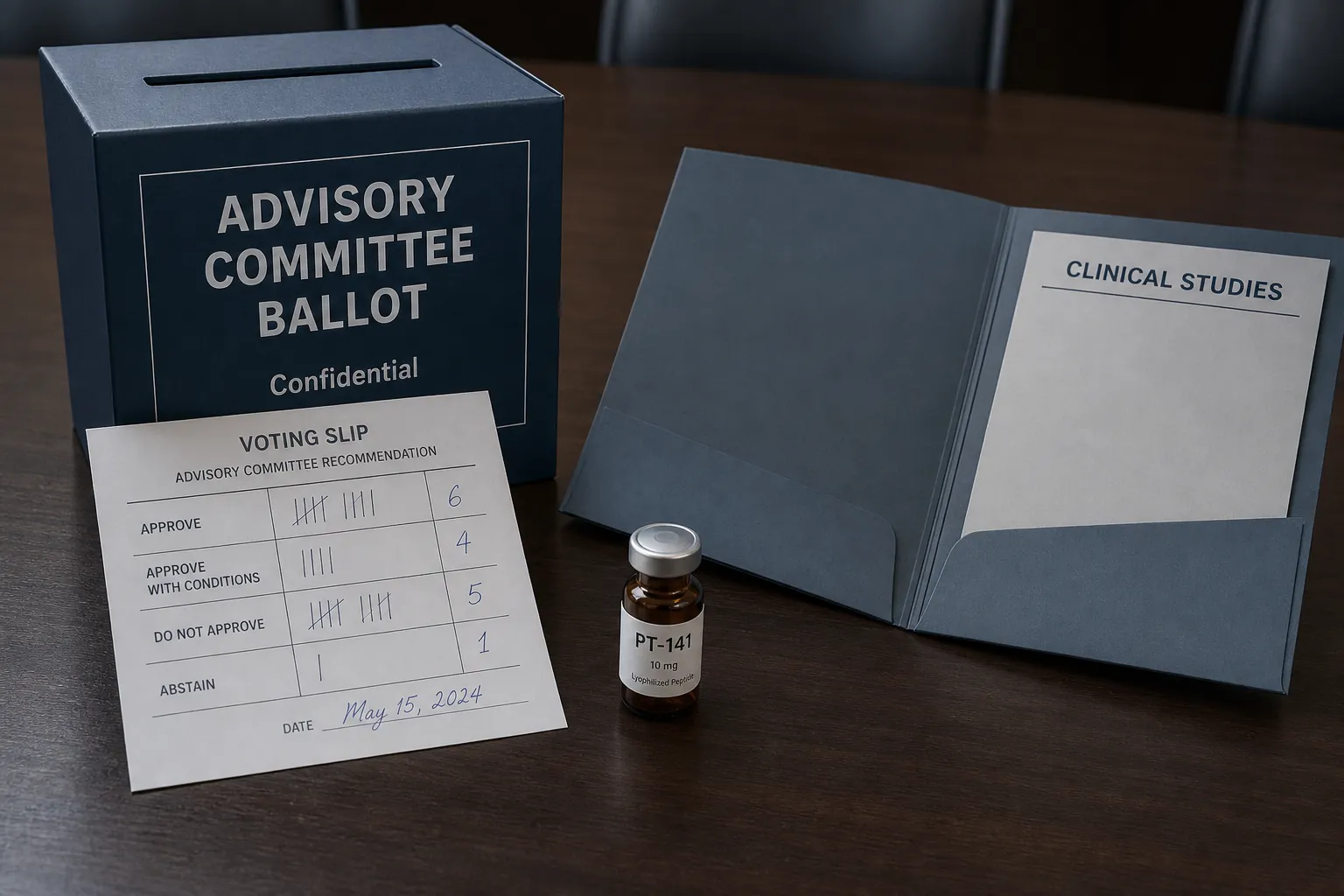
For a formulary memo, procurement file, or pharmacy compliance note, the cleanest wording is: PCAC recommended TB-500 for possible inclusion on the 503A Bulks List, but FDA has not completed rulemaking, has not approved TB-500 under 21 U.S.C. § 505, and FDA staff identified no human clinical studies supporting TB-500 safety or effectiveness.
Readers tracking the broader peptide rulemaking fight may also want the timeline in How FDA’s Peptide Compounding Rules Changed in 2025-2026, but the TB-500 question turns on a narrower distinction: compounding eligibility is an access pathway, not a clinical validation pathway.
What The Vote Actually Changes
The vote gives FDA an advisory committee recommendation to consider. It does not itself add TB-500 to the list, does not authorize every compounded TB-500 product, and does not convert TB-500 into an approved drug. The 503A Bulks List is about which bulk drug substances may be used by certain traditional compounders when statutory conditions are met; it is not a finding that a finished drug product is safe and effective for a disease.
That separation matters because a committee vote can travel faster than the legal document it is supposed to inform. A purchasing team may hear “recommended for compounding” and file it mentally beside “permitted,” while a clinician may hear “FDA panel backs TB-500” and infer that the agency accepted the wound-healing claim. Neither inference is supported by the current status.
The relevant next step would be FDA rulemaking. The research record for this meeting indicates that formal notice-and-comment rulemaking would still be required and would typically take more than a year. Until that process is complete, the July 23 vote is a signal about possible policy direction, not an operative change in federal drug approval status.
This is also where TB-500 differs from a routine formulary addition. A hospital or clinic does not just ask whether a supplier can obtain a substance. It has to ask what representation is being made to patients, who is evaluating adverse events, what evidence supports the route and indication, and whether the institution is treating an advisory recommendation as though it were an approval decision.
The Evidence File FDA Staff Put In Front Of The Committee
The central fact is not subtle: FDA career scientists found no human clinical studies of TB-500 by any route of administration. Drug Topics and MedPage Today both reported that FDA staff identified zero human clinical studies for TB-500 in the materials prepared ahead of the peptide review. [4][5]
That finding is narrower and more important than a general statement that “more research is needed.” It means the committee was not weighing a small randomized trial against a larger observational series, or arguing about whether a wound-healing endpoint was clinically meaningful. For human use, the record described in the coverage contained no clinical studies for any administration route.
The in vitro signal did not rescue the file. Drug Topics reported FDA’s briefing discussion that intact TB-500 free base did not promote wound closure in cultured fibroblasts. [4]
That is not the same as proving TB-500 cannot have any biological effect in humans. Cell-culture findings are not human outcomes, and negative or limited laboratory findings do not settle every clinical question. But they also do not provide the missing human evidence. For a wound-healing claim, the absence of human clinical studies leaves pharmacists and P&T committees without the usual anchors: patient selection, dose, route, duration, comparator, wound type, healing endpoint, adverse-event capture, and follow-up.
The practical consequence is straightforward. If a clinic’s intake script says TB-500 is available because an FDA panel recommended it for compounding, that may describe the vote. If the script implies that FDA has validated TB-500 for wound healing, it outruns the evidence file.
Safety Questions Are Not Limited To Effectiveness
The safety issue is not solved by pointing out that compounded peptides are already commercially popular. FDA flagged immunogenicity concerns for injectable peptide use, and Forbes noted that TB-500 remains on the World Anti-Doping Agency prohibited list. [6]
Those facts answer different questions. WADA status is not a therapeutic-risk assessment for ordinary patients, and FDA immunogenicity concern is not a quantified adverse-event rate for TB-500. Still, both are reasons to avoid casual wording around injectable use, particularly when the human clinical evidence base is empty.
Why A Committee Could Recommend TB-500 Anyway
The vote did not occur in a neutral vacuum. Bloomberg Law reported that the PCAC roster was overhauled in June 2026 with additions that drew criticism over peptide-industry ties, and that FDA then added eight temporary academic voting members on July 21, 2026, shortly before the meeting. [7]
That procedural history does not prove why any individual member voted yes or no. Advisory committee members may disagree in good faith about compounding access, enforcement priorities, patient demand, or how to weigh uncertainty. But the roster dispute is relevant because it helps explain how a recommendation could diverge so sharply from FDA staff’s evidence review without new human clinical data appearing in the record.
The broader political context also mattered. NPR reported that HHS Secretary Robert F. Kennedy Jr. publicly advocated for peptides on Joe Rogan’s podcast in February 2026. [8]
Public enthusiasm from senior political leadership is not clinical evidence, and it is not binding law. It does, however, shape the environment in which a high-attention compounding decision is heard, amplified, and then translated into sales language by parties far from the committee room.
The meeting also followed litigation. NPR and FDA Law Blog described the Evexias/Farmakeio lawsuit, filed in 2023, and a September 2024 settlement that required FDA to put several peptides through PCAC review. [8][9]
That procedural route is important for interpretation. The fact that a court settlement forced review does not mean the substances reviewed acquired better clinical data. It means the agency process moved. For TB-500, the process moved all the way to an 8-6-1 advisory recommendation while the human study file, as described by FDA staff, remained empty.
For the related multi-peptide context, see What the Hims FDA Peptide Decision Actually Means. The TB-500 file should still be read on its own terms.
How To Record The Decision In A Pharmacy Or Formulary File
A defensible institutional note should separate four questions that often get collapsed in peptide discussions:
- Advisory status: PCAC voted 8-6-1 on July 23, 2026 to recommend TB-500 free base and acetate for the 503A Bulks List for wound healing.
- Rulemaking status: FDA still has to complete formal rulemaking before the 503A Bulks List changes.
- Approval status: TB-500 remains an unapproved drug; the vote is not an approval under 21 U.S.C. § 505.
- Evidence status: FDA staff found zero human clinical studies for TB-500 by any route of administration.
- Safety status: injectable peptide use raises unresolved immunogenicity questions, and TB-500’s WADA status should not be confused with a therapeutic endorsement or rejection.
The most useful sentence for many internal documents may be the least dramatic one: “As of July 24, 2026, PCAC has recommended TB-500 for possible 503A Bulks List inclusion, but FDA has not completed rulemaking and TB-500 remains unapproved, with no human clinical studies identified by FDA staff.”
That language leaves room for the compounding pathway without overstating it. It does not accuse a pharmacist of misconduct for monitoring a substance that may later become eligible. It does not tell clinicians that patient interest is irrelevant. It simply keeps the vote in the correct box.
The parallel BPC-157 question has its own evidence record and vote history; readers comparing the two can use How the 2026 PCAC Vote Changed BPC-157 Compounding Status as a companion FAQ.
Bottom Line For TB-500 Access
The July 23 vote may influence agency policy, but it is not a clinical trial, approved labeling, or completed rulemaking.
Procurement teams, P&T committees, and regulatory counsel should monitor FDA’s rulemaking docket, cite the 8-6-1 PCAC recommendation accurately, and avoid any language suggesting that compounded TB-500 is FDA-approved or clinically validated for wound healing.
References
- FDA panel votes to add peptides to permitted compounding list despite opposition from agency scientists, The Hill.
- FDA advisory committee backs two controversial peptides, RAPS.
- July 23-24, 2026: Meeting of the Pharmacy Compounding Advisory Committee, FDA.
- FDA Panel to Evaluate 7 Popular Peptides for Compounding Substances List, Drug Topics.
- FDA Scientists Raise Peptide Concerns Ahead of Committee Meeting, MedPage Today.
- FDA's Review Of Peptides Signals A Growing Public Health Challenge—Separating Science From Hype, Forbes.
- FDA Adds More Peptide Panel Experts After Conflict Criticism, Bloomberg Law.
- Peptides get their regulatory close-up, NPR.
- FDA's Pep(tide) Rally! What Compounders and Industry Need to Know (Post 1 of 2), FDA Law Blog.