

What Is Ambient Intelligence in Healthcare? — Definition and Core Concepts
Ambient intelligence (AmI) in healthcare refers to physical care environments — clinics, hospital rooms, operating theaters, and homes — that are sensitive and responsive to the presence of humans without requiring explicit instruction or direct interaction with a computer. Rather than forcing clinicians to navigate screens, keyboards, and dropdown menus, AmI systems use embedded sensors and artificial intelligence to passively perceive what is happening, interpret the context, and act in ways that support clinical work.
The foundational definition comes from a 2020 Nature review by Haque, Milstein, and Fei-Fei, which describes ambient intelligence as "physical spaces that are sensitive and responsive to the presence of humans." The authors argued that advances in machine learning and contactless sensors had reached a tipping point where computing could recede into the background of clinical spaces, addressing what they called the "dark spaces" of healthcare — the moments when clinicians are with patients but not directly interacting with a computer, yet still burdened by documentation and data entry tasks.
This represents a fundamental paradigm shift. Traditional health IT requires active engagement: a clinician must log in, navigate to the correct module, type or select data, and confirm entries. Ambient intelligence inverts this model. The system observes, interprets, and documents automatically, freeing the clinician to focus entirely on the patient. The Arm glossary captures this succinctly, defining ambient intelligence as "the concept of capturing and processing data through sensors, processors, and actuators unobtrusively embedded throughout the environment," weaving data together so that technology systems become "intuitive, responsive ecosystems."
Enabling Technologies: Sensors, IoT, Edge Computing, and AI
Ambient intelligence depends on a layered technology stack that spans hardware sensing, connectivity, real-time processing, and AI interpretation. A 2023 review in PMC (Nahar & Kachnowski) provides a comprehensive sensor taxonomy and describes ambient AI as operating at the intersection of IoT devices, pervasive computing, machine learning, and human-computer interaction.
Sensor Layer
- Contactless sensors: Cameras (visible light and infrared), microphones, depth sensors (e.g., Kinect-style), and radio-wave sensors that can detect motion, presence, and even physiological signals through walls.
- Wearable and IoT devices: Smartwatches, patches, bed sensors, and environmental monitors that track vital signs, movement, and ambient conditions.
- Environmental actuators: Smart lighting, speakers, displays, and automated doors or blinds that can respond to sensed conditions without human intervention.
Processing and AI Layer
- Edge computing: Real-time processing of sensor data at the point of collection, reducing latency and privacy risks associated with sending raw audio or video to the cloud.
- Computer vision: Analyzes video feeds for activities such as hand hygiene compliance, patient mobilization, surgical instrument counting, and fall detection.
- Automatic speech recognition (ASR) and natural language processing (NLP): Convert clinician-patient conversation into structured clinical text. The Microsoft blog notes that in 2014, clinical speech recognition had a roughly 50% word error rate (WER); by 2025, with generative AI and large language models, WER had dropped below 10% in clinical settings.
- Large language models (LLMs): Enable clinical reasoning, summarization, and code suggestion from transcribed conversations — the engine behind modern ambient clinical intelligence platforms.
The rapid improvement in speech recognition accuracy — from roughly one error in every two words to fewer than one in ten — was a critical enabler. The Microsoft blog reports that advances in generative AI accelerated improvement from a cadence of once every 1.5 years to roughly four times per year, making real-time, reliable ambient documentation feasible at scale.
The Three Pillars of Ambient Intelligence: Context-Awareness, Intelligence, and Ubiquity

The PMC 2023 review organizes ambient intelligence around three interdependent pillars. Understanding these pillars helps clinicians and IT leaders distinguish genuine AmI systems from simpler automation tools that lack one or more of these capabilities.
1. Context-Awareness
The system must sense the environment and understand the clinical context: who is in the room, what activity is occurring, what devices are present, and what the typical workflow looks like. This goes beyond simple motion detection. A context-aware system knows the difference between a clinician performing a physical exam, a patient resting, and a family member entering the room — and adjusts its behavior accordingly.
2. Intelligence
The system must interpret sensed data and make decisions or generate outputs that are clinically meaningful. In an ambient documentation system, this means converting a 15-minute conversation into a structured SOAP note with appropriate ICD-10 codes. In an ICU monitoring system, it means distinguishing between clinically significant alarms and artifact noise, reducing alarm fatigue. Intelligence requires not just pattern recognition but domain-specific clinical reasoning.
3. Ubiquity
The system must be seamlessly integrated across care settings — outpatient clinic, inpatient ward, operating room, and home — so that the ambient experience is consistent and data flows between settings without friction. Ubiquity also implies that the technology is unobtrusive: sensors are embedded in the environment rather than worn or carried, and interaction with the system happens through natural speech and behavior rather than through screens and keyboards.
Clinical Applications by Care Setting
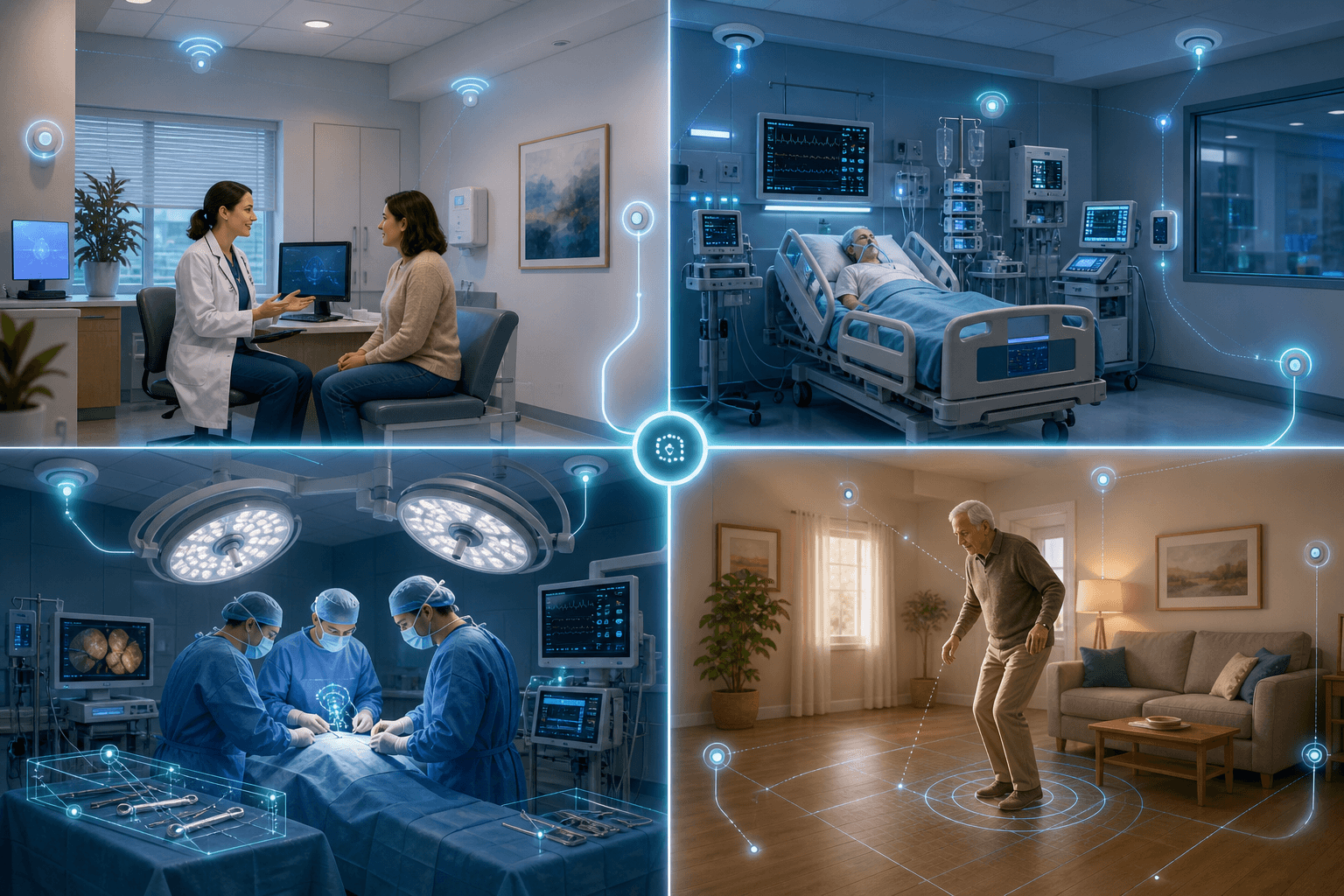
Ambient intelligence is often discussed primarily in the context of outpatient clinical documentation, but its applications span the full care continuum. The following table summarizes the major application areas by setting, with representative examples from the peer-reviewed and industry literature.
| Care Setting | Primary AmI Application | Example Systems / Studies | Key Function |
|---|---|---|---|
| Outpatient clinic | Ambient clinical intelligence (ACI) for automated documentation | Microsoft DAX Copilot, Suki, Abridge; Providence RCT (2025) | Captures clinician-patient conversation via microphone; generates structured clinical notes, orders, and patient instructions using ASR, NLP, and LLMs |
| Inpatient ICU | Clinical decision support and alarm management | Mayo Clinic AWARE system | Filters and prioritizes streams of patient data to prevent information overload; surfaces meaningful alerts |
| Inpatient ward | Infection control and patient safety monitoring | Chen et al., Open Forum Infect Dis 2015 (hand hygiene and PPE adherence via computer vision and depth sensing) | Monitors hand hygiene compliance and PPE use using cameras and depth sensors; provides real-time feedback |
| Operating room | Surgical workflow tracking and skill assessment | Computer vision systems for instrument counting and surgical phase detection | Tracks surgical instruments to prevent retained items; assesses surgical skill from video; automates OR documentation |
| Home health | Fall detection, chronic disease monitoring, ambient assisted living | Yang et al., Nature Medicine 2022 (Parkinson's detection from nocturnal breathing via contactless radio sensors) | Detects falls using ambient sensors; monitors nocturnal breathing patterns for Parkinson's and other conditions; supports aging in place with social robots and smart home integration |
The outpatient ACI application has seen the most rapid adoption. By mid-2025, roughly two-thirds of U.S. hospitals using Epic — approximately 1,744 hospitals — had adopted an ambient AI documentation tool, according to an AJMC study cited in the Suki 2026 guide. This adoption rate reflects the acute pain point of clinical documentation burden and the maturity of the underlying speech recognition and LLM technologies.
In the ICU, the Mayo Clinic's AWARE system exemplifies a different AmI use case: rather than generating documentation, it filters the overwhelming flow of data from monitors, ventilators, and lab systems to present only clinically meaningful information to the care team. The goal is to reduce cognitive overload and alarm fatigue, not to replace human judgment but to ensure it is applied to the right signals.
Home health applications represent the fastest-growing frontier. The 2022 study by Yang et al. in Nature Medicine demonstrated that Parkinson's disease could be detected and monitored from nocturnal breathing patterns using contactless radio-wave sensors — no wearable device required. Fall detection systems using ambient sensors are already commercially available, and ambient assisted living environments that combine sensors with social robots are being piloted in several countries.
Evidence Outcomes: What the Data Shows
The evidence base for ambient intelligence in healthcare, particularly for outpatient ACI, has grown substantially since 2024. The following table summarizes the key quantitative findings from the most cited studies and surveys.
| Study / Source | Design / Population | Key Outcomes |
|---|---|---|
| Providence RCT (2025) | Step-wedge randomized controlled trial; 24 family medicine providers across 7 states | 30.3% less burnout; 49.5% less frustration with documentation; 51.7% less time on documentation; 19.6% improvement in patient connection; ~2.5 hours less Pajama Time per week (Epic Signal data) |
| JAMA multi-site study (2025) | 5 academic medical centers; pre-post design | 13.4 minutes less total EHR time per day; 16.0 minutes less documentation time per day; 0.49 more visits per week |
| Microsoft DAX Copilot survey (July 2024) | 879 clinicians across 340 healthcare organizations | 70% improvement in work-life balance; 80% reduction in cognitive burden; 5 minutes saved per clinician per encounter |
| Microsoft DAX Copilot patient survey (June 2024) | 413 patients | 93% of patients reported their physician was more personable and conversational when using DAX Copilot |
| Emory Healthcare (JAMA Network Open 2025) | Health system deployment | 30.7% increase in documentation-related well-being |
| Mass General Brigham (JAMA 2025) | Health system deployment; 84-day observation | 21.2% reduction in burnout prevalence |
| Cleveland Clinic | Health system deployment | 14 minutes per day decrease in clinician time on EHR notes |
| Cooper University Healthcare | Health system deployment | 4.15 minutes saved in documentation time per patient (~1 hour or more saved daily) |
| Mercy (nursing) | Health system deployment | ~2 hours saved per shift for nurses |
| Intermountain Health | Dragon Copilot users with ≥10 encounters (Apr 2024–Dec 2025) | 27% reduction in time in notes per appointment |
| Phyx Primary Care (Suki, 2026) | 116 primary care providers; 37 practice locations; 30+ days of use | 60% reduction in burnout (p<0.001); 81% increase in physician satisfaction (p<0.001); 41% reduction in documentation time per note (13.8 to 8.2 minutes); 37% decrease in after-hours work (~48 minutes saved per day); 32% fewer rushed visits; 46% more notes completed before the next patient |
Across these studies, a consistent pattern emerges: ambient documentation tools reduce the time clinicians spend on EHR tasks by roughly 13–17 minutes per day in multi-site academic studies and by substantially larger margins in single-system reports. The reductions in burnout — ranging from 21% to 60% depending on the measurement tool and population — are clinically meaningful. The patient experience data, while limited to a single vendor survey, suggests that patients perceive improved eye contact and conversational quality when clinicians are not typing during visits.
For a deeper analysis of the peer-reviewed evidence, including study designs, limitations, and methodological caveats, see the dedicated evidence review on this site.
Key Challenges: Privacy, Bias, Transparency, Liability, and Adoption
Despite the promising outcomes, ambient intelligence in healthcare faces significant challenges that must be addressed before widespread, safe deployment is possible. The PMC 2023 review and the foundational Nature 2020 article both identify these as critical barriers.
Data Privacy and Security
Continuous audio and video capture in clinical spaces raises obvious privacy concerns. Patients and clinicians must trust that sensitive conversations are not being recorded for purposes beyond clinical documentation, that recordings are not accessible to unauthorized parties, and that data is deleted or de-identified according to policy. The PMC 2023 review notes that the same sensors that enable ambient intelligence could, if compromised, expose the most intimate details of clinical encounters. HIPAA compliance is necessary but not sufficient — the ambient nature of sensing means that data is being collected even when no one is actively interacting with a system, expanding the attack surface.
Algorithmic Bias and Fairness
Ambient AI systems are trained on data that reflects existing patterns of care, which may encode racial, gender, socioeconomic, and geographic disparities. The PMC 2023 review, citing NIST Special Publication 2022, distinguishes between three types of bias relevant to AmI: human bias (preferences and stereotypes that influence system design), systemic bias (inequities embedded in healthcare institutions and data collection practices), and statistical bias (model errors that disproportionately affect certain populations). An ambient documentation system trained primarily on English-language, urban, academic medical center conversations may perform poorly with non-native speakers, dialectal variation, or rural clinical workflows.
Transparency and Explainability
When an ambient system generates a clinical note, a diagnosis suggestion, or an order, clinicians need to understand why the system produced that output and whether it can be trusted. The "black box" nature of deep learning models, particularly LLMs, makes this difficult. The Nature 2020 review identified model transparency as a key challenge, and the PMC 2023 review reiterates that explainability is essential for clinical acceptance and safe use.
Legal Liability
The question of who bears liability when an ambient system makes an error — a missed diagnosis, an incorrect order, a hallucinated finding — remains unresolved. The PMC 2023 review cites Gerke et al. (JAMA, 2020) on the complexity of assigning responsibility when multiple actors (clinician, hospital, vendor, algorithm developer) are involved in a chain of decisions that includes AI-generated output. Current regulatory frameworks were not designed for systems that continuously learn and adapt, creating a liability gap that slows adoption.
End-User Resistance and Human-Centered Design
Clinicians may resist ambient systems due to concerns about surveillance, loss of autonomy, or the perception that the technology adds complexity rather than reducing it. The PMC 2023 review emphasizes that successful AmI deployment requires a human-centered design approach — involving clinicians in system design, providing adequate training, and ensuring that the technology adapts to existing workflows rather than forcing workflow changes. The Suki 2026 guide notes that implementation timelines range from weeks for a pilot to 3–9 months for enterprise-wide deployment, reflecting the complexity of workflow integration.
For a detailed procurement evaluation framework covering EHR integration depth, specialty coverage, accuracy benchmarks, security certifications, total cost of ownership, and vendor stability, see the full ACI capability landscape article on this site.
Regulatory and Ethical Landscape
The regulatory framework for ambient intelligence in healthcare is still evolving. Key considerations include:
- FDA oversight: Ambient systems that generate clinical documentation or provide decision support may qualify as Software as a Medical Device (SaMD) and require FDA clearance. The specific regulatory pathway depends on the system's intended use and the level of risk it poses. Systems that merely transcribe speech without clinical interpretation may not require clearance, while those that suggest diagnoses or orders likely do.
- HIPAA compliance: Continuous audio and video capture in clinical settings must comply with HIPAA privacy and security rules. This includes encryption, access controls, audit trails, and business associate agreements with vendors. The ambient nature of data collection — where recording may happen automatically without explicit patient consent at each encounter — creates additional compliance complexity.
- Emerging governance frameworks: Organizations such as the Coalition for Health AI (CHAI) and the World Health Organization (WHO) are developing standards and guidance for AI in healthcare, including ambient systems. These frameworks address transparency, bias testing, clinical validation, and post-market surveillance.
- Ethical principles: The PMC 2023 review, citing Martinez-Martin et al. (Lancet Digital Health, 2021), identifies autonomy, privacy, transparency, accountability, and equity as the core ethical principles that should govern ambient intelligence deployment. These principles require that patients and clinicians are informed about what data is being collected, how it is used, and what recourse they have if errors occur.
Future Directions: Beyond Documentation to Intelligent Care Environments
The current generation of ambient intelligence in healthcare is dominated by documentation — capturing conversations and generating notes. But the technology is rapidly expanding into adjacent clinical tasks. The Suki 2026 guide describes a five-stage pipeline that extends beyond note generation: capture, transcription, clinical reasoning, coding and tagging, and EHR delivery. The clinical reasoning and coding stages are where ambient systems begin to move from passive transcription to active clinical support.
Emerging capabilities include:
- Order entry and referral generation: Ambient systems that not only document the encounter but also generate orders for labs, imaging, and referrals based on the conversation, subject to clinician review and approval.
- Clinical coding and billing: Automated ICD-10 and CPT code suggestion from clinical conversation, reducing the administrative burden of coding and potentially improving revenue cycle accuracy.
- Clinical decision support: Ambient systems that surface relevant guidelines, drug interactions, or evidence-based recommendations during the patient encounter, based on the content of the conversation.
- Predictive analytics: Integration of ambient data with EHR data to predict deterioration, readmission risk, or disease progression, enabling proactive rather than reactive care.
The longer-term vision, articulated in both the Nature 2020 review and the PMC 2023 review, is the "smart hospital" — a care environment where ambient sensing is integrated across all clinical areas, data flows seamlessly between settings, and AI systems collaborate with clinicians rather than simply documenting their work. The PMC 2023 review advocates for collaborative communities of practice and data stewardship governance frameworks to ensure that this vision is realized equitably and safely.
For a deeper exploration of how ambient clinical intelligence is expanding beyond scribing into decision support, order entry, and predictive analytics, see the article on ACI beyond scribing to decision support.
Comments
Join the discussion with an anonymous comment.