
What Is Conversational AI in Healthcare?
Conversational AI refers to systems that use natural language processing (NLP), natural language understanding (NLU), and natural language generation (NLG) to simulate human dialogue. In healthcare, these systems typically sit on top of an automatic speech recognition (ASR) layer that transcribes spoken language into text, which the NLP pipeline then interprets and responds to. The technology stack matters for evidence evaluation because each layer introduces distinct failure modes — a system with excellent NLU can still fail if the ASR layer misrecognizes medical terminology.
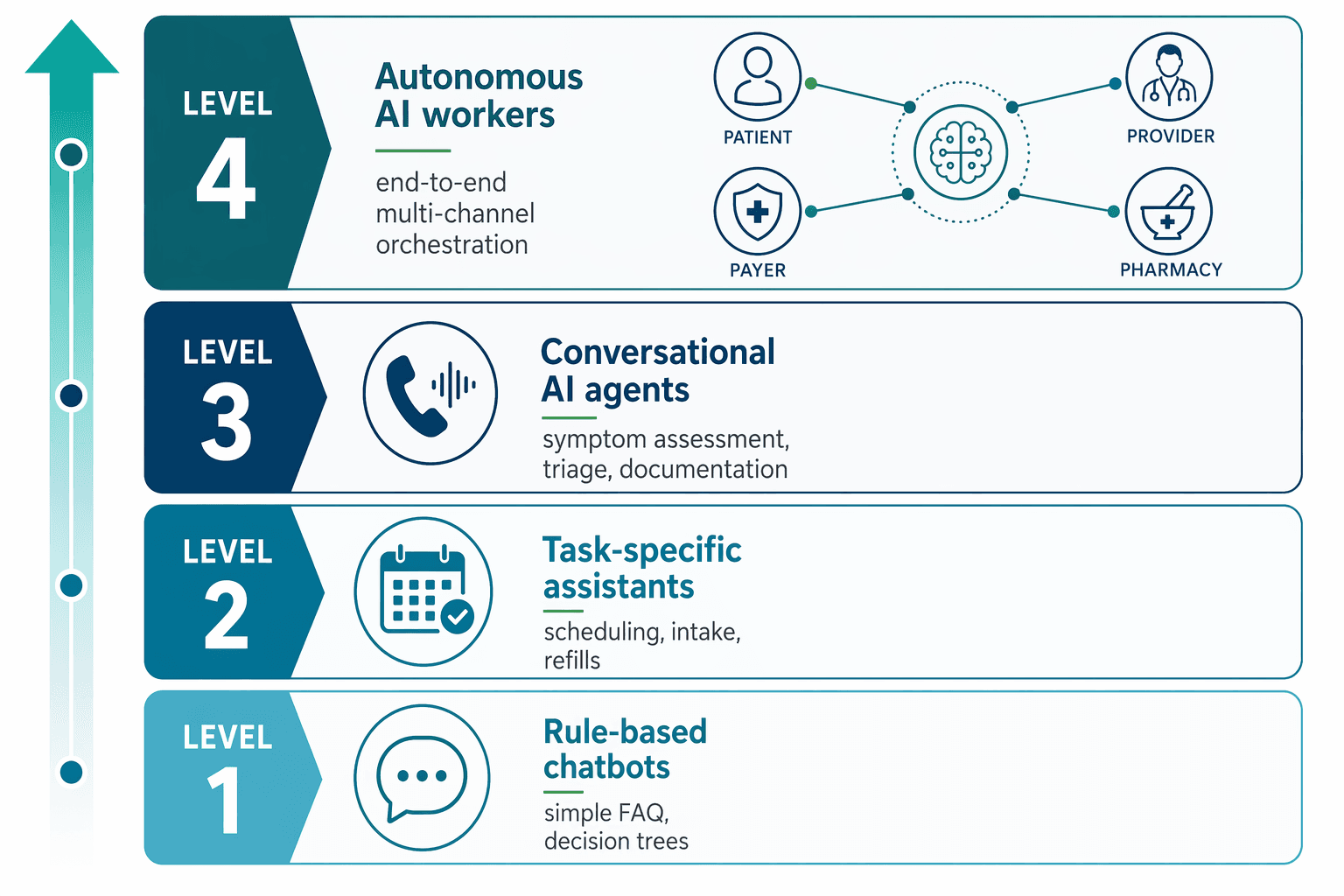
This is not the same as a rule-based chatbot that follows a decision tree. Modern conversational AI in clinical settings increasingly relies on large language models (LLMs) that generate free-text responses rather than selecting from predefined options. That shift from deterministic to generative output has direct implications for accuracy, safety, and regulatory classification. As the npj Digital Medicine 2025 review by Mahajan and Powell notes, voice AI can function as both an unregulated communications tool and, depending on its intended use, as software as a medical device (SaMD) requiring FDA clearance.
Landscape of Published Clinical Evidence
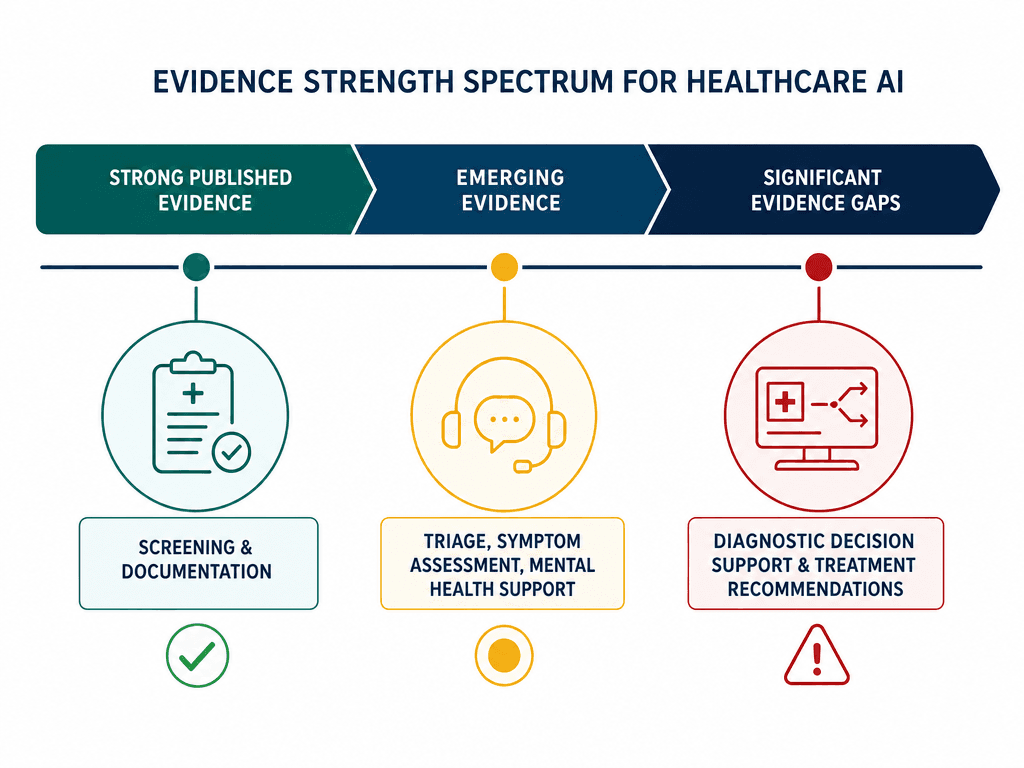
As of mid-2026, the published evidence base for conversational AI in healthcare is growing but unevenly distributed across use cases. The strongest evidence comes from screening and ambient documentation applications, where multiple peer-reviewed studies and case reports have been published. Triage and symptom assessment have emerging support from single-site studies and retrospective analyses. Diagnostic decision support and treatment recommendation use cases remain the least supported by rigorous clinical evidence.
| Use Case | Evidence Strength | Study Types Available | Key Limitation |
|---|---|---|---|
| Screening (e.g., symptom checkers, pre-visit history) | Strongest | Randomized crossover trial, retrospective cohort | Mostly single-site; limited multi-center validation |
| Ambient documentation (AI scribes) | Strong | Case studies, single-site implementations | No multi-center RCTs; vendor-reported metrics common |
| Triage and symptom assessment | Emerging | Retrospective analyses, single-site pilots | Limited prospective validation; accuracy varies by condition |
| Mental health support | Emerging | Pilot studies, bias-roadmap publications | Preliminary; no large-scale efficacy trials |
| Medication adherence | Preliminary | Small pilots, conceptual frameworks | No published RCTs as of mid-2026 |
| Diagnostic decision support | Weakest | None (no large multi-center RCTs) | No published prospective clinical trials against standard workflows |
Screening and Triage: Strongest Evidence for Accuracy
The most rigorous published evidence for conversational AI accuracy comes from a randomized crossover trial described in the npj Digital Medicine review. In that study, an AI-enabled voice assistant captured SARS-CoV-2 screening histories and achieved 97.7% agreement compared to human staff. Patient satisfaction was high — 87% of participants rated the AI interaction as "good or outstanding." These results are notable because the study used a randomized design, which controls for selection bias that plagues many retrospective analyses.
Real-world deployment data from Regina Maria, a European healthcare provider, adds further support. Their symptom checker, covering over 720 conditions, handled 92,182 investigations and served 210,000 patients, saving an estimated 23,045 staff hours annually. Optegra, a UK ophthalmology provider, reported 97% patient satisfaction for voice-based preoperative assessments, with per-call costs dropping from £50–60 to approximately £2.
Ambient Documentation: Evidence for Time Savings and Clinician Satisfaction
Ambient documentation — AI scribes that listen to patient-clinician conversations and automatically generate clinical notes — has attracted significant investment and adoption interest. The npj Digital Medicine review notes that physicians spend 15–18 minutes per primary care visit, with nearly half of the clinic day devoted to documentation. Ambient AI scribes aim to reclaim that time.
A behavioral health AI scribe case study reported a 90% reduction in documentation time for clinicians. While this figure is striking, it comes from a single-site implementation and has not been replicated in a multi-center trial. On the quality side, a 2023 JAMA Internal Medicine study found that patients rated AI-generated responses as more empathetic and of higher quality than actual physician responses — a finding that has been widely cited but also raises questions about what "empathy" means in a clinical context when delivered by a non-human system.
| Metric | Reported Value | Source Type | Independent Replication? |
|---|---|---|---|
| Documentation time reduction (behavioral health AI scribe) | 90% | Single-site case study | No |
| AI response empathy rating vs. physicians | AI rated higher | Peer-reviewed study (JAMA Internal Medicine 2023) | Not yet replicated in clinical setting |
| Medical entity error rate (Universal-3 Pro Medical Mode) | 4.9% | Vendor benchmark | No independent audit |
| Medical entity error rate (Deepgram) | 7.3% | Vendor benchmark | No independent audit |
Mental Health Support and Medication Adherence: Emerging Evidence
Conversational AI for mental health support and medication adherence is an active area of research, but the evidence base remains preliminary. A 2024 study published in PLOS Digital Health proposed a roadmap for developing bias-resistant healthcare chatbots, acknowledging that current AI systems risk perpetuating health disparities if not carefully designed. The roadmap is a conceptual framework, not an empirical validation of any specific tool.
On medication adherence, the clinical need is well established — patients forget up to 80% of medical information shared during visits, and up to 50% of patients do not take medications as prescribed. Several pilot programs are testing conversational AI for post-visit follow-up and adherence reminders, but no published RCTs have demonstrated improved adherence outcomes using conversational AI as of mid-2026.
Evidence Gaps: Where the Research Falls Short
The most significant evidence gap is the absence of large multi-center randomized controlled trials validating diagnostic conversational AI against standard clinical workflows. As of mid-2026, no such trials have been published. This is not a minor gap — it is the difference between knowing whether a tool works in a controlled research setting and knowing whether it improves patient outcomes across diverse real-world populations.
- No multi-center RCTs exist for diagnostic conversational AI tools. The strongest study design available is the single-site crossover trial for screening, which is a narrower use case than diagnosis.
- Longitudinal safety data is essentially absent. Most studies report immediate accuracy metrics but do not track adverse events, misdiagnoses, or delayed diagnoses over time.
- Most vendor-reported outcomes — including documentation time reductions, cost savings, and patient satisfaction scores — have not been independently replicated. The distinction between vendor case studies and peer-reviewed research is critical for evidence evaluation.
- Population diversity reporting is inconsistent. Many studies do not report the demographic composition of their study populations, making it impossible to assess generalizability across racial, ethnic, and socioeconomic groups.
- Comparative effectiveness studies — head-to-head comparisons of different conversational AI tools for the same clinical task — are virtually nonexistent.
Known Failure Modes and Safety Considerations
The npj Digital Medicine review by Mahajan and Powell identifies four key technical barriers to clinical deployment of conversational AI: latency (delays in response time that disrupt natural conversation flow), end-of-utterance detection (the system's inability to reliably determine when a speaker has finished talking), audio quality degradation (background noise, accents, and poor microphone quality reducing ASR accuracy), and generative unpredictability (LLMs producing plausible-sounding but factually incorrect responses, also known as hallucination).
Beyond technical failures, equity concerns are significant. Jamal Uddin from Cornell University, writing in the Journal of Communication in Healthcare (2025), argues that LLM-based chatbots produce inaccurate, generalized, or biased responses due to reliance on user-generated prompts and publicly available training data. These failures disproportionately impact underserved populations with limited digital or health literacy. The commentary calls for inclusive chatbot design, content regulation, and public education on prompt literacy.
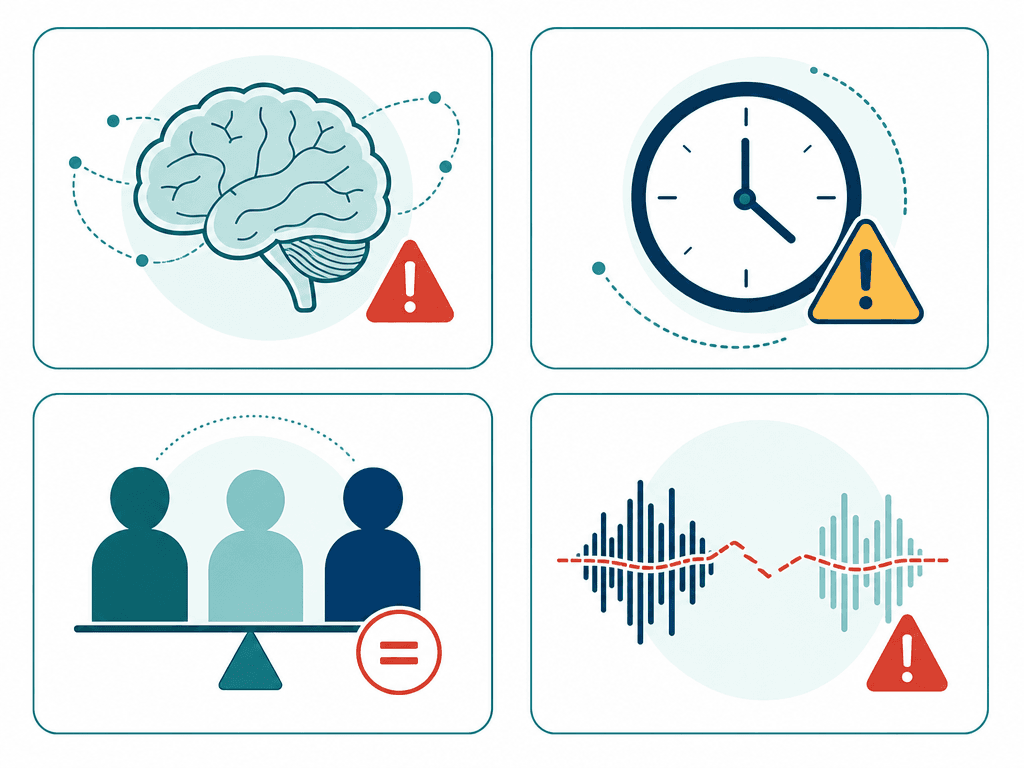
- Hallucination rates in LLMs: Generative unpredictability means the system can produce confident-sounding but incorrect clinical statements. Unlike rule-based systems, LLMs have no built-in mechanism to recognize when they are wrong.
- Latency and end-of-utterance detection: Delays as short as 500 milliseconds can make conversations feel unnatural. Misdetecting when a patient has finished speaking can lead to interruptions or missed information.
- Audio quality degradation: ASR accuracy drops significantly in noisy clinical environments, with non-native accents, or with patients who have speech impairments. Medical terminology further stresses ASR systems.
- Bias across demographic groups: Training data that over-represents certain populations leads to lower accuracy for underrepresented groups. The Cornell/Uddin analysis highlights that this can exacerbate existing health disparities.
Recommendations for Evidence-Based Adoption
For clinicians and clinical informaticists evaluating conversational AI tools, the evidence base supports adoption in specific use cases while urging caution in others. The following recommendations are grounded in the published literature and identified evidence gaps.
- Prioritize use cases with the strongest evidence. Screening and ambient documentation have the most published support. Deploying conversational AI for these tasks carries lower risk than diagnostic or treatment recommendation use cases.
- Require independent validation for diagnostic claims. If a vendor claims their tool can diagnose or triage conditions, ask for peer-reviewed studies — not case studies — that validate the tool against a reference standard in a prospective, multi-site design.
- Monitor for bias and drift post-deployment. Even tools that perform well in initial studies can degrade over time or perform poorly in specific patient populations. Implement ongoing performance monitoring that tracks accuracy by demographic subgroup.
- Treat vendor-reported metrics as directional, not verified. Documentation time reductions, cost savings, and patient satisfaction scores from vendor blogs and case studies should be independently confirmed before being used for procurement decisions.
- Understand the regulatory classification. Determine whether the tool is an unregulated communications aid or a medical device requiring FDA clearance. Using an unregulated tool for diagnostic purposes may create liability exposure.
- Plan for the 10-20-70 rule. As noted in BCG's 2026 analysis, successful AI deployment requires 10% of effort on algorithms, 20% on technology and data infrastructure, and 70% on people and process change. The technology is the smallest part of the investment.
Comments
Join the discussion with an anonymous comment.