
The hard liability question in AI-assisted fetal monitoring does not begin with a robot replacing an obstetrician. It begins in a quieter place: a fetal heart tracing, a labor nurse watching the monitor, a clinician balancing maternal and fetal risks, and an AI system that either flags a pattern, misses it, or is overridden. After a neurologic injury, the record is read backward. What did the system see? What did the clinician see? Was the alert clear enough to matter? Was the algorithm known to be wrong in this kind of case? Who was supposed to escalate, and where is that written?
That is where AI-assisted birth injury litigation is becoming less speculative. As of July 2026, no published U.S. court decision has resolved a birth injury claim specifically arising from AI-assisted fetal monitoring. The legal analysis therefore has to be built from adjacent materials: AI malpractice simulations, medical AI liability scholarship, computerized cardiotocography trials, fetal monitoring datasets, and early litigation-facing claims. The caution matters. A hospital cannot cite “AI” as though it automatically improves obstetric safety, and a plaintiff cannot yet point to a settled AI fetal monitoring doctrine.

The more immediate point is narrower and more practical: AI changes what jurors may believe a reasonable clinician and hospital should have known. It also changes what must be reconstructable later. In traditional fetal monitoring litigation, the strip, notes, staffing, escalation, and timing are already heavily contested. Add an algorithmic interpretation layer, and the missing document is no longer just a missing nursing note. It may be the missing explanation of what the system reported, how reliable that report was, and whether anyone was trained to act on it.
The Brown/NEJM Finding That Should Make Risk Managers Pause
The most useful evidence so far does not come from obstetrics. It comes from a July 2025 Brown University study published through NEJM AI, using radiology malpractice scenarios and more than 1,300 participants. The study found that when an AI system detected an abnormality and the physician missed it, participants found the physician liable about 75% of the time. When participants were told that the AI system had a high error rate, physician liability dropped to 33%.[1]
That is not a fetal monitoring verdict. It is not a rule of law. It is also not something a labor and delivery unit can safely ignore. The study turns an abstract worry into a measurable shift: jurors may treat an AI-detected abnormality as evidence that the physician had notice, unless they are also given context about the system’s limitations. In a birth injury case, that distinction could become central. If an AI-assisted CTG system marks a tracing as concerning and the clinician does not intervene, the plaintiff’s theory almost writes itself: the hospital’s own tool identified fetal distress, and the bedside team failed to respond.
The other half of the finding is just as important. Disclosure of error rates did not eliminate liability in the Brown simulation, but it changed how participants assigned blame. That is a documentary lesson before it is a courtroom lesson. If an institution deploys AI fetal monitoring but cannot later show what clinicians were told about false positives, false negatives, validation limits, and intended use, it has left the bedside clinician exposed to a simplified narrative: the machine saw danger, the doctor did not.
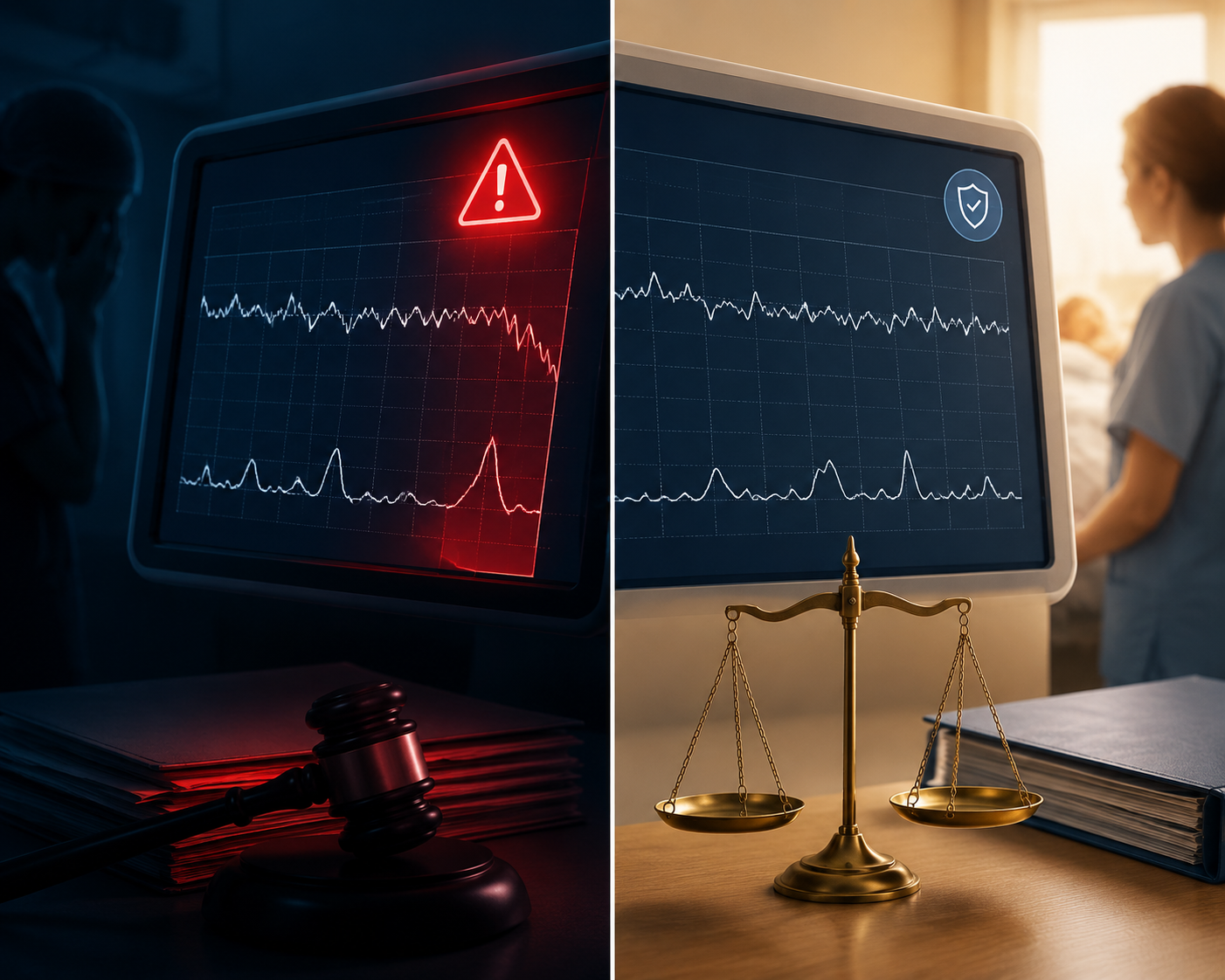
Hospitals tend to prefer clean procurement language: decision support, clinician in the loop, not a substitute for medical judgment. Those phrases may be accurate, but they are not enough. In a malpractice file, someone will ask what “clinician in the loop” meant at 2:17 a.m. during a prolonged deceleration, or during a tracing with recurrent variable decelerations, or during a period when the AI output conflicted with a nurse’s interpretation. The Brown study suggests that the answer may affect not only expert testimony but lay blame assignment.
Disclosure Is Not a Magic Shield
There is an uncomfortable tension here. Transparency about AI limitations may reduce the impression that an AI alert is infallible. But a disclosed limitation can also become a plaintiff exhibit if the hospital did not train staff around it. If the vendor warned that the tool performed less reliably under certain signal-quality conditions, and those conditions appeared during labor, the chart had better show how clinicians assessed the tracing independently and what escalation rules applied.
The safer inference from Brown is not “disclose everything and liability falls.” It is that jurors respond to context. A hospital that documents AI error rates, trains clinicians on them, embeds them into escalation policies, and preserves the alert trail has a different defense record than a hospital that treats the AI output as a silent background layer. The same disclosure that helps explain a clinician’s decision can hurt the institution if the workflow never absorbed it.
| AI monitoring event | Likely litigation question | Record that becomes important |
|---|---|---|
| AI flags a concerning tracing and clinician does not intervene | Did the alert create notice of fetal distress? | Alert text, timing, severity level, escalation rule, clinician review note |
| AI misses a tracing later characterized as abnormal | Was the tool unreliable, poorly validated, or used beyond its intended role? | Validation materials, known error rates, vendor limitations, independent clinician interpretation |
| Clinician overrides or disagrees with AI output | Was the override reasonable under the circumstances? | Rationale for disagreement, strip interpretation, staffing context, communication chain |
| Nurse, physician, and AI outputs conflict | Who had authority to resolve the conflict? | Policy assigning responsibility, training records, handoff documentation |
Why Existing Liability Boxes Fit Poorly
Medical malpractice is still the first legal home for a birth injury claim. The plaintiff alleges that clinicians failed to meet the standard of care, and expert testimony reconstructs what reasonable obstetric clinicians should have done. AI complicates that familiar structure because the alleged error may not sit neatly inside human interpretation. It may be distributed across model design, training data, hospital configuration, alert thresholds, bedside response, and documentation.
Maliha and colleagues’ liability framework for AI in medicine explains the pressure points: malpractice law assumes a human professional whose conduct can be judged against professional norms, while products liability focuses on defective products and warnings. Clinical AI can fall between those theories when the physician relies on a system whose internal reasoning is not transparent, or when the vendor controls parts of performance the clinician cannot inspect.[2]
In fetal monitoring, that division is not academic. The clinician at bedside may be responsible for interpreting the tracing, but the hospital selected the AI system, integrated it into the electronic record, decided whether alerts interrupt workflow, and trained staff on response expectations. The vendor may know more about model development and error behavior than either the clinician or the patient. If the model changes over time, the question becomes harder: which version of the system was running during the labor, and can anyone prove it?
A 2024 systematic review by Cestonaro and colleagues similarly identifies gaps in assigning medical liability when AI is applied to diagnostic algorithms, including uncertainty around black-box systems, shared decision-making, and the division of responsibility among clinicians, healthcare institutions, and developers.[3] The review is not about birth injury litigation specifically, but its categories map uncomfortably well onto AI-assisted CTG: the output is probabilistic, the clinical decision is time-sensitive, and the harm may be catastrophic.
Vicarious Liability Reaches the Hospital, But Not the Whole Problem
Hospitals already face exposure for the acts of employed clinicians and for institutional failures in staffing, credentialing, policies, and supervision. AI-assisted fetal monitoring adds another institutional layer. If the hospital buys the system, places it in the labor unit, tells staff it is part of monitoring, and stores or fails to store its outputs, the hospital cannot plausibly treat the tool as an incidental vendor feature when a case is litigated.
That does not mean every bad AI-associated outcome becomes hospital negligence. The more precise question is whether the hospital controlled the conditions that made the AI clinically meaningful: selection, validation for its patient population, training, downtime procedures, alert routing, escalation policy, and auditability. If those conditions are undocumented, the litigation record will tend to collapse back onto the individual clinician, even when the real workflow was institutional.
Products Liability Has Its Own Gaps
Products liability may seem attractive when an algorithm misses fetal distress or generates a misleading reassurance. But clinical AI is not a broken infusion pump. A plaintiff would still have to identify a defect, warning failure, or design problem under applicable law. The vendor may argue that the tool provided decision support, that clinicians retained judgment, and that the hospital used the system in a particular local workflow outside the vendor’s control.
That defense becomes more persuasive when the vendor’s documentation is specific and the hospital’s implementation is idiosyncratic. It becomes less persuasive when performance limitations are vague, model behavior is opaque, and the product’s commercial promise implies vigilance that the technical materials do not support. The black-box problem is not just philosophical. It affects discovery: what can be obtained, what can be explained to a jury, and whether an expert can connect an algorithmic failure to the injury.
Computerized CTG Has Not Earned a Presumption of Better Outcomes
The liability discussion should not assume that computerized fetal monitoring interpretation reliably improves neonatal outcomes. The INFANT randomized trial, published in The Lancet in 2017, enrolled 47,062 women and tested decision-support software for CTG interpretation during labor. The trial found no significant improvement in poor neonatal outcomes with the computerized interpretation system compared with usual care.[4]
That result should be used carefully. INFANT tested a specific computerized CTG system, not every current or future AI model. It also does not prove that AI fetal monitoring cannot help in narrower settings or with better tools. But it does block a lazy defense: that adding computerized interpretation is, by itself, evidence that the hospital reduced risk. In litigation, adoption and effectiveness are different facts.
This distinction matters because hospitals often describe AI monitoring as extra vigilance. Extra vigilance that does not change outcomes, or that changes alerts without changing response capacity, may not help the patient or the defense. If the labor unit receives more warnings but no clearer authority, staffing, or escalation path, the AI system may add a discoverable layer without adding dependable protection.
The Dataset Problem Shows Up in the Courtroom
Training data is often treated as a technical concern until a lawsuit makes it evidentiary. Aeberhard and colleagues’ work introducing AI for fetal cardiotocography interpretation used a Bern University dataset of 6,141 CTG tracings.[5] The number is useful not because it guarantees reliability, but because it makes visible the curation problem behind the interface: which tracings were included, how they were labeled, what outcomes were available, and whether the dataset resembles the hospital’s labor population.
A fetal monitoring strip is not a lab value. It is interpreted in clinical context: gestational age, medications, maternal fever, contractions, prior tracing behavior, labor stage, and the availability of operative delivery all matter. If an AI model compresses that complexity into a risk score or alert category, the hospital needs to know what the system was trained to recognize and what it was not trained to resolve. Otherwise, the chart may show reliance without showing a reasonable basis for reliance.
The same problem applies when an AI system appears to be “right” in hindsight. A plaintiff may argue that the alert proved the danger was recognizable. A defense expert may answer that the alert had a known false-positive profile and was not, standing alone, an indication for intervention. Both arguments depend on materials that many hospitals have historically kept outside the clinical chart: validation summaries, version histories, threshold settings, and training content.
Early Claims Are Already Being Framed Around AI Monitoring Failure
Law firm materials are advocacy-facing sources, not neutral incidence data. They should not be treated as proof that AI fetal monitoring claims are common or successful. Still, they are useful as an early signal of how allegations may be pleaded. Davis & Davis Law Group has published litigation-oriented content describing claims where AI monitoring allegedly missed signs during labor and delivery.[6] What matters is not the frequency of such cases, but the narrative form.
That narrative usually does not require the plaintiff to prove that AI controlled the delivery. It only requires the plaintiff to show that AI was part of the monitoring environment and that a preventable injury followed a missed or mishandled warning. Once that frame is accepted, the defense must explain the system’s role with more precision than marketing materials usually provide.
What Actually Changes the Liability Picture
The most important risk controls are not slogans about human oversight. They are records that connect the AI system to actual labor and delivery practice. A hospital using AI-assisted fetal monitoring should be able to reconstruct, for a specific labor, what the system displayed, when it displayed it, who received it, what policy governed response, and whether the clinician’s action or inaction was consistent with training.
- Error-rate disclosure should be operational, not decorative: clinicians need to know what kinds of false positives and false negatives matter for the tool they are using.
- Alert governance should define who must respond, how quickly, and when disagreement with the AI output must be documented.
- Training should address conflicts between clinician interpretation and AI output, not merely teach users where the alert appears on the screen.
- Audit trails should preserve AI outputs, timestamps, version information, and user interactions in a form that can be reviewed after an adverse event.
- Vendor contracts should allocate access to model documentation, validation materials, incident investigation support, and version-change notices before litigation begins.
The hardest entry on that list is disagreement. Labor and delivery teams should not be trained to obey an algorithm, but they also should not be left with an undocumented override culture. If the AI flags a concerning pattern and the clinician reasonably disagrees, the record should say enough to let another obstetric reviewer understand the clinical judgment. If the AI reassures and the clinician remains concerned, the same principle applies. The chart should not make the AI look like the only party that formed an interpretation.
For vendors, the burden is different but related. A vendor that markets AI fetal monitoring as enhanced detection should be prepared to explain detection limits in terms clinicians and courts can use. A black-box posture may protect intellectual property in ordinary sales conversations, but it creates predictable friction in a catastrophic injury case. If the hospital cannot explain the tool, the clinician may be left defending a decision made inside a system no witness can adequately describe.
No-Fault Models Are a Limited Answer
Some scholarship has looked to no-fault compensation models for injuries involving medical AI, and Florida’s Birth-Related Neurological Injury Compensation Association is the obvious birth-injury reference point. NICA is a compensation plan for certain birth-related neurological injuries in Florida, and it has been discussed in scholarship as a possible model when fault-based litigation struggles with complex causation.[7][2]
That should not be overstated. NICA is not an AI fetal monitoring reform proposal currently resolving this problem nationwide. It is useful because it shows one way legal systems can separate compensation from individualized blame in a narrow category of severe birth injury. AI may strengthen interest in those models if causation becomes harder to assign among clinician, hospital, and vendor, but current U.S. AI fetal monitoring liability remains mainly a tort-law problem.
The Emerging Center of Gravity
Predictions about AI liability in healthcare often move faster than doctrine. AI Standard of Care, for example, has published 2026 liability predictions addressing how AI may reshape expectations around clinical reasonableness and institutional responsibility.[8] Those predictions are useful as a signal of professional concern, but they are not a substitute for cases, statutes, or specialty-specific evidence.
For AI-assisted fetal monitoring, the current center of gravity is not a settled legal rule. It is documentation and disclosure. The Brown/NEJM simulation suggests jurors may punish physicians when AI appears to have detected something the physician missed, while also responding differently when AI error rates are disclosed. The INFANT trial cautions against assuming computerized CTG interpretation improves neonatal outcomes. Liability scholarship shows why malpractice, vicarious liability, and products liability each capture only part of the workflow.
That leaves hospitals and vendors with a plain burden. If AI changes what clinicians are expected to notice during labor, it must also change what institutions record, explain, and accept responsibility for. Otherwise, the injured family and the bedside clinician are left to litigate around a missing middle: a system important enough to influence care, but not documented well enough to account for what happened.
References
- Radiology artificial intelligence malpractice study, Brown University, July 28, 2025.
- Artificial Intelligence and Liability in Medicine, Milbank Quarterly.
- Defining medical liability when artificial intelligence is applied on diagnostic algorithms, PMC, 2024.
- INFANT trial, The Lancet, 2017.
- Introducing Artificial Intelligence in Interpretation of Foetal Cardiotocography, PMC.
- AI Monitoring Missed Signs Labor Delivery, Davis & Davis Law Group.
- About NICA, Florida Birth-Related Neurological Injury Compensation Association.
- AI Liability Predictions 2026, AI Standard of Care.
Comments
Join the discussion with an anonymous comment.