
The useful starting point for an ai chips for healthcare applications market forecast is not a single market-size number. It is a reconciled range. Across three current analyst views, the total AI chip market sits around $100 billion to $107 billion in 2026, with one adjacent estimate at $102.89 billion for 2025 rather than 2026.[1][2][3] Within that broader market, Roots Analysis estimates healthcare at roughly one quarter of AI chip revenue in 2026, or about $25 billion, making it the largest end-user vertical in that segmentation.[2]
That is a large claim, but it is not the same as saying hospitals have already converted a quarter of global AI chip capacity into routine clinical use. The planning range that matters is narrower: healthcare AI chip demand appears likely to grow at roughly 27% to 30% CAGR through 2033, faster than the broader AI chip market in several forecasts, but realized revenue depends on whether compute moves from purchase orders and pilots into validated workflows, EHR-connected deployments, and staffed operating models.[1][2]
Why The Forecasts Do Not Match Exactly
The apparent disagreement between market forecasts is mostly a boundary problem. Coherent Market Insights sizes the AI chips market at about $107 billion in 2026 and projects 27.7% CAGR to 2033.[1] Roots Analysis gives a roughly $100 billion 2026 market and breaks out healthcare as a vertical share.[2] SNS Insider reports $102.89 billion in 2025 and extends its view on a different horizon.[3]
Those figures should not be averaged into a fake-precise answer. They are produced from different base years, market boundaries, chip categories, end-user definitions, and workload assumptions. A forecast built by chip architecture will not land in exactly the same place as one built by vertical market. A forecast that counts accelerator demand across data centers will not map cleanly to one that tries to isolate clinical imaging, pathology, genomics, remote monitoring, and drug discovery workloads.
| Planning Layer | 2026 Estimate Or Direction | How To Read It |
|---|---|---|
| Total AI chip market | $100B-$107B range | A bounded market range across three analyst views, not a single definitive value |
| Healthcare share | ~25% of AI chip revenue | Directional estimate from Roots Analysis; other firms may classify healthcare differently |
| Healthcare AI chip growth | ~27%-30% CAGR through 2033 | A planning band consistent with high-growth workload demand |
| Realistic addressable market | Headline opportunity less 15%-25% | An adjustment for procurement, validation, integration, and staffing friction |
The Demand Is Most Visible In Imaging
Medical imaging is the cleanest demand chain in the healthcare AI chip market because the workload, buyer, latency requirement, and deployment site are all easier to locate. Radiology departments already run high-volume image interpretation workflows; AI models add inference demand; and when turnaround time matters, inference cannot always wait on distant cloud infrastructure.
The medical imaging AI sub-market is projected to grow from $2.01 billion in 2025 to $22.97 billion by 2035, a 27.57% CAGR, according to Arc Compute citing Precedence Research.[4] That is not a chip-only number, but it is highly relevant to chip demand because imaging AI systems need accelerated inference in production, not just training compute during model development.
The authorization signal is also unusually strong. Arc Compute reports more than 1,300 FDA-authorized AI-enabled medical devices as of late 2025, with radiology accounting for about 80% of approvals.[4] The caveat matters: the count includes AI/ML medical devices broadly, not only devices that create new chip purchases. Still, radiology-heavy authorization does point toward a segment where clinical AI is not merely speculative.
The chip question in imaging is practical. If an AI triage tool is used only occasionally at one site, a cloud path may be sufficient. If it screens a steady stream of CT, MRI, X-ray, or ultrasound studies across a radiology network, the case for on-premise or edge inference gets stronger. The hardware then moves from a vendor demo line item to a capital-planning decision: server room capacity, GPU availability, failover, cybersecurity review, and service-level expectations.
Pathology is adjacent but less mature operationally. Whole-slide imaging can create large memory and storage demands, and Arc Compute notes pathology workloads as VRAM-constrained in infrastructure planning.[4] The demand logic is real, but the deployment base is not as broad as radiology. For chip forecasts, that means pathology should be counted as an expanding workload rather than treated as if it already has radiology-like installation density.
Drug Discovery And Genomics Pull From A Different Budget
Drug discovery and genomics contribute to the same healthcare AI chip forecast, but the buyer and workload are different. Here, accelerated compute is less about a radiologist waiting for an inference result and more about model training, molecular simulation, sequencing pipelines, variant interpretation, and large-scale research workloads.
This distinction matters because the chip sale may land outside a hospital capital committee. Pharmaceutical companies, academic medical centers, contract research organizations, genomics labs, and cloud providers can all absorb compute demand linked to healthcare applications. A market forecast that labels all of this as healthcare is directionally useful, but it can blur whether the revenue is attached to clinical operations, research infrastructure, or outsourced cloud capacity.
For 2026-2033 planning, genomics and drug discovery support the upper end of the 27%-30% growth band because they scale with data volume and model complexity. They do not, however, prove that hospitals will install proportionate hardware inside clinical environments. That is why imaging deserves more weight when estimating health-system procurement, while discovery and genomics deserve more weight when estimating total healthcare-labeled accelerator demand.
GPU Dominance Is Real, But It Is Not The Whole Architecture Story
GPUs remain the main architecture in the current forecast. Roots Analysis estimates GPUs at 45% to 50% of AI chip revenue in 2026.[2] That share fits healthcare demand because GPUs can support training, inference, imaging workloads, research pipelines, and multi-model environments without locking a buyer into a single narrow model class.
ASICs are the faster-growing architecture layer, with Roots Analysis estimating 28% CAGR, driven by hyperscaler custom silicon and edge inference.[2] In healthcare, ASIC growth is most relevant where inference becomes repeatable, power-sensitive, and embedded: imaging appliances, monitoring systems, device-side analytics, and narrow clinical AI functions that do not need the flexibility of a general-purpose GPU cluster.
NVIDIA remains the most visible vendor signal, but vendor evidence should be used carefully. Arc Compute identifies the Blackwell B200, with 192GB HBM3e, as the recommended GPU for 2026 healthcare deployments and describes performance claims of 3x faster training and 15x faster inference versus H100.[4] The same source notes MONAI deployment across more than 15,000 clinical devices through Siemens Healthineers.[4] Those facts show the direction of infrastructure planning and ecosystem pull; they do not, by themselves, establish the total market size.
The same caution applies to adoption surveys. NVIDIA reported in 2026 that 70% of surveyed healthcare organizations were actively using AI.[5] That is useful evidence that AI has moved beyond boardroom curiosity, but “actively using AI” can include a wide range of maturity levels. It does not tell a procurement officer whether a specific hospital network has validated, integrated, monitored, and staffed a given AI workload at scale.
Regional Demand: North America Leads, Asia-Pacific Accelerates
Regional forecasts add another reason not to treat the healthcare AI chip market as one uniform adoption curve. Roots Analysis estimates North America at 42% share, while SNS Insider identifies Asia-Pacific as the fastest-growing region at about 34% CAGR, supported by China, India, South Korea, and Taiwan semiconductor ecosystems.[2][3]
North America’s current advantage is not just purchasing power. It also reflects a dense base of AI vendors, academic medical centers, imaging networks, drug discovery programs, cloud partnerships, and FDA-regulated device activity. The Food and Drug Administration’s AI/ML Software as a Medical Device framework remains a key reference point for how AI-enabled medical software enters regulated use in the United States.[6]
Asia-Pacific’s faster growth has a different profile. Semiconductor capacity, national AI strategies, hospital digitization, and large population-scale health data opportunities can all support acceleration. The uncertainty is less about whether demand exists and more about how quickly domestic infrastructure, regulatory pathways, reimbursement, and clinical integration converge into recurring chip purchases.
The Realistic Addressable Market Is Below The Headline Opportunity
The forecast should be discounted before it becomes a procurement or revenue model. A health system can have authorized AI tools available, executives willing to evaluate them, and vendors ready to sell compute, and still fail to move quickly from pilot to routine use. The friction usually appears in four places: regulatory validation, cybersecurity and data governance, EHR or PACS integration, and workforce readiness.
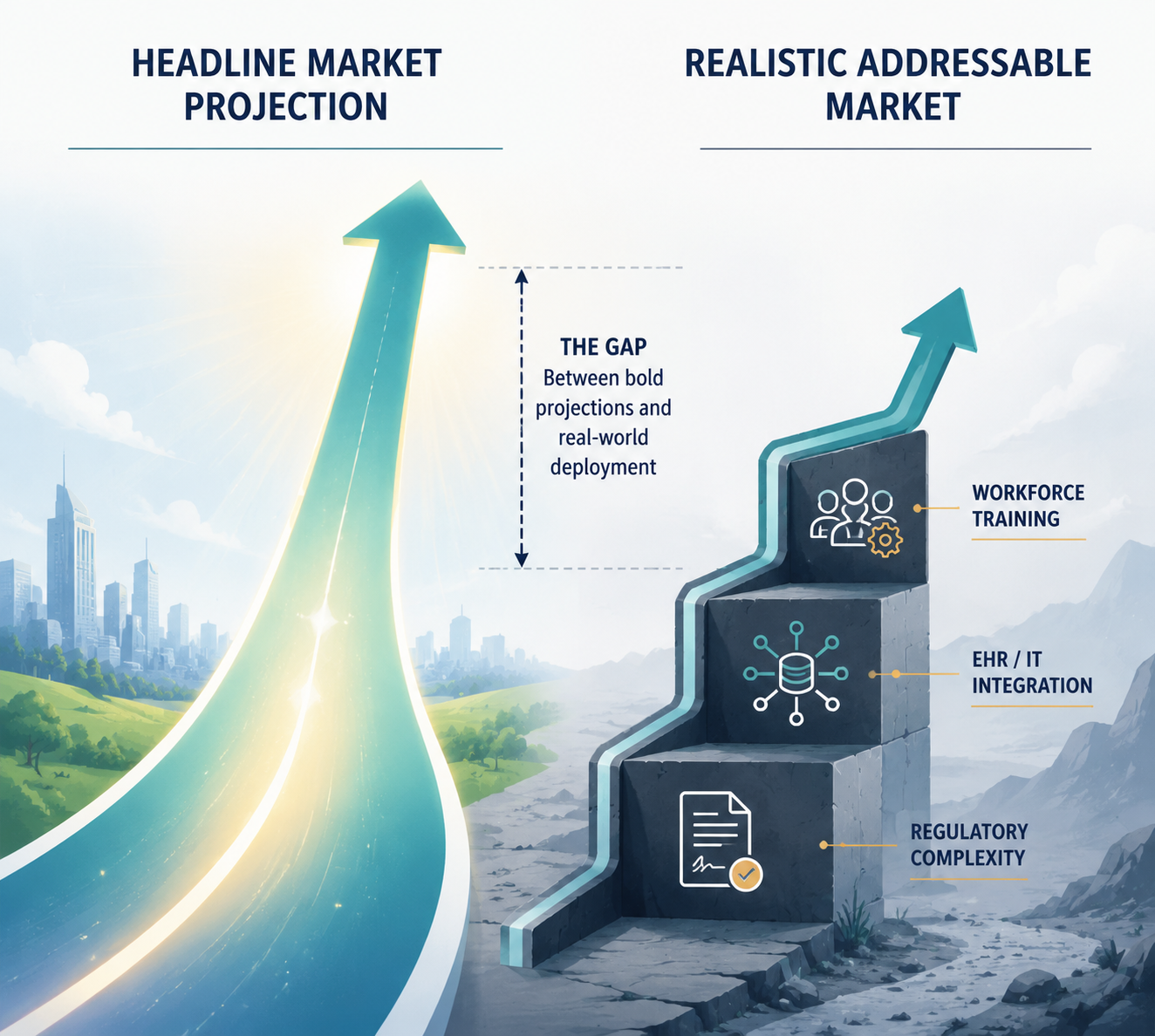
Survey-based estimates cited in a 2026 barriers analysis put EHR integration difficulty at 66%, data privacy concerns at 60%, and workforce training gaps at 85%.[7] The provenance is not as strong as a peer-reviewed longitudinal deployment study, so these figures should not be over-weighted. They are still directionally consistent with what slows clinical AI: the model may work, but the workflow around it is not automatically ready.
A practical planning adjustment is to reduce headline healthcare AI chip opportunity by 15% to 25% when estimating near- and medium-term addressable revenue. That discount is not a claim that demand disappears. It recognizes that chip vendors book shipments, health systems approve budgets, clinical departments validate tools, IT teams integrate systems, and staff must actually use the output. Those events do not happen on the same schedule.
| Headline Driver | What It Supports | What It Does Not Prove |
|---|---|---|
| FDA-authorized AI devices | Regulated product momentum, especially in radiology | Installed hardware across every eligible hospital |
| Healthcare share of AI chip revenue | A large vertical demand pool | Routine clinical use of all purchased compute |
| Vendor GPU performance claims | Infrastructure direction and workload capability | Independent proof of market size |
| AI adoption survey responses | Organizational engagement with AI | Mature integration, governance, and utilization |
Forecast Through 2033
For 2026, the most defensible baseline is a total AI chip market of about $100 billion to $107 billion, with healthcare near $25 billion if the Roots Analysis vertical-share estimate is applied.[1][2][3] From there, a 27% to 30% CAGR band through 2033 is a reasonable healthcare-specific planning range, with medical imaging, drug discovery, genomics, and edge inference providing the main support.
| Segment | Demand Signal | Forecast Treatment |
|---|---|---|
| Medical imaging inference | Large imaging AI market growth, radiology-heavy FDA authorization activity, latency-sensitive workflows | Highest-confidence clinical chip demand segment |
| Drug discovery | GPU-intensive research and model-development workloads | Strong accelerator demand, often outside hospital procurement |
| Genomics | Sequencing and interpretation pipelines that scale with data volume | High-growth compute demand, split across labs, research centers, cloud, and health systems |
| Pathology | Large image files and VRAM-constrained workloads | Promising but less broadly deployed than radiology |
| Remote monitoring and edge devices | Need for lower-latency, embedded inference | Relevant to ASIC and edge accelerator growth, but heterogeneous by device category |
The forecast should be read as demand for compute created by healthcare workloads, not as a guarantee that every dollar will pass through hospital capital budgets. Some revenue will be captured by cloud providers, some by device makers, some by research infrastructure, and some by health systems that decide latency, privacy, or throughput justify on-premise installations.
The market is genuinely growing faster than the broader AI chip category because healthcare has concrete workloads that consume accelerated compute. The usable forecast, however, is the adjusted one: authorization, purchase, integration, and routine clinical use are separate milestones, and chip revenue projections become inflated when they assume all four move at the same speed.
References
- AI Chips Market Size, Share and Forecast, 2026-2033, Coherent Market Insights
- AI Chip Market Size, Share & Industry Forecast 2040, Roots Analysis, June 2026
- AI Chip Market Size, Share and Industry Trends, 2035, SNS Insider
- GPU Infrastructure for Medical Imaging AI: 2026 Guide, Arc Compute
- Survey Reveals AI Is Delivering Clear Return on Investment in Healthcare, NVIDIA, 2026
- Artificial Intelligence in Software as a Medical Device, FDA
- The Main Barriers Slowing AI Adoption in Healthcare in 2026, Medium
Comments
Join the discussion with an anonymous comment.