
The cleanest way to understand health insurance litigation over AI claims processing is not to start with the software. Start with the denominator no one wants to talk about.
Plaintiffs challenging UnitedHealth’s use of nH Predict allege that about 90% of denials based on the tool are reversed when patients appeal. That figure is not an adjudicated fact; it comes from complaints and reporting on those complaints. But set it beside the appeal rates KFF has documented: fewer than 1% of denied claims in ACA marketplace plans are appealed, and only about 0.2% of in-network claim denials were appealed in 2021. Even in Medicare Advantage, where the appeals channel is more familiar to many providers, only 11.5% of denied prior authorization requests were appealed in 2024, though more than 80% of those appealed denials were overturned.[1][2]
That is the denial gap. If a denial is wrong but the patient never challenges it, the error does not behave like an error inside the insurer’s financial system. It behaves like savings.

Forbes framed the core logic bluntly in its 2026 analysis of the nH Predict litigation: a wrongful denial can be profitable if the patient does not appeal.[1] That is not a technical claim about model architecture. It is an operational claim about workflow design. A claim can be denied at scale. An appeal usually cannot be filed at scale by the person most affected by it.
Someone has to receive the letter, understand the reason code, determine what record is missing or what criterion was allegedly not met, ask a clinician’s office for documentation, make calls, wait on hold, meet deadlines, and keep going after a first rejection. If the member is recovering from a hospitalization, caring for a spouse, or trying to avoid a bill they cannot pay, every small administrative step functions like a financial control.
The appeal rate is the business case
The alleged 90% reversal rate is attention-grabbing, but it only becomes economically meaningful when paired with the non-appeal rate. A denial system does not need to be right most of the time if it is rarely forced to prove itself. It needs to move enough cases into nonpayment, delay, or abandonment before a reviewer, regulator, or judge sees the underlying file.
KFF’s figures show why ordinary appeals are a weak disciplining mechanism. In ACA marketplace plans, consumers appeal fewer than 1% of denied claims. For in-network denials, the rate was roughly 0.2% in KFF’s analysis of 2021 data. Medicare Advantage prior authorization appeals were more common in 2024, but still reached only 11.5% of denials; when appealed, more than 80% were overturned.[2]
| Measure | What it shows | Why it matters |
|---|---|---|
| Alleged nH Predict reversal rate | About 90% of challenged denials allegedly reversed on appeal | If accurate, many denials that survive are surviving because they are not challenged |
| ACA marketplace appeal rate | Fewer than 1% of denied claims appealed | The formal appeal right exists, but most denials never enter it |
| In-network denial appeal rate | Roughly 0.2% appealed in KFF’s 2021 analysis | Administrative burden can matter more than legal entitlement |
| Medicare Advantage prior authorization appeals | 11.5% appealed in 2024; more than 80% overturned | Even in a more active appeal environment, most denials are not appealed |
The important distinction is not whether appeals sometimes work. They clearly can. The issue is that the appeal channel is too narrow, too slow, and too individualized to discipline a denial process that can operate across thousands or millions of claims. When a system produces a large volume of adverse determinations, the economic question is not only accuracy. It is how many people have the time, stamina, records, and procedural knowledge to make accuracy matter.
nH Predict turned a post-acute care dispute into a workflow case
The nH Predict litigation matters because it puts a concrete operational system behind the abstract debate over AI in claims review. The tool, developed by NaviHealth and used in the Medicare Advantage post-acute care context, is described in reporting as drawing on a database of about 6 million patient records to estimate how long a patient may need skilled nursing, rehabilitation, or similar post-hospital care.[3][4]
UnitedHealth disputes the plaintiffs’ characterization of the system. The company has maintained that nH Predict does not make coverage decisions and has described it as guidance for providers and families rather than a substitute for individualized review.[3] That distinction is legally important. It is also operationally incomplete unless the surrounding process is visible.
A tool can be called guidance and still become the practical center of a decision if staff are trained to follow it, if departures require extra justification, if reviewers face productivity pressure, or if the system’s output becomes the default expected length of stay. The question is not only what the vendor manual says. It is what happens to the claim when the predicted discharge date arrives and the clinical record points in a different direction.
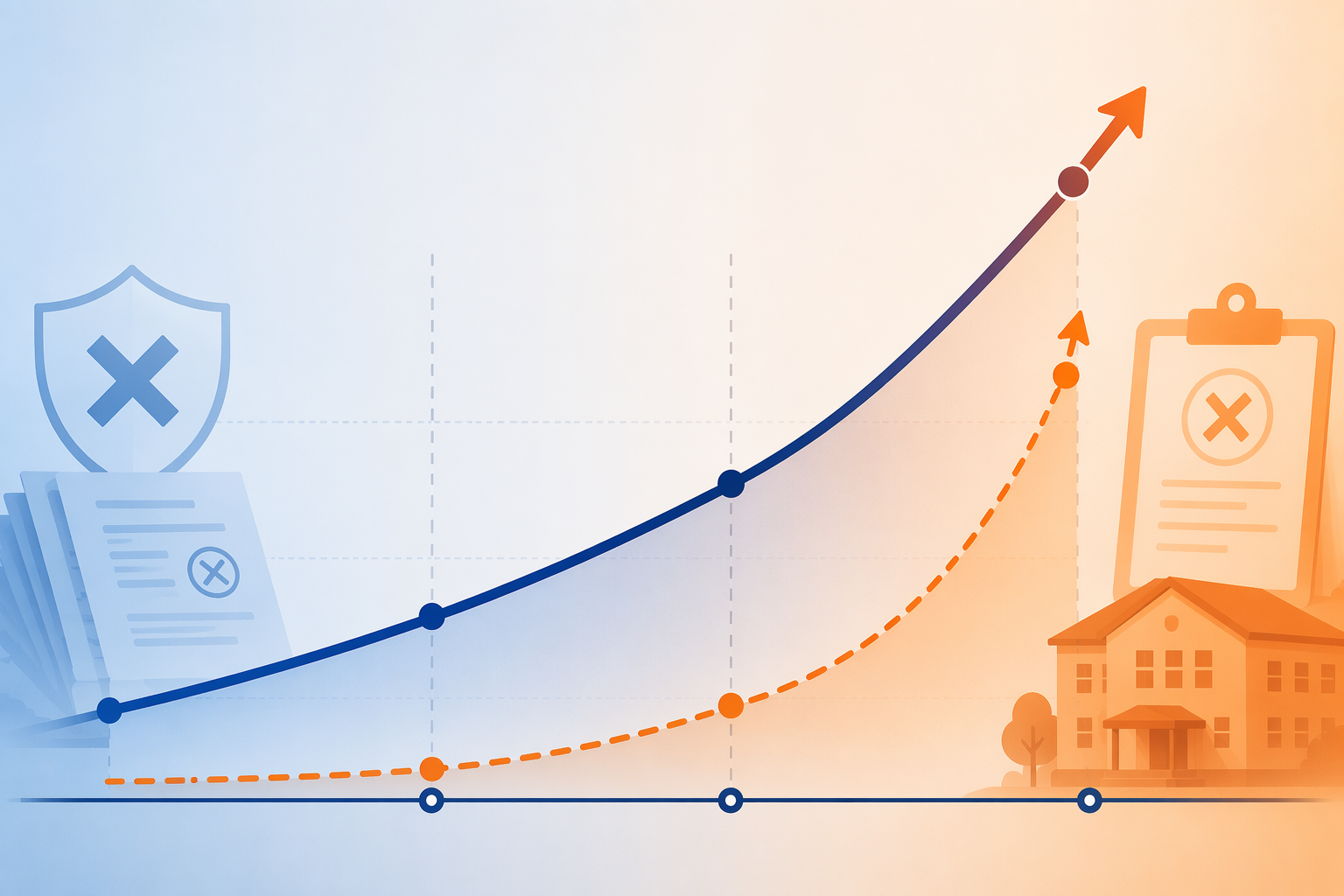
That is why the denial-rate trajectory is so hard to ignore. A Senate investigation found that UnitedHealth’s post-hospital care denial rate rose from 10.9% in 2020 to 22.7% in 2022 after nH Predict was deployed. Skilled nursing facility denials climbed roughly nine-fold over the same period, according to legal analysis discussing the Senate findings.[5]
Those figures do not, by themselves, prove that nH Predict caused improper denials. Utilization management can change for many reasons: coding practices, documentation standards, plan policy, provider behavior, staffing models, or a stricter interpretation of medical necessity. But a denial rate that doubles in two years, paired with a roughly nine-fold rise in skilled nursing facility denials, is exactly the kind of operational signal that should trigger questions about what the tool changed inside the review process.
Discovery is where the administrative machinery becomes visible
The March 2026 discovery order in Estate of Lokken v. UnitedHealth is important for that reason. The order requires UnitedHealth to produce internal records concerning nH Predict’s design, development, intended purpose, and staff training, while source code and financial data remain sealed. The order is procedural; it is not a finding that UnitedHealth is liable or that nH Predict made unlawful decisions.[1][5]
Still, the records at issue go to the part of the system ordinary appeals almost never reveal. A patient appeal may show whether one person should have received more days in a skilled nursing facility. Discovery can show whether the organization designed a workflow that predictably shortened stays, how staff were instructed to use the predicted length of stay, and whether the company monitored reversals, complaints, savings, or denial rates after deployment.
That is the institutional test. If human review is real, the file should show clinicians weighing the patient’s condition against coverage criteria and using the tool as one input. If human review is nominal, the file may show reviewers treating the predicted endpoint as the answer and the clinical record as something to reconcile afterward. The legal process is now being asked to distinguish between those two worlds.
The harm question is not as simple as denial equals bad outcome
One reason the nH Predict debate should not collapse into a generic “AI denial equals patient harm” story is that the evidence is more complicated. A peer-reviewed study reported by Stanford found that use of nH Predict reduced post-acute care coverage by 13% without worsening mortality or readmissions.[6]
That finding matters. It leaves room for the possibility that some post-acute utilization was reduced without measurable deterioration on those outcomes. It also leaves several accountability questions intact. Mortality and readmissions do not capture every meaningful consequence of shortened care: functional recovery, caregiver burden, out-of-pocket spending, confusion during discharge, or the administrative labor required to fight for additional days. Nor does a population-level outcome settle whether individual coverage decisions followed the plan’s legal and contractual standards.
For health plans, this is the uncomfortable middle ground. They can have legitimate reasons to manage post-acute utilization and still face litigation if the system used to do it is opaque, overly automated, or insulated from appeal pressure. The problem is not that every reduction in care is proof of abuse. The problem is that the ordinary claims process often cannot show whether a reduction was clinically justified, contractually valid, and independently reviewed.
PXDX shows the same pressure point outside post-acute care
Cigna’s PXDX system is a different dispute, but it exposes the same structural question: how much human judgment remains when high-volume denial workflows are built around automation?
ProPublica reported that Cigna’s PXDX process allegedly allowed company doctors to deny more than 300,000 claims over two months, spending an average of 1.2 seconds per case. Members of Congress later questioned Cigna about the practice.[7]
Cigna disputes the characterization of PXDX as AI and has described it as process automation. The company has also said the claims at issue involved payment denials rather than denials of care.[7] Those distinctions should be kept in view. A payment denial after care is delivered is not identical to a prior authorization denial before care occurs. A rules-based automation process is not necessarily the same as a predictive model.
But the operational concern survives those distinctions. If a physician’s review is measured in seconds, the relevant question is not whether a doctor’s name appears in the workflow. It is whether the doctor had a realistic opportunity to evaluate the record, identify exceptions, and disagree with the automated result. Human review is not a job title. It is time, information, authority, and a documented path to override.
That is why these cases keep moving toward litigation and congressional scrutiny. The public-facing vocabulary — AI, automation, guidance, review, payment integrity — often does less work than the internal workflow. Who sees the record? What does the system pre-fill? What is the default? How often do reviewers override it? What happens to employees who override too often? Those are not philosophical questions. They are claims-operation questions.
Denials are accounting events until they reach the patient
Inside an insurer, a denial can look like a code, a workflow status, a utilization metric, or a line in a savings analysis. Outside the insurer, it becomes a person waiting for care, a provider deciding whether to keep treating without payment assurance, or a family trying to understand why coverage stopped before recovery did.
The American Medical Association’s 2024 survey found that 61% of physicians were concerned that AI increases prior authorization denials, and 29% reported that a prior authorization requirement had led to a serious adverse event for a patient.[8] Public survey data cited by Forbes also found that nearly half of U.S. adults report unexpected medical bills, while four in five said delayed care caused anxiety and worsened conditions.[1]
Those figures should not be treated as proof that a specific algorithm caused a specific injury in every disputed case. They do show why claims automation cannot be evaluated as a back-office efficiency project alone. A denied authorization may delay treatment. A denied payment may shift administrative work to a provider or financial risk to a patient. A denial letter that is technically appealable may still be practically final if the recipient cannot navigate the process.
The industry has seen a version of this problem before in other insurance lines, where algorithmic claim valuation can turn individualized loss into standardized settlement ranges. Health insurance adds a more immediate coverage problem: the disputed decision may determine whether care continues, whether a facility keeps a patient, or whether a bill becomes the patient’s next crisis.
Why litigation is becoming the control mechanism
Appeals are supposed to correct claim-level mistakes. They are poorly suited to expose system-level incentives. A member appeal can ask whether Mrs. Smith should receive more rehab days. It usually cannot ask whether the insurer deployed a tool that shifted thousands of post-acute cases toward earlier termination, trained reviewers to follow predicted discharge dates, and then benefited because almost no one appealed.
That is the gap litigation is now trying to fill. In the nH Predict cases, plaintiffs are not only contesting individual coverage decisions. They are trying to obtain records about design intent, staff training, and the role the system played inside the organization. In the PXDX controversy, the pressure point is whether the nominal presence of physician reviewers was enough to make mass denials meaningfully reviewed.
None of that means every automated denial is unlawful, every insurer use of predictive analytics is abusive, or every utilization management reduction is patient harm. The legal cautions are real: the nH Predict error rate remains alleged, UnitedHealth disputes that the tool makes coverage decisions, Cigna disputes the AI characterization of PXDX, and the Lokken discovery order is not a liability ruling.
But the arithmetic remains. If denials can be issued at scale and appeals arrive only in tiny fractions, the correction mechanism is too weak to govern the system. Litigation rises because it can ask questions an appeal file rarely reaches: what the company built, what staff were told, what metrics moved after deployment, and whether the process made incorrect denials financially tolerable.
The danger in AI claims processing is not only that an algorithm may be wrong. It is that the business process around the algorithm may make being wrong profitable.
References
- The Algorithm That Counted On No One Appealing, Forbes, June 2026.
- Regulation of AI in Prior Authorization and Claims Review, KFF, May 2026.
- UnitedHealth uses faulty AI to deny elderly patients medically necessary coverage, lawsuit claims, CBS News.
- AI with 90% error rate forces elderly out of rehab nursing homes, suit claims, Ars Technica.
- The Legal Landscape for AI-Enabled Decisions for Health Care Claims and Coverage, Maynard Nexsen.
- Stanford Report, Stanford Report, Jan 2026.
- Congress Questions Cigna's Large-Scale Denial of Insurance Claims, ProPublica.
- Physicians concerned AI increases prior authorization denials, AMA.
Comments
Join the discussion with an anonymous comment.