
AI computing power in healthcare and defense is no longer a theoretical resource question. It is becoming a purchasing-power problem. The Department of Defense requested $13.4 billion for AI in FY2026 and, for FY2027, is seeking nearly $30 billion for next-generation AI supercomputers; the latter remains a proposal subject to congressional appropriation, so it should not be treated as guaranteed spending yet.[1] Healthcare, by comparison, spent $1.4 billion on AI in 2025, according to Menlo Ventures.[2]
Those figures are not a clean line-item comparison. A defense budget request and healthcare-sector AI spend measure different institutional behaviors, budget processes, and procurement categories. Still, they are a useful warning signal because both sectors are moving toward the same constrained infrastructure layer: advanced GPUs, high-bandwidth memory, cloud clusters, power-dense data centers, and the vendor capacity wrapped around them.
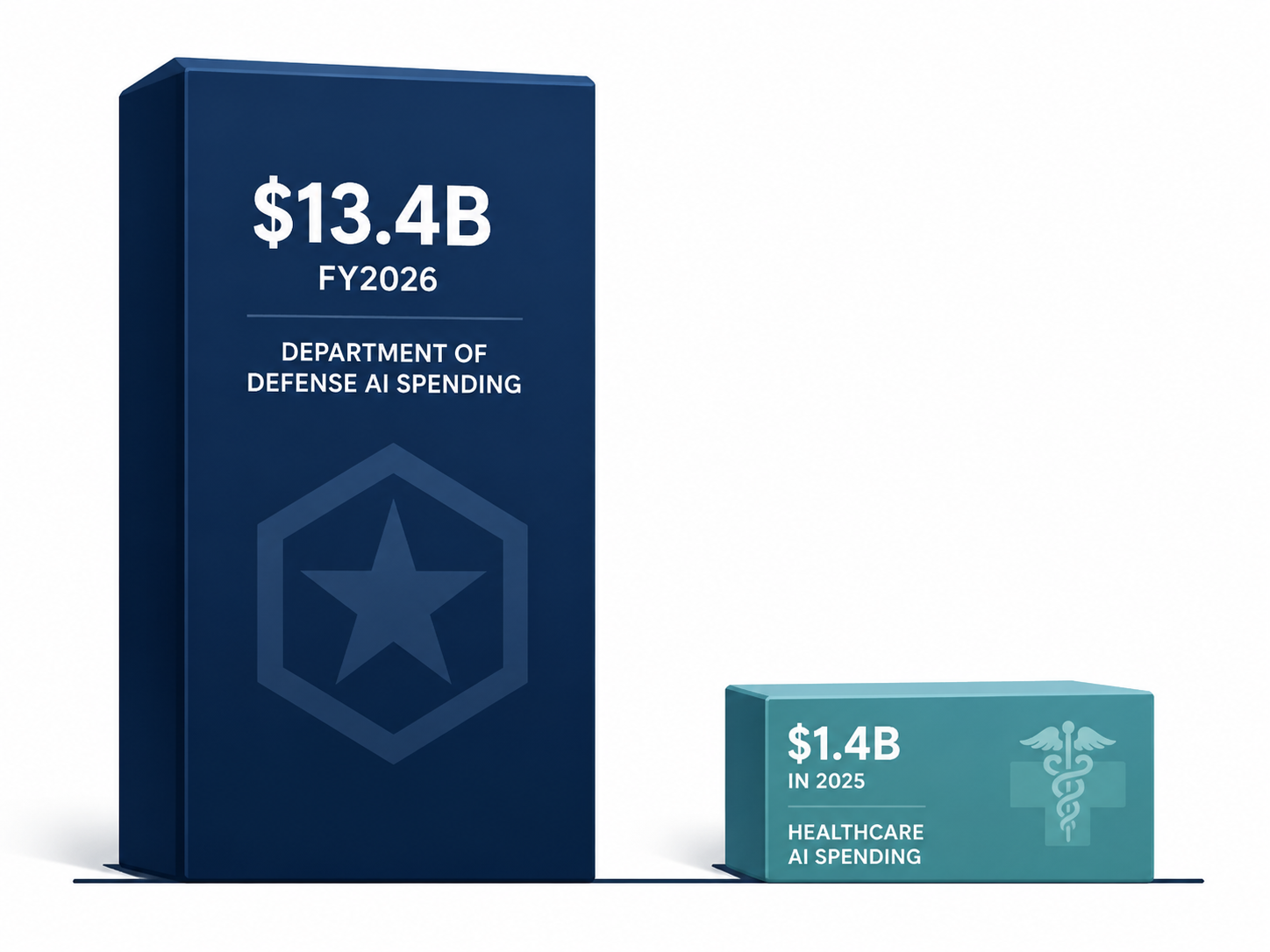
That asymmetry matters because healthcare demand is no longer speculative. NVIDIA’s 2026 healthcare survey found that 70% of healthcare organizations were actively using AI, and 85% of executives reported that AI was helping increase revenue.[3] Whatever one thinks of vendor-sponsored surveys, the adoption signal is directionally important: health systems are not merely watching AI from a conference stage. They are putting it into workflows, revenue-cycle operations, imaging support, patient engagement, analytics, and administrative automation. Once those workloads become routine, compute stops being an innovation budget accessory and starts behaving like infrastructure.
The Collision Is Happening Below the Application Layer
Healthcare leaders usually encounter AI as a product decision: a model embedded in an imaging tool, a clinical documentation system, a contact-center assistant, a coding workflow, or an analytics platform. The compute squeeze appears one layer lower. It shows up when the same vendors need more accelerator capacity, when cloud commitments are renegotiated, when memory costs move faster than budget cycles, and when infrastructure teams discover that an AI roadmap written in software language depends on hardware that cannot be wished into existence.
Forbes reported in June 2026 that healthcare AI leaders were trying to outmaneuver sharply rising memory and GPU costs.[4] That is the practical market symptom. The reported pressure is not simply that GPUs are expensive in the abstract; it is that memory and accelerator economics are becoming a live constraint for healthcare organizations trying to scale AI beyond pilots.
The defense side has a different justification, but it lands in the same supply chain. Defense AI supercomputing is tied to sovereignty, classified workloads, mission assurance, and control over sensitive data and infrastructure. Health systems do not have the same mission profile, but they do have their own reasons to care about locality, control, resilience, and predictable cost. The uncomfortable point is that healthcare is trying to make those decisions while a sector with far greater budget authority is signaling much larger demand to the same hardware ecosystem.
What Can Be Documented, and What Cannot
The evidence supports a cautious but serious conclusion. It documents three separate facts: defense is requesting very large AI and supercomputing budgets; healthcare AI use and spending are rising from a much smaller base; and healthcare AI leaders are already confronting rising GPU and memory costs.[1][2][3][4] It does not quantify exactly how many accelerators a defense program takes away from healthcare, or how much of a given hospital’s cloud price increase can be attributed to Pentagon demand.
That distinction matters. A precise causal chain would require supplier allocation data, chip-order timing, cloud capacity commitments, contract terms, and product-level demand across defense contractors, hyperscalers, medical AI vendors, and health systems. The available public material does not provide that. What it does provide is enough to treat defense-scale AI supercomputing demand as a strategic pressure on a shared market, not as a distant policy story with no bearing on healthcare procurement.
| Signal | What It Shows | What It Does Not Prove |
|---|---|---|
| DoD $13.4B FY2026 AI request | Defense AI demand is being budgeted at a scale far above healthcare AI spend | The exact share of GPUs or HBM that defense will consume |
| Nearly $30B FY2027 supercomputing request | Defense wants a large modernization push for next-generation AI supercomputers | Final appropriated spending, since the request is subject to Congress |
| Healthcare $1.4B AI spend in 2025 | Healthcare demand is real but budgeted at a much smaller scale | Uniform spending capacity across all health systems |
| Rising healthcare GPU and memory costs | Infrastructure cost pressure is already visible in healthcare AI planning | A quantified one-to-one link between DoD buying and hospital prices |
How Defense Demand Pressures Healthcare Compute
The most direct mechanism is competition for advanced accelerators and high-bandwidth memory. Modern AI infrastructure depends heavily on GPUs and memory systems capable of feeding those processors fast enough to train or run large models efficiently. When a defense customer, a cloud provider serving defense workloads, or a prime contractor reserves substantial capacity, the rest of the market does not need to be explicitly excluded to feel the effect. Allocation priority, delivery timing, and volume pricing can shift before a hospital CIO ever sees a formal shortage notice.
The second mechanism is supplier behavior. Chipmakers, memory manufacturers, server vendors, cloud providers, and systems integrators respond to large, durable demand signals. A multi-year defense supercomputing push can influence where engineering attention goes, which configurations are prioritized, how long lead times become, and which buyers receive the most favorable commercial treatment. None of that requires a simple auction in which a hospital and a defense agency bid for the same physical chip on the same day.
The third mechanism is cloud pricing. Many health systems avoid buying accelerator hardware directly because cloud access appears more flexible, faster to procure, and easier to scale down if use cases disappoint. That logic weakens when AI workloads stop being occasional experiments. If medical imaging pipelines, documentation tools, operational forecasting, call-center automation, or data-science environments begin drawing steady compute, the cloud bill becomes a recurring infrastructure exposure. A constrained GPU market can then reach healthcare through cloud unit economics even when the organization never owns a GPU.
The fourth mechanism is time. Healthcare procurement rarely moves at the pace of the accelerator market. Security reviews, contracting, capital committees, facilities planning, data governance, model validation, vendor risk management, and clinical stakeholder review all add friction. When supply tightens or prices move during that cycle, the original business case can become stale before the purchase order is complete.
That is why the DoD numbers change the temperature of the conversation. Healthcare does not need proof that every defense dollar directly increases every hospital GPU quote. It needs to recognize that it is no longer planning AI infrastructure in a neutral commodity market. It is planning inside a market where another buyer class can send larger, earlier, and more durable signals to the same supply base.
Healthcare Adoption Has Outgrown the Pilot Mentality
The adoption data matters because compute scarcity is easier to ignore when AI sits in a laboratory budget. NVIDIA’s survey finding that 70% of healthcare organizations are actively using AI suggests a different operating reality.[3] Even allowing for the limits of survey data, that level of reported use means infrastructure teams are increasingly being asked to support AI as part of standard operations rather than as isolated demonstrations.
Menlo Ventures’ $1.4 billion healthcare AI spend figure gives that adoption a spending scale, and its reported $50.7 billion addressable market shows why vendors are pursuing healthcare aggressively.[2] Market-size estimates for healthcare AI vary by methodology, and they should not be treated as precision instruments. Their main usefulness here is simpler: they show a sector moving from experimentation toward broader commercialization while still operating with far less purchasing power than the defense AI budget signals now entering the market.
For a health system, the resulting problem is not only whether a particular AI product works. It is whether the organization can afford the compute path that makes the product dependable at scale. A model that is tolerable for one department may become costly when expanded across facilities. A cloud architecture that looks attractive for early deployment may become harder to defend once utilization stabilizes. A vendor-hosted solution may reduce local infrastructure burden while increasing dependence on the vendor’s own access to scarce compute.
The Cloud Choice Is Getting Less Passive
Cloud remains the default answer for many healthcare AI deployments because it shortens the path from approved use case to operational workload. It also lets organizations avoid building specialized facilities, hiring deep accelerator operations talent, and guessing too early about which models or vendors will survive. For a hospital with limited capital flexibility, that is not a trivial benefit.
The weakness of that approach appears when flexibility becomes dependency. If cloud GPU capacity becomes more expensive, more rationed, or more tightly coupled to long-term commitments, the health system inherits market pressure through operating expense. The CFO then sees AI not as a bounded innovation line, but as a growing compute utility with uncertain pricing. Infrastructure leaders have to explain why last year’s estimate no longer matches this year’s contract reality.
This does not make cloud the wrong answer. It makes passive cloud consumption a weaker posture. Health systems need to know which workloads are bursty, which are steady, which require low latency, which are sensitive enough to merit stronger locality controls, and which can tolerate queueing or lower-cost compute. Without that workload segmentation, every AI use case competes for the same premium path.
- Training or fine-tuning workloads may tolerate scheduled windows but can be memory-intensive.
- Inference workloads embedded in clinical or operational workflows may need predictable latency and uptime.
- Administrative automation may be easier to route through vendor platforms if data sensitivity and service levels are acceptable.
- Research and data-science environments may benefit from shared internal capacity controls to avoid uncontrolled cloud consumption.
On-Premise Compute Is Strategic, Slow, and Easy to Romanticize
The obvious counterweight to cloud exposure is some form of on-premise or sovereign compute. That can mean a hospital-owned AI cluster, a regional shared facility, a private cloud arrangement, a colocation model, or a tightly governed hybrid architecture. The attraction is clear: more control over sensitive data flows, more predictable capacity for critical workloads, and less exposure to every turn in public cloud accelerator pricing.
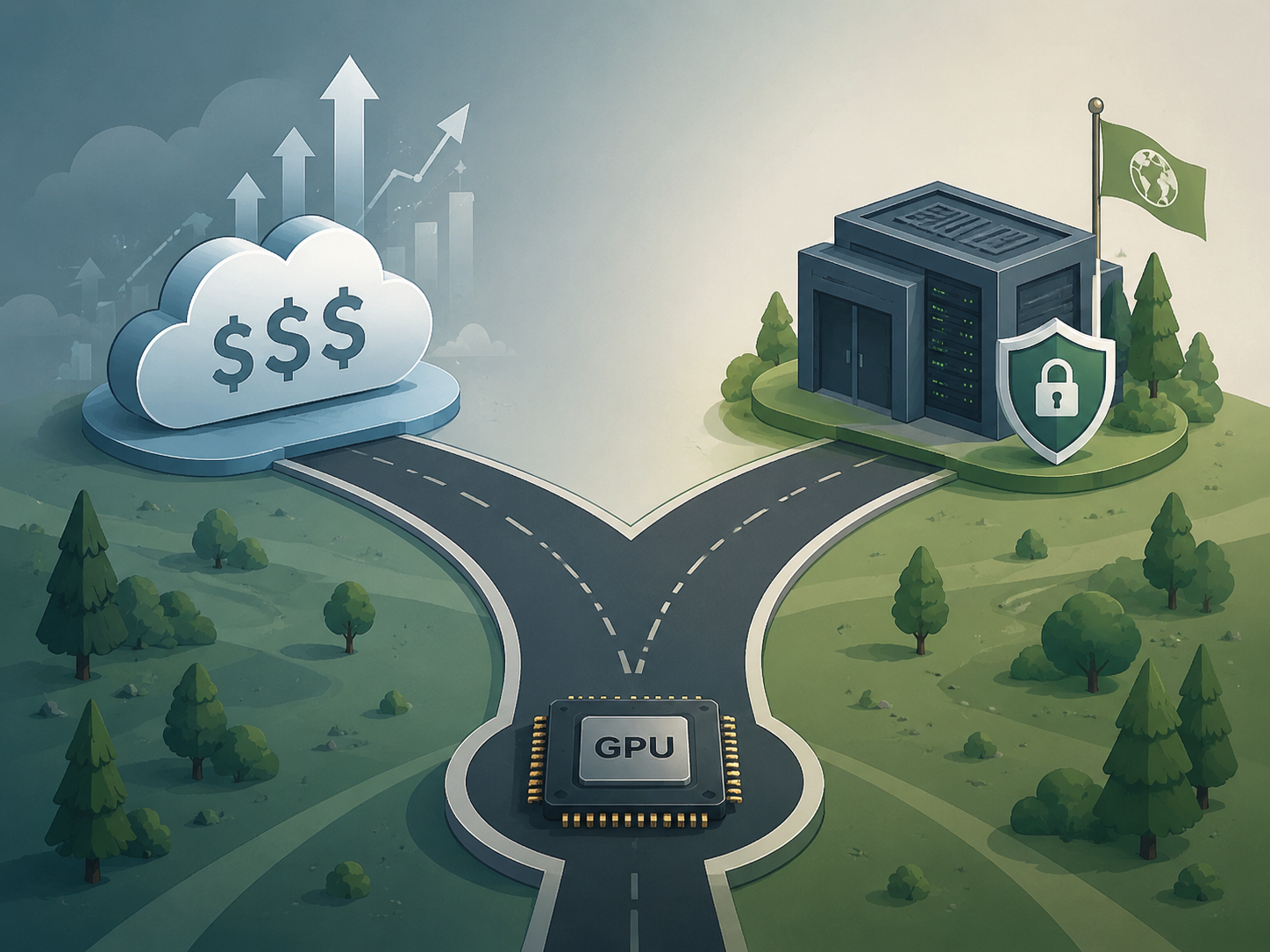
But on-premise AI compute is not a procurement slogan. Forbes reported that average hospital data center build timelines of 2 to 5 years are complicating rapid AI deployment.[4] That timeline is a hard check on any argument that hospitals can simply build their way out of cloud dependency. Power, cooling, space, redundancy, networking, physical security, hardware lifecycle management, and specialized operations talent all have to arrive before the first production workload can depend on the environment.
The more realistic question is not cloud or on-premise as a binary. It is which workloads deserve controlled capacity and which can remain rented. A health system may decide that research experimentation belongs in cloud, while certain recurring inference workloads justify reserved capacity. Another may use cloud for model access but insist on stronger data residency or private connectivity. A third may conclude that its scale does not justify owning accelerators and instead negotiate harder for cost transparency and portability.
The defense analogy is useful only up to a point. Defense invests in sovereign compute because mission requirements and classified workloads create a distinct threshold for control. Healthcare should not copy that posture mechanically. It should take the underlying lesson seriously: when compute becomes strategically important, depending entirely on someone else’s future capacity and price schedule is itself a risk.
Procurement Needs a Compute Assumption, Not Just an AI Use Case
The practical change is in the business case. Many AI proposals still lead with product capability, departmental benefit, and implementation cost. That is no longer enough. The proposal should also say what compute it assumes, who controls that compute, how pricing changes with volume, what happens if model use doubles, and whether the vendor’s own infrastructure costs can be passed through to the customer.
Procurement teams should press vendors on whether pricing is tied to usage, model size, inference volume, data retention, premium GPU availability, or cloud-provider pass-through charges. They should also ask what service levels mean during constrained capacity periods. A vendor can be clinically impressive and still leave the health system exposed to opaque compute economics.
Infrastructure teams need similar discipline internally. If a health system cannot yet justify sovereign compute, it can still maintain a workload inventory, identify the AI systems most likely to become recurring compute consumers, and avoid architectures that make migration prohibitively difficult. The important move is to stop treating compute as an invisible utility behind the application contract.
- Identify which AI workloads are experimental, seasonal, or permanently embedded in operations.
- Separate workloads that require premium accelerator capacity from those that can run on lower-cost infrastructure.
- Model cloud cost sensitivity before expanding a pilot across facilities.
- Review vendor contracts for compute pass-throughs, usage escalators, and capacity commitments.
- Evaluate whether any recurring workloads justify reserved, private, colocated, or on-premise capacity.
A Smaller Buyer in a Larger Compute Market
Healthcare is not helpless in this market, but it is not the price setter. The DoD’s FY2026 AI request and FY2027 supercomputing proposal indicate a level of demand signaling that healthcare organizations cannot match sector-wide.[1] At the same time, healthcare’s reported adoption and spending show that its own need for compute is now operational enough to be exposed to those signals.[2][3]
The infrastructure posture that follows is less dramatic than a prediction about who wins the GPU race. Health systems should assume that AI compute is a constrained strategic resource shaped partly by defense-sector demand, cloud-provider allocation, memory pricing, and long procurement timelines. That assumption changes how AI projects are approved, how vendor contracts are read, how cloud commitments are modeled, and how seriously organizations examine private or sovereign capacity.
The risky assumption is that compute will remain a neutral utility available at last year’s price. For healthcare leaders trying to turn AI adoption into dependable infrastructure, that assumption now deserves to be retired.
References
- DoD wants nearly $30 billion to modernize its AI supercomputing arsenal in fiscal 2027, DefenseScoop, May 2026
- 2025: The State of AI in Healthcare, Menlo Ventures
- AI in Healthcare Survey 2026, NVIDIA Blog
- Healthcare AI Leaders Are Rapidly Trying To Outmaneuver Skyrocketing Memory And GPU Costs, Forbes, June 2026
Comments
Join the discussion with an anonymous comment.