
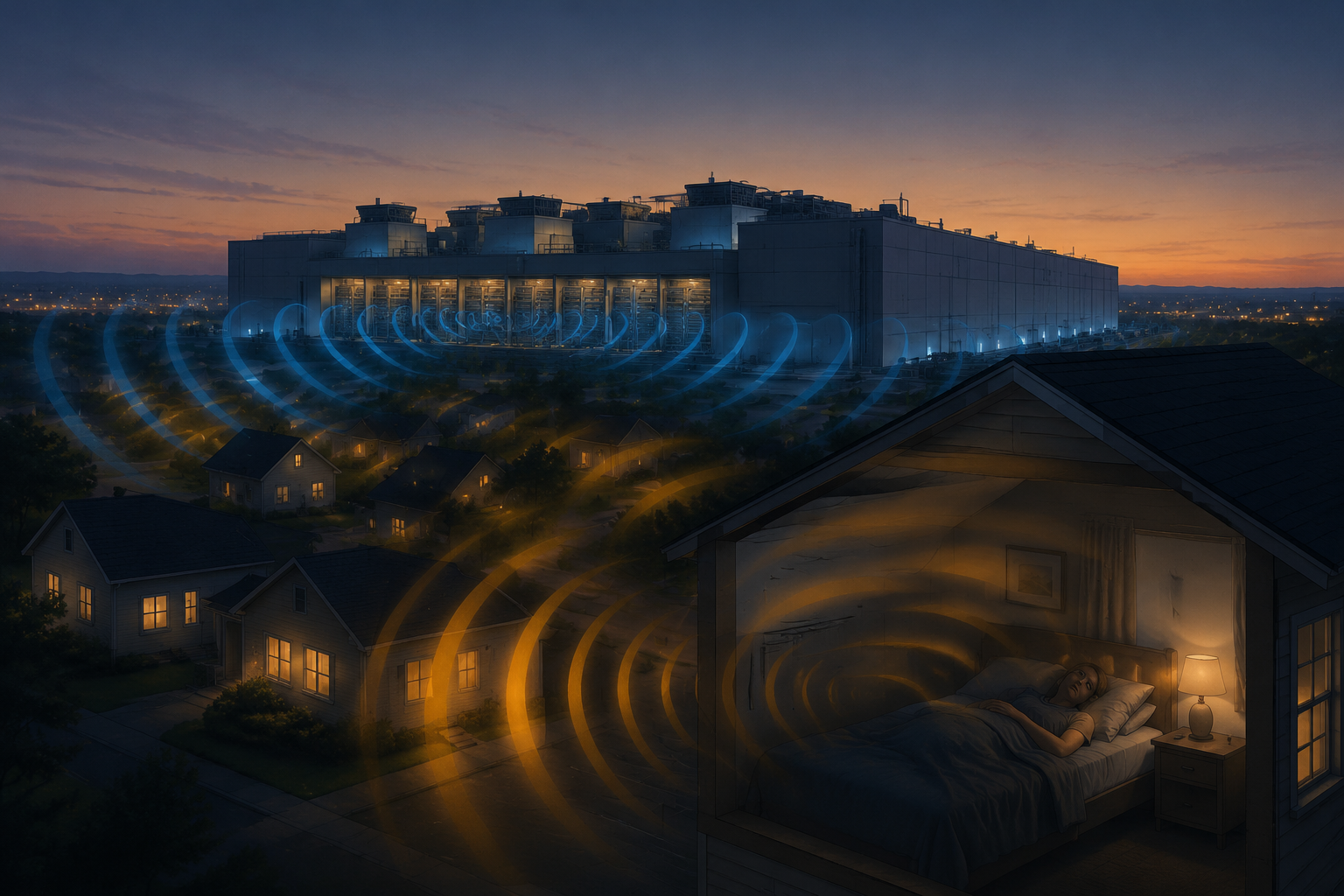
A data center can sound ordinary on paper and intolerable at a bedroom window. External measurements reported near Virginia data centers have ranged from 40 to 59 dB on residential property, levels that may not look extreme when compared with many urban soundscapes.[1] Yet the complaint that keeps surfacing around AI infrastructure is not simply “it is loud.” It is that the sound is steady, low, mechanical, difficult to escape indoors, and worst at the hours when the body is trying to sleep.
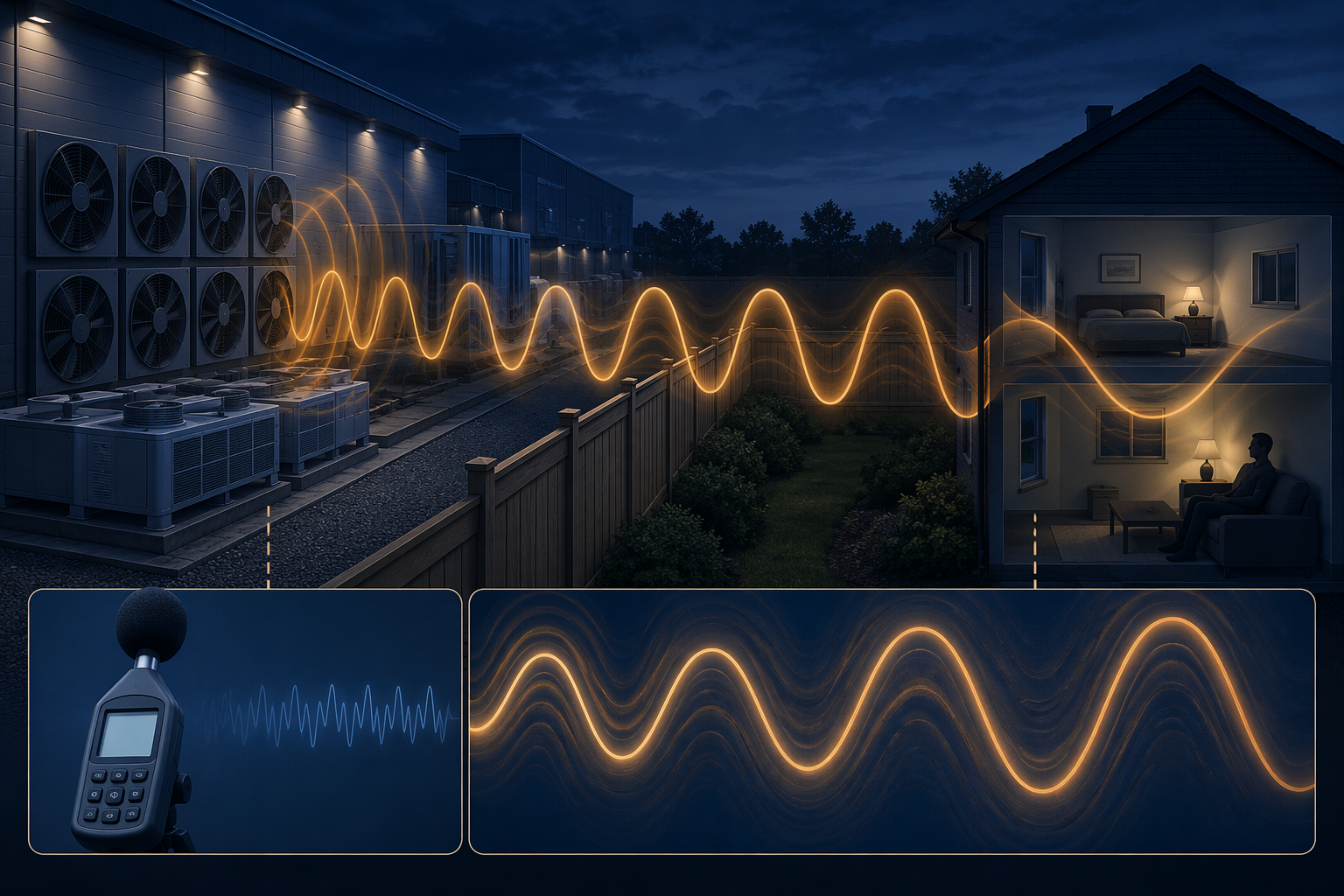
That distinction matters for assessing the health impacts of data center noise pollution in AI infrastructure. The most relevant exposure is often the 50–200 Hz hum from cooling fans and HVAC systems. Standard A-weighted measurements can understate that low-frequency component; one technical analysis of data center noise control says dBA readings can underestimate low-frequency hum by as much as 25 dB.[2] A number that satisfies an ordinance can therefore miss the part of the exposure residents describe as vibration, pressure, or an inescapable drone.
The Health Question Starts With Measurement
Noise regulation often depends on what is easy to measure and enforce. Human physiology is less tidy. A-weighted decibels were designed to approximate the ear’s sensitivity across frequencies, but low-frequency sound can remain perceptible and intrusive even when an A-weighted reading looks modest. It also travels differently: longer wavelengths penetrate walls and windows more readily than higher-frequency noise, which is why indoor nighttime exposure can remain the central concern even when outdoor compliance is documented.
The distinction is not academic. Data centers can produce very high sound levels inside their facilities: internal noise has been reported at 96–100 dBA, above OSHA’s 85 dBA hearing-protection threshold.[1] That occupational figure should not be confused with residential exposure; a worker in a mechanical room and a child sleeping nearby are not receiving the same dose. But it does indicate the acoustic intensity of the machinery before distance, barriers, enclosure design, and operating patterns reshape the exposure.
For residents, the more important questions are where the sound is measured, at what time, with which frequency weighting, and whether the metric captures the character of a continuous hum. A short daytime reading at a property line does not answer the same health question as an overnight indoor low-frequency assessment in a bedroom. “Within legal limits” may be true and still be incomplete.
What Peer-Reviewed Data Center Evidence Now Supports
The strongest data-center-specific anchor is a 2026 Frontiers in Climate mini-review by researchers at George Mason University. The review explicitly connects data center noise with cardiovascular, cognitive, and mental health concerns, drawing on broader environmental and occupational noise literature while applying that evidence to the emerging pattern of AI data center siting and community exposure.[3]
The word “mini-review” is important. It does not mean the health concern is invented; it means the data-center-specific epidemiology is still thin. The review’s value is that it pulls the exposure pathway into a peer-reviewed frame: large facilities, continuous cooling demand, low-frequency sound, nearby residential receptors, and health outcomes already associated with chronic noise exposure in other settings.[3]
That is a credible public-health inference, but it is still an inference. Transportation noise studies, occupational noise studies, and general environmental-noise research can establish biological plausibility and expected outcome categories. They cannot, by themselves, quantify how many data-center neighbors develop hypertension, how many lose sleep, or which siting distances reliably prevent harm.
| Health concern | What the current evidence can support | What remains uncertain |
|---|---|---|
| Sleep disruption | Chronic nighttime noise is a well-established pathway for disturbed sleep, and data center hum is plausibly relevant because it can be continuous and low frequency. | The size of the sleep burden in specific host communities has not yet been well quantified. |
| Hypertension and cardiovascular strain | Broader noise-health literature supports links between chronic noise exposure, stress physiology, hypertension, and cardiovascular effects; the 2026 review applies this concern to data centers. | Data-center-specific longitudinal studies are still needed to estimate incidence or attributable burden. |
| Cognition and learning | Noise exposure is linked in broader literature to cognitive effects, with children a particular concern; the data center review flags cognitive harms as part of the risk profile. | Evidence specific to children living near data centers remains limited. |
| Anxiety and mental health effects | Persistent, uncontrollable noise can contribute to stress and mental health burden; data center sources and community reports align with that concern. | Resident-reported symptoms are signals, not a substitute for diagnostic population studies. |
Why Sleep Is the First Outcome to Watch
Sleep is where the evidence and the lived complaints most directly meet. Nighttime noise does not need to wake a person fully to matter. It can fragment sleep, increase arousals, and leave people functioning the next day with impaired concentration, irritability, or fatigue. For shift workers, the exposure may move into the day, when community noise rules are often less protective and household routines make recovery sleep harder.
Public-health guidance has long treated nighttime noise as a health issue, not just an annoyance problem. WHO night-noise guidance and EPA health criteria have identified 55 dBA outdoor and 45 dBA indoor levels as protective thresholds, as summarized in a review of data center noise ordinance challenges.[4] Those thresholds are not data-center-specific, and they do not solve the low-frequency measurement problem. They do, however, show that sleep protection has a recognized place in environmental noise policy.
Children, older adults, people with existing cardiovascular disease, and low-income households have less margin for this kind of exposure. A family with resources may retrofit a bedroom, change routines, or move. A renter, an elderly homeowner, or a household tied to local work and school usually cannot treat relocation as a practical mitigation strategy. That asymmetry is part of the health burden, even when it does not appear in a sound report.
Cardiovascular and Cognitive Harms Are Plausible, but the Burden Is Not Yet Counted
The pathway from chronic noise to cardiovascular strain is not mysterious. Persistent sound can activate stress responses, interfere with sleep recovery, and contribute to elevated blood pressure over time. When the Frontiers in Climate review links data center noise to cardiovascular harms, it is not asking readers to believe that cooling equipment has a novel biological effect. It is applying a known environmental-noise pathway to a newer infrastructure source.[3]
The same is true for cognitive effects. The concern is especially sharp for children because sleep quality, attention, and learning are closely connected. A school-age child trying to sleep in a house exposed to a continuous mechanical hum is not merely experiencing a nuisance; the exposure can plausibly affect the conditions required for learning and emotional regulation. The current evidence supports that concern as biologically and epidemiologically reasonable, while stopping short of proving a measured cognitive decline in data-center-adjacent children as a population.
That boundary should be kept visible. Modeled estimates in related work can help policymakers imagine possible population burdens, but a modeled projection is not an observed count of deaths or diagnoses. The better interpretation is more restrained: data center noise has exposure characteristics that fit established harm pathways, and the specific long-term burden in host communities remains undermeasured.
The Evidence Gap Is Not a Reassurance
A 2025 letter from Harvard T.H. Chan School of Public Health authors Tao and Gao makes the necessary correction: the pace of data center deployment has outrun empirical study of long-term health outcomes in host communities, and urgent research is needed.[5] That is not the same as saying there is no evidence of harm. It means the evidence base is strongest for exposure plausibility and outcome categories, weaker for community-specific dose-response estimates and long-term incidence.
For clinicians and public-health researchers, this distinction matters. A patient’s sleep disturbance, headaches, anxiety, or elevated blood pressure cannot be automatically attributed to a nearby data center without careful assessment. But it is also poor environmental-health practice to dismiss those complaints because the local ordinance uses a metric that may undercount low-frequency sound. The correct question is not whether the complaint is “real” or “anecdotal.” The question is whether exposure assessment is valid enough to interpret the complaint.
A better study base would include indoor and outdoor measurements, frequency-specific analysis, nighttime sampling, distance from source, housing characteristics, operational load, weather conditions, and health outcomes followed over time. It would also distinguish annoyance from sleep disruption, symptom burden from diagnosis, and self-reported distress from clinically measured disease. Those distinctions protect residents as much as they protect scientific credibility.
Community Reports Show the Questions Researchers Need to Answer
Community surveys, journalism, and lawsuits are not epidemiological studies. They are still useful when they identify recurring symptoms, exposure patterns, and institutional failures. Reports compiled by EESI, The Conversation, and U.S. News describe residents raising concerns about headaches, vertigo, nausea, sleep disturbances, ear pain, hypertension, anxiety, and cognitive impairment near data centers.[6][7][8] Those reports do not establish prevalence or causation. They do show what kinds of outcomes deserve structured measurement.
The legal record points in the same direction. A 2026 New York Times investigation reported three noise lawsuits filed in May and June 2026 and captured the lived-experience dimension of residents dealing with persistent data center sound.[9] Lawsuits can exaggerate, simplify, or select for the most aggrieved cases. They can also reveal a gap between formal compliance and daily exposure severe enough for households to seek relief through courts.
For industry readers, the practical lesson is not that every complaint proves a diagnosable injury. It is that legitimacy now depends on showing that exposure has been measured in the way people actually experience it. A permitting record built around average A-weighted property-line levels may be inadequate if residents are reporting nighttime low-frequency intrusion inside homes.
What a Stronger Health Assessment Would Require
The immediate need is not a new vocabulary for concern; it is better exposure accounting. Data center assessments should identify low-frequency components, measure indoor nighttime sound where feasible, report frequency bands rather than only A-weighted averages, and evaluate tonal or continuous qualities that influence sleep and stress. They should also be transparent about operating conditions during testing, because cooling load and backup systems can change the acoustic profile.
- Measure the exposure residents describe, including low-frequency bands and nighttime indoor conditions.
- Separate occupational noise risks inside facilities from residential exposures outside them.
- Track sleep outcomes, blood pressure, anxiety symptoms, and cognitive complaints with methods that can distinguish correlation from causation.
- Report uncertainty plainly, especially where evidence is extrapolated from general noise-health research.
- Treat vulnerable groups as part of the baseline assessment rather than as an afterthought.
This is also where AI infrastructure planning meets public health. Operators may view cooling noise as an engineering constraint. Nearby households experience it as an environmental exposure. Regulators are increasingly asked to decide which frame should govern siting, mitigation, and enforcement. The answer cannot be supplied by decibel compliance alone.
A Careful Reading of the Evidence
Claims that AI data center noise can harm health are now well-founded. The exposure pathway is plausible, the low-frequency measurement problem is real, and peer-reviewed data-center-specific review literature has connected this infrastructure source to cardiovascular, cognitive, sleep, and mental health concerns. Community reports and lawsuits are consistent with those concerns, even though they cannot determine rates of disease.
The more cautious statement is also the more useful one: the health burden is not yet quantified with the precision that mature environmental-health fields demand. Until long-term, data-center-specific epidemiological studies catch up with deployment, the strongest position is neither corporate reassurance nor unsupported certainty. It is precaution grounded in established noise-health science, improved measurement of low-frequency exposure, and a refusal to treat legal compliance as the end of the health question.
References
- Understanding the impact of data center noise pollution, TechTarget.
- Data Center Noise Attenuation, INVC.
- Frontiers in Climate mini review on data center noise and health, Frontiers in Climate, 2026.
- Data centers challenge communities revising noise ordinances for balance, Ramboll.
- Letter calling for urgent empirical studies on long-term health outcomes in data center host communities, Harvard T.H. Chan School of Public Health, 2025.
- Communities Are Raising Noise Pollution Concerns About Data Centers, Environmental and Energy Study Institute.
- 5 ways data centers endanger their local communities and the country as a whole, The Conversation.
- ‘Living in Hell’: Data Center Neighbors Grapple With Noise, Air Pollution, U.S. News, April 28, 2026.
- Data Centers and Noise Pollution, The New York Times, June 17, 2026.
Comments
Join the discussion with an anonymous comment.