
The February 2026 selloff made AI-driven stock market volatility harder for healthcare leaders to dismiss as a tech-sector problem. In LSEG/FTSE Russell’s account of the episode, medical services appeared among the 15 worst-performing Russell 1000 sectors during AI-driven selloffs associated with new Anthropic tool releases.[1] That single data point does not prove healthcare services are suddenly more volatile than software, or that clinical businesses face the same replacement risk as call-center vendors. It does show that investors have started treating some healthcare work as automatable labor exposure.
That is a meaningful boundary crossing. Healthcare has long argued, often correctly, that regulation, clinical liability, reimbursement friction, EHR fragmentation, and clinician trust slow the translation of new technology into operating results. Markets can still reprice faster than hospitals can implement. When a model release outside healthcare can help pressure medical-services stocks, the defensive halo around healthcare services becomes less reliable.

The February Selloff Was Not Just About Tech
The useful part of the February event is not that the market became nervous about AI. That has happened before. The useful part is the sector map. LSEG/FTSE Russell described a selloff in which the market reaction to Anthropic tool releases spread into sectors whose labor models depend on information processing, coordination, documentation, risk assessment, and professional judgment.[1]
Bloomberg’s reporting on the same period described AI fears driving routs across logistics, real estate, software, private credit, insurance, and wealth management within 10 days of new Anthropic tool releases.[2] That list matters because it is not organized around one industry code. It is organized around the market’s intuition that generative AI may compress the cost of knowledge work across very different operating models.
Medical services belongs in that conversation for reasons that are uncomfortable but not mysterious. A large share of healthcare service economics sits between the patient encounter and the final financial result: documentation, coding, prior authorization, utilization review, claims handling, care navigation, risk adjustment, quality reporting, and analytics. These are not peripheral activities. They shape revenue capture, administrative cost, physician time, payer negotiations, and medical-loss management.
Investors do not need to believe that AI will replace physicians to reprice healthcare services. They only need to believe that some margin, workflow control, or bargaining power could move if AI vendors automate enough of the administrative and analytic work around physicians, payers, and patients.
Why Medical Services Became Visible in an AI Shock
The market mechanism begins with a simple question: where does an organization employ people to read, summarize, classify, recommend, reconcile, or defend decisions? Healthcare has a great deal of that work. It also has unusual constraints on replacing it. Both facts can be true, and that tension is exactly why the sector is now harder to price.
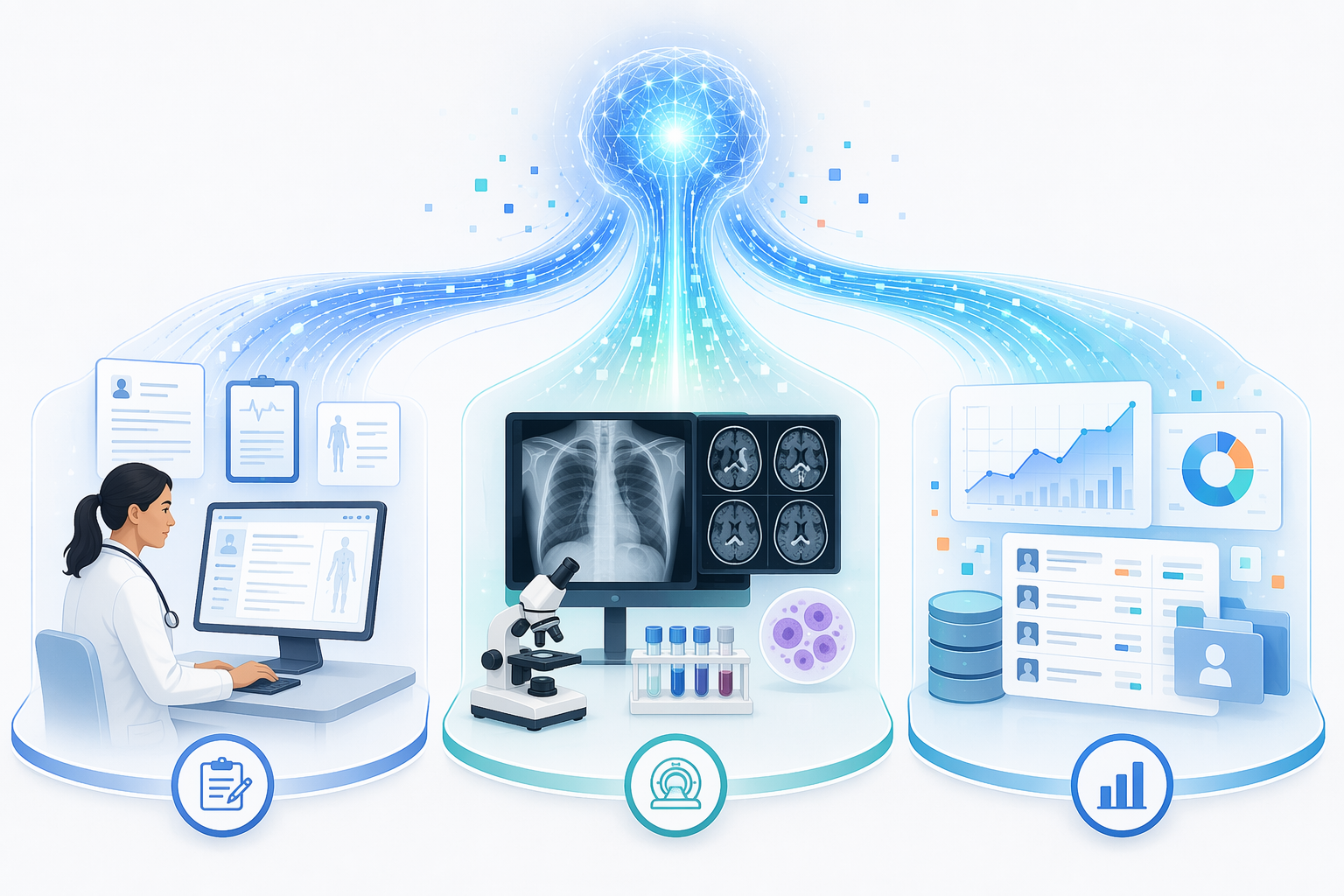
Clinical Documentation
Ambient documentation and summarization tools are among the easiest healthcare AI use cases for markets to understand. The workflow is visible, the labor burden is widely recognized, and the buyer pain is acute. A tool that drafts notes, extracts encounter details, or prepares referral summaries does not have to diagnose a patient to affect staffing models, physician productivity expectations, or the perceived value of legacy documentation services.
The operational caveat is significant. Clinical notes are not generic meeting minutes. They feed coding, liability defense, continuity of care, quality measurement, and payer review. A system that saves time but introduces subtle omissions can create downstream risk. That is why adoption may be slower and more supervised than a market selloff implies. Still, the stock market is now willing to price the direction of travel before the workflow has fully changed.
Diagnostic and Triage Workflows
Diagnostic AI carries a different kind of disruption signal. It is not just about labor substitution; it is about where judgment enters the workflow. If AI can pre-read images, surface likely conditions, prioritize cases, or standardize triage recommendations, then the affected economics may include throughput, referral patterns, specialist demand, malpractice exposure, and vendor positioning inside the clinical stack.
That does not make diagnostic services instantly replaceable. The more clinical the decision, the heavier the requirements for validation, accountability, integration, and trust. But investors do not need full autonomy to worry about repricing. They can sell when they believe a workflow’s control point may shift from a service organization to a software-enabled platform.
Health Data Analytics and Payer Administration
The payer side gives the market a more concrete cost story. McKinsey estimates cited by U.S. Bank suggest that, for every $10 billion in revenue, AI could help health insurers save $150 million to $300 million in administrative costs and up to $970 million in medical costs.[3] These are estimates, not guaranteed margin expansion. They are still large enough to explain why the market pays attention.
Administrative savings could come from fewer manual touches in claims, call centers, document intake, coding review, provider communications, and compliance workflows. Medical-cost savings are more complicated because they depend on whether AI improves care management, utilization decisions, and intervention timing without creating new denial, quality, or member-experience problems. A spreadsheet can capitalize those savings quickly; a payer has to earn them through operations.
| Healthcare workflow | Why markets see AI exposure | Why implementation remains slower than repricing |
|---|---|---|
| Clinical documentation | Large volume of summarization, note drafting, coding support, and administrative review | Clinical liability, EHR integration, physician acceptance, and downstream billing risk |
| Diagnostic support | Potential to change triage, image review, case prioritization, and specialist workflow | Validation burden, accountability, regulatory oversight, and trust requirements |
| Health data analytics | AI can classify records, summarize populations, identify risk, and support care management | Messy data, fragmented systems, bias concerns, and unclear accountability |
| Payer administration | Claims, utilization review, prior authorization, and member service contain repetitive knowledge work | Regulatory scrutiny, provider abrasion, appeals, and member-experience consequences |
The Market Is Pricing Possibility Before Proof
One mistake to avoid is treating the February selloff as evidence that generative AI is already transforming healthcare earnings at scale. The LSEG data supports a narrower conclusion: medical services were caught in an AI-driven disruption repricing event.[1] That is different from proving that AI adoption has already reduced provider headcount, compressed payer costs, or displaced incumbent service vendors.
Morgan Stanley’s March 2026 discussion of market dissonance helps explain the gap. Investors are simultaneously treating AI as a powerful productivity force and as an uncertain disruption risk.[4] In healthcare, that dissonance is especially sharp. The same AI capability can look bullish for a payer trying to reduce administrative cost, bearish for a service vendor selling labor-intensive workflow support, and ambiguous for a provider that must absorb implementation risk before realizing benefits.
This is why healthcare AI stocks and AI-exposed healthcare services can move on signals that do not originate in healthcare. A new model release, enterprise automation demo, or benchmark improvement may cause investors to revisit which companies own workflow data, which rely on billable labor, which have integration leverage, and which could be squeezed by faster-moving software platforms.
Why the Reaction Can Move Faster Than Healthcare Itself
Healthcare executives often respond to AI disruption fears by pointing to the adoption drag: procurement cycles, security reviews, clinical governance committees, pilots, change management, and reimbursement uncertainty. Those are real frictions. They do not prevent fast market reactions because trading systems respond to signals before hospital committees finish evaluating them.
LSE Research reported in September 2025 that 60% to 70% of trades are now algorithmic.[5] That does not mean algorithms caused the February healthcare move, and it should not be used as a catch-all explanation for every selloff. It does help explain why sentiment shocks can propagate rapidly once market participants connect a new AI capability to a set of exposed sectors.
The practical consequence is uncomfortable for health-system strategists. A hospital may take a year to decide whether an AI documentation tool is safe and useful. A public-market investor may take minutes to decide that documentation-heavy services deserve a lower multiple. The two timelines are not aligned, but they now interact.
How Healthcare AI Investors Should Read the Signal
The February evidence does not support indiscriminate pessimism toward healthcare services. It supports a more specific investment discipline: separate companies with AI-exposed labor economics from companies with defensible data access, workflow integration, clinical trust, and measurable implementation evidence.
A health AI vendor with strong demos but weak deployment evidence should not be valued as though savings are already captured. A services incumbent with complex clinical operations should not be assumed safe simply because its work is regulated. The question is where the value is created and who controls the workflow when AI lowers the cost of producing notes, recommendations, summaries, reviews, and analytics.
- Track AI capability releases outside healthcare when they affect summarization, reasoning, coding, image interpretation, document review, or agentic workflow execution.
- Map revenue exposure to labor-intensive clinical, administrative, payer, and analytics workflows rather than relying on broad healthcare sector labels.
- Distinguish announced pilots from scaled implementation, contracted savings, clinician adoption, and audited operating results.
- Watch whether AI vendors are selling point tools, embedded workflow infrastructure, or decision-support systems that alter bargaining power.
- Treat regulatory and integration friction as timing variables, not as permanent immunity from disruption.
Diversification also deserves a more practical role than it often receives in AI discussions. Goldman Sachs argued in December 2025 that, when AI and tech jitters hit U.S. markets, emerging markets declined less than the S&P 500 on average.[6] That point is not healthcare-specific, and it should not be stretched into a guarantee. It does suggest that investors with healthcare AI exposure may want to think about geography as well as subsector, especially when U.S. market sentiment is tightly linked to a small group of AI narratives.
What Health Systems Should Take From a Market Selloff
For health systems, the market signal is not a directive to chase every AI tool. It is a warning that capital partners, vendors, payers, and competitors may change behavior as AI disruption risk gets repriced. Procurement budgets can tighten. Venture-backed vendors can face funding pressure. Strategic partnerships can be renegotiated around automation roadmaps. A selloff that begins as market sentiment can eventually shape the operating choices available to a hospital.
The most useful response is to inventory workflow exposure. Which documentation tasks are already semi-structured? Which prior authorization or claims processes depend on repetitive review? Which analytics contracts are selling outputs that generative AI may make cheaper to produce? Which AI tools are close enough to clinical decisions that governance, validation, and liability will slow adoption? These questions connect market volatility to mechanisms rather than headlines.
Healthcare AI exposure now carries both repricing risk and adoption upside. The February 2026 selloff did not prove that medical services are broken. It proved that investors are willing to pull healthcare into AI disruption trades when the workflow logic is plausible. That is enough to change how healthcare leaders should monitor model releases, vendor durability, implementation evidence, and the assumption that healthcare remains a defensive shelter from AI volatility.
References
- The US market’s take on AI disruption, LSEG/FTSE Russell, link
- AI Morphs Into Villain of the Stock Market It Powered for Years, Bloomberg, February 13, 2026, link
- Healthcare stocks: Positioned for performance?, U.S. Bank, February 2026, link
- AI Disruption Fears and the Stock Market in 2026, Morgan Stanley, March 2026, link
- AI and the stock market, LSE Research, September 2025, link
- Emerging markets stocks can balance volatility from the AI trade, Goldman Sachs, December 2025, link
Comments
Join the discussion with an anonymous comment.