
The most important fact about using AI to track public figures' health is not that someone could invent a sinister new surveillance system from scratch. It is that much of the sensing layer already exists in ordinary, consent-based products. A phone camera, tablet, laptop webcam, or embedded camera can now support contactless health screening workflows that estimate vital signs from facial video, often in less time than it takes to answer a telehealth intake question.
Shen AI, for example, describes an SDK that uses a 30-second facial scan to process more than 30 health markers, with on-device processing and no cloud dependency in its product architecture.[1] The underlying method, remote photoplethysmography, or rPPG, is not marketing fiction. It is a camera-based technique that estimates physiological signals from subtle color changes in skin associated with blood volume variation, and independent reviews describe its use for heart rate, respiratory rate, oxygen saturation, and blood pressure estimation under defined capture conditions.[2]
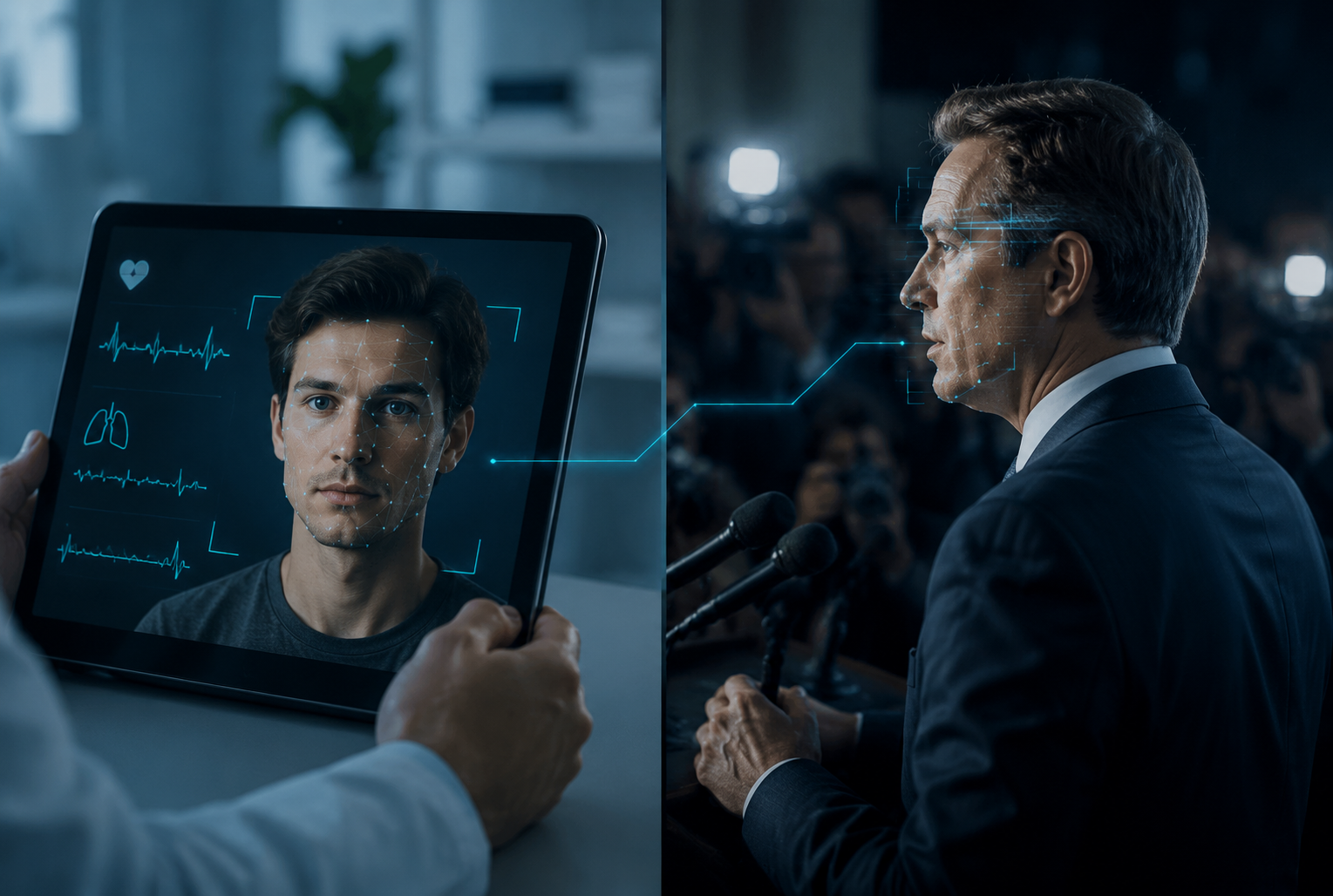
That benign starting point matters. In a clinic, telehealth visit, employee wellness program, or insurer-supported screening flow, the camera is supposed to be pointed at a person who knows why the scan is happening. The vendor language around privacy usually assumes that context: the scan is initiated by the user, the interface tells the user what is being measured, and the deployment has some relationship to care, wellness, or risk screening.
The dual-use problem begins when the same technical pathway is separated from that setting. Consent is not a feature embedded in an rPPG model. It is a condition created by the workflow around the camera, the interface, the data controller, and the person being scanned.
The sensing layer is already productized
The market has moved beyond isolated demos. FaceHeart says its SDK can be integrated into smartphones, tablets, computers, smart home devices, and embedded boards, and describes a 30–150 cm capture range for measuring physiological signals from a face.[3] That range is not exotic. It is the distance of a laptop interview, a seated television appearance, a podium camera, a smartphone held by a staffer, or a mounted device in a reception area.
FaceHeart also has two FDA 510(k) clearances: K223622 for heart rate and K243966 for respiratory rate, both as Class II software as a medical device.[3] Those clearances are significant, but they should be read literally. They support use within the cleared indications and conditions; they do not certify the broader idea that any face appearing in any video can be reliably converted into a medical signal.
IntelliProve similarly presents camera-based health measurements for integration into insurer, telehealth, and wellness workflows, and reports a 20% user engagement increase within three months in consented wellness deployments.[4] The engagement claim is useful mainly as a market signal: these tools are being packaged for routine digital workflows, not just shown at conferences.
| Capability | What the cited material supports | What it does not support |
|---|---|---|
| rPPG vital-sign estimation | Camera-based estimation of signals such as heart rate, respiratory rate, oxygen saturation, and blood pressure under defined capture conditions | Reliable diagnosis from arbitrary public footage |
| SDK integration | Deployment into common devices such as phones, tablets, computers, smart home devices, and embedded boards | A guarantee that every deployment is consented or clinically governed |
| FDA-cleared functions | Specific cleared heart-rate and respiratory-rate software functions within intended use | Regulatory approval for passive analysis of non-consenting public figures |
This is the first preparedness issue for healthcare organizations evaluating such tools. A vendor may build a product for legitimate screening. A health system may deploy it carefully. An insurer may use it in an opt-in wellness flow. Yet the same architecture — camera input, face detection, physiological signal extraction, model output — can be copied, licensed, wrapped, or approximated by another actor with very different incentives.
Public video supplies more than a face
Public figures generate an unusually rich stream of health-adjacent data. They appear under bright lights. They speak into fixed cameras. They sit for long interviews. They walk across stages. They gesture, pause, blink, smile, read prepared remarks, and answer questions while multiple cameras record them. For elected officials, executives, athletes, entertainers, and institutional leaders, being visible is part of the job.
That visibility is why the risk is not limited to pulse estimation. A comprehensive 2025 review in Patterns catalogued AI facial analysis across eight disease categories and reported performance figures for several conditions with visible facial manifestations, including 88% accuracy across 128 genetic diseases, 96% sensitivity and 96% specificity for acromegaly, an AUC of 0.96 for Cushing's syndrome, 80% sensitivity for coronary artery disease, an AUC of 0.84 for anemia, and AUC values from 0.85 to 0.99 for ophthalmic diseases.[5]
Those figures do not mean a pundit can diagnose a senator from a cable-news clip. They do mean that standard images and video frames can contain medically relevant facial information when the task, dataset, labeling, and model are structured for that purpose. The capability argument is strongest when kept this narrow: certain disease markers have been detected from facial imagery in research settings, and public figures create a large supply of facial imagery.
Movement and speech add another layer. A validation study of the PARK tool, currently available as a preprint, reported 80.2–80.6% accuracy and AUROC values of 0.85–0.87 for Parkinson's disease screening across 1,865 participants using standard webcam video of speech, facial expression, and finger tapping. The same study reported 83.7% agreement with ground truth and 86.7% sensitivity.[6]
The PARK study deserves both attention and caution. It has not completed peer review, and it used structured tasks rather than incidental news footage. Still, its input modality is ordinary video, not a specialized medical scanner. Public appearances routinely contain fragments of speech, facial expression, and hand movement. They do not reproduce the study protocol, but they make the idea of video-based neurological inference commercially and operationally relevant.
The weak point is not capability; it is context
A responsible analysis has to separate three claims that are often collapsed. First, rPPG and facial analysis can extract health-related signals from images or video under defined conditions. Second, commercial SDKs are available for integration into ordinary digital devices. Third, public footage of a non-consenting person can be used to make reliable medical conclusions about that individual. The first two claims are well supported. The third is where evidence thins out.
No peer-reviewed study in the supplied research examined the specific use case of applying these tools to public figures. The pathway is inferred from validated and commercial components: contactless vital-sign extraction, facial disease-marker detection, video-based neurological screening, SDK integration, and abundant public video. That is enough to define a plausible dual-use pathway. It is not enough to endorse armchair diagnosis.
Uncontrolled footage introduces predictable technical problems. Lighting changes across a stage. Video compression alters color signals. Makeup, skin tone, camera angle, head movement, distance, frame rate, and broadcast processing can all interfere with rPPG. A public figure may be exhausted, medicated, stressed, jet-lagged, dehydrated, or simply squinting into lights. A model may still output a number; the harder question is what confidence anyone should assign to it.
The same caution applies to disease markers. A facial phenotype model trained for a clinical or curated photographic task is not automatically a population-scale public-screening instrument. A neurological model tested on webcam tasks is not automatically validated for podium footage. The industry risk is therefore not that every inference will be correct. It is that some actors will treat model outputs as publishable intelligence, opposition research, trading signals, employment risk indicators, or reputational weapons before reliability, consent, and accountability have been settled.
Why existing governance does not neatly catch the repurposing
Medical-device regulation is the easiest mismatch to see. FDA clearance can evaluate a software function for an intended clinical use. It does not, by itself, police every later attempt by a third party to run a similar algorithm against public video. FaceHeart's cleared heart-rate and respiratory-rate functions therefore tell us something important about maturity inside a regulated use case, but they do not close the passive surveillance question outside that use case.[3]
Privacy law has a different boundary problem. The GDPR treats health data and biometric data as special categories of personal data, and its protections are powerful when a regulated actor is processing identifiable data within its scope.[7] But passive health inference from public video can be fragmented across jurisdictions, actors, and data types: one party collects the footage, another extracts signals, a third aggregates outputs, and a fourth draws conclusions. The harm can occur before the resulting profile looks like a conventional medical record.
The EU AI Act also leaves room for classification uncertainty. The 2024 regulation addresses biometric identification and places limits on certain emotion-recognition uses, while also treating medical AI through other product-safety and high-risk pathways.[8] Passive health inference from public video sits awkwardly among these categories. It may not be trying to identify a person; the person may already be publicly known. It may not be framed as emotion recognition. And if the actor presents the output as wellness, risk scoring, intelligence, or media analysis rather than diagnosis, the regulatory hook may become less direct.
This is not an argument that no law applies. It is an argument that the market architecture is moving faster than the categories most organizations use when they review camera-based health AI. A procurement checklist that asks whether a device has FDA clearance, whether processing is on-device, and whether the user accepts a consent screen may miss the more uncomfortable question: what prevents the same sensing capability from being aimed at someone who never entered the workflow?
The surveillance mechanism is familiar
Muller and colleagues' 2025 framework for health data-AI surveillance gives useful language for this problem without requiring a leap into science fiction. The framework identifies five challenges: pervasiveness and unobtrusiveness, hypercollection and function creep, hypervisibility and profiling, informational power, and surveillant assemblage formation.[9]
Each element maps cleanly onto contactless health inference. The collection can be unobtrusive because a public figure is already being filmed. Function creep appears when video recorded for news, investor relations, sports coverage, or entertainment is reused for health analysis. Profiling emerges when scattered measurements are turned into a longitudinal story about stamina, cognitive status, cardiovascular risk, or disease progression. Informational power shifts toward whoever can collect, process, and interpret the signals at scale.
The assemblage is the part healthcare organizations should take most seriously. No single actor has to build a complete surveillance stack. Public footage platforms, clipping services, SDK vendors, open-source models, analytics firms, political consultants, employers, insurers, investors, media outlets, and social-media accounts can each contribute one piece. The final profile may feel ownerless, even though it can damage a person's career, negotiating position, public legitimacy, or safety.
Public figures are especially exposed because opting out of visibility is rarely realistic. A hospital CEO addressing staff after a cyberattack, a central-bank official at a hearing, a candidate at a debate, a professional athlete in a postgame interview, and an actor on a press tour all supply high-resolution behavioral and facial data as a condition of their role. Their bodies become unofficial data sources for audiences they did not choose.
What preparedness would have to cover
For healthcare AI vendors, the narrow response is no longer enough. Saying that a product is designed for consented use, processes data on-device, or does not store video may be true and still incomplete. The dual-use question is whether licensing terms, technical controls, audit rights, customer screening, watermarking, rate limits, and misuse reporting address analysis of non-consenting people in public or semi-public footage.
For deployers, the relevant review should not stop at the approved workflow. A health system or insurer adopting camera-based screening needs to understand where the SDK can run, whether outputs can be exported, whether raw or derived signals are retained, and whether the same vendor supports non-clinical verticals with looser oversight. A technically elegant screening tool can still create reputational exposure if its broader ecosystem enables passive inference.
For regulators and standards bodies, the missing category is not simply “AI in healthcare.” It is health inference about an identifiable person who did not seek care, did not initiate a scan, and may not know that public media is being processed for physiological or disease-related signals. That scenario does not fit comfortably into the usual boxes of medical-device authorization, patient privacy, biometric identification, or consumer wellness.
There are reasonable safeguards that do not require treating the technology as forbidden. Vendors can prohibit non-consensual public-person analysis in acceptable-use policies. Enterprise contracts can bar repurposing of camera inputs outside disclosed workflows. Model cards and validation summaries can state the capture conditions under which performance claims apply. Procurement teams can ask whether products include misuse detection and customer termination rights. Regulators can clarify when passive health inference from public video becomes a regulated health, biometric, or high-risk AI activity.
None of those steps will stop every misuse. They would, however, make it harder for the industry to keep pretending that the only relevant user is the consenting person holding the phone.
The real risk is premature certainty
The weakest version of this debate turns public figures into diagnostic guessing games. That is bad medicine and poor intelligence. A tremor in a compressed video clip, a flushed face under stage lighting, or a high estimated heart rate during a hostile interview is not a diagnosis. It may not even be a stable measurement.
The stronger claim is more limited and more consequential. Contactless health AI has a validated and commercial base in consented settings. Facial, physiological, speech, and movement signals can carry health-relevant information. Public figures produce unusually abundant video data. Current governance frameworks do not explicitly settle the passive inference pathway from public media to health profile. That is enough for healthcare AI vendors, deployers, and regulators to treat the issue as an industry preparedness gap rather than a celebrity privacy anecdote.
References
- What Is rPPG?, Shen AI.
- Remote photoplethysmography for contactless monitoring of vital signs: A review, National Library of Medicine.
- FaceHeart Vitals SDK, FaceHeart.
- IntelliProve, IntelliProve.
- A comprehensive review of artificial intelligence in facial disease detection, Patterns, 2025.
- PARK: Parkinson's Analysis with Remote Kinetics, National Library of Medicine.
- Regulation (EU) 2016/679, General Data Protection Regulation, EUR-Lex, 2016.
- Regulation (EU) 2024/1689 laying down harmonised rules on artificial intelligence, EUR-Lex, 2024.
- Health data-AI surveillance: A framework for understanding the challenges, PLOS Digital Health, 2025.
Comments
Join the discussion with an anonymous comment.