
Executive Summary: Key Statistics at a Glance
Artificial intelligence in healthcare has crossed a threshold. It is no longer a pilot project or a speculative investment for most U.S. health systems — it is operational infrastructure. The data from 2025 and early 2026 paints a clear picture: adoption is broad, spending is accelerating, and the regulatory pipeline is full. But the same data also reveals a persistent gap between surface-level deployment and deep clinical integration.
This article compiles and cross-references more than 100 data points from primary surveys, FDA regulatory databases, peer-reviewed studies, and industry analyses. The goal is a single, evidence-grounded reference for healthcare executives, health IT leaders, policy analysts, and market researchers who need to understand where AI in healthcare stands — and where the real opportunities and risks remain.
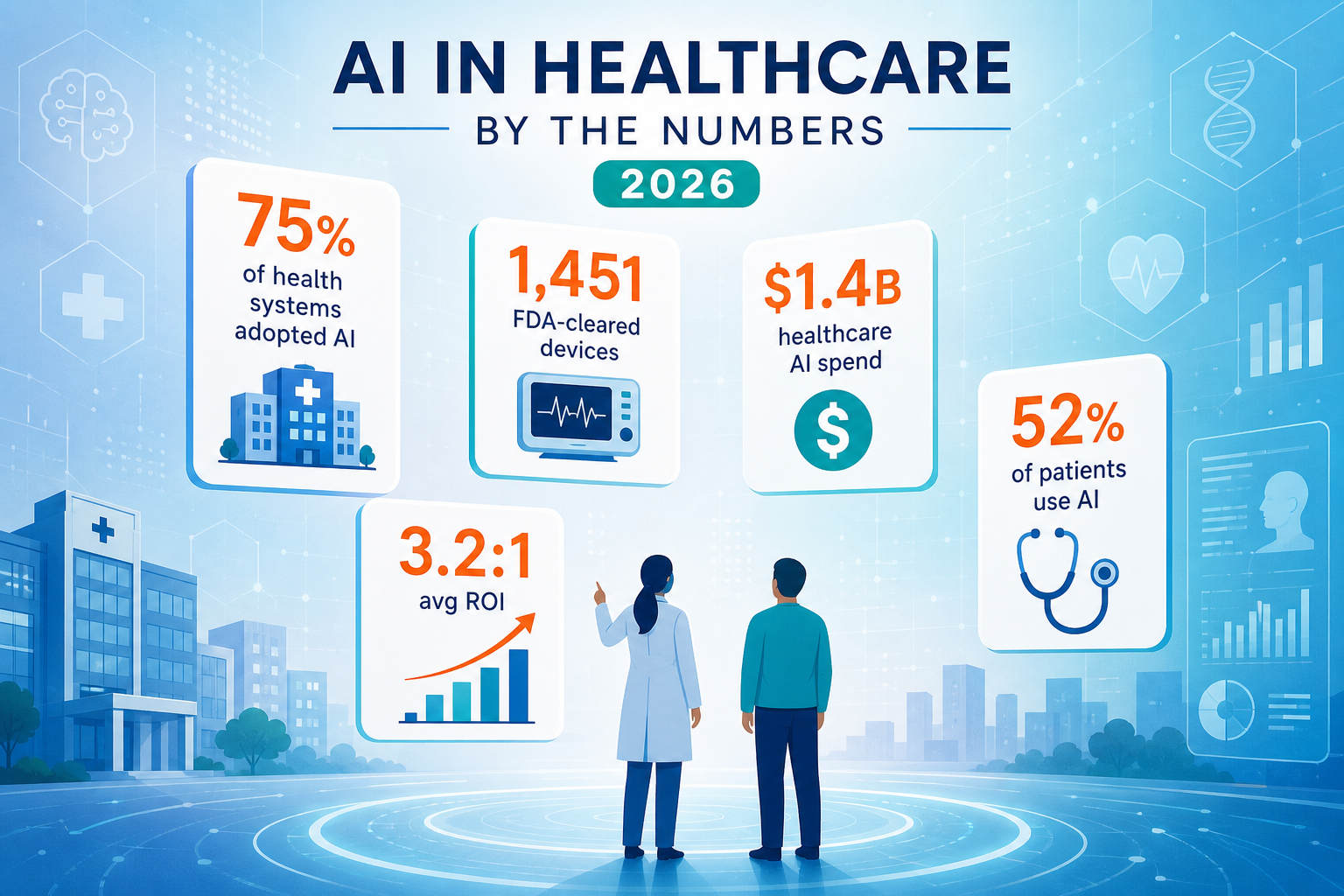
- Hospital adoption: Approximately 80% of U.S. hospitals report using AI in at least one clinical or operational function. However, only 18% of organizations are ready to deploy AI in direct care delivery.
- FDA device landscape: 1,451 AI-enabled medical devices have been authorized by the FDA through the end of 2025, with 76% concentrated in radiology. A record 295 devices were cleared in 2025 alone.
- Market spending: Healthcare AI spending hit $1.4 billion in 2025, nearly tripling the previous year. An estimated 85% of generative AI spend flows to startups.
- Clinician adoption: 66% of U.S. physicians used health AI in 2024, up from 38% in 2023 — a 78% relative increase. 70% of healthcare organizations report actively using AI, up from 63% in 2024.
- Patient engagement: 52% of patients now use AI to research health conditions, and 74% trust AI-generated health answers. However, 78% expect their doctor to validate that information.
- ROI: The average reported ROI on healthcare AI investments is 3.2:1, with 59-71% of implementers reporting 2x or greater returns. Ambient documentation tools reduce charting time by 40-45%.
- Diagnostic accuracy: Narrow AI achieves 96% accuracy in bounded tasks like diabetic retinopathy detection. In contrast, generative AI models average approximately 50% diagnostic accuracy in meta-analyses.
- Risk and bias: Shadow AI is present in 40% of hospitals. A systematic review of 30 studies found AI utilization significantly associated with exacerbation of racial disparities. 60 authorized AI devices have been linked to 182 recall events.
Market Size & Growth Forecasts
The healthcare AI market is expanding rapidly, but precise sizing depends heavily on how analysts define the category. Estimates vary by a factor of two or more across research firms, making source attribution essential.
According to the Menlo Ventures 2025 survey of 700+ healthcare executives, healthcare AI spending reached $1.4 billion in 2025, nearly tripling the 2024 figure. This spending is concentrated in a few high-growth categories: ambient clinical documentation leads at $600 million, followed by coding and billing automation at $450 million. Patient engagement AI grew 20x year over year, and prior authorization AI grew 10x.
The broader healthcare analytics market — which includes AI but also traditional business intelligence and reporting tools — was valued at $53-64 billion in 2025, with projections reaching $166-370 billion by 2030, depending on the source. McKinsey estimates that AI could increase healthcare productivity by 1.8% to 3.2% annually, equivalent to $150-260 billion per year.
| Metric | Value | Source |
|---|---|---|
| Healthcare AI spending (2025) | $1.4 billion | Menlo Ventures |
| Ambient clinical documentation spend | $600 million | Menlo Ventures |
| Coding and billing automation spend | $450 million | Menlo Ventures |
| Healthcare analytics market (2025) | $53-64 billion | Knowi / multiple |
| Projected analytics market (2030) | $166-370 billion | Knowi / multiple |
| Potential annual AI productivity savings | $150-260 billion | McKinsey / Harvard |
Hospital & Health System Adoption Rates
Adoption of AI across U.S. hospitals and health systems has reached a clear majority, but the depth of integration varies dramatically by institution size, geography, and affiliation.
The Eliciting Insights survey of 120 health systems, conducted in February 2026, found that 75% have deployed at least one AI solution, up from 59% in 2025. Multi-solution adoption — defined as three or more tools — grew 67% year-over-year to 59%. The American Hospital Association (AHA) data cited by Jonathan Govette shows that 81% of urban hospitals use predictive AI, compared to only 56% of rural and critical access hospitals. The gap is even wider by affiliation: 86% of health system-affiliated hospitals use predictive AI versus 37% of independent facilities.
Year-over-year implementation growth in specific categories is striking. Clinical note-taking and ambient listening jumped 62% to 68% adoption. AI-based clinical documentation improvement (CDI) grew 59% to 43%. Patient text draft replies grew 80% to 36%. However, revenue cycle management (RCM) AI remains below 30% implementation, with 34-45% of organizations 'actively considering' it. Sub-100 bed systems show near-zero RCM AI adoption.
| Segment | AI Adoption Rate | Source |
|---|---|---|
| Health systems (any AI solution) | 75% | Eliciting Insights (Feb 2026) |
| Urban hospitals (predictive AI) | 81% | ASTP/AHA |
| Rural / critical access hospitals | 56% | ASTP/AHA |
| Health system-affiliated hospitals | 86% | ASTP/AHA |
| Independent hospitals | 37% | ASTP/AHA |
| Multi-solution adoption (3+ tools) | 59% | Eliciting Insights |
| Ready to deploy in care delivery | 18% | HIMSS |
Clinician Adoption and Patient Usage
Clinician adoption of AI has accelerated sharply. The American Medical Association (AMA) data, cited in the Menlo Ventures report, shows that 66% of U.S. physicians used health AI in 2024, up from 38% in 2023 — a 78% relative increase. The NVIDIA 2026 survey of healthcare executives reports that 70% of respondents said their organizations are actively using AI, up from 63% in 2024. 85% of executives said AI is helping increase revenue, and 80% said it is helping reduce costs.
On the patient side, the Wolters Kluwer 2026 Future Ready Healthcare survey found that 52% of patients now use AI to research health conditions or diagnoses. 74% of patients are confident that AI-generated health answers are accurate. However, 78% of patients expect doctors to validate AI-derived information, and 60% of clinicians report spending appointment time reviewing AI-generated health information that patients bring in. 77% of clinicians validate AI-generated outputs before acting on them.
| Stakeholder | Statistic | Source |
|---|---|---|
| Physicians using health AI (2024) | 66% (up from 38% in 2023) | AMA / Menlo Ventures |
| Organizations actively using AI (2026) | 70% (up from 63% in 2024) | NVIDIA |
| Executives saying AI increases revenue | 85% | NVIDIA |
| Executives saying AI reduces costs | 80% | NVIDIA |
| Patients using AI for health research | 52% | Wolters Kluwer |
| Patients trusting AI health answers | 74% | Wolters Kluwer |
| Patients expecting doctor validation | 78% | Wolters Kluwer |
| Clinicians validating AI outputs | 77% | Wolters Kluwer |
FDA Regulatory Landscape: Device Clearances and Specialty Concentration
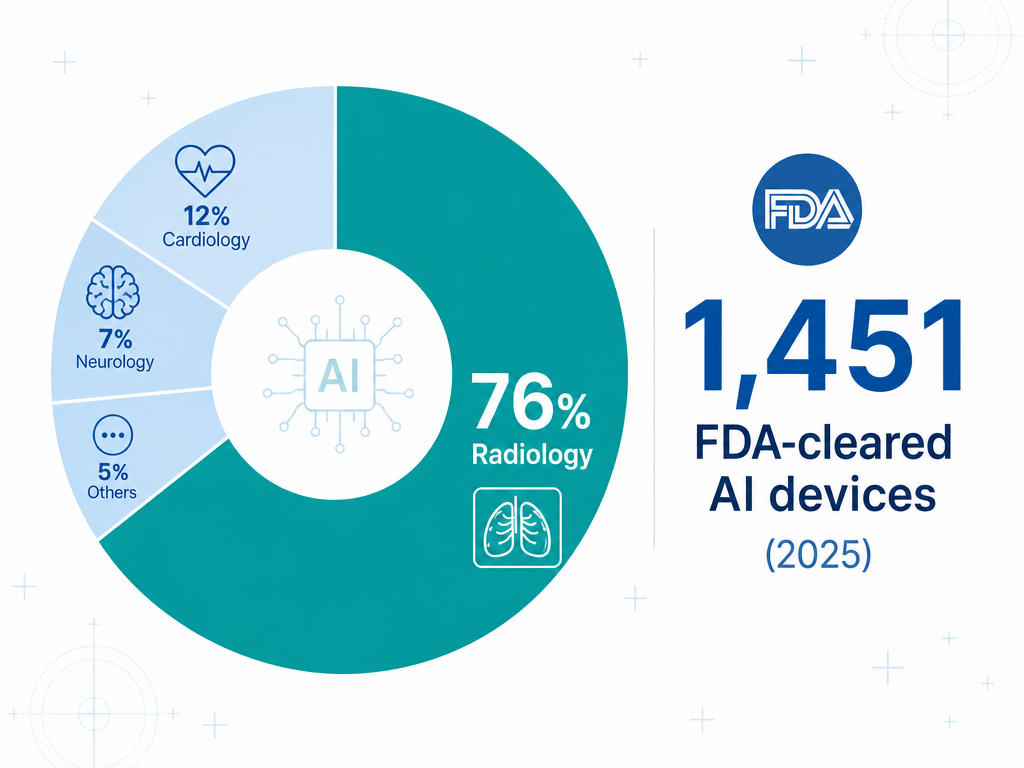
The FDA's list of AI-enabled medical devices, updated through the end of 2025, shows cumulative authorizations of 1,451 devices since 1995. Of these, 1,104 — or 76% — are in radiology. The pace of clearance is accelerating: 295 devices were authorized in 2025, a record, up from 253 in 2024 and 221 in 2023.
The Innolitics 2025 year-in-review analysis of all 295 AI/ML 510(k) clearances provides additional detail: 62% of clearances were for Software as a Medical Device (SaMD), 63% were diagnostic, and 10% (30 devices) were authorized with Predetermined Change Control Plans (PCCPs). The median clearance time was 142 days, with 24% cleared in under 90 days. Radiology dominated at 71.5% of clearances (211), followed by cardiovascular at 8.8% (26) and neurology at 4.7% (14). Shanghai United Imaging led all manufacturers with 10 clearances, while 183 manufacturers had single clearances.
Among companies with the most cumulative radiology AI authorizations, GE HealthCare leads with 120 (including acquisitions), followed by Siemens Healthineers at 89, Philips at 50, Canon at 45, United Imaging at 38, Aidoc at 31, and DeepHealth at 28.
| Metric | Value | Source |
|---|---|---|
| Cumulative FDA-authorized AI devices (end 2025) | 1,451 | FDA / Imaging Wire |
| Radiology share | 76% (1,104 devices) | FDA / Imaging Wire |
| 2025 clearances (record) | 295 | Innolitics |
| 2024 clearances | 253 | Innolitics |
| 2023 clearances | 221 | Innolitics |
| Devices cleared via 510(k) pathway | 97% | Jonathan Govette / FDA |
| Devices authorized with PCCPs (2025) | 30 (10%) | Innolitics |
| Median clearance time (2025) | 142 days | Innolitics |
Clinical Diagnostic Accuracy: Narrow AI vs. Generative AI
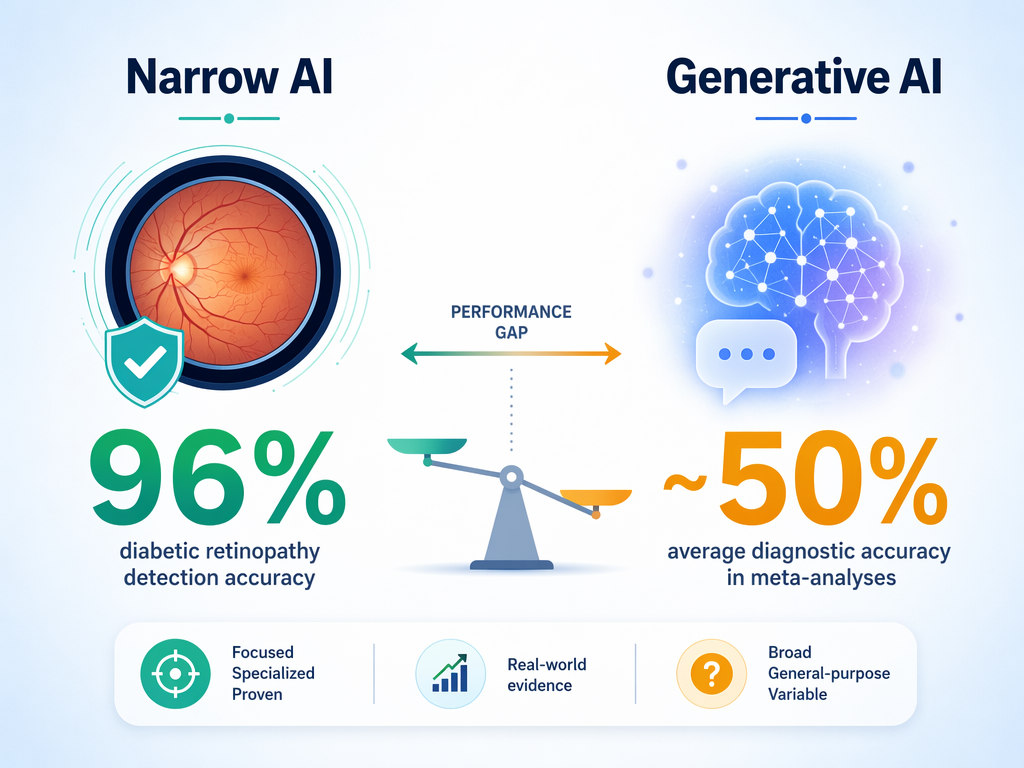
The performance of AI in clinical diagnostics depends critically on the scope of the task. Narrow AI models trained on bounded, well-defined tasks have demonstrated high accuracy. For example, AI systems for diabetic retinopathy detection achieve approximately 96% accuracy. Breast cancer detection AI models report 90-92% sensitivity in screening mammography.
Generative AI models — including large language models (LLMs) used for clinical reasoning — perform substantially worse on diagnostic tasks. A 2024 meta-analysis (PMC11702416) found that generative AI models average approximately 50% diagnostic accuracy. This gap is not surprising: narrow AI operates within constrained input and output spaces, while generative AI attempts open-ended clinical reasoning without the safeguards of task-specific training.
| AI Type | Task | Accuracy | Source |
|---|---|---|---|
| Narrow AI (deep learning) | Diabetic retinopathy detection | ~96% | Uvik / multiple studies |
| Narrow AI (deep learning) | Breast cancer screening sensitivity | 90-92% | Uvik / multiple studies |
| Generative AI (LLMs) | General diagnostic accuracy (meta-analysis) | ~50% | PMC11702416 (2024) |
Documentation & Workflow Impact
Administrative burden remains one of the most painful and costly problems in U.S. healthcare. AI-powered ambient documentation and clinical note-taking tools have emerged as the most impactful category for reducing that burden.
Ambient AI scribes reduce physician documentation time by 40-45%, according to multiple sources. The Menlo Ventures survey identifies ambient clinical documentation as the largest AI category by spending at $600 million in 2025. The Eliciting Insights survey confirms that clinical note-taking and ambient listening adoption grew 62% year-over-year to 68% of health systems.
Beyond documentation, AI-based clinical documentation improvement (CDI) saw 59% year-over-year implementation growth to 43% adoption. AI for denial prediction in revenue cycle management shows 70% of implementers reporting 2x+ ROI, with 43% reporting 3x+. However, overall RCM AI implementation remains below 30%, indicating substantial whitespace.
| Application | Impact | Source |
|---|---|---|
| Ambient AI scribes | 40-45% reduction in charting time | Uvik / multiple |
| Clinical note-taking / ambient listening | 62% YoY adoption growth (to 68%) | Eliciting Insights |
| AI-based CDI | 59% YoY adoption growth (to 43%) | Eliciting Insights |
| Denial prediction AI | 70% of implementers report 2x+ ROI | Eliciting Insights |
| RCM AI overall | Below 30% implementation; 34-45% considering | Eliciting Insights |
ROI & Financial Impact
Return on investment is the central question for health system executives evaluating AI purchases. The available data — while largely from industry surveys and vendor-adjacent sources — consistently points to positive returns for well-implemented AI tools.
The average ROI on healthcare AI investments is 3.2:1, typically realized within 14 months, according to Demand Sage data cited by Productive Edge. The average ROI from advanced analytics is 147% within three years, per NumberAnalytics data cited by Knowi. The Eliciting Insights survey of 120 health systems found that 71% of CDI implementers report 2x+ ROI (42% report 3x+), and 70% of denial prediction implementers report 2x+ (43% report 3x+).
Longer-term case studies show even more dramatic returns. Mayo Clinic's radiology AI deployment achieved a 280% cumulative five-year ROI, despite a negative first-year return. Radiology AI projects in academic settings project 451% ROI over five years. On the cost side, McKinsey estimates that AI could save the U.S. healthcare system $200-360 billion annually, and 86-90% of claim denials — a major source of revenue leakage — are avoidable.
| ROI Metric | Value | Source |
|---|---|---|
| Average ROI per $1 invested | $3.20 (within 14 months) | Demand Sage / Productive Edge |
| Average analytics ROI (3 years) | 147% | NumberAnalytics / Knowi |
| CDI implementers reporting 2x+ ROI | 71% | Eliciting Insights |
| Denial prediction 2x+ ROI | 70% | Eliciting Insights |
| Mayo Clinic radiology AI (5-year cumulative) | 280% | Thinking Inc / Productive Edge |
| Radiology AI academic projects (5-year) | 451% | Jonathan Govette |
| Potential annual AI savings (U.S. healthcare) | $200-360 billion | McKinsey / Harvard |
Generative AI in Healthcare: Adoption, Use Cases, and Limitations
Generative AI and large language models (LLMs) have entered healthcare at remarkable speed. The NVIDIA 2026 survey found that 69% of healthcare organizations are using generative AI or LLMs, up from 54% in 2024. 85% of respondents said AI budgets would increase. For payers and providers, 39% cited administrative tasks and workflow optimization as the top ROI area for generative AI.
The Menlo Ventures data shows that 85% of generative AI spend flows to startups rather than incumbent vendors. Ambient clinical documentation is the largest generative AI category at $600 million in spending. Patient engagement AI — much of it powered by LLMs — grew 20x year over year.
However, the limitations of generative AI in clinical settings are substantial. The meta-analysis showing ~50% diagnostic accuracy for generative AI models raises serious questions about their readiness for autonomous clinical use. Hallucination risk — where models generate plausible but factually incorrect information — remains a documented concern. 45% of healthcare organizations using generative AI achieved measurable ROI within 12 months, according to Vention Teams data cited by Productive Edge, meaning a majority have not yet seen returns.
- Top use cases: Ambient clinical documentation, patient messaging draft replies, clinical decision support summarization, prior authorization letter generation, and patient education content.
- Key limitations: Hallucination risk, ~50% average diagnostic accuracy in meta-analyses, lack of consistent clinical validation standards, and the need for human-in-the-loop oversight.
- Governance gap: 63% of organizations have no AI governance policies, according to Productive Edge. Shadow AI — the use of unauthorized AI tools by employees — is present in 40% of hospitals.
Patient Engagement & Consumer Adoption
Patients are adopting AI for health purposes faster than many healthcare organizations anticipated. The Wolters Kluwer 2026 survey found that 52% of patients use AI to research health conditions or diagnoses. 32% of U.S. adults use AI chatbots specifically for health information, according to KFF data. OpenAI reports that 40 million people globally turn to ChatGPT daily for health information, with users asking 1.6-1.9 million questions per week on insurance and billing topics.
Trust levels are mixed. While 74% of patients are confident that AI-generated health answers are accurate, 67% of U.S. adults trust AI 'not too much' or 'not at all' for health information, per KFF. The tension is resolved by the expectation of professional oversight: 78% of patients expect doctors to validate AI-derived information, and 60% of clinicians report spending appointment time reviewing AI-generated health information that patients bring in.
| Patient Metric | Value | Source |
|---|---|---|
| Patients using AI for health research | 52% | Wolters Kluwer |
| U.S. adults using AI chatbots for health info | 32% | KFF |
| Global daily ChatGPT health users | 40 million | OpenAI / KFF |
| Weekly ChatGPT insurance/billing questions | 1.6-1.9 million | OpenAI / KFF |
| Patients trusting AI health answers | 74% | Wolters Kluwer |
| Adults trusting AI 'not too much' or 'not at all' | 67% | KFF |
| Patients expecting doctor validation | 78% | Wolters Kluwer |
| Clinicians reviewing patient AI info during visits | 60% | Wolters Kluwer |
Risks, Bias & Limitations
The rapid adoption of AI in healthcare has outpaced the development of governance structures, safety monitoring, and equity safeguards. The data on risks and limitations is sobering.
Shadow AI — the use of unauthorized AI tools by employees without IT or compliance oversight — is present in 40% of hospitals, according to Wolters Kluwer data cited by Knowi. This adds an average of $670,000 to data breach costs, per IBM's 2025 Cost of a Data Breach report. 63% of organizations have no AI governance policies at all.
Algorithmic bias is a documented and persistent problem. A KFF-commissioned systematic review of 30 studies published between 2013 and 2023 found that AI utilization was significantly associated with exacerbation of racial disparities. Specific findings include: 33% longer wait times for Black patients, algorithms assigning Black patients the same risk as healthier White patients, and AI underperforming for patients with darker skin. 84% of health insurers surveyed across 16 states use AI or ML for fraud detection, utilization management, and prior authorization — raising concerns about algorithmic bias in coverage decisions.
Patient safety is another concern. 60 authorized AI devices have been linked to 182 recall events, with 43% of recalls occurring within one year of clearance. Only 18% of healthcare organizations are actually ready to deploy AI in care delivery, despite 85% having explored or adopted some form of AI.
- Shadow AI: Present in 40% of hospitals; adds $670K average to breach costs.
- Governance gap: 63% of organizations have no AI governance policies.
- Algorithmic bias: Systematic review of 30 studies found AI exacerbates racial disparities, including 33% longer wait times for Black patients and underperformance for darker skin patients.
- Recall events: 60 authorized AI devices linked to 182 recalls; 43% within one year of clearance.
- Clinical readiness: Only 18% of organizations ready to deploy AI in care delivery.
- Insurer AI use: 84% of health insurers across 16 states use AI for fraud detection, utilization management, and prior authorization.
Methodology & Sourcing Notes
This article synthesizes data from multiple source types, each with distinct methodological strengths and limitations. Readers should evaluate statistics with these caveats in mind.
- Primary industry surveys: Menlo Ventures (N=700+ healthcare executives, Aug-Sept 2025), NVIDIA (annual State of AI survey, 2026), Eliciting Insights (N=120 health systems, Feb 2026), and Wolters Kluwer (Future Ready Healthcare, 6,000+ respondents). These are the most current and methodologically transparent sources, but Menlo is a venture capital firm and Eliciting Insights is a consulting firm — their surveys may overrepresent organizations with higher AI engagement.
- Regulatory databases: FDA AI/ML-enabled medical device list (updated through end of 2025) and Innolitics 510(k) clearance analysis. These are the most authoritative sources for device counts and clearance pathways. The FDA count includes hardware with embedded AI.
- Peer-reviewed studies: Meta-analysis on generative AI diagnostic accuracy (PMC11702416, 2024) and KFF systematic review on algorithmic bias (30 studies, 2013-2023). These provide the strongest evidence for clinical performance and bias claims.
- Industry compilations: Uvik, Knowi, and Productive Edge aggregate data from multiple primary sources. These are useful reference points but should not be treated as primary research. ROI figures from these sources (3.2:1, 147%) lack independent academic audit.
- Market size estimates: Vary significantly across analyst firms (Grand View Research, MarketsandMarkets, Fortune Business Insights, Precedence Research) due to different scoping definitions. Any cited figure must name the source and scope.