
The Administrative Cost Crisis: Why AI Is No Longer Optional
The scale of administrative waste in the US healthcare system is difficult to overstate. According to the Peterson Health Technology Institute (PHTI), the country spends approximately $350 billion annually on administrative activities that do not directly improve patient outcomes. Of that total, roughly $266 billion is attributed to administrative complexity — the redundant paperwork, fragmented billing systems, and manual prior authorization processes that clinicians and staff navigate daily. An additional $59 billion to $84 billion is lost to fraud and abuse.
To put this in perspective, the US spends more than $1,000 per person on healthcare administration alone — a figure that far exceeds what peer nations allocate for their entire primary care systems. When total healthcare spending reached $5.3 trillion in 2024, administration accounted for roughly 25% of that total, as reported in JAMA. Operating margins for health systems hovered around 1.5% at the end of 2025, according to Strata Decision Technology. In this environment, administrative AI is no longer a speculative efficiency play — it is a strategic necessity for organizations trying to preserve margin while maintaining care quality.
Adoption Snapshot 2026: From Pilot to Production
The most telling indicator that administrative AI has crossed into mainstream adoption comes from a March 2026 survey by Eliciting Insights, which polled 120 US health systems. The headline figure: 75% of health systems are now using at least one AI application, up from 59% in 2025 — a 27% relative increase in a single year. Half of all respondents reported using three or more AI applications across their organizations.
But the aggregate number masks significant variation by use case. Clinical note-taking and ambient listening leads the pack at 68% adoption, driven by a 62% year-over-year growth rate. AI-based clinical documentation improvement follows at 43% (59% YoY growth), while AI coding and draft replies to patient texts each sit at 36% — though the latter grew 80% year over year, signaling a rapid shift toward generative AI in patient communication.
| AI Application | Adoption Rate (2026) | YoY Growth | Rank by Adoption |
|---|---|---|---|
| Clinical note-taking / ambient listening | 68% | 62% | 1 |
| Clinical documentation improvement | 43% | 59% | 2 |
| AI coding | 36% | 29% | 3 |
| Draft replies to patient texts | 36% | 80% | 4 |
The American Medical Association's survey of nearly 1,200 physicians, conducted between August 2023 and November 2024, provides the clinician-side perspective: 57% identified addressing administrative burdens as the single biggest opportunity for AI in healthcare. Enthusiasm for health AI has risen from 30% to 35% year over year, and 75% of physicians now believe AI can improve work efficiency — up from 69% in the prior survey period.

Highest-Impact Use Cases: Where the ROI Is Real
Not all administrative AI applications deliver equal returns. Based on the available evidence from peer-reviewed studies, independent surveys, and health system case reports, four use cases stand out for their documented impact on operational efficiency, revenue integrity, and clinician well-being.
| Use Case | Primary Benefit | Key Evidence Source | ROI Signal |
|---|---|---|---|
| Ambient documentation | Reduced charting time, lower burnout | JAMA (2026), JAMA Network Open (2025) | 13-16 min/shift time savings; 13-17 ppt burnout reduction |
| Revenue cycle management | Lower cost-to-collect, faster reimbursement | McKinsey (2024-2025) | 30-60% cost-to-collect reduction |
| AI-assisted coding | Higher first-pass rates, fewer denials | HOMRCM (2025) | 95%+ first-pass; 40-50% denial reduction |
| Scheduling optimization | Reduced administrative workload, improved access | Deloitte, SmarterTech benchmark | 13-21% staff productivity increase |
For readers evaluating specific tools, the site offers deeper dives into each area. The Evaluating Ambient AI Scribes guide provides a structured procurement framework for health systems, while the AI in Healthcare Administration: Evidence-Based Benchmarks article offers a comprehensive reference table of cost reduction and accuracy figures across all major administrative functions.
Evidence Deep-Dive: What the Data Actually Shows
The most rigorous evidence for administrative AI comes from a 2026 study published in JAMA, which tracked 1,800 clinicians across five academic medical centers between 2023 and 2025. The findings: clinicians using AI scribes saved an average of 16 minutes of documentation time and 13 fewer minutes in the EHR per 8-hour shift. Primary care physicians and female clinicians saw the largest reductions. The time savings translated to approximately one additional patient seen every two weeks per clinician.
The impact on clinician burnout is equally significant. A 2025 study in JAMA Network Open reported that burnout rates among clinicians using AI scribes dropped from 51.9% to 38.8% after just 30 days of use — a 13.1 percentage point reduction. A separate study at Mass General Brigham found a 21.2 percentage point reduction in burnout scores. At Hattiesburg Clinic, job satisfaction improved by 13-17% during ambient AI scribe pilots, according to AMA reporting.
| Metric | Before AI | After AI | Source |
|---|---|---|---|
| Documentation time per shift | Baseline | -16 minutes | JAMA (2026) |
| EHR time per shift | Baseline | -13 minutes | JAMA (2026) |
| Clinician burnout rate | 51.9% | 38.8% | JAMA Network Open (2025) |
| Cost-to-collect reduction | Baseline | 30-60% reduction | McKinsey (2024-2025) |
| First-pass coding rate | Baseline | 95%+ | HOMRCM (2025) |
| Claim denial rate | Baseline | 40-50% reduction | HOMRCM (2025) |
| AI claim approval prediction accuracy | Baseline | 95% | Keragon / RapidClaims |
On the revenue cycle side, McKinsey's 2024-2025 analysis found that AI-enabled RCM reduces cost-to-collect by 30-60%, translating to $150 million to $300 million in savings per $10 billion in payer revenue. Hybrid AI-human coding systems achieve 95% or higher first-pass rates and reduce claim denial rates by 40-50%, according to HOMRCM's 2025 data. AI models can predict claim approval or denial with 95% accuracy, per Keragon and RapidClaims.
The Prior Authorization Paradox: When Automation Inflates Costs
The most counterintuitive finding in the 2026 administrative AI landscape comes from the Peterson Health Technology Institute. In January 2026, PHTI convened senior health system leaders under Chatham House Rule to assess the impact of AI on administrative costs. Their conclusion: AI may reduce individual organizations' prior authorization costs, but it has not reduced system-level costs. In fact, it may be making the problem worse.
The mechanism is straightforward. AI makes it faster and cheaper for providers to submit prior authorization requests. But faster submission does not reduce the number of submissions — it increases them. Providers can now automate the generation and submission of authorization requests for more procedures, more patients, and more scenarios than was feasible with manual processes. The result is higher transaction volumes, increased coding intensity, and inflated medical spending. Health plans, in turn, are beginning to respond with across-the-board downcoding, creating an arms race dynamic.
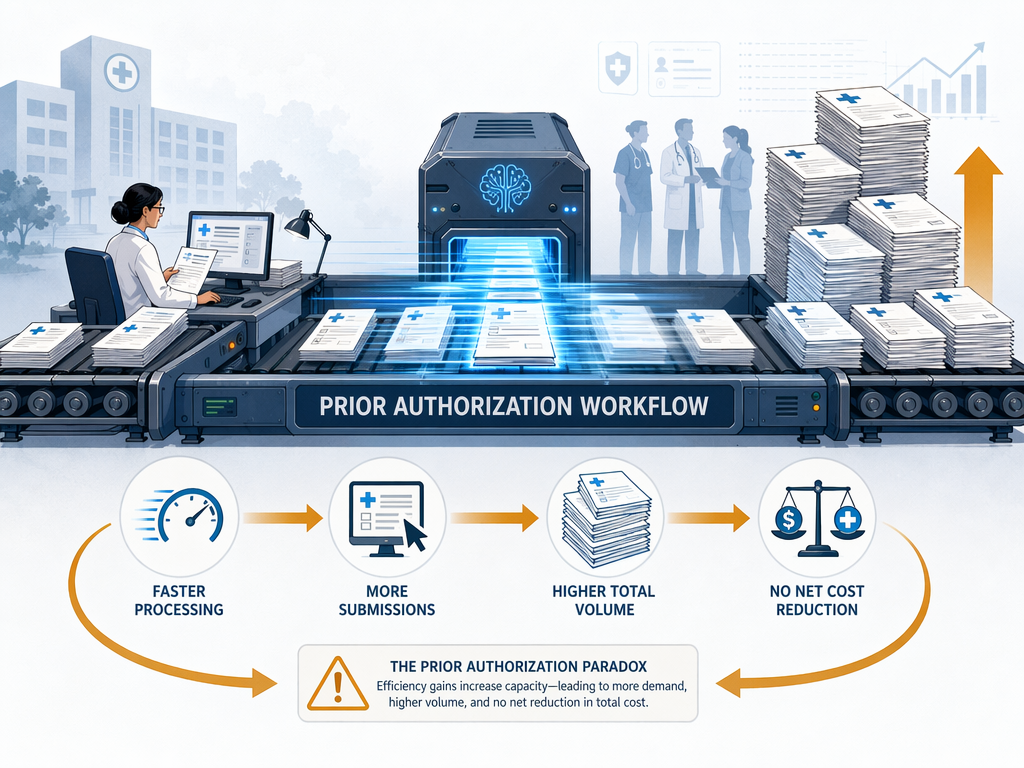
This paradox is explored in depth in the site's dedicated article, The Administrative AI Paradox: Why Automation Is Driving Up Healthcare Costs in 2026. For the purposes of this assessment, the key takeaway is that prior authorization AI, unlike documentation or revenue cycle AI, operates within a structurally broken incentive system. Until reimbursement policy is reformed — and PHTI identifies policy change as the strongest lever for system-level savings — automating a flawed process may simply amplify the flaws.
ROI Patterns: Payback Periods, Success Rates, and the 3.2:1 Average
For health system executives evaluating AI investments, the most frequently asked question is whether the returns justify the upfront costs. The available data suggests that for a majority of implementers, the answer is yes — but with important caveats about the distribution of outcomes.
According to the Eliciting Insights survey, over half of health systems that were able to quantify their AI ROI reported at least a 2x return. The Stealth Agents compilation of 20 sources, drawing on McKinsey, HOMRCM, and other primary data, reports that 64% of AI implementers confirm positive ROI, with an average return of 3.2:1. Typical payback periods range from 12 to 18 months. The SmarterTech 2025 benchmark report found that 73% of organizations reported reduced operational costs through AI implementation, and 81% reported increased revenue from administrative AI functions. Notably, 45% of organizations realized benefits in less than one year.
| ROI Metric | Value | Source |
|---|---|---|
| Implementers reporting positive ROI | 64% | Stealth Agents compilation (multiple sources) |
| Average ROI multiple | 3.2:1 | Stealth Agents compilation |
| Typical payback period | 12-18 months | Industry consensus |
| Organizations reporting reduced costs | 73% | SmarterTech 2025 Benchmark Report |
| Organizations reporting increased revenue | 81% | SmarterTech 2025 Benchmark Report |
| Organizations realizing benefits <1 year | 45% | SmarterTech 2025 Benchmark Report |
| Health systems reporting ≥2x ROI | >50% of quantifiers | Eliciting Insights survey (2026) |
However, the 3.2:1 average masks a wide distribution. Some implementations — particularly those targeting high-volume, low-complexity tasks like claim status inquiry or appointment reminder automation — achieve returns well above the average. Others, especially those attempting to automate complex, multi-step workflows without adequate data integration, fail to deliver measurable ROI. The Gartner analyst Robert Potts, quoted in HealthTech Magazine, notes that organizations tend to think in terms of individual tasks rather than entire departments, and that ideal automation candidates couple high transaction volume with low process complexity.
Implementation Barriers and Governance Considerations
The transition from pilot to production-scale administrative AI deployment is not frictionless. Health systems that have successfully scaled AI tools consistently report several categories of implementation barriers that must be addressed upfront.
- Data integration and EHR interoperability: AI tools require clean, structured data from EHRs, practice management systems, and billing platforms. Many health systems operate on fragmented IT stacks where data does not flow seamlessly between systems. Without a unified data layer, AI models produce inconsistent results and require manual data reconciliation that erodes the efficiency gains.
- Staff training and change management: The AMA survey found that while 75% of physicians believe AI can improve work efficiency, enthusiasm remains tempered by concerns about workflow disruption and loss of control. At The Permanente Medical Group, where ambient AI scribes save physicians approximately one hour per day at the keyboard, the implementation required sustained training and workflow redesign. Geisinger, which has 110+ live automations, invested heavily in clinician engagement and iterative feedback loops.
- Governance and oversight frameworks: As AI tools take on tasks with direct revenue implications — coding, billing, prior authorization — health systems need clear governance structures for monitoring model performance, auditing for bias, and managing vendor relationships. The PHTI findings on the prior authorization paradox underscore the risk of deploying AI without understanding its system-level effects.
- Vendor lock-in and contract risk: The administrative AI vendor landscape is fragmented and rapidly evolving. Health systems that commit to a single vendor's platform risk being locked into proprietary data formats and workflows that become difficult to unwind. Procurement teams should evaluate API openness, data portability, and exit clauses as seriously as they evaluate feature sets.
- Regulatory and compliance uncertainty: While most administrative AI tools do not require FDA clearance (they are not medical devices), they still operate within a regulatory environment shaped by HIPAA, state privacy laws, and evolving CMS guidance on AI-generated billing codes. The Prior Authorization AI: Evidence, Adoption, and Regulatory Landscape article provides a deeper look at the regulatory dimensions specific to prior authorization automation.
The organizations that have navigated these barriers most successfully share a common pattern: they start with a clearly defined problem, pilot with a small group of willing users, measure outcomes rigorously, and scale only after validating both the technology and the workflow integration. The 13-21% staff productivity increases reported by SmarterTech and the 240-400 hours per nurse per year in administrative time reduction estimated by Deloitte are not automatic — they are the result of deliberate implementation strategy.
Outlook 2026-2027: Where the Field Is Headed
Several converging trends will shape the trajectory of administrative AI over the next 18 months. First, adoption will continue to accelerate. The Eliciting Insights survey's finding that 75% of health systems already use AI, combined with the 80% year-over-year growth in generative AI applications like patient text drafting, suggests that the remaining 25% of non-adopters will face increasing pressure to invest. The 83% of healthcare executives who, according to an Nvidia survey, believe AI will revolutionize the industry within 3-5 years, are acting on that belief.
Second, the reimbursement policy environment is the single most important variable for whether administrative AI delivers system-level savings or simply accelerates the arms race. The PHTI findings make clear that under current fee-for-service incentives, AI-driven prior authorization and billing automation will continue to inflate transaction volumes and medical spending. If CMS and commercial payers introduce payment reforms that reward value over volume, the economics of administrative AI will shift dramatically. If they do not, the paradox will deepen.
Third, the maturation of generative AI will expand the scope of administrative automation beyond structured tasks. Drafting patient replies, summarizing clinical notes, and generating prior authorization letters are already in production at 36% of health systems. As large language models become more reliable and better integrated with EHR data, the boundary between clinical and administrative AI will blur. The Health Tech AI in 2026 article provides a broader market and investment perspective on these trends.
Finally, the question of whether the projected $200 billion to $360 billion in total annual US savings — cited by McKinsey and NBER — will materialize remains open. The evidence from 2026 suggests that documentation and revenue cycle AI are delivering measurable, if incremental, returns. Prior authorization AI is delivering efficiency for individual organizations but may be increasing system-level costs. The gap between organizational ROI and system-level savings is the central unresolved question of administrative AI in 2026. The answer depends less on technology than on the policy choices that health systems, payers, and regulators make in the next two years.