
AI in medical malpractice litigation and settlement caps now has to be analyzed as a three-party problem. The physician remains the easiest defendant to name because the physician still signs the note, orders the test, reviews the image, or decides whether to discharge. The health system becomes harder to ignore when the disputed act happened inside a workflow it selected, configured, trained, and monitored. The AI developer may sit farthest from the bedside, but product theories follow the tool when plaintiffs can frame the harm as a design defect, biased training data, inadequate warning, or unsafe integration.
That map matters because state malpractice caps do not apply to every defendant, claim, or damage category in the same way. A cap that limits noneconomic damages against a clinician may not control a product-liability claim against a developer. A hospital may face both vicarious liability for a clinician and direct institutional negligence for the system it deployed. The same patient injury can therefore create different legal theories, different insurance towers, and different settlement pressure depending on who is in the caption.

The workflow itself can become evidence
The clean version of an AI malpractice case says that the algorithm was right or wrong and the clinician either relied on it or did not. Real incident narratives are usually less tidy. Someone decided where the AI alert would appear. Someone decided whether the physician would see the image before the alert, after the alert, or both. Someone wrote the training module. Someone monitored override rates, false positives, false negatives, and model drift, or failed to do so.
A Penn State mock juror study makes that operational point unusually concrete. In a hypothetical radiology scenario involving 282 participants, respondents were about 50% more likely to find a radiologist liable when the radiologist reviewed a CT scan only once after an AI system flagged it, compared with a workflow in which the radiologist reviewed the scan before and after the AI output appeared.[1]
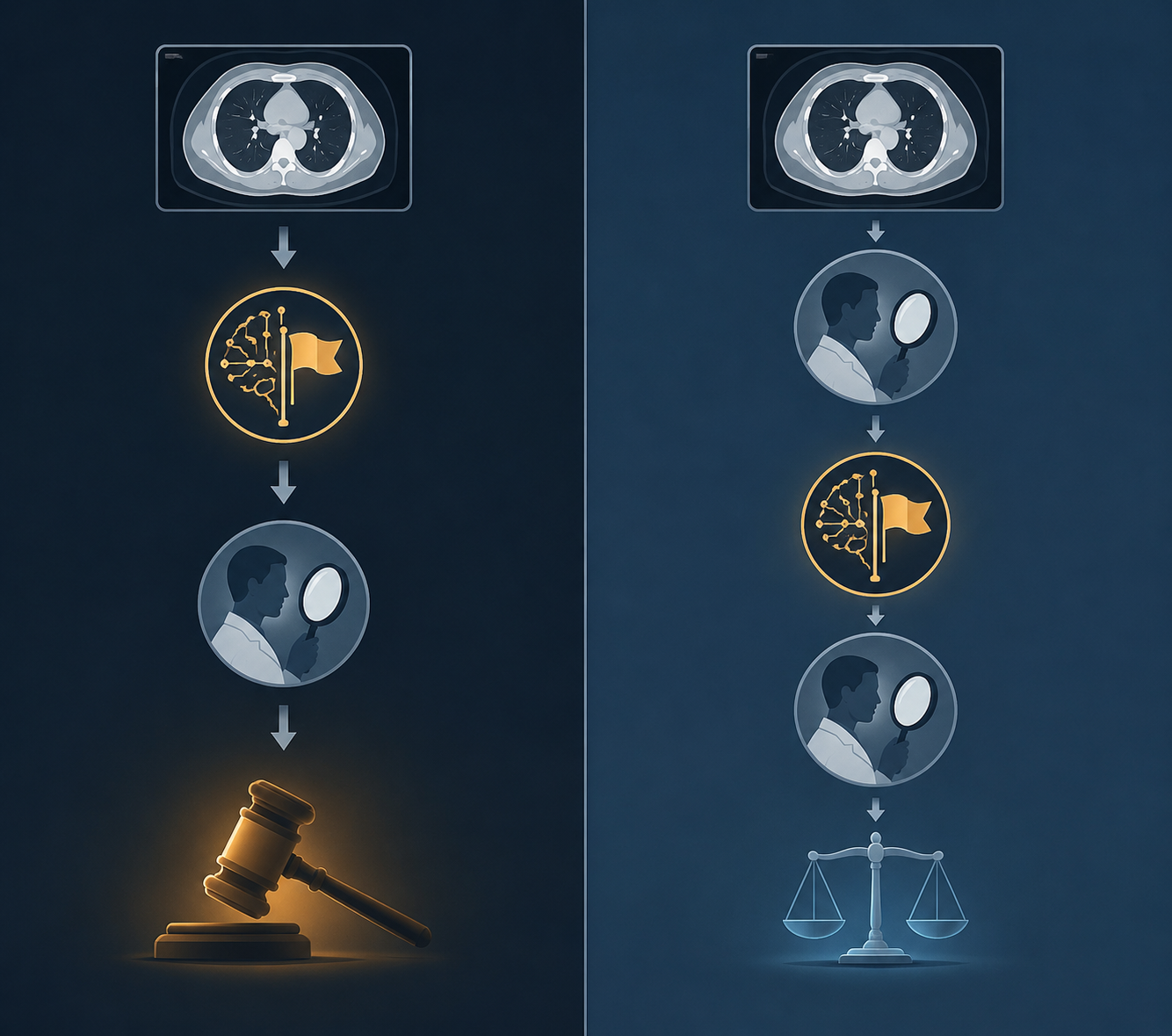
That is not proof of how real juries will behave. The study used a hypothetical fact pattern, not an actual deliberation after live testimony, expert cross-examination, and jury instructions. But for a health system risk file, the signal is still hard to dismiss: a small workflow choice can change how laypeople read professional independence. A once-after-AI review can look like the radiologist accepted the machine’s frame. A before-and-after review gives the defense a cleaner story of independent judgment.
The exposure is not just whether the AI tool made a mistake. It is whether the surrounding process made the clinician look like a rubber stamp, made the hospital look careless, or gave the developer an opening to say its software was only one input in a human decision.
Physicians still face the familiar malpractice theory
For physicians, AI does not erase the older malpractice question: did the clinician act as a reasonably prudent professional under the circumstances? Courts do not need a new doctrine to treat blind acceptance of AI output as a failure of independent judgment. Existing tort principles already leave room for liability when a physician accepts an AI recommendation without clinically appropriate review.[2]
The plaintiff’s argument is straightforward. The AI may have generated the suggestion, but the physician used it in diagnosis, treatment, triage, or follow-up. If the recommendation conflicted with symptoms, imaging, labs, history, or basic clinical caution, the plaintiff does not have to prove that the physician designed the algorithm. The plaintiff can argue that the physician failed at the ordinary bedside task of reconciling a tool’s output with the patient in front of them.
Automation bias gives that argument a name, but the litigation problem is more practical than theoretical. A physician who documents only the AI score, clicks through a warning, or fails to explain why a contradictory clinical sign was discounted may have made the chart easier for a plaintiff expert to read. A physician who records an independent impression, the AI result, and the reason for accepting or rejecting it has not eliminated risk, but has changed the evidence.
That point is especially important because clinicians often work inside tools they did not buy and cannot meaningfully reconfigure. The law may still ask whether they exercised independent judgment, even when the institution gave the tool a badge of approval and embedded it into the clinical path. That tension is where physician sympathy and physician exposure separate. A court may understand the operational pressure and still allow a negligence claim to proceed.
The health system owns more than procurement
The health system’s exposure begins before the first AI-assisted decision reaches a patient. The institution chooses the vendor, evaluates the use case, decides which clinicians will see the output, determines how much training is required, and controls whether the model is monitored after deployment. Those facts support a direct negligence theory that is different from simply blaming the physician’s final decision.
The Milbank Quarterly has described health-system claims in this area as including negligent credentialing of AI tools, insufficient training, and failure to monitor model drift.[3] Those theories matter because they attach to institutional acts: the governance committee that approved the tool without adequate validation, the rollout plan that treated training as a software announcement, or the monitoring program that never checked whether performance changed in a local patient population.
Model drift is a useful example because it does not require anyone to be reckless on day one. A tool can perform acceptably at launch and become less reliable as patient mix, scanner equipment, documentation practices, disease prevalence, or clinical workflow changes. If the institution has no owner for post-deployment review, no threshold for escalation, and no record of periodic performance checks, the plaintiff’s case is no longer only about a physician’s mistaken reliance. It becomes a governance case.
Training failures create a similar route. If clinicians were told that a model was approved but not told its intended use, its limits, its alert logic, or the circumstances requiring override, the health system may have handed physicians responsibility without giving them the operational knowledge needed to exercise it. In deposition, that can produce the worst version of institutional evidence: a physician explaining a screen they did not design, a risk officer pointing to vendor materials, and a vendor pointing back to the hospital’s implementation choices.
Developers are attractive defendants, but not simple ones
AI developers are attractive to plaintiffs for reasons that have little to do with doctrinal neatness. They may have deeper insurance or commercial resources than an individual clinician. They may have marketing materials that oversold performance. They may have internal validation records, training-data decisions, or known failure modes that look more concrete than a physician’s recollection of a busy shift.
The available theories sound in product liability: design defect, failure to warn, and, for AI systems, alleged training-data bias or unsafe model design. The Milbank Quarterly has identified developer product-liability exposure in medicine while also noting that software liability remains legally unsettled.[3] That unsettled status should not be confused with immunity. It means the pleadings, expert proof, contract documents, regulatory posture, and state product-liability law will do much of the work.
A developer will usually try to widen the distance between its product and the bedside decision. It may argue that the tool was clinical decision support, that the institution controlled integration, that the physician retained final authority, or that the alleged harm resulted from misuse outside the intended workflow. Plaintiffs will try to narrow that distance by pointing to the design of the alert, the asserted performance claims, the foreseeability of automation bias, or a training dataset that performed poorly for a relevant patient subgroup.
The contract will not decide patient liability by itself, but it will shape the lawsuit’s economics. Indemnity language, warranty disclaimers, limitation-of-liability clauses, audit rights, validation obligations, and documentation of intended use can determine who funds the defense, who has settlement authority, and who has leverage when defendants start blaming one another. Procurement paperwork becomes litigation architecture when the patient injury arrives.
Caps change settlement pressure before they change verdicts
Damage caps enter the AI malpractice problem less as a clean answer and more as a pressure system. A state cap may limit noneconomic damages in medical malpractice claims, but the plaintiff may plead separate theories against a hospital and a developer. The defendant mix matters because a physician malpractice cap, an institutional negligence claim, and a product-liability claim may not all share the same ceiling.
The insurance effects of caps are real enough to matter in settlement planning. A RAND/Harvard study of North Carolina’s 2011 $500,000 noneconomic damage cap found premium reductions of 5.5% for internal medicine, 11% for general surgery, and 9.8% for OB-GYN, with effects appearing about three years after enactment.[4] The study used data ending in 2017 and speaks to insurance economics, not to how an AI case with multiple defendant categories would be decided.
A separate RAND/Harvard analysis of Georgia and Illinois found that repealing caps increased premiums by 16% to 23%, with larger effects in surgical specialties.[5] That study used data ending in 2019, making it useful evidence that caps affect the price of malpractice risk, not proof that a plaintiff will recover more in any particular AI case or that a developer will be treated like a capped medical defendant.
| Actor | Likely theory | Cap question |
|---|---|---|
| Physician | Failure of independent clinical judgment; automation bias; negligent diagnosis or treatment | Most likely to fall within traditional medical malpractice cap rules, depending on state law and damage category |
| Health system | Negligent implementation, training, credentialing, monitoring, or failure to address model drift | May face direct institutional claims as well as vicarious liability; cap treatment depends on how the claim is pleaded and how state law defines covered healthcare defendants |
| AI developer | Design defect, failure to warn, training-data bias, unsafe software or product theory | Most uncertain cap treatment because product-liability and software theories may sit outside traditional medical malpractice caps |
The settlement implication is immediate. If the physician’s noneconomic exposure is capped but the developer’s alleged product exposure is not, the plaintiff has an incentive to keep the developer in the case. If the hospital faces a direct negligent-implementation theory that may not be treated the same as bedside malpractice, the hospital has an incentive to settle early or shift attention to the vendor’s design and warnings. If all defendants believe a cap applies, settlement values may compress; if one defendant may sit outside the cap, the case can stay expensive even when the clinician’s exposure is bounded.
The cap patchwork is wide enough to alter strategy
By 2026, reported state medical malpractice cap figures ranged from roughly $250,000 to more than $1 million, with some states using inflation adjustments and others moving away from general caps entirely. Reported examples include Michigan at $596,400 for the lower cap and $1,065,000 for the higher cap, Missouri at $481,494 for non-catastrophic injuries and $842,614 for catastrophic injuries, and Oregon at $500,000, with annual inflation adjustments noted for those examples.[6]
Those figures should be checked against current statutory text before anyone prices a live case; inflation adjustments and state-specific definitions can matter. But the broader point does not require false precision. A case filed in a capped state, a partially capped state, or a state where a general cap has been invalidated presents different leverage even before the parties reach expert discovery.
The trend line is not uniformly toward tighter ceilings. Kansas and Oklahoma have recently struck down general caps, according to the same 2026 state-cap survey.[6] That does not forecast what any state supreme court will do next, but it does warn against treating caps as permanent background noise. A health system deploying AI across multiple states may face materially different settlement assumptions for the same tool and the same clinical workflow.
Multistate deployment creates a practical mismatch. The vendor may sell one model, the enterprise may implement one governance policy, and clinicians may receive one training package, but a patient injury will be litigated under the law of a particular jurisdiction. The cap environment can decide whether the plaintiff focuses on the physician, presses direct claims against the hospital, or works hardest to keep the developer in the case.
Evidence quality will matter in the courtroom too
AI is also entering the litigation process itself, though that should not distract from the clinical liability problem. Defense attorneys have already cautioned that AI tools used by plaintiff experts for standard-of-care analysis should receive heightened scrutiny under Daubert and Rule 702. The same commentary warns that AI legal research tools have produced hallucinated citations at reported rates of 17% to 33%.[7]
That concern has a narrow but important place in AI malpractice cases. If an expert relies on an AI tool to define standard of care, summarize literature, or generate case support, the opposing party will ask what the tool was, what sources it used, whether the output was verified, and whether the methodology is reliable. An AI-generated expert shortcut can become its own admissibility fight.
For defendants, this is not a license to wave away every plaintiff expert who mentions AI. Courts already have tools for testing expert reliability. The better point is evidentiary discipline: the party using AI in litigation should be ready to show the human expert’s reasoning, the source materials, and the validation behind any AI-assisted step. The same standard should apply when the defense uses AI to analyze records or prepare standard-of-care arguments.
Where the law has not yet landed
The current legal materials can describe the likely defendants better than they can predict the final allocation. Physicians face conventional malpractice exposure when they defer to AI without independent judgment. Health systems face institutional exposure for the design and oversight of AI deployment. Developers face product-style theories that are appealing to plaintiffs but still unsettled for software used in clinical care.
Damage caps add another layer without resolving the first one. The cap may limit part of the physician’s exposure, influence the hospital’s insurance and settlement posture, or leave the developer fighting over whether the claim is outside the medical malpractice regime. The studies on North Carolina, Georgia, and Illinois show that caps and repeals can move malpractice premiums; they do not tell us how a court will treat a single AI-involved injury with three differently situated defendants.[4][5]
That is the unresolved intersection. Existing tort principles are sufficient to plead the physician, the institution, and the developer into the story. Existing state caps are sufficient to change settlement incentives. What is still missing is a published opinion showing how those caps apply when physician malpractice, institutional AI governance, and developer product liability are all litigated in the same patient-harm case.
References
- How AI is integrated into clinical workflow lowers medical liability perception, Penn State Health News, March 2026.
- The New Standard of Care: AI and the Future of Medical Malpractice Law, Suffolk Journal of Health & Biomedical Law, January 25, 2026.
- Artificial Intelligence And Liability In Medicine: Balancing Safety And Innovation, Milbank Quarterly, 2021.
- The impact of malpractice damage caps on physician premiums in North Carolina, Yu & Baker, 2022.
- The impact of medical malpractice damage cap repeal on physician premiums, Mizushima, Whaley & Yu, 2025.
- Medical Malpractice Caps by State, Tavrn.ai.
- Artificial Intelligence: From Clinical Decision-Making to Courtroom Strategy, Hall Booth Smith, 2026.
Comments
Join the discussion with an anonymous comment.