
The strongest argument for AI in ransomware defense for critical infrastructure does not begin in a security operations center. It begins with a patient who arrives while medication records are unavailable, a lab result that cannot be returned, an ambulance that has to go somewhere else, and a clinician deciding whether a paper workaround is safe enough.
The mortality claim is stark: a University of Minnesota Medicare analysis, cited in Halcyon’s healthcare ransomware white paper, found that in-hospital mortality during ransomware incidents rose by 33%, from roughly 3 deaths per 100 admissions to 4 per 100. Halcyon further reports that this translated to an estimated 42 to 67 additional preventable deaths per affected hospital over five years.[1] That figure should not be treated as a slogan. Because it is being cited through a vendor white paper, hospital leaders should verify the original academic study for its methods, population, confidence intervals, and definition of exposure. Even with that caveat, it changes the category of the discussion: ransomware downtime is not only a financial loss event. It is a patient safety exposure.
That matters because hospital downtime does not stay inside the affected hospital. A 2024 ransomware attack on London pathology provider Synnovis was linked to delayed blood tests and a patient death, according to Halcyon’s summary of the incident.[1] The same white paper cites regional evidence from JAMA Network Open showing that hospitals adjacent to a ransomware-affected facility experienced 81% more cardiac arrests, 75% more suspected strokes, and 48% longer wait times during nearby attacks.[1] The harm pathway is not mysterious: when one facility loses capacity, surrounding emergency departments inherit the volume, the uncertainty, and the delay.
Downtime Becomes Clinical Risk Before It Becomes a Board Report
Calling this an “IT outage” hides the part that patients and staff experience. The electronic health record may be unavailable, but the emergency department is still open. The medication cabinet may require manual controls, but pain, sepsis, stroke symptoms, and chest pain keep arriving. The lab interface may be down, but someone still has to decide whether a result is missing, delayed, or not yet ordered. The risk is created in those intervals.
That interval is what any serious defense has to shorten: the time between abnormal behavior in the environment and containment that preserves clinical operations. A faster alert only matters if the hospital can understand it, trust it, and act on it without creating a second operational crisis. A tool that detects suspicious behavior but floods a thin security team with untriaged noise may not protect a nurse trying to reconcile medications at 2 a.m. A tool that triggers containment without enough explanation may protect a server while interrupting a clinical workflow that no one mapped.
This is why mortality and regional cascade data should sit ahead of vendor performance claims. The board-level question is not whether ransomware is bad. It is whether a given investment can reduce the dangerous window in which downtime turns into diverted ambulances, delayed transfers, missing diagnostic information, and regional congestion.
The Financial Story Is Also an Operational Story
Healthcare pays for ransomware twice: first in disruption, then in recovery. Invenio IT reports that Ascension had 136 hospitals affected by a ransomware incident, with systems offline for six weeks, a $1.8 billion loss, and 5.5 million records breached.[2] It also reports that the Change Healthcare attack involved a $22 million ransom, more than 190 million records, and effects on 94% of hospitals.[2] These are not small technology cleanup projects. They are systemwide operating failures.
For rural hospitals, the margin for recovery can be even thinner. Invenio IT describes an Illinois hospital that permanently closed after being offline for 14 weeks following a ransomware attack.[2] Index Engines places the average healthcare ransomware recovery cost at $2.5 million and reports that 44.4% of attacks disrupt care delivery.[3] A hospital can survive a week of hard manual work and still fail later because cash flow, billing, staffing stability, and community trust do not restart as neatly as servers.
| Pressure Point | What It Means for Hospital Risk |
|---|---|
| Mortality increase during ransomware incidents | Downtime can coincide with measurable increases in inpatient deaths, according to the Medicare analysis cited by Halcyon.[1] |
| Regional spillover | Nearby hospitals may see higher cardiac arrests, suspected strokes, and wait times when a neighboring facility is attacked.[1] |
| Large-system disruption | Ascension and Change Healthcare show how a single event can affect hospitals, records, payment flows, and operations at scale.[2] |
| Recovery cost | Average recovery cost and care-disruption rates make ransomware a resilience issue, not only a compliance issue.[3] |
Healthcare’s ransom-paying behavior reflects that pressure. Vectra reports that healthcare organizations are 2.3 times more likely to pay ransoms than other sectors and cites a $1.2 million average demand.[4] Halcyon also reports that nearly two-thirds of healthcare ransomware incidents involve data theft and that demands exceed $1 million in most cases.[1] Those figures should be read carefully because they come from industry sources, but the direction is consistent with hospital reality: downtime is intolerable when the work cannot simply stop.
Why Behavioral Analytics Belong in the Conversation
Traditional signature-based defenses are weakest when attackers avoid looking like known malware. Ransomware operators can abuse legitimate credentials, trusted processes, administrative tools, and routine-looking network paths. The activity is dangerous not because every file or command is unfamiliar, but because the pattern is wrong: an account accesses systems it rarely touches, a process begins encrypting at abnormal speed, an endpoint contacts infrastructure outside its usual behavior, or privilege changes occur in a sequence that does not match ordinary work.
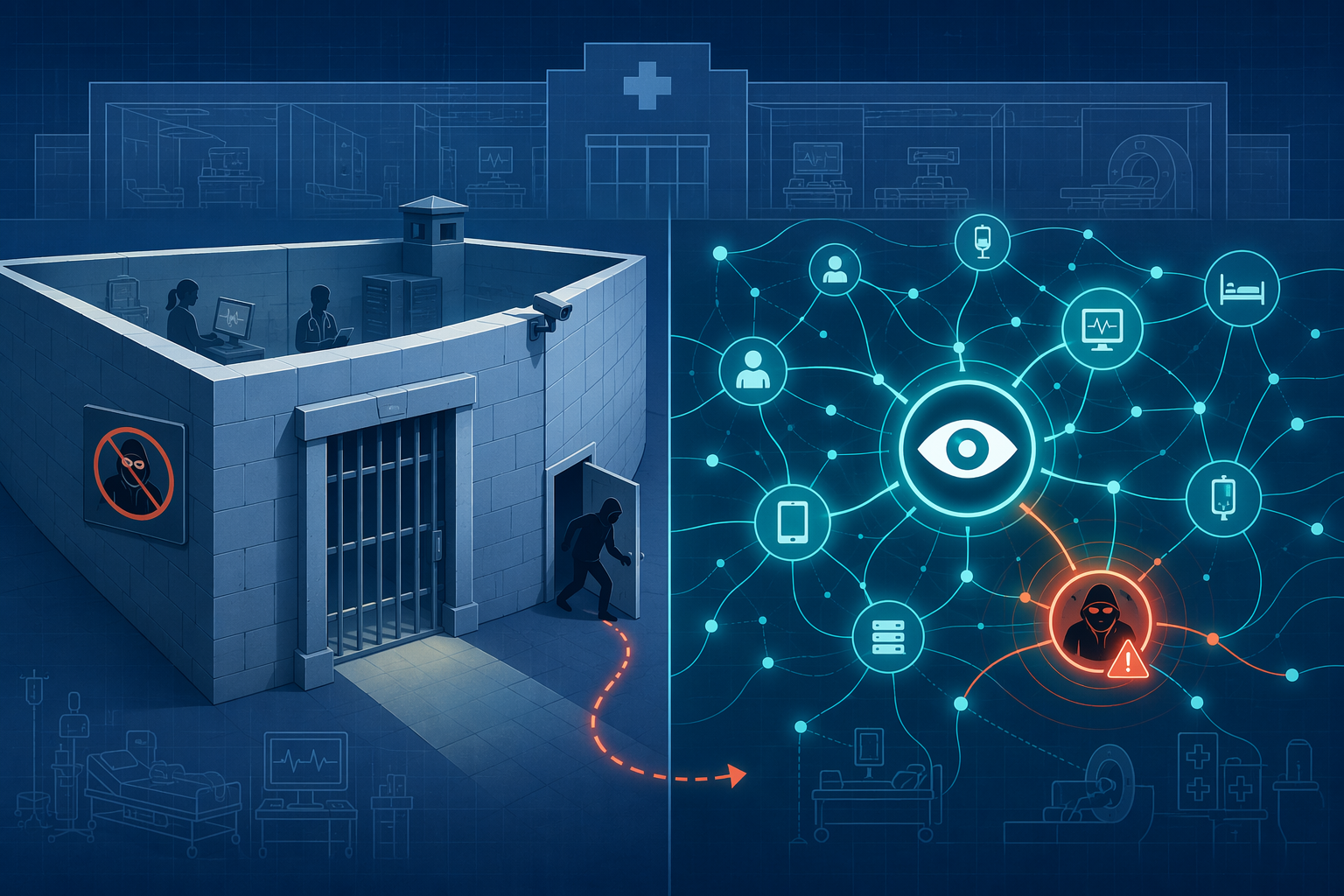
AI-driven anomaly detection and behavioral analytics are relevant because they watch behavior across identities, endpoints, networks, cloud services, and trusted processes instead of waiting only for a known ransomware signature. In plain executive terms, they ask whether the activity fits the hospital’s normal operating pattern. That is the right question for an environment where the attacker may be using tools the organization already trusts.
The vendor-reported performance claims are large. Vectra says its AI approach can detect threats 98 days faster and reports 293 attacks detected across three quarters, along with a 0.001% token manipulation risk claim.[4] Seceon reports 90% to 99% faster detection, 98% faster response, and 60% security operations cost savings through consolidation of 20 to 35 tools.[5] Halcyon positions its anti-ransomware platform specifically for healthcare ransomware defense.[1] These figures may reflect selected deployments, published conditions, or vendor-defined measurements rather than average outcomes across hospitals. They are still worth attention because the clinical question is speed.
A 98-day improvement sounds impressive in a slide deck. In a hospital, the more meaningful question is whether the organization can move from suspicious behavior to containment before encryption, exfiltration, downtime, diversion, or regional overload begins. If behavioral analytics identify credential abuse early enough to isolate a compromised account, block lateral movement, preserve backups, and keep the electronic health record available, the performance metric has a plausible patient-safety pathway. If the alert arrives without context, sits in a queue, or triggers a containment action no clinical leader understands, the metric is less persuasive.
What Speed Has to Connect To
For hospital executives, the test is not whether a product uses AI. The test is whether faster detection changes the operating posture of the hospital during the hours that matter. That requires at least four connections.
- Alert explainability: security teams and operational leaders need to know what behavior changed, which asset is involved, and why the system believes it is risky.
- Clinical triage: containment rules must distinguish a back-office system from a system tied to medication administration, imaging, laboratory turnaround, or emergency care.
- Segmentation and backup readiness: detection only preserves care if the organization can isolate affected systems and recover cleanly.
- Incident command: the alert has to reach people authorized to make operational decisions before downtime procedures become the default mode of care.
This is where AI ransomware defense becomes part of critical infrastructure resilience rather than a technology add-on. Hospitals need speed, but speed without governance can create its own hazards. Automated containment may be appropriate for a compromised endpoint. It may be much harder to justify for a system supporting urgent clinical decisions unless the organization has already defined the tradeoff.
The Limits Are Not Footnotes
The case for AI-driven defense is strongest when it is not oversold. False positives matter in healthcare because attention is already scarce. A hospital security team that spends the night chasing benign anomalies may miss the event that should have triggered incident command. A clinician who sees unexplained access restrictions during a busy shift may lose confidence in the system even if the security rationale is sound.
Explainability also matters. If a model says an identity, endpoint, or process is abnormal, someone has to translate that into operational language: what system is at risk, what care process depends on it, what containment option exists, and what harm might result from acting or not acting. Hospital leaders do not need every mathematical detail, but they do need enough clarity to authorize action under pressure.
Data quality is another constraint. Behavioral models depend on a baseline of normal activity. Hospitals are messy environments: traveling nurses, rotating residents, outsourced services, emergency access, device fleets, and temporary workflows can all make “normal” hard to define. Poor baseline data can turn anomaly detection into either noise or blind spots.
Attackers adapt as well. The same field that gives defenders better pattern recognition gives adversaries new ways to test evasion, manipulate signals, and move more patiently. AI defense should therefore sit inside defense-in-depth: zero-trust segmentation, least-privilege access, immutable backups, tested downtime procedures, incident response exercises, vendor-risk controls, and regulatory compliance work that is actually connected to operations.
Medical device exposure adds another reason to keep the frame broad. Paubox reported more than 460 medical device cyberattacks in 2025 and described that as a fivefold increase since 2015.[6] That does not prove every device attack causes direct patient harm, and it should not be used that way. It does show that hospital attack surfaces increasingly include equipment and connected systems that sit close to care delivery.
A Defensible Standard for Hospital Boards
The defensible judgment is narrow but important: AI behavioral analytics are currently one of the most viable ways to reduce ransomware detection and response time in hospitals, and that speed could plausibly reduce patient harm when it prevents or limits care disruption. The evidence does not support a cleaner promise than that. Faster detection is not the same as fewer deaths unless it is connected to containment, recovery, staffing decisions, ambulance coordination, and clinical downtime procedures.
That is enough to change how the investment should be evaluated. If ransomware is associated with increased in-hospital mortality, documented regional strain, large-system disruption, and even permanent facility closure, then cyber defense belongs in the same board conversation as emergency preparedness and critical infrastructure resilience. Vendor performance claims can inform that conversation, but they should not lead it. The first metric is whether the hospital can keep delivering safe care when an attacker tries to turn its systems against it.
References
- Ransomware: A Public Health Crisis, Halcyon, September 2025.
- Ransomware Attacks on Healthcare Facilities Have Doubled, Invenio IT, updated 2026.
- The State of Ransomware in Healthcare: A 2026 Analysis, Index Engines.
- Healthcare Cybersecurity: Defending Against AI Threats and Third-Party Breaches, Vectra AI, 2026.
- The 2025 Healthcare Cyber Crisis: Unified AI Defense Against $10.3M Breaches, Seceon, November 2025.
- Medical Device Cyberattacks in 2026, Paubox, July 2026.
Comments
Join the discussion with an anonymous comment.