
The uncomfortable part of the Replacement.AI billboards was not that they looked fake. It was that they looked usable.
In October 2025, the satirical “human replacement” AI company appeared on billboards in places including San Francisco’s Castro neighborhood, Times Square, and Lombard Street. Its ads leaned into the bleak promise that software could replace human workers. The campaign came from filmmakers, not a real enterprise software vendor, and its website and press trail included signals that it was fiction. Still, Reddit users debated whether the company was real or parody before they tracked those signals down.[1][2]
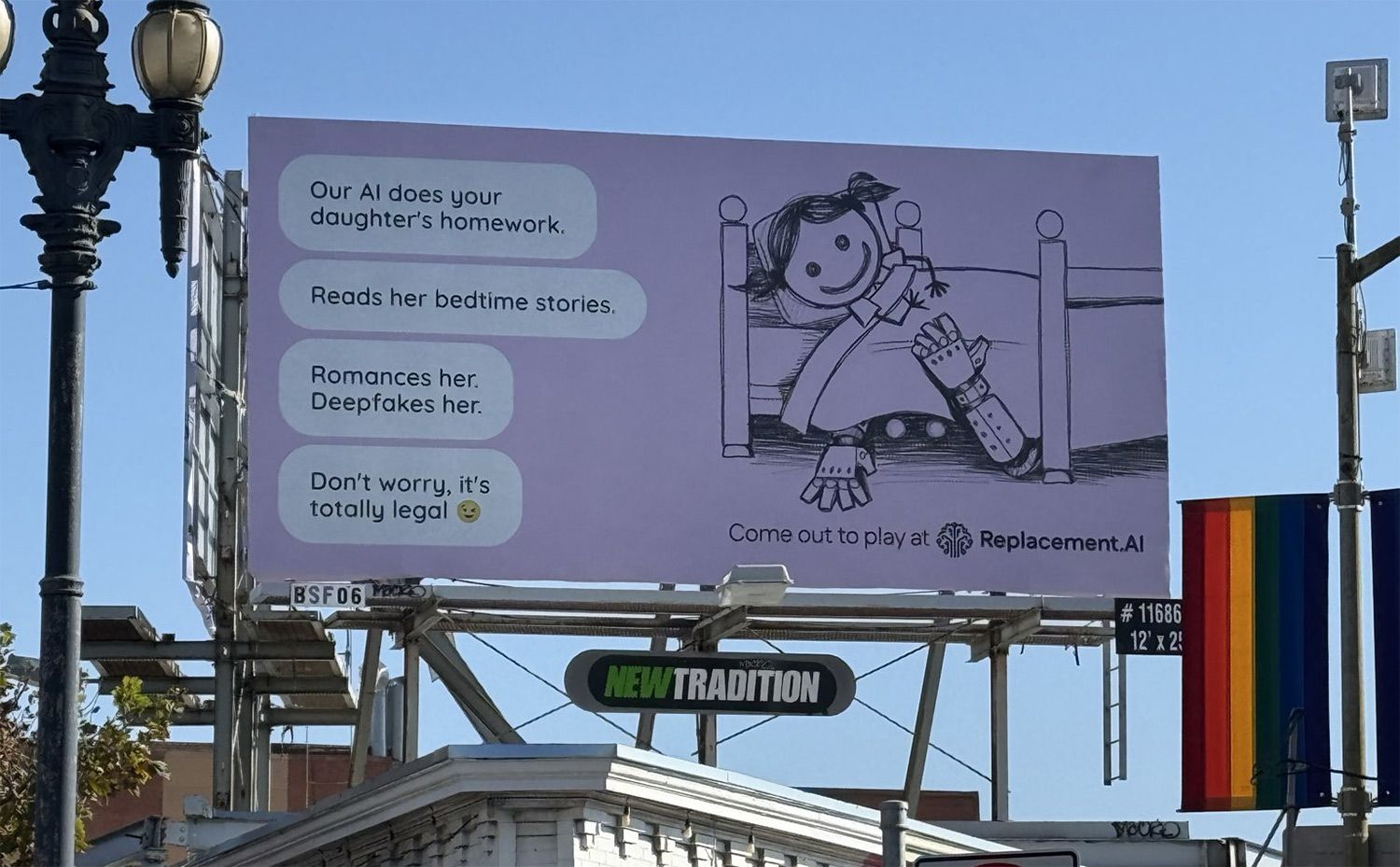
That is the part healthcare marketers should sit with. Replacement.AI was not a pharmaceutical ad. It was not a scam. It was satire aimed at AI hype. But the campaign worked because the public had already been trained to accept a certain kind of AI-brand language as plausible: glossy, blunt, vaguely menacing, and oddly proud of removing people from the scene.
The problem is not confined to parody. Real AI startup advertising has used similar cues. Artisan’s “Stop Hiring Humans” billboards, for example, placed a sincere commercial proposition inside the same visual and tonal neighborhood as Replacement.AI: a clean billboard, a provocative anti-human line, and the implied efficiency of software over labor.
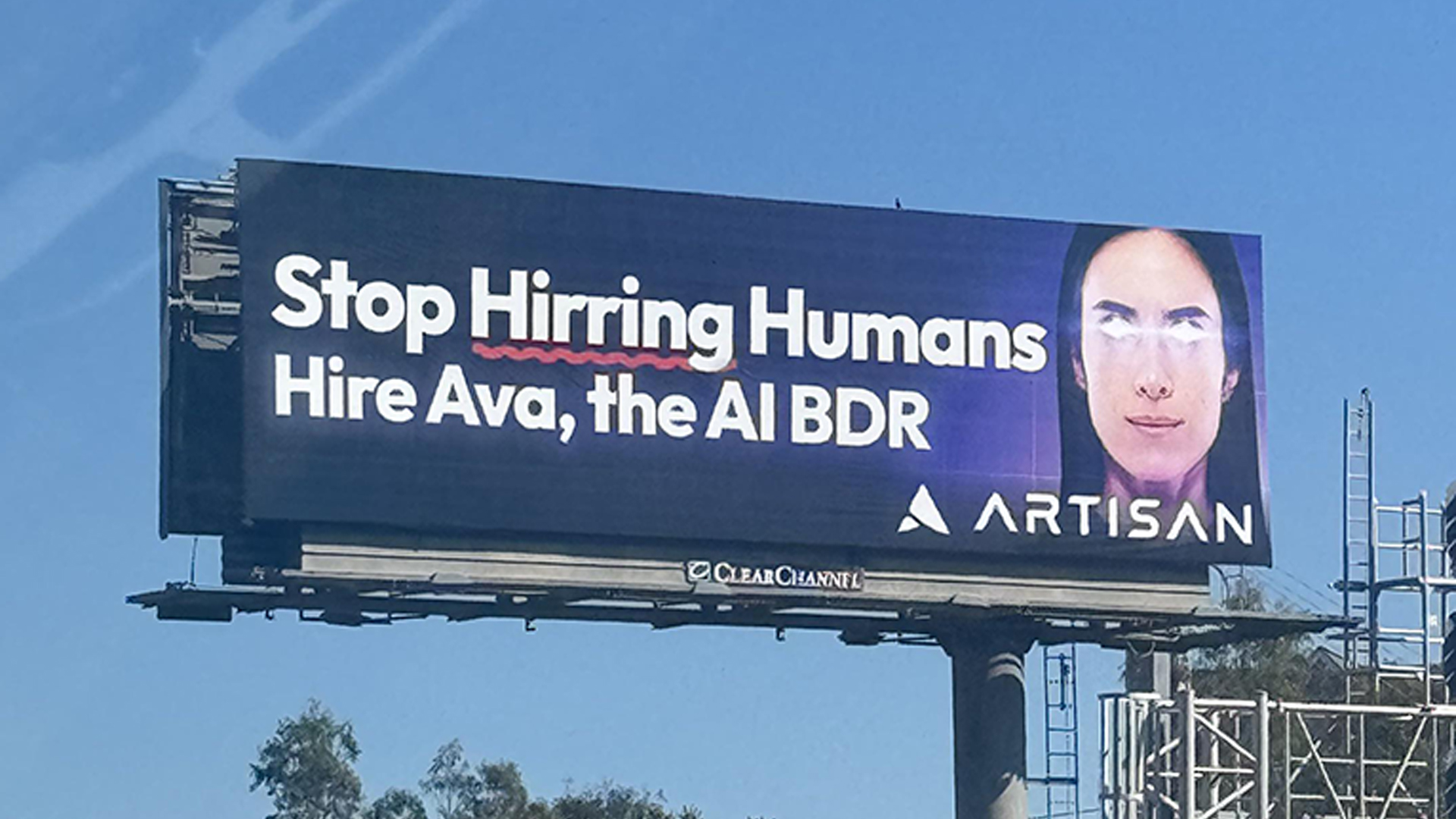
Once sincere hype and satire share the same grammar, the audience has to investigate intent before it can evaluate the message. In most categories, that is a brand problem. In healthcare, it becomes a trust problem.
The Backlash Starts Before the Claim
Healthcare advertising usually treats credibility as a matter of claims: what is said, what is substantiated, what is balanced, what is omitted. The backlash to AI satire in advertising changes the timing. Suspicion can begin before a patient reaches the claim, because the surface of the ad already looks like something circulating as a joke, a stunt, or a scam.
That is a different review problem from “does this image meet brand standards?” A too-smooth caregiver interaction, an expression that feels composited rather than observed, a voiceover that performs empathy without saying anything verifiable—none of those details may violate a claims grid by themselves. Together, they can make the ad feel unearned. Patients do not need formal media training to notice that.
The current AI ad environment makes those small cues heavier. A polished synthetic face no longer just reads as a creative choice. It can read as evidence that the brand wanted the authority of a healthcare scene without the friction of real people, real settings, or real accountability.
That interpretation may be unfair in a given case. AI-assisted production can be responsible, especially when it is used for early concepting, accessibility, localization, or controlled visualization. But fairness is not the first thing an anxious patient owes an ad. The ad has to earn enough orientation for the viewer to know who is speaking, what is being claimed, and why the presentation looks the way it does.
When a Fake Pharma Spot Looks Expensive Enough
The clearest healthcare-adjacent warning is PJ Ace’s “Puppramin,” a fake pharmaceutical commercial for a fictional dog anxiety medication. Stephen Andekian described the spot as being made for about $500 in Veo 3 credits and produced in under 24 hours, while resembling the style of a much more expensive pharma ad.[3]
That example should not be stretched into more than it can support. It is not peer-reviewed evidence of patient response, and a fictional dog medication is not an oncology launch. Its significance is narrower and still serious: a low-cost synthetic production could borrow enough of the pharmaceutical advertising look—warm lighting, soft domestic reassurance, clean product rhythm, familiar emotional pacing—to make the category’s visual conventions feel easy to counterfeit.
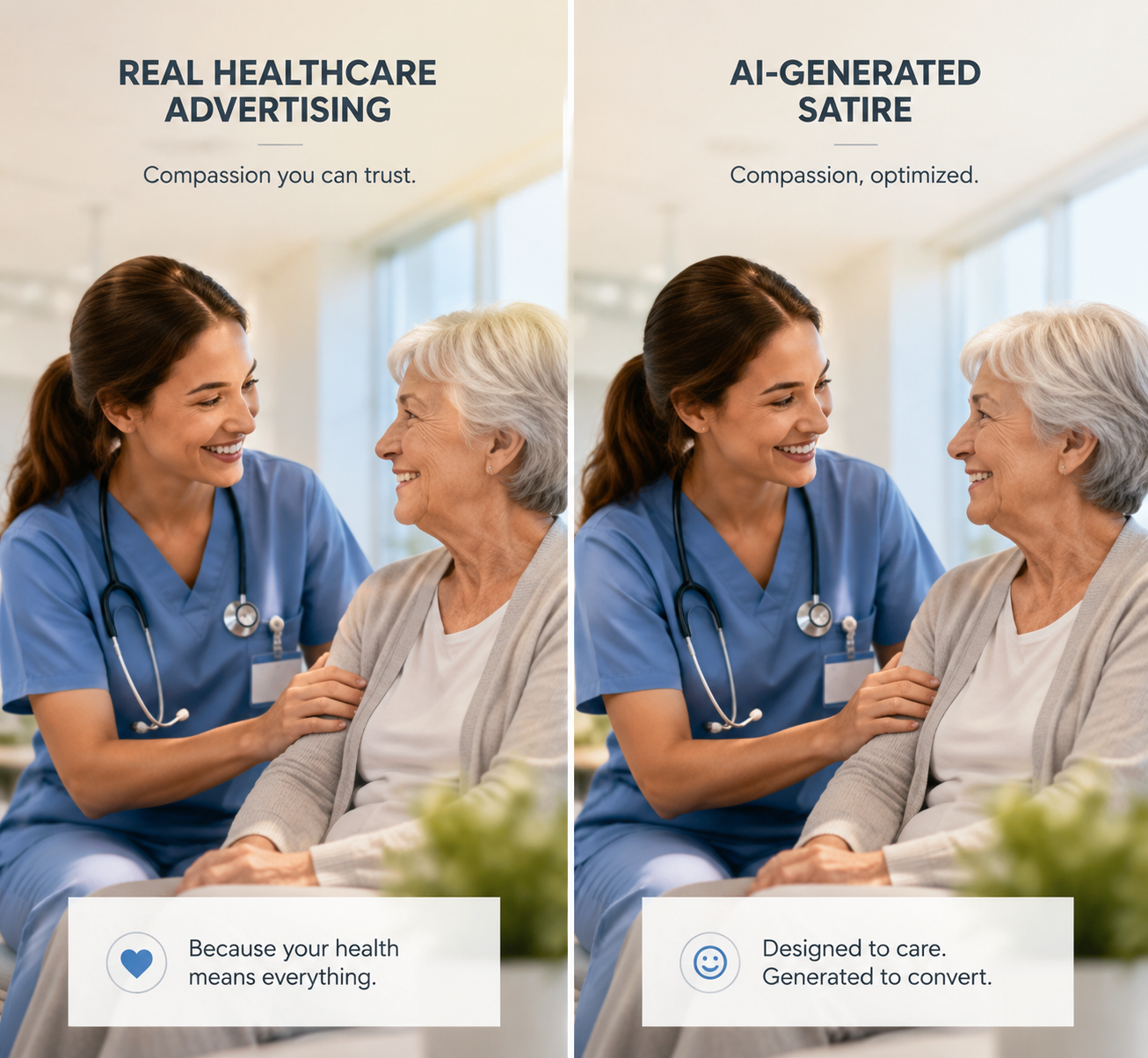
For healthcare brands, that resemblance is not a production novelty. It weakens a recognition system the industry has relied on for years. Patients have learned that certain visual signals mean “this is a real healthcare message”: the careful caregiver gesture, the bright clinical space, the patient looking relieved but not cured, the authoritative but gentle narration. When the same signals can be assembled quickly for parody or fiction, they stop working as quiet guarantees.
The burden then shifts onto the legitimate advertiser. A compliant campaign may still inherit suspicion created elsewhere. The viewer may not be asking whether the fair balance is adequate yet. The first question may be whether the spot belongs to the trust economy of medicine at all.
Healthcare Audiences Read Defensively
There is a persistent executive fantasy that younger audiences, having grown up with synthetic media, will simply accept AI-generated ads as normal. Some may. But the available perception data does not support treating acceptance as a default.
IAB and Sonata Insights research reported by Digiday in February 2026 found a sharp gap between marketer assumptions and consumer response: 82% of ad executives believed Gen Z and millennial consumers felt positively about AI-generated ads, while only 45% of those consumers actually did. Digiday also reported that the gap had widened from 2024.[4]
That figure is not a healthcare-specific patient trust study, and it should not be used as if it were. It is better read as a pressure reading. Marketers are more comfortable with AI advertising than the audiences they are trying to reach, and the mismatch matters most in categories where the viewer is already scanning for risk.
Healthcare is one of those categories. ThinkGen’s patient advertising testing found that breast cancer patients dismissed AI-generated pharma concepts because of subtle visual cues. The lesson is not that every AI image fails with every patient group. It is that patients in serious disease contexts may examine an ad with a defensive attentiveness that general consumer testing misses.[5]
That defensiveness is rational. A person evaluating information about a cancer therapy, a rare disease treatment, or a chronic condition support program is not just reacting to aesthetic taste. They are judging whether the communicator understands the stakes. If the image feels too frictionless, the patient may infer that the brand has smoothed out the very reality it claims to support.
Category Context Is Not a Footnote
One reason AI ad debates become shallow is that they treat “the audience” as a single body. A synthetic joke for a snack brand, a surreal fashion spot, an enterprise software billboard, and a patient-facing disease awareness campaign do not carry the same obligations.
DesignRush’s review of AI advertising backfires in 2025 emphasized three patterns that are especially relevant here: cost savings do not offset cultural damage, legacy brands face harsher criticism, and category context determines acceptability.[6]
Healthcare sits near the least forgiving end of that spectrum. A consumer technology brand can sometimes survive looking uncanny because novelty is part of its promise. A pharmaceutical or medical device brand usually cannot. The category asks patients to accept regulated, consequential information from an institution they may already distrust, fear, or depend on.
Even within healthcare, the risk is uneven. A rare-disease campaign involving caregivers and diagnostic delay carries a different emotional load than an over-the-counter seasonal allergy campaign. A corporate reputation ad has different evidentiary demands than a branded treatment ad. An HCP-facing mechanism-of-action animation is not the same as a patient story built around synthetic faces. The review standard should follow the trust burden of the communication, not the mere presence of AI in production.
The Compliance Question Moves Upstream
Medical, legal, and regulatory review often receives creative after the campaign language and visual system have already hardened. That sequence is poorly suited to AI-era credibility risk. By the time a reviewer is asked whether the generated caregiver looks acceptable, the campaign may already have committed to an aesthetic that resembles the wider internet’s idea of an AI parody ad.
The practical question is not only whether the team can disclose AI use, although disclosure may be relevant in some contexts. The harder question is whether disclosure would solve the viewer’s actual confusion. If the ad still looks like synthetic empathy wrapped around a medical claim, a label may clarify production without restoring trust.
Review needs to happen before the creative grammar is locked. That means asking, early, whether the concept depends on a stock-like patient, an idealized caregiver, a simulated testimonial mood, or a level of polish that erases the texture of real illness. Those are not merely taste objections. They are signals that may affect whether the audience can locate the message as authentic healthcare communication.
Patient testing should also change. It is not enough to ask whether a concept is clear, appealing, or motivating. In AI-assisted work, teams should test whether the audience believes the message is real, whether they think the people shown are real or synthetic, whether that matters to them, and whether any visual cue makes the brand feel less accountable. The point is not to let every skeptical reaction veto the work. It is to learn which cues carry distrust in the specific population being addressed.
Authenticity Has to Be Designed, Not Assumed
The safest answer is not “never use AI.” That would be too broad and, in many production processes, already unrealistic. AI can support concept exploration, versioning, localization, accessibility, internal visualization, and production planning without becoming the face of the patient relationship.
The better standard is legibility. A patient should be able to tell who is speaking. They should be able to identify what is being claimed. They should know what kind of evidence supports that claim. They should not have to perform a forensic read of the image to decide whether the brand is real, the scene is real, or the empathy is simulated.
That standard leads to different choices depending on the campaign. In a high-stakes patient setting, it may mean avoiding glossy synthetic humans altogether. In a disease education context, it may mean using illustration, clearly labeled animation, or real patient advocate input rather than generated pseudo-documentary scenes. In an HCP context, it may mean keeping AI-generated visuals abstract and clearly separated from patient representation. In corporate communications, it may mean explaining the governance behind AI use instead of celebrating AI enthusiasm in general terms.
Responsible leadership matters here, but it has to be visible in decisions, not just language. “We use AI responsibly” is not much of a credibility signal if the campaign looks like every other piece of AI hype the audience has learned to distrust. Stronger signals are more concrete: documented review standards, patient-population testing, clear separation between synthetic scenarios and real testimony, and restraint in contexts where realism would imply lived experience.
There is room for clever AI work outside the trust economy of medicine. Satire can expose the absurdity of tech marketing precisely because it exaggerates what real marketers have allowed to become normal. But a healthcare brand does not get the same margin for ambiguity. If its ad can be mistaken for the critique of an ad, the campaign has already lost part of the audience.
Healthcare brands are not barred from using AI in advertising. In 2026, they are required to design against misrecognition. The audience’s first question may no longer be “Do I believe this claim?” It may be “Is this even a real healthcare message?”
References
- So funny we forgot to laugh, Gazetteer SF
- Replacement AI satire blurs line between parody and tech reality, KRON4
- From Puppy Pills to Job Loss, Stephen Andekian
- With AI backlash building, marketers reconsider their approach, Digiday, February 2026
- AI-Generated Pharma Advertising: Opportunity and Risk, ThinkGen
- 7 Worst AI Advertising Backfires 2025, DesignRush
Comments
Join the discussion with an anonymous comment.