
AI-based actor health monitoring for role decisions becomes a serious production question only after one uncomfortable fact is put first: the entertainment industry already asks performers to carry physical risk that is measurable, repeatable, and often managed through self-report. A stunt performer may know the difference between soreness and danger, but that knowledge has to survive the pressure of a schedule, a coordinator’s expectations, and the quiet knowledge that another body can be put in the harness.
That is why the first useful version of AI wearable monitoring is not a futuristic casting filter. It is a safety and readiness layer for demanding work: fight scenes, falls, vehicle work, wire work, long dance days, underwater work, heat exposure, and repeated takes that turn a manageable load into accumulated strain. The technical question is whether sensors can measure enough of that strain. The harder question is whether the output can be used without punishing the person who admits the risk is real.
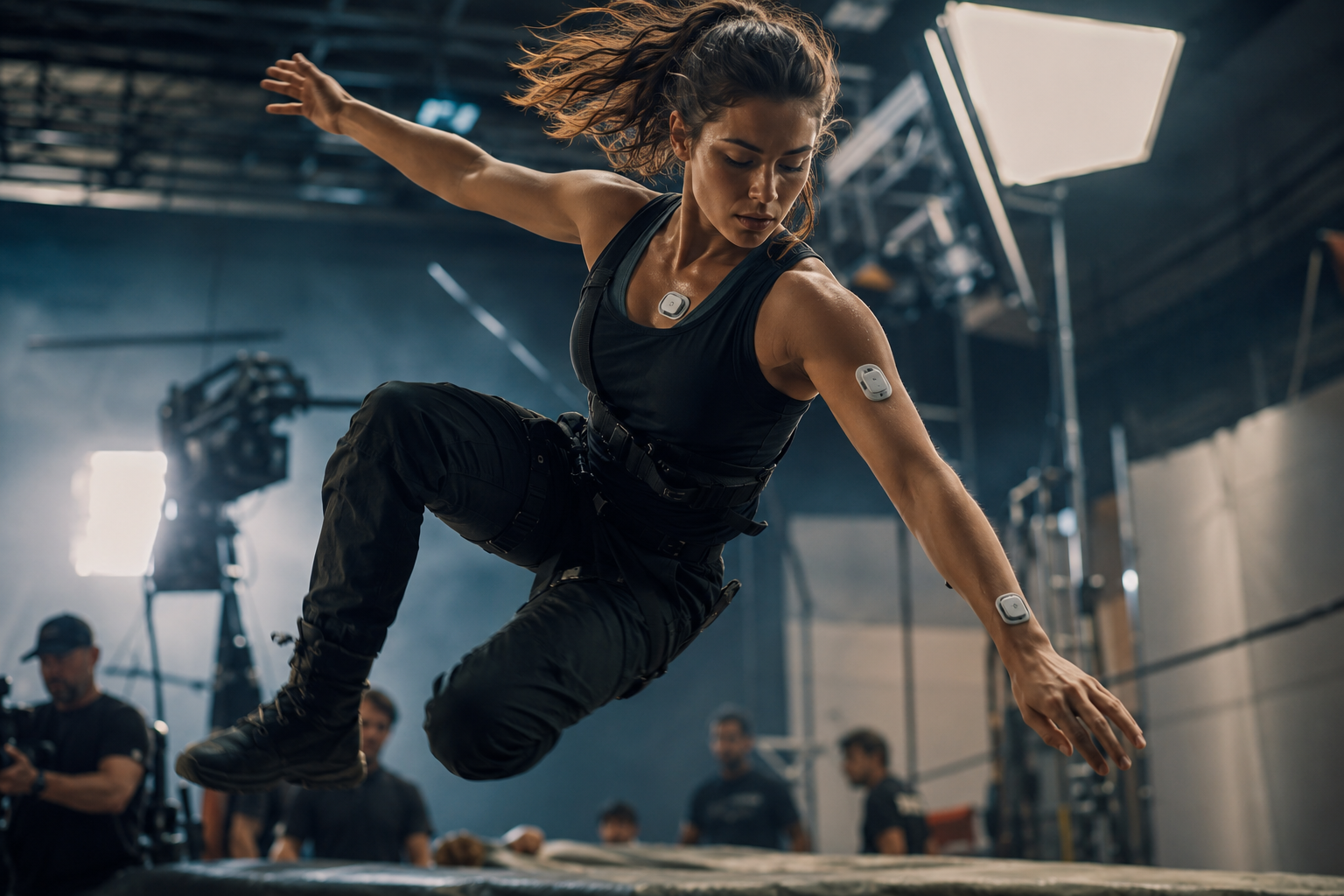
The readiness problem already exists on set
The strongest argument for monitoring does not come from the wearable market. It comes from stunt-performer health evidence. Russell et al. describe a workplace in which head impacts are treated as part of the job, concussion knowledge is unevenly operationalized, and reporting can be discouraged by the culture around employability and toughness.[1] Senn et al. found that stunt performers reported an 80–100% career prevalence of head impacts, a range that should make any readiness discussion less theoretical.[2]
The absence that matters is not only a missing device. Russell et al. report no on-set concussion specialists in the stunt-performer context they studied.[1] Without specialist oversight, the decision to continue often falls back on self-assessment, peer norms, and production momentum. Those are weak controls for head trauma because the performer being assessed is also the person whose future work may depend on appearing reliable.
Self-report fails for structural reasons. A performer may minimize symptoms to avoid losing the day’s work. A coordinator may not see the full effect of cumulative sub-concussive impacts. A production manager may see a delay before seeing a medical risk. Even when no one acts maliciously, the system rewards continuation until something becomes visibly unsafe. Wearable monitoring is attractive because it could make invisible load harder to ignore, but it would enter a workplace where silence has often been adaptive.
Head impacts also sit apart from ordinary fatigue. A performer can look composed after a hit and still have impaired balance, reaction time, or decision-making. For stunts, those impairments are not private health details; they can affect the next fall, the driver beside them, the timing of a fight partner, or the crew member standing near a moving rig. That does not mean every impact becomes a medical event. It means the industry needs a better way to know when the next setup has become a different risk category.
What AI wearables can plausibly measure
The sensing layer is no longer speculative. Shajari et al.’s review of wearable health-monitoring systems covers physical sensors such as ECG, motion, and gait; chemical biosensors such as sweat cortisol, lactate, and glucose; and machine-learning systems that classify physiological and movement patterns.[3] That does not make an entertainment-ready readiness score. It does show that the components needed to observe strain already exist in adjacent medical and sports contexts.
| Signal | What it could indicate for demanding performance | Why it is not enough alone |
|---|---|---|
| Heart rate and HRV | Cardiovascular load, recovery state, autonomic stress, possible fatigue accumulation | Performance anxiety, caffeine, heat, sleep, and conditioning can shift readings without proving unsafe readiness |
| Motion and gait | Changes in balance, asymmetry, landing mechanics, tremor, or compensation after impact | A role’s choreography may intentionally include unusual movement, so context-specific baselines matter |
| Sweat cortisol | Physiological stress response during intense work or repeated takes | Stress is not automatically injury risk, and sampling conditions can affect interpretation |
| Sweat lactate | High exertion, fatigue load, or poor recovery between physically demanding sequences | Workload thresholds would need role-specific validation |
| Activity recognition | Classification of falls, jumps, impacts, exertion periods, and rest intervals | Correctly recognizing an activity is different from judging whether the performer should continue |
The activity-recognition numbers are impressive but easy to overread. Shajari et al. report deep-learning classifiers achieving more than 99% accuracy in human activity recognition in the reviewed literature.[3] That is a signal-classification achievement, not proof that a production can safely deny, approve, or reassign a role based on a readiness score. Recognizing that someone jumped, landed, stumbled, or rested is a different claim from predicting whether tomorrow’s vehicle rollover is medically acceptable.
Still, the transfer case is plausible. Sports medicine already uses continuous physiological and biomechanical monitoring to support workload management, injury prevention, and return-to-play decisions. The same family of models discussed in AI sports injury evidence points toward a practical production use: not replacing medical judgment, but flagging patterns that deserve review before the next physically demanding call.
The closest fit is not the celebrity lead wearing a consumer watch. It is a monitored system around high-load work: baseline testing before a stunt sequence, passive collection during rehearsals and takes, threshold-based review after impacts or abnormal exertion, and an independent health professional empowered to slow or stop the work. The AI model would not need to decide who is brave enough. It would need to identify when the body in front of the camera is deviating from its own safe operating range.
Readiness is a workflow, not a score
A useful readiness system would have to separate several decisions that productions often collapse into one: whether a performer is medically fit, whether a specific stunt should be modified, whether the schedule should change, whether a double or alternate should be used, and whether an insurer needs documentation that risk controls were followed. One number cannot carry all of that.
For physically demanding roles, the relevant question is narrower than general health. A performer may be healthy enough for ordinary shooting and not ready for repeated high falls after a poor recovery night. Another may have elevated cardiovascular strain during a heat-heavy exterior day but remain safe for lower-load blocking. A dancer’s movement asymmetry may matter more than resting heart rate. A stunt driver’s reaction time after a head impact may matter more than their conditioning.
The output therefore needs a role-specific shape. A production system might flag “review before next impact sequence,” “modify take count,” “extend recovery interval,” or “medical evaluation required after head impact.” Those are safer categories than “cast” and “do not cast.” They also match how risk is actually managed: through adjustments to the work, not only through replacement of the worker.
Rehabilitation is part of the same loop. AI-assisted motion analysis and recovery tools already parallel sports-injury workflows, including the kinds of movement-quality observations discussed in AI-assisted rehabilitation for sports injuries. For performers, that matters because the job often requires return to a very specific physical task rather than general return to activity. A performer does not merely need to feel better; they may need to land on one side, repeat a fight rhythm, climb in costume, or react inside a rig.
Who would use the data?
The most defensible user is not a casting director scanning biometric dashboards. It is a health-and-safety function with enough independence to act against schedule pressure. On a high-risk day, wearable outputs could help a medic, athletic trainer, concussion specialist, stunt coordinator, and production safety officer decide whether the next setup needs modification. The performer should also receive the data in a form they can understand, because readiness monitoring without performer access becomes surveillance dressed as safety.
Insurers may be the near-term economic driver. They have a direct interest in reducing injury-related delays, documenting safety controls, and distinguishing ordinary production risk from unmanaged physical exposure. A wearable readiness program could become attractive as evidence that a production planned for recovery intervals, tracked high-impact work, and escalated abnormal readings to qualified review. That is different from claiming insurers already use biometric readiness scores for casting decisions; the available research does not document that practice.
Studios also have a business reason to care, but that reason cuts both ways. Duke Tech Policy @ Sanford’s 2026 analysis describes a film-production environment shaped by AI cost-saving pressure and cites a greater than 35% decline in LA County production jobs since 2022.[4] The same analysis notes reporting that frames AI actors as lower-risk substitutes for humans who can be injured, but that Forbes framing is available here only through Duke’s discussion, not as independently reviewed evidence in this article.[4]
That economic backdrop changes the ethics of health monitoring. If a human performer is being compared, implicitly or explicitly, with a digital alternative that does not get concussed, fatigued, or insured in the same way, then biometric readiness data can become more than a safety tool. It can become a labor-market signal. A system introduced to prevent injury could quietly sort workers by perceived liability unless its permitted uses are defined in advance.
The governance gap is larger than the sensor gap
The entertainment industry already has an AI labor framework problem, but most of the visible debate has centered on digital likeness, synthetic performance, and consent for replication. Duke’s 2026 analysis notes that SAG-AFTRA’s current AI consent frameworks focus on digital replication rather than biometric health-data governance.[4] That leaves a different category of AI use underdeveloped: systems that collect body data from working performers and convert it into operational judgments.
Biometric health data needs rules before it becomes routine. The minimum questions are blunt: Who owns the data? Who can see raw signals? How long are records retained? Can a studio reuse readings from one production during negotiations for another? Can an insurer request historical strain profiles? Can casting see a readiness flag? Can a performer refuse monitoring without losing consideration for high-risk work? What appeal exists when an algorithm labels someone high risk?
Medical AI regulation offers some context, but it does not solve the production problem by itself. Health AI tools that influence clinical decisions may eventually face clearer regulatory expectations, the kind discussed in relation to the FDA’s 2026 clinical decision support guidance in AI CDS FDA guidance. But a film set is not a hospital, a casting office is not a clinic, and a production insurer is not a treating physician. The legal category of a tool may depend on how it is marketed and used; the workplace consequences can arrive before the regulatory classification feels settled.
The cultural barrier is just as hard as the legal one. Russell et al. describe a “cowboy culture” around stunt work that can discourage injury reporting.[1] That phrase matters because AI systems depend on truthful baselines, consistent participation, and trust. If performers believe the data will be used to replace them, they will have rational reasons to avoid monitoring, mask symptoms, or treat the device as another production demand rather than a safety control.
A readiness model trained on incomplete or distorted data will not become fair because it is automated. If the people most at risk are least willing to report symptoms, the system may learn from a biased version of the workplace. If performers with more bargaining power can refuse or negotiate data limits while less powerful performers cannot, monitoring can deepen the very imbalance it claims to manage.
What would have to exist before role decisions are safe
The technical infrastructure can be imagined now: wearable ECG or heart-rate monitoring, motion sensors, impact detection, sweat biomarkers where validated, and AI models that compare current readings against individual baselines and task demands. The missing infrastructure is less glamorous and more important.
- Standardized performer health datasets that distinguish stunt categories, dance, fight work, driving, heat exposure, underwater work, and ordinary acting demands.
- Role-specific validation showing that a signal predicts relevant safety outcomes for performers, not just athletes, patients, or military personnel.
- Independent clinical or occupational-health oversight, especially for head impacts and return-to-work decisions.
- Consent rules that separate safety monitoring from casting evaluation, employment screening, marketing claims, and insurance pricing.
- Audit rights, appeal mechanisms, and data-retention limits negotiated with performers and their representatives.
The hardest boundary is casting. A production can reasonably ask whether a performer is safe to complete a defined task on a defined day with appropriate controls. It is much more dangerous to let historical biometric data become a general employability score. The first use protects the person taking the risk. The second can punish them for having a body that records strain.
Insurance use needs the same constraint. A carrier may want evidence that a production followed safety protocols, responded to abnormal readings, and provided specialist review after impacts. That is a legitimate risk-management interest. It should not automatically give the carrier access to identifiable longitudinal health profiles that follow a performer across jobs.
For unions, the lesson from digital likeness negotiations is that consent language has to reach the actual mechanism of harm. A performer’s scan can be reused to create a synthetic performance. A performer’s biometric record can be reused to characterize them as fragile, expensive, or unsuitable. Both involve AI-mediated control over future work, but the second is easier to disguise as safety.
A conditional yes
AI wearables can technically support performer readiness and injury-risk assessment for demanding roles. The sensors can capture relevant physiological and biomechanical signals, and adjacent fields have already shown that continuous monitoring can inform readiness and injury-prevention workflows. For entertainment production, the strongest near-term use is safety planning and insurance risk management: identifying when a stunt sequence needs review, when recovery time should be extended, when a head impact requires specialist evaluation, and when production risk controls need documentation.
The case is weaker, and more dangerous, when the same data is used for direct role denial or broad casting decisions. The entertainment industry does not yet have standardized performer health databases, role-specific validation, biometric consent rules, limits on use in casting and insurance, or union frameworks that address health data as directly as digital likeness. The technology is close enough to matter. The governance is not yet close enough to make it safe.
References
- Stunt performers and concussion: an exploratory qualitative study, Journal of Occupational Medicine and Toxicology, 2024, link
- Occupational concussion in stunt performers: an exploratory study, Journal of Occupational Medicine and Toxicology, 2023, link
- A Survey on Wearable Sensors and IoT Applications for Healthcare, Sensors, 2023, link
- AI & the Film Industry: Production, Duke Tech Policy @ Sanford, May 2026, link
Comments
Join the discussion with an anonymous comment.