
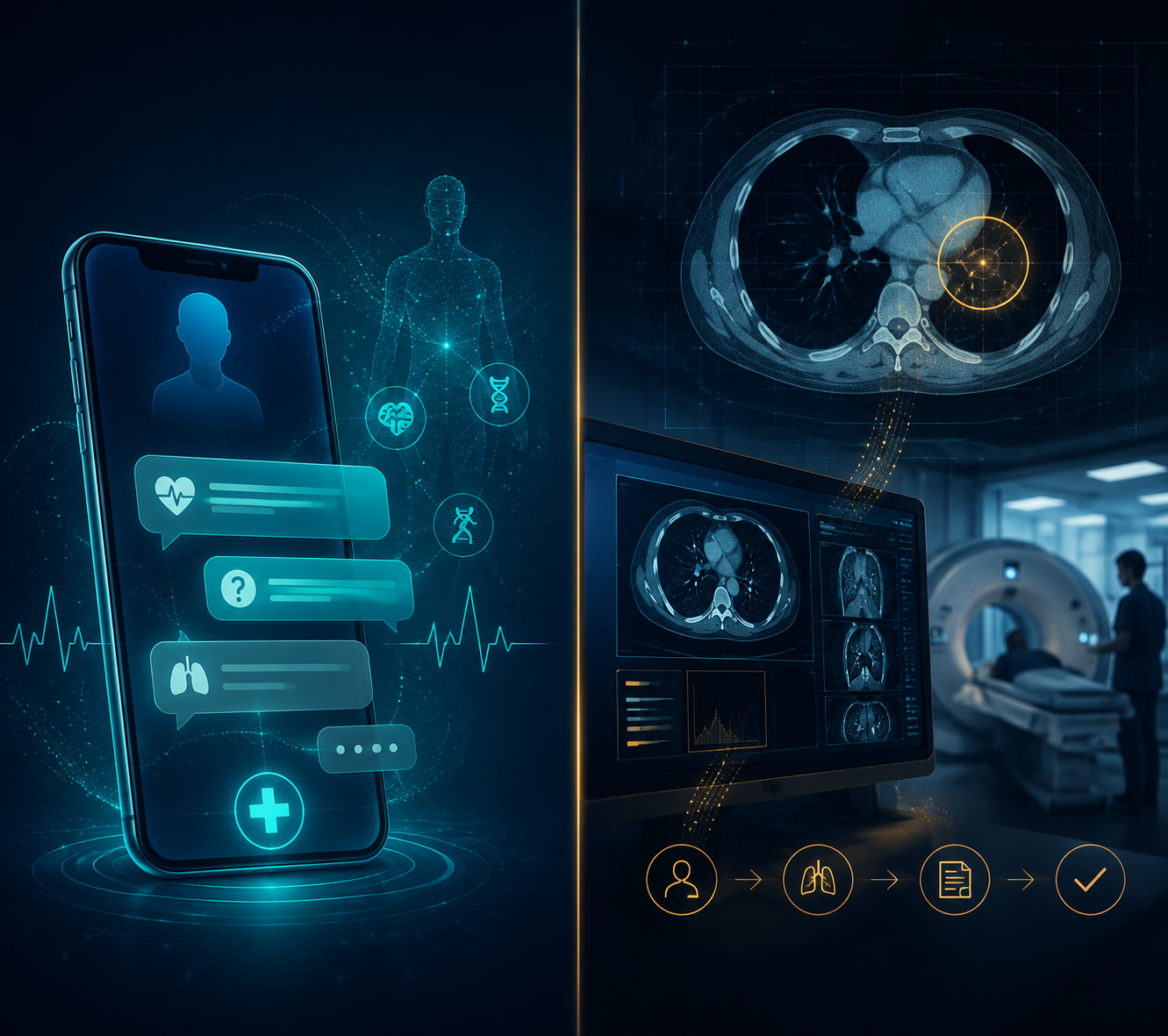
The useful way to read the Apple-Alibaba AI partnership in healthcare is not as a single pipeline from Alibaba's medical AI portfolio into every iPhone in China. It is a sorting problem. Some capabilities belong at the language layer, where a consumer asks a health question and receives an answer through Apple Intelligence. Others belong inside a hospital imaging workflow, where a CT study is acquired, routed, analyzed, reviewed, documented, and acted on by clinicians. Those are not the same deployment channel.
That distinction matters more now because China's Cyberspace Administration approved Apple Intelligence for China on July 15, 2026, with Alibaba's Qwen handling the language AI layer and Baidu handling search, according to reporting on the approval and architecture.[1][2] The approval is only three days old as of this article's current date, so Apple has not yet defined a consumer launch date or the exact scope of any health-related features. But the basic question is already in the market: does Alibaba's healthcare AI now come to iPhones?
The short answer is narrower than the headline suggests. Qwen-based health information features are plausible. DAMO Academy's imaging and screening systems are not iPhone features by default. Enterprise pharmaceutical and traditional Chinese medicine platforms sit in a third category: meaningful healthcare AI, but deployed through institutional back ends rather than through Siri or Apple Intelligence.
The Deployment Map
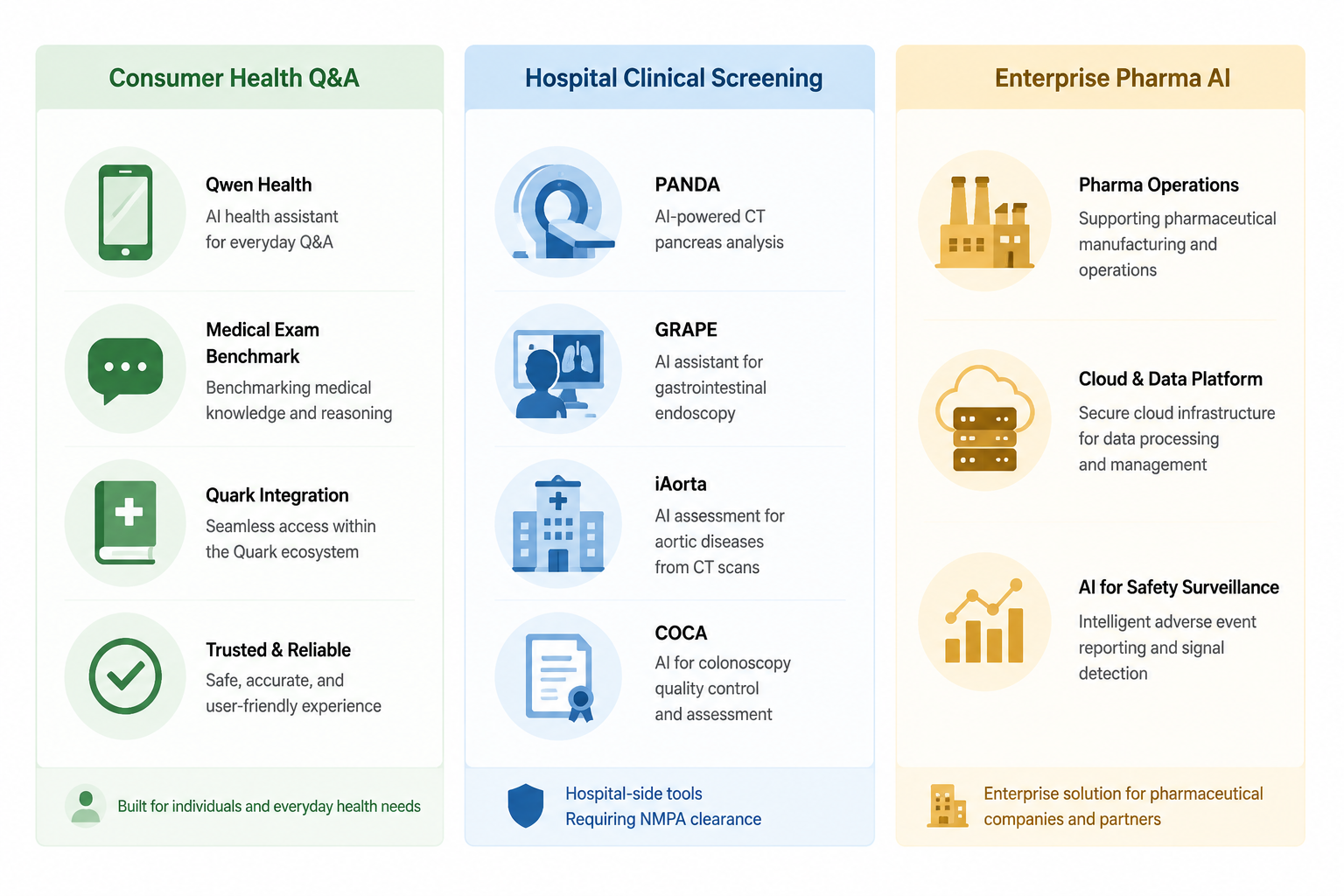
Alibaba brings several healthcare-adjacent AI assets to the discussion, but they do not travel through the same infrastructure. A model that can answer medical exam questions can plausibly support consumer health Q&A. A pancreatic cancer screening model that reads CT images needs imaging access, clinical validation, hospital IT integration, and regulatory clearance as a medical device or clinical decision support product. A pharma adverse-event system may never touch a patient-facing phone at all.
| Alibaba healthcare AI asset | Most realistic deployment channel | What the evidence shows | What Apple Intelligence does not automatically provide |
|---|---|---|---|
| Qwen Health | Consumer health information and Q&A through Qwen-powered assistant experiences | Reported 74.8% accuracy at China's Deputy Chief Physician medical exam level; already integrated into Alibaba's Quark browser app | Clinical safety evidence, diagnostic authorization, or proof that consumer answers improve outcomes |
| PANDA pancreatic cancer screening | Hospital-side CT imaging workflow | Reported 92.9% sensitivity, 99.9% specificity, FDA Breakthrough Device designation, and more than 6 million screenings completed | CT image access, radiologist workflow placement, NMPA-style clearance, or clinical accountability |
| GRAPE gastric cancer screening | Hospital-side imaging workflow | Reported 85.1% sensitivity, 96.8% specificity, trained on more than 100,000 patients | A consumer distribution path, scanner integration, or hospital deployment rights |
| iAorta acute aortic syndrome system | Hospital-side acute imaging workflow | Reported 95% sensitivity in a prospective trial of 15,584 patients | Emergency department adoption, PACS/RIS integration, or clinician sign-off |
| COCA | Hospital-side clinical screening category | Identified as part of DAMO Academy's clinical screening portfolio | Automatic consumer availability through Apple Intelligence |
| AstraZeneca Qwen adverse-event reporting | Enterprise pharmaceutical back end | Reported 95% accuracy, improved from 90%, and 300% efficiency gain | A consumer health feature or direct point-of-care diagnostic tool |
| PuraPharm/HerbMiners TCM platform | Enterprise and hospital clinical decision platform | Reported deployment across hospitals in China, Hong Kong, the United States, Canada, and Australia | Native iPhone availability or Apple-mediated clinical deployment |
This table is the difference between a distribution story and a clinical implementation story. Apple can provide a channel to a very large installed base of Chinese iPhone users. It does not thereby provide access to CT scanners, hospital picture archiving systems, radiologist worklists, local medical-device approval, or institutional risk management.
Qwen Health Is the Plausible Apple-Facing Asset
If any Alibaba healthcare asset can plausibly ride the Apple channel soon, it is Qwen Health. Alibaba's healthcare model reportedly scored 74.8% accuracy at China's Deputy Chief Physician level in medical exams, outperforming GPT-4o, DeepSeek R1, and DeepSeek V3 on that test, and it has already been integrated into Alibaba's Quark browser app.[3]
That is a meaningful consumer-AI signal. It suggests that Alibaba has a medical-language model capable of handling medical terminology, exam-style reasoning, and user-facing health questions better than a generic assistant in at least one benchmark setting. For Apple, which needs a China-compliant language layer for Apple Intelligence, Qwen Health or related Qwen medical capabilities are the most obvious healthcare-adjacent ingredient.
But the benchmark should stay in its lane. A medical exam score is not evidence that a consumer assistant safely triages chest pain, evaluates a medication interaction for a specific patient, or reduces unnecessary visits without delaying necessary ones. Exam questions are structured. Real users are vague, anxious, multilingual, sometimes wrong about their own histories, and often missing the very detail a clinician would need before acting.
The best near-term version of Qwen-powered health on iPhones is therefore likely to look like health information assistance: explaining terms, preparing questions for a doctor, summarizing general guidance, helping a user understand a report they already have, or navigating when to seek professional care. Even there, Apple and Alibaba would need careful guardrails around emergency symptoms, pediatric and pregnancy scenarios, medication advice, and the difference between general education and individualized diagnosis.
The architecture also deserves attention. Reporting on the China rollout says language AI routes through Alibaba's Qwen cloud rather than Apple's Private Cloud Compute.[1][2] That makes the product different from the privacy architecture Apple has emphasized in other markets. No independent security audit of Apple Intelligence China's data handling has been published, and Alibaba's status under China's National Intelligence Law Article 7 creates structural data-sovereignty questions for health queries. Those issues do not make Qwen Health unusable; they do mean health features should not be described as if they inherit Apple's global AI architecture unchanged.
There is also a hardware-efficiency subplot that should not be overread. TechTimes reported that Apple's PrismML 1-bit quantization technology, which could compress Qwen 3.6 from 54 GB to less than 4 GB, is under evaluation, but not confirmed as shipping.[1] Until Apple confirms what runs on device, what runs in Alibaba's cloud, and what is excluded from health-related uses, PrismML is an implementation possibility rather than a healthcare deployment fact.
PANDA Shows Why Clinical AI Does Not Become an iPhone Feature
PANDA is the strongest example of the confusion. It is also the best example of why the confusion should be resisted. DAMO Academy's pancreatic cancer detection tool has been reported with 92.9% sensitivity, 99.9% specificity, an FDA Breakthrough Device designation, and more than 6 million screenings completed.[4][5] Those are not throwaway numbers. In hospital AI procurement, a tool with named disease focus, imaging modality, sensitivity, specificity, regulatory milestone, and screening volume deserves serious attention.
But PANDA operates on non-contrast CT. That fact alone puts it in a different world from Apple Intelligence. A patient does not generate a diagnostic abdominal CT by asking Siri a question. A hospital acquires the scan, stores it, routes it, applies an algorithm under defined conditions, presents results to a radiologist or clinical team, and documents what happens next. Every one of those steps carries operational and legal meaning.
For a hospital, PANDA's deployment question is practical before it is philosophical. Does the system connect to the CT scanner, PACS, RIS, or a separate AI orchestration layer? Does it process all eligible non-contrast CTs or only scans ordered for specific indications? Where does the output appear: radiologist worklist, secondary capture, structured report suggestion, dashboard, or alert queue? Who clears false positives? Who ensures follow-up for incidental findings? Who audits drift across scanners and patient populations?
These questions are not friction for friction's sake. They define whether an AI screening tool becomes care or just software installed near care. A pancreatic finding that appears in a radiology workflow can trigger comparison imaging, specialist referral, additional testing, and patient anxiety. A missed finding can become a liability issue. An unclear alert can become another unread notification in an already overloaded department.
The Apple-Alibaba partnership does not answer those questions. It may make Alibaba's AI brand more visible to Chinese consumers and developers. It may normalize Qwen as the language layer on hundreds of millions of devices. It does not place PANDA inside a hospital's imaging stack, obtain local diagnostic approval for a specific clinical use, or define the radiologist's obligation to review its output.
GRAPE, iAorta, and COCA Belong on the Same Side of the Line
The same deployment logic applies to DAMO Academy's other clinical screening systems. GRAPE, a gastric cancer screening tool, is reported with 85.1% sensitivity and 96.8% specificity and was trained on more than 100,000 patients.[5][6] iAorta, focused on acute aortic syndrome, is reported with 95% sensitivity in a prospective trial of 15,584 patients.[5][6] COCA is part of the same clinical screening family, though the cited sources do not provide comparable performance figures.
GRAPE and iAorta are not less important because they are not consumer-phone features. In fact, their clinical value depends on not being treated like general-purpose assistant functions. Gastric cancer screening and acute aortic syndrome detection require patient selection, imaging quality controls, clinically appropriate thresholds, reporting paths, and escalation rules. Aortic emergencies also compress time: an alert is useful only if it reaches the right clinician fast enough and fits the emergency department's existing decision process.
That is why regulatory labels and deployment labels should stay separate. CAC approval for Apple Intelligence is not the same thing as NMPA-style clinical clearance for a diagnostic or screening product. ClinicalMind has already covered that regulatory distinction in its analysis of Apple's China AI registration. For DAMO's imaging tools, the harder day-to-day question is what hospitals can safely deploy, monitor, and govern after any required authorization is in place.
A consumer assistant can explain what an aortic dissection is. It should not be confused with an acute aortic syndrome detection system that evaluates imaging inside a hospital workflow. A phone can help a patient prepare for an appointment after a gastric imaging report. It is not the system that reads the study, inserts a finding into the reporting workflow, or triggers a cancer-screening follow-up program.
Enterprise Healthcare AI Is a Third Category, Not a Hidden iPhone Feature
Alibaba's healthcare AI footprint is not limited to consumer Q&A and radiology screening. Its enterprise cases show another route: institutional systems that use Qwen or Alibaba Cloud infrastructure to improve back-office or clinical operations.
AstraZeneca's Qwen-based adverse-event reporting system is described by Alibaba Cloud as improving accuracy to 95% from 90% and producing a 300% efficiency gain, and Alibaba Cloud calls it the first system of its kind in the pharmaceutical industry.[7] That is relevant to healthcare AI strategy, especially pharmacovigilance and regulatory operations. It is not a consumer-facing Apple Intelligence feature.
PuraPharm's HerbMiners platform is another enterprise case. Alibaba Cloud describes it as a Qwen-powered traditional Chinese medicine clinical decision platform deployed across hospitals in China, Hong Kong, the United States, Canada, and Australia.[8] Again, the deployment object is an institutional platform, not the iPhone as a medical device. The clinical governance questions run through participating hospitals and platform operators.
These cases matter because they keep the Apple-Alibaba story from being too narrow. Alibaba has healthcare AI assets across consumer information, clinical screening, pharma operations, and specialty decision support. But the presence of a Qwen connection does not collapse them into one product surface. Qwen can be a language layer for Apple Intelligence, a model component in an enterprise workflow, or part of a clinical decision platform. Each use inherits a different evidence burden.
What Could Actually Reach iPhone Users
The most realistic healthcare applications of the Apple-Alibaba AI partnership are device-facing language features. A Chinese iPhone user could ask a Qwen-powered assistant to explain a lab term, compare common meanings of symptoms, draft questions for a doctor, summarize general prevention guidance, or translate medical language into plainer wording. Those uses fit the Apple Intelligence channel because they are language tasks initiated by the consumer.
Even that modest version would be consequential. Apple has more than 280 million active iPhones in China. A health information assistant available through that device base would be one of the largest consumer deployments of healthcare-adjacent AI anywhere. Scale, however, is not the same as clinical effectiveness. It measures reach, not whether users make safer decisions or clinicians receive better-prepared patients.
For health IT strategists, the clean test is simple: what data does the system see, where does the model run, and who acts on the output? If the input is a consumer's typed or spoken question and the output is general guidance, the Apple channel is plausible. If the input is a CT series and the output is a suspected pancreatic lesion, gastric cancer signal, or acute aortic syndrome alert, the deployment path runs through hospital infrastructure. If the input is an adverse-event narrative or a traditional medicine knowledge base, the path is enterprise software.
The broader generative AI market is moving toward exactly this kind of channel confusion: models appear in consumer apps, enterprise copilots, clinical documentation systems, imaging workflows, and research platforms, often under the same vendor brand. For readers tracking that wider landscape, ClinicalMind's 2026 overview of generative AI in healthcare is the more appropriate place to widen the lens. Here, the relevant discipline is narrower: do not borrow evidence from one deployment category to validate another.
A Current Q3 2026 Judgment
As of Q3 2026, the Apple-Alibaba AI partnership creates a credible consumer distribution pathway for Qwen-based health information features on iPhones in China. Qwen Health is the asset that most naturally fits that channel, with the important caveat that medical exam performance is not real-world clinical safety evidence.
Alibaba's DAMO Academy screening systems are a different matter. PANDA, GRAPE, iAorta, and COCA remain hospital-side clinical infrastructure products. Their path to patient care runs through imaging systems, clinicians, regulators, compliance teams, procurement committees, and IT integration. The Apple-Alibaba partnership may make the language layer on Chinese iPhones more capable. It does not carry Alibaba's CT-based screening portfolio onto those phones.
References
- Apple Intelligence Wins China Approval After 22 Months: Qwen Handles Language, Baidu Handles Search — TechTimes, July 17, 2026
- Alibaba's Qwen AI to power Apple Intelligence in China — CNBC, July 15, 2026
- Alibaba's healthcare AI model scores as high as senior-level doctors in medical exams — SCMP
- Alibaba's AI cancer detection tool clears FDA hurdle — SCMP
- DAMO MED product page — DAMO MED
- Advancing multi-disease detection with AI imaging at Alibaba DAMO Academy — AI for Good, ITU
- AstraZeneca — Alibaba Cloud
- PuraPharm — Alibaba Cloud
Comments
Join the discussion with an anonymous comment.