
Noah Wyle did not walk the 2025 Emmys red carpet in scrubs. That would have been too literal, and probably too easy to dismiss. Instead, FIGS put him in a custom tuxedo cut from the visual language of healthcare workwear, and the result traveled far beyond the usual trade conversation about uniforms. The look went viral and appeared among Vogue’s Emmy highlights, a small but revealing signal that medical apparel had become legible as fashion outside the hospital walls.[1]
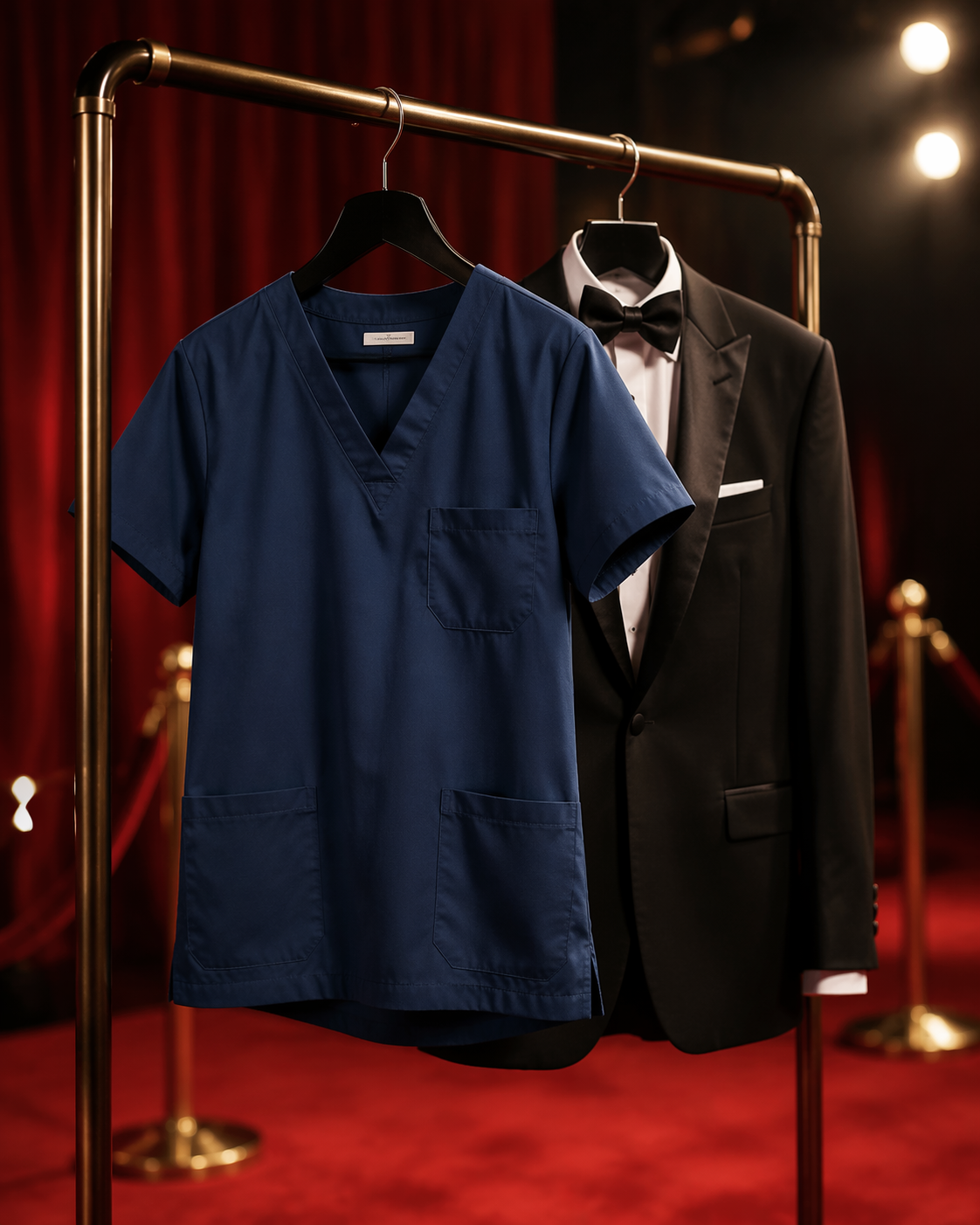
For anyone who has sat through a hospital apparel standardization meeting, the moment was less absurd than it looked. Scrubs have been carrying more than fabric weight for years: hierarchy, department identity, recruitment polish, infection-control expectations, staff morale, patient recognition, and the quiet daily judgment of whether a garment can survive a twelve-hour shift without becoming a punishment.
The useful question is not whether celebrity influence has made medical clothing more glamorous. That is too broad and too flattering. The better question is where pop culture has actually changed demand, vendor behavior, and institutional choices. On that narrower test, the change is real. Staff scrubs have become a consumer-facing, fashion-conscious category at scale. Patient gowns have changed more unevenly: designers have produced better, more dignified garments in specific programs, but cost, laundering, and clinical-access requirements still keep that side of the market far more constrained.
Television Taught Scrubs To Have A Look
The Wyle tuxedo was a red-carpet punctuation mark, not the beginning of the story. A more durable shift started with television, especially Grey’s Anatomy. Barco launched its licensed Grey’s Anatomy scrubs line in 2006, and the line became a major commercial force by turning a television medical aesthetic into real-world demand for recognizable colors, cuts, and styling.[2]
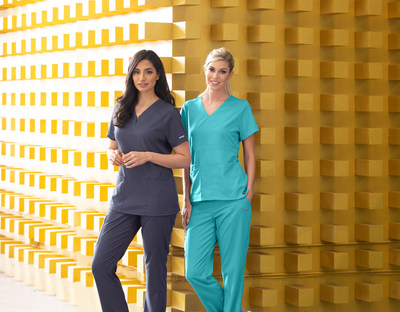
That matters because hospital apparel purchasing used to be easier to describe in institutional terms: approved color, acceptable vendor, unit compliance, laundry compatibility, price, durability. Television added another layer. It gave clinical identity a mass-market visual vocabulary. The scrub top was no longer only a standardized work garment; it could also suggest competence, belonging, personality, and polish.
There is a reason licensed scrubs landed with clinicians rather than only with fans. Nurses, physicians, techs, and students already spend their working lives in garments that flatten personal presentation. A scrub line associated with a beloved medical drama did not have to persuade them that apparel carried emotion. It only had to offer a version of that emotion that still looked acceptable inside a clinical environment.
This was not haute couture entering the ICU. It was more practical and more consequential: a consumer cue entering a regulated workplace category. Once staff had seen scrubs that felt selected rather than merely issued, procurement teams were no longer the only audience vendors needed to satisfy.
FIGS Turned The Scrub Buyer Into A Consumer
FIGS did not invent the desire for better scrubs, but it understood the buyer differently. The company positioned medical apparel closer to fashion and athleisure than to a uniform commodity. Its rise made that distinction financially visible: FIGS reached a $3 billion valuation at its May 2021 IPO, after reporting 2020 revenue of $263 million and nearly $50 million in profit.[3]
The company also arrived with cultural and investor credibility that traditional uniform vendors rarely had. Its celebrity and high-profile investors included Will Smith, Legendary Pictures founder Thomas Tull, and former Lululemon CEO Christine Day.[3] That mix is worth noticing. It tied medical apparel to entertainment capital, performance apparel expertise, and direct-to-consumer brand logic in one package.
The shift was not just in marketing language. Direct-to-consumer scrub brands trained clinicians to shop for medical apparel the way they shop for leggings, sneakers, or outerwear: by fit, silhouette, color drop, fabric feel, pocket placement, and social proof. That is a different purchasing rhythm from an annual hospital uniform contract. It also creates a predictable management problem. Staff may remain inside the hospital’s color policy while stepping outside the approved vendor list because the off-contract product fits better, looks better, or simply feels less like institutional residue.
FIGS’ charitable work also helped the brand occupy a more complicated space than ordinary fashion disruption. Its Threads for Threads program donated more than 500,000 scrub sets in more than 35 countries; during COVID-19, the company donated 30,000 scrub sets to New York City hospitals and contracted production of more than 1 million N95 masks.[3] Those programs do not prove product superiority, but they did reinforce the company’s claim to be part of the healthcare workforce story rather than merely selling into it.
By the time Wyle appeared in a custom FIGS tuxedo at the 2025 Emmys, the brand did not have to explain why scrubs belonged in a pop-culture conversation. The company had already spent years collapsing the distance between clinician identity, apparel preference, and public image. The tuxedo simply made that collapse visible to people who do not read uniform catalogs or sit on dress-code committees.[1]
The Market Is Large, But The Definitions Are Messy
Market estimates support the broader direction, though they should be handled carefully. Coherent Market Insights estimates the global medical scrubs market at $55.1 billion in 2026 and projects it to reach $86.76 billion by 2033, with a 6.7% compound annual growth rate. The same source puts North America at 44.4% of market share.[4]
Those numbers are useful as context, not as a clean measurement of celebrity influence. Scrub-market estimates vary because sources draw category boundaries differently: some include broader medical apparel, lab coats, disposable products, reusable garments, or adjacent uniform categories. That makes the direction of growth more persuasive than any single headline number.
| Market Layer | What It Means For Health Systems |
|---|---|
| Legacy B2B giants such as Careismatic, Cherokee, and Dickies | Contracting familiarity, scale, color-program support, and established institutional channels |
| DTC disruptors such as FIGS, Jaanuu, and Mandala | Higher staff expectations around fit, style, fabric feel, and brand identity |
| Private-label OEMs such as Fuyi Group and Bestex Scrubs | Cost flexibility and customization options, with more responsibility on buyers to validate quality and claims |
That three-layer structure appears in 2026 industry guides that describe legacy B2B suppliers, DTC brands, and private-label manufacturers competing for different parts of the same apparel spend.[5] It is a more fragmented environment than the old hospital-buyer-versus-uniform-vendor model suggests.
Trend reports for 2026 also point to design movement: joggers giving way to wide-leg or bootcut pants, softer palettes, earth tones, and more unisex designs.[6][7] These reports often come from commercial apparel sources, so they should not be read as neutral epidemiology of taste. Still, they track what buyers are being shown and what staff are learning to ask for.
For procurement teams, the practical issue is not whether bootcut pants are back. It is that silhouette, color, and fabric preference now enter the same conversation as compliance and cost. A health system that standardizes apparel without acknowledging that reality may still get a signed policy. It may not get actual adherence.
Why Apparel Standardization Has Become Harder
A hospital uniform program has never been only a purchasing exercise. At minimum, it touches infection prevention, employee relations, patient navigation, unit culture, brand standards, laundry operations, and payroll or stipend policy. Celebrity-driven scrub culture adds pressure because it moves some of the category’s authority away from the institution and toward the individual clinician.
That does not mean hospitals should surrender apparel standards to Instagram. It means they need to understand why staff bypasses happen. A nurse who buys off-policy scrubs may be rejecting a vendor, not a color system. A resident who chooses a DTC brand may be responding to pocket layout or stretch rather than vanity. A department that pushes for a softer palette may be trying to look less industrial to patients, even if the request arrives wrapped in trend language.
The procurement consequence is straightforward: apparel contracts now carry workforce-branding risk. If the approved garment is uncomfortable, unflattering, or visibly lower quality than what staff can buy directly, the policy starts to look punitive. If every unit negotiates its own exception, the organization loses the patient-facing clarity that uniform standards were supposed to create.
The better institutional response is usually not a binary choice between a fully centralized catalog and a free-for-all. Health systems can define nonnegotiables, then create flexibility inside them: approved color families, approved silhouettes, approved vendors that include both traditional and DTC-style options, and fabric or laundering requirements that are explicit rather than assumed. The point is to make the real constraints visible before staff discover them through denial notices.
- Clinical identification: Can patients and colleagues still tell who is who?
- Operational durability: Can the garment tolerate the required washing, drying, and shift conditions?
- Fit range: Does the program work across body types, roles, and mobility needs?
- Vendor governance: Are substitutions, color drift, and backorders manageable?
- Workforce signal: Does the apparel support recruitment and retention, or quietly undermine them?
That last item can sound soft until it becomes expensive. Apparel dissatisfaction shows up in manager escalations, shadow purchasing, inconsistent branding, and the slow erosion of trust in centralized decisions. A scrub top does not fix staffing shortages. But a bad one can become one more daily reminder that decision-makers do not understand the work.
Patient Gowns Are The Harder Test
Staff scrubs became fashion-conscious because workers had purchasing power, social visibility, and a growing set of brands willing to speak directly to them. Patient gowns are different. Patients often wear them when they have the least control, the least privacy, and the least ability to complain without feeling difficult.
The standard gown has been disliked for reasons that are not cosmetic. A 2021 Hofstra/Northwell study described it as “dehumanizing, anachronistic, and designed for providers’ convenience.” A 2020 Patient Experience Journal study found patients using terms including “nightmare,” “flapping in the breeze,” and “one-size-fits-none.”[8]
That language should make patient-experience teams uncomfortable. It describes a garment that solves for access while transferring embarrassment to the person wearing it. Anyone who has watched a patient clutch the back of a gown while walking a hallway knows this is not a branding problem first. It is an indignity built into a supply item.
Fashion designers have tried to intervene. Diane von Furstenberg redesigned gowns for Cleveland Clinic in 2010. Carhartt’s Henry Ford Model G gown appeared in 2014. Cynthia Rowley collaborated with Hackensack in 1999.[8] These examples matter because they show that the patient garment has not been invisible to design culture. They also show how long the problem has persisted despite periodic attention.
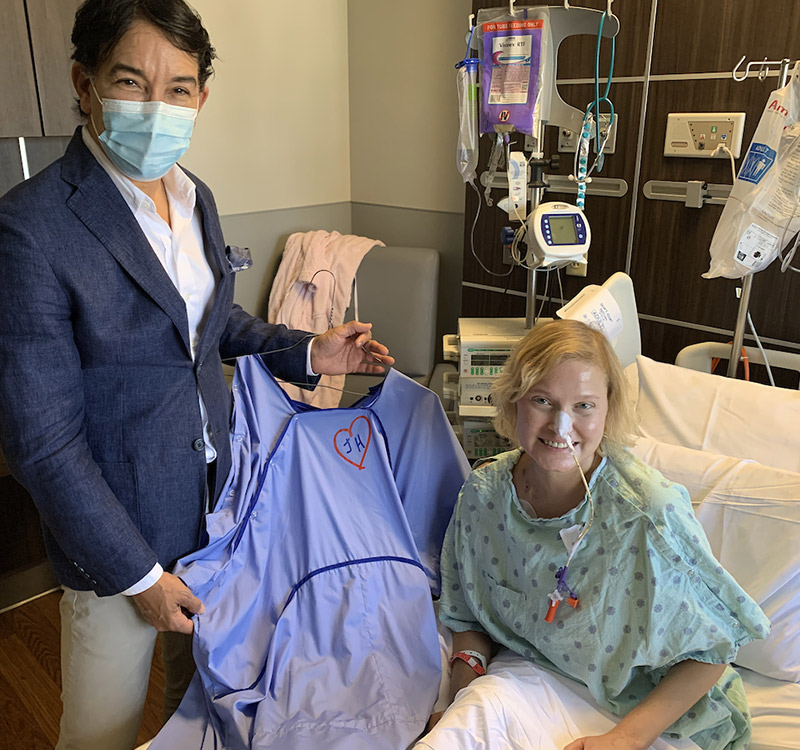
René Ruiz’s work for Jackson Memorial Hospital’s Miami Transplant Institute is the strongest example because the design choices are not merely decorative. Beginning in 2021, Ruiz delivered more than 4,000 custom transplant recovery gowns featuring snaps, slits for lines, and inside pockets for telemetry devices.[9] Those details address the daily mechanics of recovery: clinicians need access, devices need placement, and patients need coverage that does not collapse every time care happens.
This is where the patient-gown conversation should slow down. A patterned gown can lift mood, but the more durable achievement is functional dignity. Snaps can reduce unnecessary exposure. Line access can prevent staff from improvising with fabric. Telemetry pockets can keep monitoring equipment from turning into an awkward burden. The design is doing patient-experience work because it changes what happens during care, not because a designer’s name appears beside it.
The caution is equally important. Premium gown programs face cost and laundering barriers. Standard gowns have been described in the $3 to $4 range, while premium alternatives can cost more; industrial laundering can involve drying temperatures around 450°F.[8] A gown that cannot survive hospital laundry is not a scalable patient-experience solution. A gown that survives but costs far more must compete with every other unfunded improvement on the patient-experience list.
That is why designer patient gowns have not followed the same path as fashion scrubs. Staff apparel can ride consumer demand and individual purchase behavior. Patient gowns usually require institutional adoption, inventory management, laundering validation, unit workflow changes, and a clear decision about which patient populations receive the upgraded garment. The moral case may be stronger, but the operating model is heavier.
What Health Systems Should Do With The Trend
Celebrity culture has not magically improved every scrub or gown. It has changed what people expect medical apparel to do. That is enough to affect strategy.
For staff apparel, the first decision is governance. A health system can keep a centralized program, but it should test whether the approved catalog still reflects how clinicians buy and wear scrubs in 2026. If the policy assumes staff care only about color and compliance, it is already behind the market. Fit range, fabric performance, pocket architecture, silhouette options, and size inclusivity belong in the evaluation.
The second decision is whether to allow approved DTC-style options. That does not require handing the program to the loudest brand. It means writing requirements that a culturally fluent vendor can meet: color consistency, role identification, laundering tolerance, return processes, size availability, data reporting, and a plan for discontinued styles. If a brand wants to sell to a hospital rather than around it, it should be able to operate under hospital-grade constraints.
The third decision is whether apparel is part of workforce branding. In competitive labor markets, what staff wear is one of the most visible artifacts of how an organization treats them. It appears in recruitment videos, campus tours, patient encounters, and peer-to-peer conversations. A hospital does not need celebrity styling to use apparel as a morale signal. It does need to stop treating apparel quality as invisible.
For patient gowns, the question is more targeted. Health systems do not need to replace every gown with a designer program to take the problem seriously. They can start where the standard garment causes the most harm: transplant recovery, oncology, maternity, behavioral health, imaging-heavy pathways, pediatrics, or any population where exposure, line access, and device management repeatedly collide. The evaluation should include patient dignity, clinician access, laundering, inventory, and total cost per use rather than unit price alone.
Finally, market claims need source discipline. A retailer trend report can be useful for understanding what products are being pushed. It cannot, by itself, prove adoption or clinical value. A market-size forecast can show commercial momentum. It cannot show that celebrity influence caused the growth. A designer collaboration can demonstrate what better gowns might look like. It cannot prove broad scalability unless the cost, laundry, and workflow model follows.
The credible conclusion is not that every hospital will become fashion-forward. It is that medical apparel is no longer protected from consumer expectations just because it sits inside healthcare. Celebrity culture, television aesthetics, DTC brands, and designer collaborations have already changed the category. Health systems that ignore that shift will still pay for it through staff dissatisfaction, off-policy purchasing, inconsistent branding, and missed chances to make vulnerable patients feel less exposed.
References
- Figs scrubs in with viral red carpet debut for 'The Pitt's Emmy-winning night, MM+M.
- Everything You Want to Know About Scrubs on 'Grey's Anatomy', Shondaland.
- Figs (company), Wikipedia.
- Global Medical Scrubs Market Size and Forecast, 2026-2033, Coherent Market Insights.
- Top Medical Apparel Companies 2026: The Ultimate Industry Guide, Bestex Scrubs.
- 2026 Medical Fashion Trends, UniformShop.eu.
- Top Scrub Design Trends for Healthcare in 2026, WearMedFit.
- The patient gown: Ugh. No one likes it, AAMC.
- From The Red Carpet To Hospital Hallways, Jackson Health.
Comments
Join the discussion with an anonymous comment.