
The practical question around Claude AI service outages and reliability in healthcare is not whether Claude can produce useful clinical or operational text. It can. The harder question is whether a health system can let a Claude-dependent workflow become part of ordinary production operations when the measured availability record is still well below the level most healthcare procurement teams write into contracts.
By Q3 2026, the gap is not subtle. StatusGator's automated monitoring record counted 134 Claude-related incidents since January 2026, although its methodology may include degradations that Anthropic would classify differently from full outages.[1] A June 23 TechTimes analysis of status.claude.com reported 90-day uptime of 99.12% for claude.ai, 99.41% for the API, and 99.28% for Claude Code, translating to roughly 19 to 23 hours of downtime per service per quarter.[2] That sits far from the 99.9% availability threshold, about two hours of downtime per quarter, that enterprise healthcare contracts commonly require.[3]
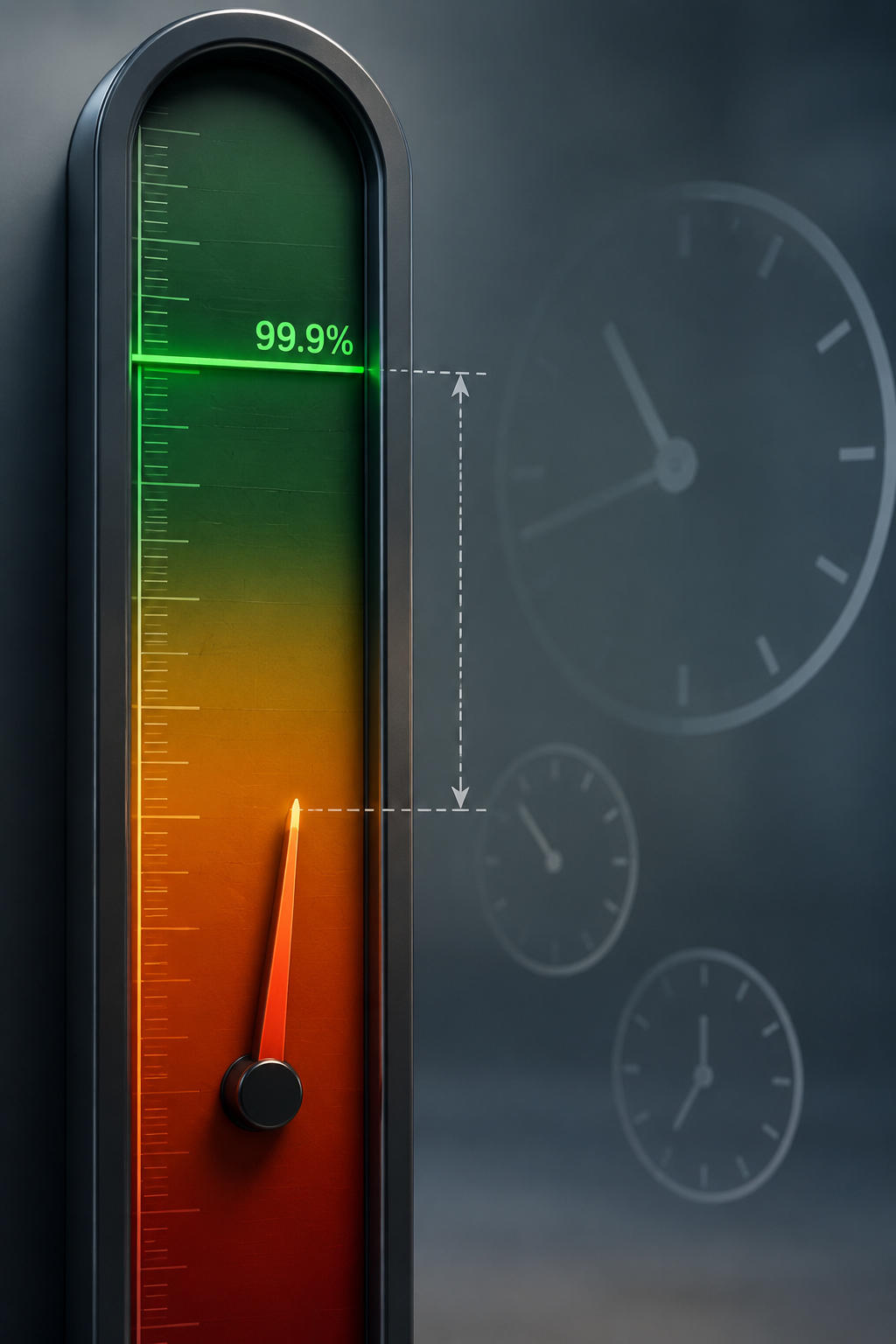
That arithmetic matters because healthcare does not experience downtime as an abstract platform event. It becomes a nurse waiting for a patient-message triage queue to recover, a revenue-cycle team bypassing automated prior authorization logic, an informatics analyst explaining why yesterday's generated note summary cannot be trusted today, or a care-management team reverting to manual routing while a vendor status page says the service is degraded.
Claude's healthcare push is still commercially plausible. Anthropic launched Claude for Healthcare in January 2026 with HIPAA-ready infrastructure and named customers including Banner Health, Novo Nordisk, Sanofi, and Commure.[4] That makes the reliability question more important, not less. Once a model becomes eligible for covered workflows, procurement has to treat it less like a promising assistant and more like a production dependency.
The Reliability Record Needs Careful Reading
The 134-incident figure is the number that catches attention first, but it should not be read as if every entry represents the same operational event. Third-party monitors such as StatusGator watch public service signals and may count partial degradations, elevated error rates, or component-level trouble in ways that differ from Anthropic's own incident taxonomy.[1] For procurement, that caveat does not make the number irrelevant. It means the number should be used as a signal of repeated instability rather than as a courtroom-grade count of full outages.
The 90-day uptime figures are more directly useful because they translate into time lost. A service at 99.41% uptime can sound acceptable until it is converted into hours of unavailability inside a quarter. In healthcare, the difference between two hours and roughly a day of disruption is not cosmetic. It changes staffing assumptions, fallback design, escalation procedures, and whether a workflow can safely be called production-grade.
| Service component | Reported 90-day uptime | Approximate quarterly downtime | Procurement implication |
|---|---|---|---|
| claude.ai | 99.12% | About 19-23 hours | Below the 99.9% enterprise healthcare norm |
| Claude API | 99.41% | About 19-23 hours | Below the 99.9% enterprise healthcare norm |
| Claude Code | 99.28% | About 19-23 hours | Below the 99.9% enterprise healthcare norm |
| Common healthcare contract target | 99.9% | About 2 hours | Typical minimum expectation for production systems |
Forbes contributor Patrick Moorhead added another uncomfortable comparison: Anthropic markets a 99.99% enterprise SLA on negotiated terms, while service credits are typically capped at 5% to 10% of monthly fees.[3] A credit at that level may satisfy a contract clause, but it does not compensate a hospital for manual rework, delayed authorizations, duplicated documentation, or lost trust in an automation queue.
The same Forbes analysis also reported that independent monitoring showed Claude Max's actual uptime at 84%, rather than the advertised 99%.[3] That figure should be handled cautiously. The monitoring method was not fully described, so it belongs in the record as an analyst estimate, not as the foundation for a procurement decision. The stronger case rests on the broader pattern: repeated incidents, sub-99.9% 90-day uptime, and contract remedies that do not match operational exposure.
The Pattern Is More Important Than Any Single Incident
The outage trail points to several different failure modes rather than one isolated bad day. In Q1, the problem pattern included infrastructure scaling and networking degradation. On June 2, a sub-agent infinite-loop bug affected Claude Code and the API together, showing that developer tooling and API access were not cleanly isolated in that event.[5] Capacity overload has also appeared through HTTP 529 errors on Anthropic's status infrastructure, the kind of signal that matters when downstream systems have no graceful substitute ready.[6]
Anthropic has acknowledged to Fortune that demand grew faster than infrastructure could support.[7] That is a believable explanation for a fast-growing AI vendor. It is also exactly the kind of explanation a health system cannot absorb indefinitely. Healthcare buyers do not need to diagnose Anthropic's engineering culture to recognize a simpler procurement problem: a single-provider endpoint can become a shared point of failure across workflows that executives may have mentally categorized as separate.
That coupling is especially relevant for architecture review. In a hospital environment, it is not merely inconvenient. If the same vendor failure domain can interrupt both the model endpoint and the technical tools used by engineering teams to inspect or patch related automations, the fallback plan needs to be tested before the workflow goes live.
Longer-term infrastructure deals do not erase this Q3 2026 risk. Anthropic's large AWS commitment and Google or Broadcom TPU-related capacity plans are meaningful capacity signals, but they are forward-looking infrastructure plays rather than evidence that today's direct Anthropic API path already meets clinical production availability expectations.[3]
HIPAA-Ready Does Not Mean Workflow-Ready
The healthcare packaging around Claude should be separated from the broader Claude product surface. Claude for Healthcare launched with HIPAA-ready infrastructure and a business associate agreement path.[4] Hathr AI's 2026 analysis, however, distinguishes that from Claude Console, which it describes as non-compliant with HIPAA; only Claude for Healthcare carries the BAA boundary in that analysis.[8]
That distinction is not a legal footnote. In real deployments, teams often move from evaluation environments into production faster than governance teams expect. A workflow that begins as a model experiment can become a de facto operational step: summarizing referral notes, drafting a payer response, routing patient portal messages, or generating a care-management handoff. If the HIPAA boundary and the reliability boundary do not match the actual path of use, the organization has two problems, not one.
The broader adoption context explains why this issue is becoming urgent. Generative AI is no longer a novelty project in many health systems; ClinicalMind's coverage of generative AI adoption in healthcare already treats deployment scale as a live operating question. But adoption and reliability are different facts. A tool can be widely trialed, clinically useful, and still unsuitable as a direct dependency for a time-sensitive production workflow.
Where Downtime Becomes Healthcare Risk
There is no public study showing that a Claude outage has directly caused quantifiable patient harm. That boundary matters. The patient-safety argument here is inferential: if a health system places Claude in the path of care coordination, documentation, prior authorization, or patient-message triage, then Claude downtime can interrupt the people and queues attached to those tasks.
Censinet's July 2026 analysis gives the right frame: "If clinical AI fails, patient care can fail with it." The same analysis documented 239 disrupted hospital services from one outage study and reported that 85% of healthcare practices experienced vendor disruptions industry-wide.[9] Those figures do not prove anything specific about Claude. They do show why vendor reliability belongs inside patient-safety and operational-risk review, rather than being left as an IT uptime metric.
Prior authorization is a good example because the operational chain is long and time-sensitive. AI-assisted authorization workflows can help assemble documentation, match payer rules, draft responses, and route cases for human review. ClinicalMind's prior authorization coverage, including its profile of Cohere Health, shows why automation is attractive in this part of the revenue and care-access stack. But if the model endpoint disappears, the work does not disappear with it. Someone still has to submit, appeal, document, or call.
Clinical documentation creates a different kind of exposure. A note-drafting or summarization assistant may not decide care, but it can shape the timing and completeness of the record clinicians expect to review. If the service is intermittently unavailable, teams need a clear answer to several ordinary questions: Does the EHR show that an AI-generated draft is unavailable? Does a clinician know when a summary was not produced? Does the workflow silently skip the step, or does it block completion?
Patient-message triage is less glamorous and often more fragile. If an AI layer classifies inbound portal messages, prepares draft replies, or routes cases to nursing pools, an outage can create queue distortion. The issue is not that Claude makes clinical decisions during downtime. The issue is that staff may be waiting on a prioritization layer that is no longer producing output, while the inbox continues to grow.
This is where many conversational AI programs succeed or fail in practice. ClinicalMind's analysis of barriers and success factors for conversational AI in clinical workflows is relevant because reliability is not a separate infrastructure concern. It is part of whether clinicians keep using the tool, whether operations teams trust the queue, and whether downtime procedures are rehearsed instead of improvised.
Direct API Access and Hyperscaler Access Are Not the Same Risk
Healthcare buyers should avoid treating all Claude access paths as interchangeable. Direct Anthropic API access gives teams close access to the vendor's model surface and may be attractive for evaluation, prompt testing, product exploration, and fast-moving internal development. It also keeps the organization closer to Anthropic's own service availability, incident classification, capacity constraints, and negotiated credit structure.
Hyperscaler-mediated access through AWS Bedrock, Google Vertex AI, or Azure AI changes the risk profile. These platforms offer published 99.9% or better enterprise SLAs, stronger reliability terms, and infrastructure layers that are operationally distinct from Anthropic's direct API endpoint.[3] They do not make Claude immune to model-side problems. They do, however, give procurement and infrastructure teams a more familiar enterprise control surface: cloud-native monitoring, regional architecture options, identity controls, support escalation, and contractual terms that are easier to align with existing production standards.

The reason to prefer the hyperscaler route for production is not vendor favoritism. It is failure-domain separation. If a clinical workflow depends directly on one model provider endpoint, the health system has fewer places to absorb trouble. If the same model is consumed through an enterprise cloud platform, the organization may still face outages, but it can place the workload inside a broader reliability architecture with established support channels and existing operational runbooks.
That distinction should show up in the purchasing file. A procurement review should ask for measured uptime by access path, not just model family. It should ask whether the SLA applies to the specific healthcare product under a BAA. It should ask whether the service credit cap is meaningful compared with the cost of rerouting staff. It should ask whether the proposed workflow can degrade safely if Claude is slow, rate-limited, or unavailable.
What a Contract-Grade Review Should Require
A health system does not need to reject Claude to be disciplined about Claude. The appropriate standard is workload-specific. A research team evaluating prompts for oncology trial matching does not carry the same downtime consequence as a live care-coordination queue. A non-critical internal summarization pilot does not have the same availability requirement as a production prior authorization workflow tied to discharge planning or infusion scheduling.
- Measured uptime: Require component-level uptime history for the exact access path being purchased, including API, healthcare product layer, and any cloud intermediary.
- Published SLA: Confirm whether the 99.9% or higher commitment is standard, negotiated, or limited to certain components, and compare credit caps with operational exposure.
- Failure-domain separation: Identify whether a single Anthropic incident can interrupt model access, developer tooling, automation monitoring, and fallback procedures at the same time.
- HIPAA boundary: Verify that the workflow runs under the correct BAA-covered product, not merely under a general Claude or developer-console environment.
- Safe degradation: Define what happens when the model is unavailable: queue labeling, manual takeover, clinician notification, retry behavior, and documentation of skipped AI steps.
The safe-degradation test is the one most likely to reveal wishful thinking. If a clinical operations leader cannot explain how the team works for a full shift without the model, the workflow is not ready to depend on the model. If the answer is simply that staff will do it manually, the next question is who, how many, with what training, and what backlog threshold triggers escalation.
None of this requires a moral panic about AI in medicine. It requires the same dull discipline health systems already apply to EHR integrations, imaging interfaces, revenue-cycle vendors, and patient communication systems. The more useful Claude becomes, the more ordinary this discipline needs to be.
The Procurement Posture for 2026
For production clinical workloads in 2026, the prudent route is hyperscaler-mediated Claude access through AWS Bedrock, Google Vertex AI, or Azure AI, where stronger enterprise reliability terms, established cloud operations, and separate infrastructure layers can reduce the risk created by direct dependence on Anthropic's endpoint.[3] This is the better fit for care coordination, documentation support, prior authorization, patient-message triage, or any workflow where downtime creates immediate staff burden or care-access delay.
Direct Anthropic API access still has a place. It is appropriate for R&D, model evaluation, internal experimentation, non-critical prototyping, and controlled pilots where the organization can tolerate interruption and where no one mistakes a promising workflow for a production dependency. Claude may be good enough to keep evaluating aggressively. Its 2026 reliability record is not yet good enough to ignore the access path.
References
- StatusGator outage history page, StatusGator.
- TechTimes analysis of status.claude.com, TechTimes, June 23, 2026.
- Forbes analysis by Patrick Moorhead, Forbes, May 5, 2026.
- Claude for Healthcare, Anthropic, January 2026.
- Thoughtworks June 2026 analysis of Claude Code incident, Thoughtworks, June 2026.
- Anthropic status page, Anthropic.
- Fortune coverage of Anthropic infrastructure demand, Fortune.
- Hathr AI 2026 analysis of Claude HIPAA compliance, Hathr AI, 2026.
- Censinet July 2026 analysis of clinical AI failure and vendor disruption, Censinet, July 2026.
Comments
Join the discussion with an anonymous comment.