
By mid-July 2026, the national cyclospora count was already straining the way public-health numbers are usually read. The CDC reported 1,645 laboratory-confirmed cases and more than 5,100 additional illnesses under investigation across 34 states, with patients ranging from age 2 to 95, a median age of 44, and 9% hospitalized.[1] At the same time, Michigan was reporting more than 5,000 cases and Ohio more than 1,100, figures that made the official national confirmed count look less like the outbreak’s full size than the portion of it that had made it through testing, classification, and reporting.
That distinction matters because Cyclospora cayetanensis is not a pathogen most clinicians find by accident. The CDC’s July 14 Health Alert Network advisory warned that routine stool ova-and-parasite testing does not typically include Cyclospora unless specifically requested.[1] A patient can have the right symptoms, the right exposure window, and the right epidemiologic link, and still never become part of the national confirmed count if the right test is not ordered.
This is the setting in which Bill Marler, the cyclospora lawsuit attorney, becomes relevant. Not because a lawsuit is a substitute for epidemiology, and not because a complaint establishes the whole supply-chain story. The relevance is narrower and more practical: when public agencies are still sorting confirmed from probable cases, and when traceback information is arriving in pieces, litigation can begin preserving names, dates, purchase locations, suppliers, and corporate records before the official public record is complete.
The July 14–17 record moved faster than the public could easily follow
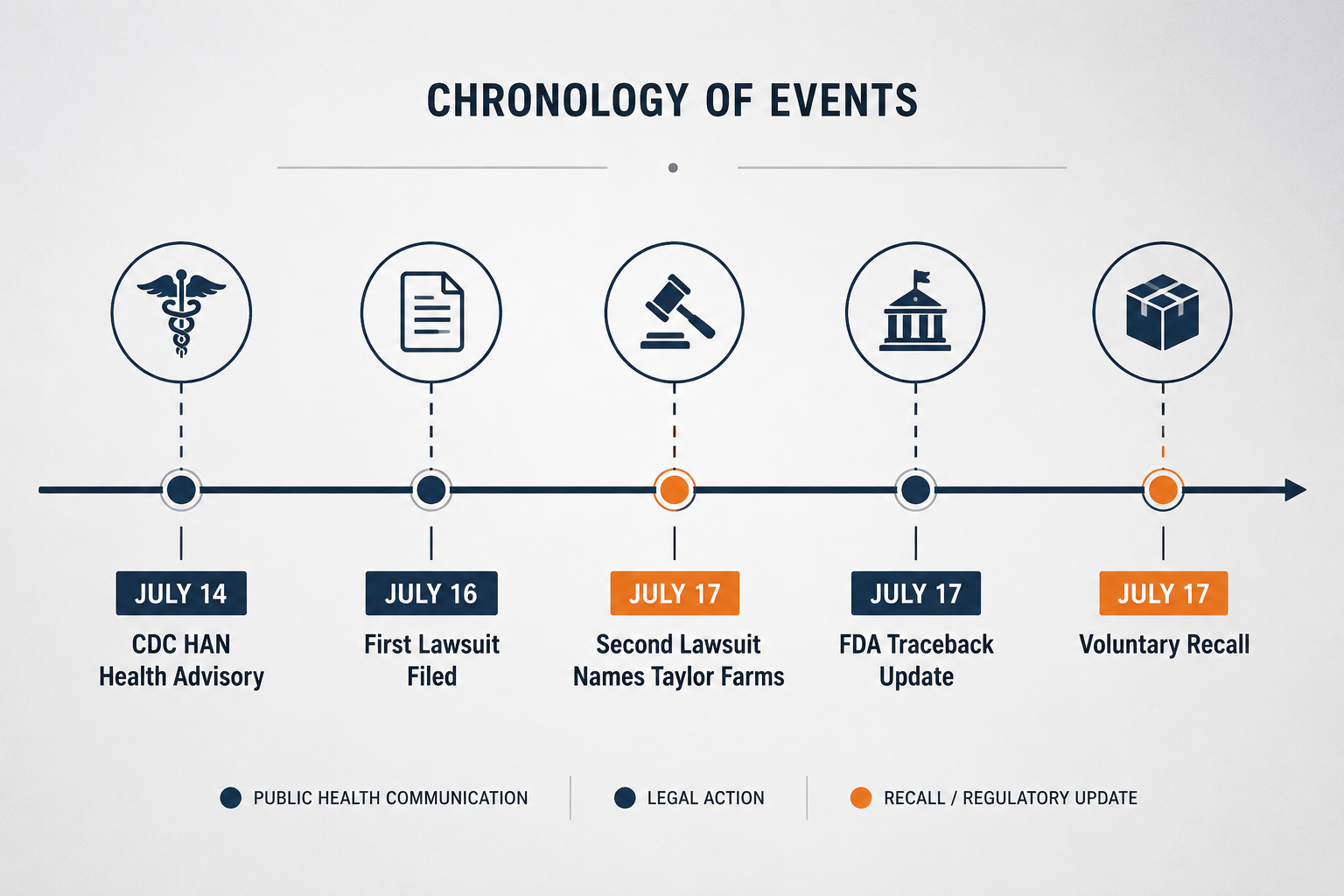
The important sequence is short. It runs from the CDC advisory on July 14 through the first Marler Clark lawsuit on July 16, then through a second lawsuit, an FDA traceback update, and a voluntary recall on July 17. Read as separate headlines, the events look like normal outbreak bureaucracy and normal product-liability litigation. Read as a dated chain, they show how thin the public-facing information layer was at exactly the moment restaurants, suppliers, clinicians, and exposed consumers needed specificity.
| Date | Public record | Why it mattered |
|---|---|---|
| July 14, 2026 | CDC HAN-00531 advisory | Warned clinicians about the outbreak and the diagnostic blind spot in routine stool testing. |
| July 16, 2026 | Ayyad v. Pacific Bells filed | Put a Taco Bell franchise operator into a formal litigation record tied to alleged cyclospora illness. |
| July 17, 2026 | Caruso v. Taco Bell Corp. et al. filed | Expanded the legal target from restaurant service to supplier responsibility by naming Taylor Farms. |
| July 17, 2026 | FDA traceback update | Identified Taylor Farms de Mexico as the single supplier of shredded iceberg lettuce in the traceback. |
| July 17, 2026 | Voluntary recall | Turned traceback information into a product-removal action. |
On July 16, Marler Clark filed Ayyad v. Pacific Bells, a federal lawsuit against the Taco Bell franchise operator Pacific Bells in connection with the outbreak.[2] As a first filing, its significance was not that it solved the outbreak. It created a formal claim while the public record still lacked the supplier detail that would arrive the next day.
The next filing carried more weight. On July 17, Marler Clark filed Caruso v. Taco Bell Corp. et al., naming Taco Bell entities and Taylor Farms, and attaching a 20-year history of cyclospora outbreaks.[3] That changed the shape of the litigation. A complaint against a restaurant operator can focus on food service and local exposure. A complaint that names a produce supplier and lays out outbreak history makes a prevention argument: this was not only about one meal, one store, or one plaintiff, but about whether a recurring produce-linked hazard had been managed with enough urgency.
The FDA’s July 17 traceback update then identified Taylor Farms de Mexico as the single supplier of shredded iceberg lettuce associated with the investigation, and Taylor Farms initiated a voluntary recall the same day.[4] That timing is the uncomfortable part. The supplier name became visible in litigation and in federal traceback almost simultaneously, after the CDC had already issued a national advisory and after thousands of illnesses were either confirmed or under investigation.
Forbes’ July 17 coverage captured the legal escalation around Taco Bell federal lawsuits, but the more consequential record is not the existence of a famous plaintiff firm in the story.[5] It is the near-overlap of public-health warning, civil complaint, supplier naming, traceback convergence, and recall. That is where litigation starts to look less like a late-stage damages process and more like a parallel channel for organizing facts.
Why the lawsuits matter before any verdict
A lawsuit does not prove contamination. It does not replace isolate matching, exposure interviews, invoices, distribution records, or regulatory traceback. It also does not deserve to be treated as a neutral public-health bulletin. Plaintiffs’ lawyers write complaints to win cases.
Still, foodborne-illness litigation can do things public agencies often cannot do quickly in public. Discovery can seek purchase records, distribution documents, supplier communications, food-safety audits, sanitation records, testing data, and internal timelines. Complaints can preserve alleged dates and exposures while memories, receipts, and corporate logs are still available. Depositions can ask who knew what, when the information moved, and who had authority to stop shipment, notify customers, or pull product.
That function is especially important in a Cyclospora outbreak because the parasite has historically been difficult to fit into the faster molecular surveillance pathways used for some bacterial outbreaks. The case definition itself can make the public event look smaller than the practical event. A lab-confirmed count is useful because it is specific. It is also incomplete when the ordinary diagnostic pathway misses the organism unless a clinician knows to ask for the test.
Marler Clark’s institutional leverage matters here, but only in that functional sense. The firm said in its July 2026 materials that it has recovered more than $900 million for foodborne-illness clients.[2] That history gives defendants reason to treat early complaints as more than public relations noise. It also gives regulators, compliance officers, and industry lawyers a second set of documents to watch as the official record develops.
The second lawsuit is therefore the hinge. By naming Taylor Farms and appending a long outbreak history, Caruso v. Taco Bell Corp. et al. pushed the case toward supply-chain accountability rather than stopping at the retail counter.[3] If discovery eventually confirms the traceback facts alleged and later identified by FDA, the litigation may narrow the questions that matter most for prevention: Was the supplier hazard known? Were prior outbreak patterns treated as operational warnings? Were buyers told enough? Were controls audited in a way that matched the pathogen risk?
The confirmed count was not the whole outbreak
The July 2026 numbers are easy to mishandle. A confirmed count is not the same as total illness. A state probable count is not the same as a CDC-confirmed national count. A traceback finding is not the same as a final judicial finding. But those distinctions do not make the larger signal disappear.
The CDC advisory reported 1,645 confirmed cases, while more than 5,100 were still under investigation across 34 states.[1] The research record also showed the 2026 outbreak running far ahead of the prior year’s pace: 1,645 confirmed cases compared with 249 at the same point in 2025, or about 6.6 times higher.[1] That does not prove a single exposure source for every reported or suspected illness. It does show that the public-health system was trying to describe a very large event through a confirmed-case lens that was likely to lag the on-the-ground burden.
The diagnostic warning explains part of the gap. If routine stool testing does not include Cyclospora, then the system depends on clinical suspicion, specific test orders, lab capacity, and reporting flow.[1] Each step filters the outbreak. People who do not seek care are filtered out. People whose clinicians order only routine testing may be filtered out. People whose cases are probable but not laboratory-confirmed may remain outside the national confirmed count even while local epidemiologists and health departments are dealing with them as part of the same practical emergency.
That is why the Michigan and Ohio figures are not a nuisance discrepancy. They are evidence of a classification problem that affects action. A restaurant chain deciding whether to pull an ingredient, a distributor deciding whether to hold product, and a health department deciding how hard to push clinical alerts cannot wait for the cleanest possible national number if the less-clean local picture is already large and coherent.
What weakened surveillance changes
The July timeline would be troubling even in a fully staffed food-safety system. It is more troubling against the backdrop described by food-safety specialists in 2026: fewer people, narrower tracking, and less institutional advice reaching agencies at the moment a parasitic outbreak required specialized attention.
CIDRAP reported criticism of the CDC response, including the characterization that the handling of the cyclospora outbreak was “terribly unfortunate” and that the response had been managed by an inexperienced parasitic disease branch.[6] The point is not to blame one branch for a national outbreak. The point is that specialized foodborne surveillance depends on experienced people recognizing patterns early enough for the warning to matter.
A June 2026 Marler op-ed cited by Marion Nestle’s Food Politics described broader institutional losses: the FDA had lost about 3,900 employees, FoodNet had reduced routine tracking from eight pathogens to two, and USDA advisory committees had been disbanded.[7] Each of those facts has a different administrative pathway, and none of them alone can be said to have caused the July cyclospora outbreak. Together, they describe a thinner system for seeing, interpreting, and publicly communicating foodborne risk.
FoodNet’s reduction is especially relevant because surveillance breadth is not a decorative metric. When fewer pathogens are tracked, fewer signals are compared across time, geography, foods, and care settings. When staff losses reduce investigative capacity, traceback can still happen, but it may take longer or become less legible to people outside the agency. When advisory structures disappear, agencies lose one channel for outside expertise before a crisis reaches the public.
This is where the legal record becomes more than adversarial paperwork. In a better-resourced surveillance system, lawsuits would still be filed after serious illness. But they would be less likely to function as an early public map of defendants, suppliers, product categories, and outbreak history. In July 2026, the complaints were not merely following the official record. They were helping readers see what the official record had not yet made orderly.
What compliance teams should take from the litigation record
The useful lesson for food companies is not to wait for a complaint and then read it as accusation management. The better use is earlier: treat outbreak litigation as one more source of structured intelligence, while still separating allegations from established facts.
- Track dates, not just headlines: advisory date, first complaint, supplier naming, traceback update, recall, and any amended complaints.
- Separate confirmed counts from probable burden, especially when the pathogen requires non-routine testing.
- Watch whether litigation moves from a retail defendant to a supplier, processor, grower, importer, or distributor.
- Compare complaint allegations with FDA traceback updates and recall language before treating either as complete.
- Preserve purchasing, receiving, lot, menu, and sanitation records as soon as a credible exposure pattern appears.
For public-health teams, the same record points to a communication problem. If clinicians must request Cyclospora testing by name, then advisories need to reach them before the outbreak has already accumulated weeks of hidden illness. If state probable counts are far ahead of the national confirmed count, public messaging has to explain the distinction plainly enough that the confirmed number is not mistaken for the event’s true size.
The reporting gap also explains why technical surveillance discussions have become more urgent. Internal work on topics such as the Cyclospora detection gap that stymied the 2026 outbreak and how AI could help track Cyclospora that PulseNet misses belongs beside, not after, the legal record. The problem is not simply whether a tool is modern. It is whether the surveillance system can see the cases, connect them, and communicate the risk before contaminated food has already moved through too much of the market.
The narrower judgment the record supports
The July 2026 cyclospora lawsuits should not be treated as proof of every supply-chain failure alleged in them. That work belongs to traceback, records, expert review, discovery, and, if the cases do not settle, the courts. It would be equally wrong to treat the lawsuits as ordinary legal noise surrounding a brand incident.
The sturdier conclusion is that the lawsuits became part of the evidence infrastructure. They named defendants in sequence, preserved a timeline, pushed supplier questions into public view, and arrived as federal and state reporting were still trying to reconcile confirmed cases with a much larger practical burden. In this outbreak, civil litigation did not fix surveillance. It exposed how much the public record needed a second channel because the official one was too slow, too thin, and too dependent on lab-confirmed visibility to describe the public-health event in time.
References
- HAN Archive - 00531, Centers for Disease Control and Prevention, July 14, 2026.
- First Lawsuit Filed in Cyclospora Outbreak Linked to Taco Bell, Marler Clark, July 16, 2026.
- Second Lawsuit Filed in Cyclospora Outbreak Names Taco Bell and Taylor Farms, Marler Clark, July 17, 2026.
- Outbreak Investigation of Cyclospora: Shredded Iceberg Lettuce, U.S. Food and Drug Administration, July 17, 2026.
- Taco Bell Hit With Federal Lawsuits Over Cyclospora Outbreak, Forbes, July 17, 2026.
- Experts criticize CDC response to cyclospora outbreak, CIDRAP, July 2026.
- Bill Marler on the dismantling of food safety, Food Politics, June 2026.
Comments
Join the discussion with an anonymous comment.