
FDA's Cyclospora finding on Taylor Farms lettuce was announced during an active outbreak investigation and then retracted within 24 hours after BAM 19b sequence verification showed the original call was false [1][2][3]. That matters, but not in the way a lot of fast-moving coverage implies: the lettuce sample result was wrong, the quality-control step worked, and the traceback evidence still pointed in the same direction.
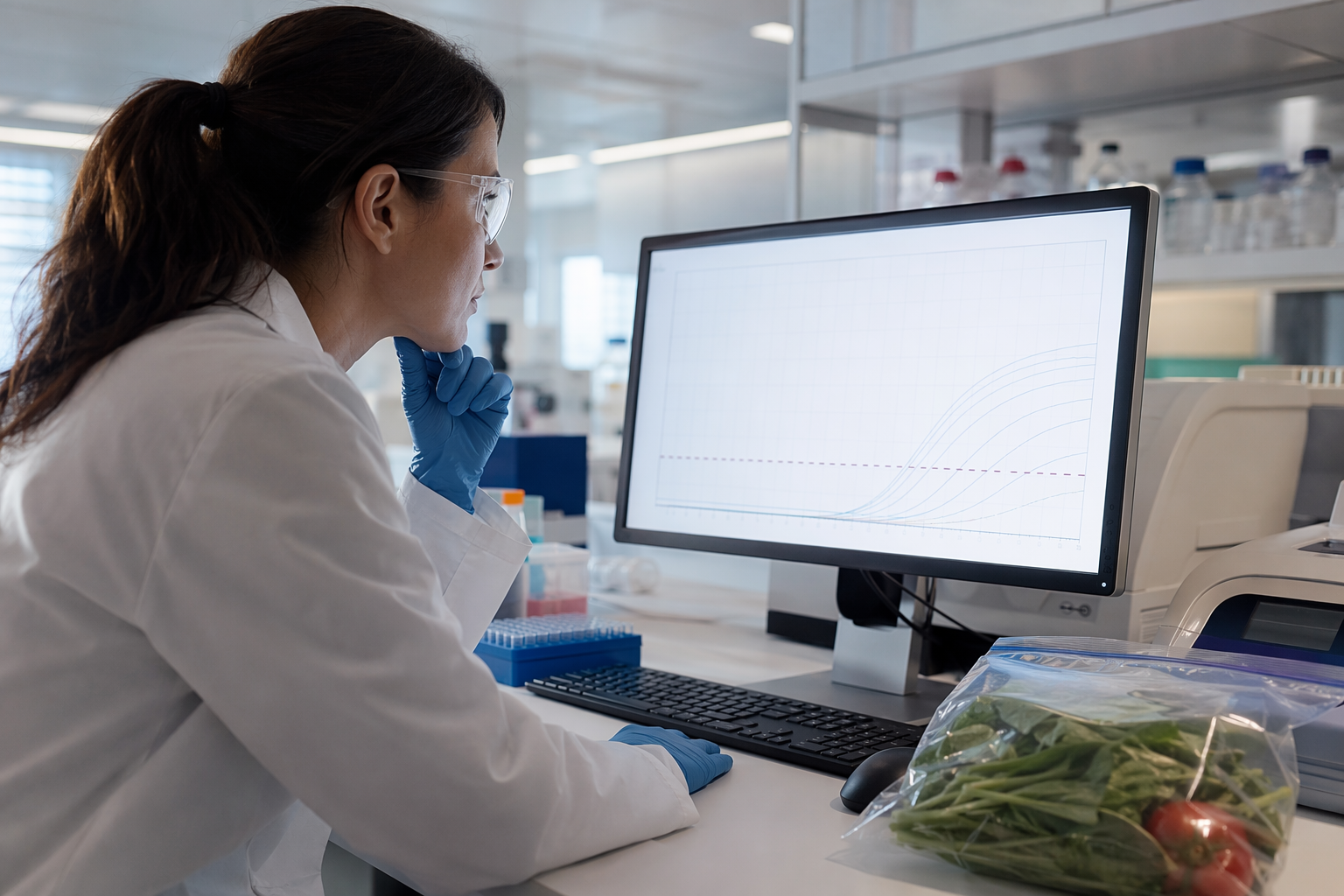
The first thing to separate is the lab result from the outbreak investigation. Official updates continued to treat the event as an ongoing Cyclospora outbreak tied to Taylor Farms shredded iceberg lettuce from central Mexico, and they did not describe the retracted food test as proof that the traceback had collapsed [1][2].
Why The Signal Is So Fragile
Cyclospora is not a pathogen that yields to a culture system and a tidy colony count. In food testing, the signal usually comes from PCR on produce washes, which means the laboratory is looking for a small amount of DNA in a messy matrix rather than growing an organism to confirm it. That setup makes the edge cases matter more than the headline result. BAM 19b's move to the Mit1C mitochondrial target in December 2024, plus its synthetic positive-control sequence-verification step, was designed for exactly that problem: to force a second check before a weak signal hardens into a confirmation [3].
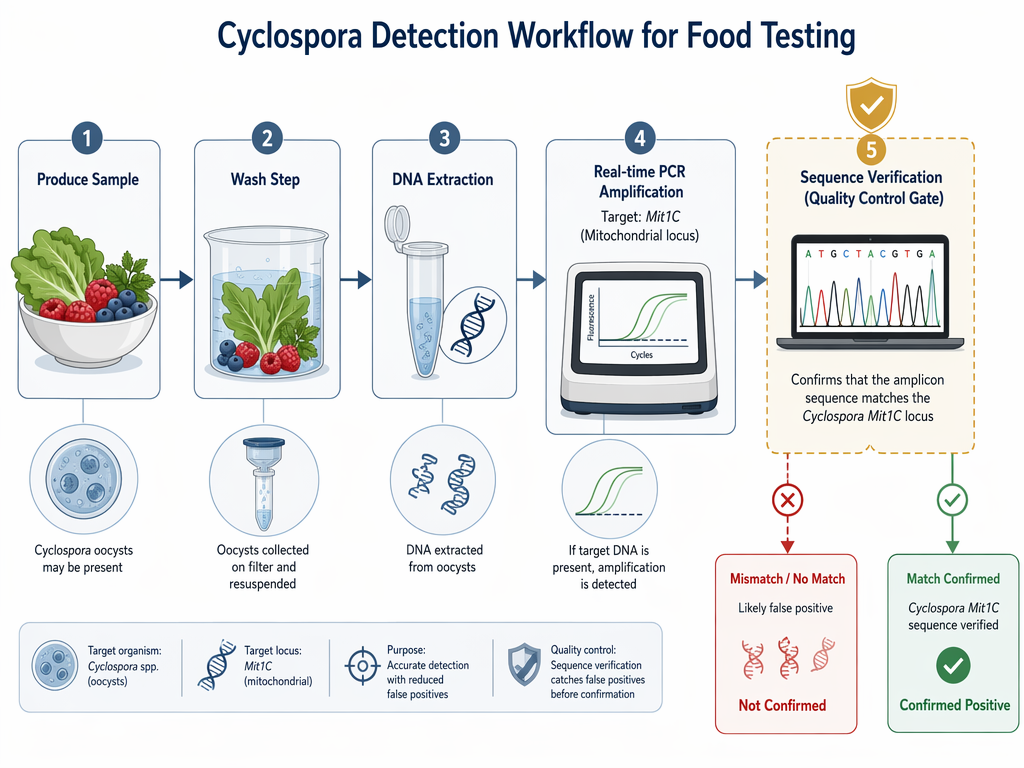
Low-burden samples are where the method behaves most unevenly. In CFIA verification work, detection was 93% at 200 oocysts per 25 g but fell to 30% at 10 oocysts per 25 g [4]. That is not a minor drop; it is the difference between a target that tends to show up and a target that slips in and out of detection depending on the wash, extraction, and amplification conditions. In that range, a single stray signal can look persuasive right up until sequence verification asks whether the amplicon is actually Cyclospora.
Earlier BAM 19a work had already shown that false positives were possible in complex produce matrices, with reported rates of 2.6% in cilantro and 5.0% in raspberries [5]. That history matters here because it shows the false positive was not a random embarrassment; it was the kind of failure a method working near the detection limit can produce if it lacks a guardrail.
What The Retraction Does And Does Not Mean
| Question | What the evidence supports | Why it matters |
|---|---|---|
| Was the lettuce sample result wrong? | Yes. BAM 19b sequence verification identified the initial positive as false [3]. | The food sample should not be treated as confirmed evidence of contamination. |
| Did the laboratory method fail? | Not in the meaningful quality-control sense. The updated workflow caught the discrepancy before it became official certainty [3]. | A safeguard that intercepts an error is part of the method working, not collapsing. |
| Did the traceback evidence fall apart? | No. CDC and FDA reporting still converged on Taylor Farms shredded iceberg lettuce from central Mexico as the outbreak source [1][2]. | The retracted sample did not replace or erase the epidemiologic trail. |
Outbreak counts were still moving, and the totals did not line up neatly across agencies. The outbreak remained open while confirmed and probable cases were being counted differently [1][2].
The Diagnostic Gap Is Bigger Than One Food Test
The uncertainty is not unique to food testing. In one evaluation of the BioFire FilmArray GI Panel, Cyclospora detection was 97.1% reproducible, or 34 of 35 replicates, which is close to a 3% false-positive baseline in that clinical setting [6]. In another study, the CYCLONE genotyping system amplified all eight markers in only 34.4% of specimens, which is a reminder that even when Cyclospora is already detected, downstream typing can still fail to resolve the isolate cleanly [7].
The Taylor Farms false positive shows how Cyclospora testing can be both important and unsurprising: important because it protects the record from a wrong answer, unsurprising because Cyclospora testing still lives in a narrow technical band where low organism burden, produce wash chemistry, and incomplete marker recovery all work against certainty. The safeguard did its job inside a system that still needs better low-burden detection, more reliable genotyping, and complementary approaches such as AI-assisted microscopy screening and food recall management tools.
References
- Cyclospora Outbreak Investigation - U.S. Food and Drug Administration
- CDC Health Alert Network (HAN) 00531 - Centers for Disease Control and Prevention
- BAM Chapter 19b: Detection of Cyclospora cayetanensis in Produce - U.S. Food and Drug Administration
- Lalonde et al. 2022, Inter-laboratory verification study on Cyclospora detection
- Hitchcock et al. 2019, Reproducibility of Cyclospora cayetanensis detection on the BioFire FilmArray GI Panel
- Barratt et al. 2021, Evaluation of the CYCLONE genotyping system for Cyclospora cayetanensis
Comments
Join the discussion with an anonymous comment.