
In healthcare cybersecurity, AI-related data breach risk is no longer a theoretical board-slide topic. It is showing up in the breach numbers, in email lures, in unmanaged employee tools, in vendor risk reviews, and in the alert queues where under-resourced security teams decide what gets investigated first.
The imbalance is the part that should worry healthcare leaders in Q3 2026. Healthcare reported a record 772 large data breaches in 2025, and hacking accounted for more than 80% of large healthcare breaches that year.[1] At the same time, 64% of healthcare organizations have seen AI-generated email attacks, while only 38% report having AI defenses fully deployed — a 26-point gap between AI-amplified exposure and AI-enabled response capacity.[2]
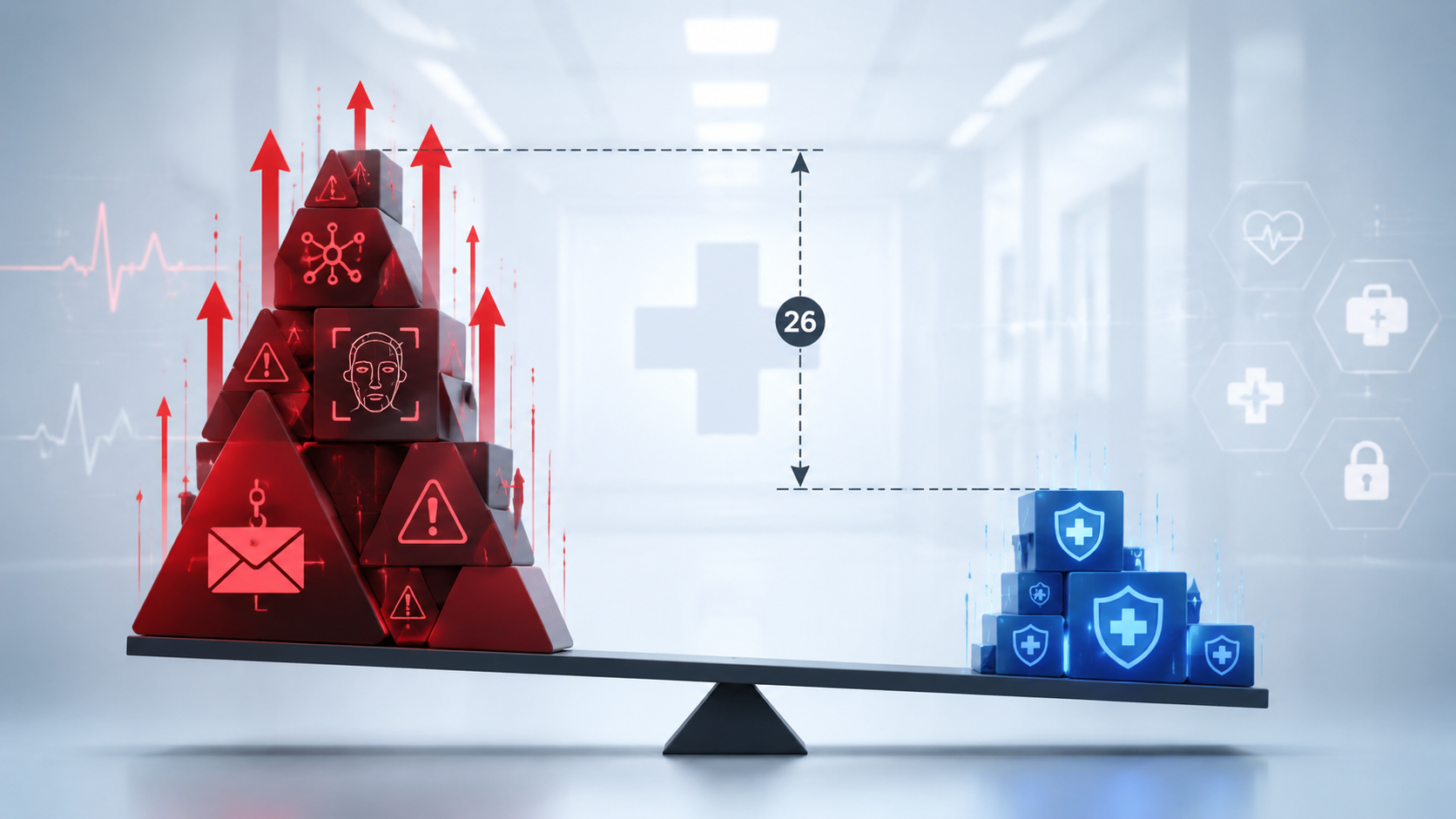
That gap matters more than the usual “AI is both threat and defense” framing. Attackers do not need a mature AI governance program to generate better phishing copy or automate reconnaissance. A hospital does need procurement review, privacy review, architecture decisions, data-use agreements, tuning, escalation logic, and staffing before an AI detection tool changes daily operations. The offense scales first; the defense has to be implemented.
The breach environment was already overloaded before AI accelerated it
Healthcare entered 2026 with little spare capacity for another threat multiplier. Large-breach volume was already at a record level in 2025, and hacking was the dominant breach category.[1] The operational result is familiar: more compromised credentials, more third-party notifications, more forensic reviews, more patient letters, and more executive briefings that begin with the same question — how long was the data exposed before anyone knew?
Early 2026 breach counts require caution. HIPAA Journal noted an apparent 9.5% decline in healthcare data breaches from January through April 2026, but also warned that HHS reporting delays related to a 43-day government shutdown may have affected the numbers.[1] For planning purposes, that is not a clean signal that risk has improved. It is a reminder that reporting pipelines can lag while the underlying attack surface continues to expand.
| What the number describes | Current evidence | Operational reading |
|---|---|---|
| Large healthcare breach environment | 772 large incidents in 2025; hacking accounted for more than 80% of large breaches | Healthcare is already operating in a high-volume breach setting |
| AI-generated email attack exposure | 64% of healthcare organizations have seen AI-generated email attacks | AI is already present in common intrusion pathways |
| Fully deployed AI defenses | 38% of healthcare organizations report full deployment | Defensive coverage is materially behind exposure |
| Deployment gap | 26 percentage points | Attack acceleration is outpacing operationalized defense |
Phishing gets cheaper, cleaner, and harder to dismiss
The most immediate way AI amplifies healthcare breaches is not exotic. It improves the material that reaches employees first: emails, fake login prompts, invoice messages, HR notices, vendor impersonation, and executive requests. A Forbes analysis citing vendor-funded research reported that 82% of phishing emails now contain AI-generated content, and that AI-automated spear phishing achieved 54% click-through rates.[2]
Those figures should not be treated as neutral, sector-wide ground truth without reading the underlying methods. Vendor-funded phishing statistics often measure conditions that differ from a specific health system’s environment. But the direction of travel is credible enough to affect security planning: AI reduces the attacker’s writing burden, improves language quality, and lets more targeted lures be produced at a pace that manual security awareness programs were not designed to match.
For healthcare, better phishing does not need to be perfect to be expensive. A single credential theft can lead to mailbox access, patient-data exposure, business associate compromise, fraudulent payment diversion, or a foothold for broader intrusion. When ransomware follows, patient-care disruption becomes a separate risk category; readers focused on that consequence can see our related analysis of AI ransomware defense and patient safety. This article stays with the breach problem: protected health information exposed, copied, misdirected, or made accessible through preventable compromise.
Deepfakes move social engineering into everyday workflow
Deepfake-enabled social engineering belongs in the same operational bucket as phishing because the control problem is similar: staff are being asked to authenticate intent under pressure. A convincing voice request, video clip, or synthetic executive message can bypass the informal trust checks that many healthcare workflows still use when the request appears urgent.
The practical issue is not whether every hospital has seen a deepfake breach. The issue is that AI makes impersonation easier to package into normal business processes: urgent payment approvals, help-desk resets, vendor-access requests, clinical operations exceptions, and executive escalations. Controls that rely on recognizing odd phrasing or obvious spoofing degrade when the attacker can generate polished, context-aware content.
Shadow AI turns unmanaged convenience into breach cost
The breach surface is not only outside the organization. Shadow AI — employee or departmental use of AI tools outside sanctioned governance — has become a healthcare exposure and cost problem. ORDR’s 2026 reporting found shadow AI present in 40% of hospitals, and Cybersecurity Dive reported that shadow AI added about $670,000 to breach costs on average.[3][4]
The risk is easy to understate because shadow AI often begins as productivity work. A staff member wants help summarizing text. A department wants a faster way to draft patient-facing materials. A manager wants to classify tickets or clean up spreadsheets. The security problem begins when regulated data, credentials, internal incident details, screenshots, transcripts, or vendor information enter a tool the organization has not reviewed, contracted, logged, or configured.
The $670,000 figure should be read as a cost association, not proof that every instance of unsanctioned AI use causes that much damage. Still, it gives security and privacy leaders a board-level translation of what they already see in ticket queues: if AI adoption spreads faster than governance, breach investigation becomes harder because the organization cannot easily answer where data went, what terms governed it, whether it was retained, and who had administrative visibility.
AI vendors are now part of the breach surface
The June 2026 Xsolis breach made the vendor side of the AI risk concrete. Reporting from Becker’s and TechTarget said the healthcare AI platform breach affected 1.4 million individuals across more than seven health systems.[5][6]
One incident should not be stretched into a claim that healthcare AI vendors are broadly unsafe. The more useful lesson is narrower and more actionable: an AI vendor that handles healthcare data is a business associate risk, a supply-chain risk, and a breach-notification dependency. If the vendor’s controls fail, the health system still owns patient trust, regulatory response, and the difficult work of explaining exposure to people who may never have heard the vendor’s name.
AI procurement can also create a false sense of separation. A tool may be sold as analytics, utilization review support, documentation acceleration, privacy monitoring, revenue-cycle improvement, or care-management enablement. From a breach perspective, the label matters less than the data flow: what PHI the vendor receives, whether it trains models on customer data, how it segregates tenants, which subcontractors it uses, how logs are protected, how quickly it detects anomalous access, and how notification obligations are written.
The vendor questionnaire therefore needs to catch up with the product category. Healthcare organizations should be asking AI vendors about model governance, prompt and output retention, administrative access, security logging, customer-specific isolation, incident timelines, subcontractor AI services, and whether any customer data is used to improve shared models. Those questions are not anti-innovation. They are the minimum needed to understand who can expose patient data when the AI system sits outside the hospital’s direct control.
Where defensive AI actually changes the workload
The defensive case for AI is strongest when it is tied to workflow compression, not when it is described as a general promise to “improve security.” Healthcare security teams need fewer irrelevant alerts, faster triage, better prioritization, and shorter investigations. If a tool does not change those conditions, it may be advanced technology without operational relief.
The Johns Hopkins case is useful because the metrics are unusually concrete. A 2018 Health Catalyst case study reported that AI privacy analytics reduced false positives from 83% to 3% and cut investigation time by 93%, from 75 minutes to 5 minutes.[7]
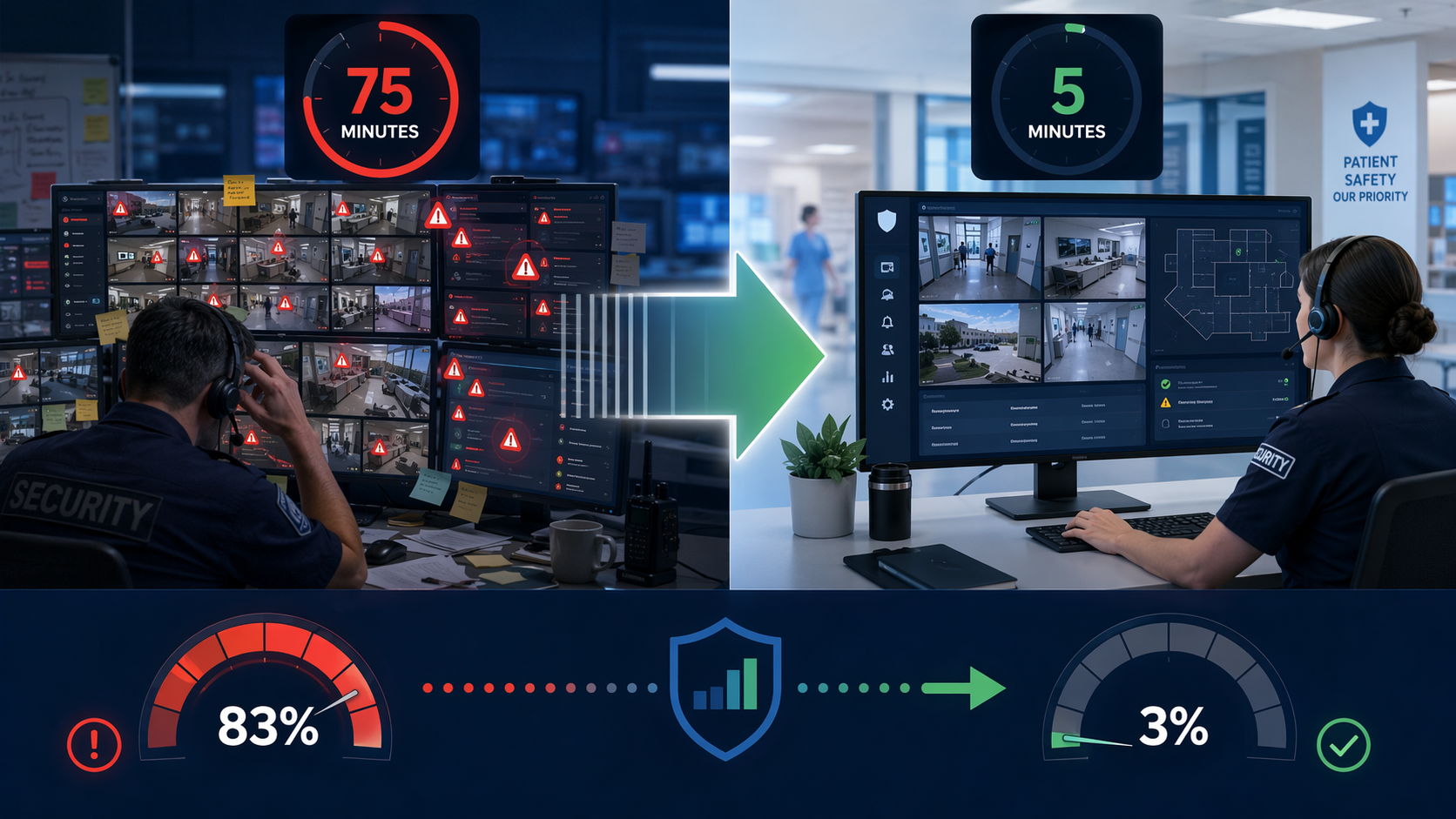
Those numbers deserve attention because they describe security labor, not abstract model performance. Reducing false positives from 83% to 3% changes who spends the morning clearing noise. Cutting an investigation from 75 minutes to 5 minutes changes how quickly a privacy team can determine whether an access event is benign, suspicious, or reportable. For a hospital with lean staffing, that can mean the difference between sampling alerts and consistently closing them.
The caveat is equally important. The Johns Hopkins case is from 2018, and its results should not be presented as a universal benchmark for every hospital in 2026.[7] A large academic medical center may have data maturity, staffing, governance, and integration capacity that a smaller or resource-constrained institution does not. The lesson is not that every deployment will reproduce the same metrics. The lesson is that AI defense should be judged by whether it measurably reduces false positives, triage time, and investigation time in the local environment.
Detection time is a breach-cost issue, not just a SOC metric
Investigation speed matters because breach lifecycles are long. IBM’s 2025 reporting, cited by Swif, put the average breach lifecycle at 279 days and the average healthcare breach cost at $7.42 million, down from $9.77 million in 2024.[8] The cost figure is useful directional evidence, but the methodology should be checked before using it as a precise forecast for a specific organization.
A shorter alert investigation does not automatically shorten a 279-day breach lifecycle. It can, however, remove delay from one part of the chain: the time between signal and decision. If anomalous access, suspicious authentication, unusual data movement, or risky user behavior is triaged faster, the organization has a better chance of containing exposure before it becomes a larger notification event.
That is the practical standard for defensive AI in healthcare: does it move the team from alert receipt to defensible action faster? Useful systems correlate signals, suppress known noise, highlight risk context, and preserve enough evidence for privacy, compliance, and legal review. Less useful systems generate another dashboard that someone has to babysit.
Procurement is not the same thing as protection
The 38% full-deployment figure is a useful corrective to AI-defense enthusiasm.[2] A purchased tool, a pilot, or a limited proof of concept does not close the exposure gap. Healthcare organizations only get defensive value when the tool is wired into logging sources, identity systems, endpoint telemetry, email controls, case management, escalation paths, and privacy investigation workflows.
A practical deployment review should separate four states that often get blurred in executive discussion:
- Purchased: the contract exists, but the system is not yet changing detection or response.
- Connected: the tool receives data, but alert logic, ownership, and escalation remain immature.
- Operationalized: analysts, privacy staff, and incident responders use the system in daily decisions.
- Measured: the organization can show local changes in false positives, investigation time, containment speed, or breach lifecycle steps.
The distinction matters because AI can also add burden. Poorly tuned detection creates another alert stream. Weak integrations force analysts to swivel between consoles. Opaque scoring makes it harder to justify decisions during incident review. A privacy office cannot rely on a risk score if no one can explain what data contributed to it or why one access event was prioritized over another.
The controls that narrow the AI breach gap
Closing the 26-point gap does not require treating AI as a standalone cybersecurity program. It requires updating familiar controls for a threat environment where content generation, impersonation, data movement, and vendor dependence are changing faster than manual review can follow.
| Risk area | What security leaders should verify | Why it matters |
|---|---|---|
| AI-generated phishing | Email controls, user reporting, identity protection, and incident playbooks are tuned for higher-quality lures | The old assumption that phishing is easy to spot is weaker |
| Automated spear phishing and impersonation | High-risk requests require out-of-band verification, especially for payments, resets, privileged access, and vendor changes | AI improves the attacker’s ability to imitate normal business context |
| Shadow AI | Approved tools, blocked tools, data-use rules, logging expectations, and workforce guidance are explicit | Unmanaged use makes it harder to know where PHI or internal data went |
| AI vendors | Business associate terms, subcontractors, model-data practices, logging, isolation, and breach-notification timelines are reviewed | A vendor incident can become a patient-notification event for the health system |
| Defensive AI | False-positive rate, triage time, investigation time, escalation quality, and analyst adoption are measured locally | Protection depends on workflow impact, not product claims |
The strongest near-term defensive use cases are the ones closest to existing queues: anomalous access detection, email-threat prioritization, identity-risk scoring, endpoint alert correlation, and privacy-monitoring analytics. These are places where security and privacy teams already have too much signal to review manually. AI is most credible when it helps decide what deserves human attention first.
For smaller hospitals and regional systems, the implementation question is not whether they can replicate a major academic center’s AI program. It is whether they can buy or configure tools that reduce a specific operational pain without adding a governance problem. A narrower deployment that reliably cuts phishing triage time may be more valuable than a broad AI platform that no one has the staff to tune.
The Q3 2026 judgment
In healthcare data breaches, AI is still more mature as an attacker’s amplifier than as a broadly deployed defense layer. The evidence points to faster and cleaner phishing, more scalable spear phishing, unmanaged shadow AI exposure, and AI vendors becoming part of the breach supply chain. Defensive AI has real promise, but its adoption is behind the threat activity it is meant to counter.
The defensive evidence is strong enough that delay is becoming harder to justify. A reduction from 83% false positives to 3%, or from 75 minutes to 5 minutes per investigation, is not a cosmetic improvement if it holds in a local workflow.[7] It gives time back to teams that are already carrying breach response, compliance documentation, vendor reviews, and executive reporting.
The work now is to close the distance between exposure and deployment without confusing AI purchasing for AI protection. That means being honest about source quality, measuring local operational impact, governing shadow AI, scrutinizing healthcare AI vendors as breach conduits, and treating older case studies as useful evidence rather than guaranteed outcomes.
References
- Healthcare Data Breach Statistics, HIPAA Journal
- AI Cybersecurity Risks In Healthcare, Forbes, June 9, 2026
- Healthcare Cybersecurity Statistics 2026 Report, ORDR
- Healthcare cyber breaches, Cybersecurity Dive
- 1.4 million patients, 7 health systems caught in AI company data breach, Becker's Hospital Review
- Healthcare AI platform Xsolis suffers data breach impacting 1.4M individuals, TechTarget
- Improving Healthcare Data Security with AI, Health Catalyst, 2018
- Healthcare Cybersecurity Statistics, Swif
Comments
Join the discussion with an anonymous comment.