
Google’s planned AI infrastructure spending for 2026 is large enough to make almost any healthcare AI forecast sound more credible than it deserves. Alphabet expects capital expenditures of $175 billion to $190 billion this year, roughly double its 2025 spending, with Reuters reporting that about 60% is directed toward servers and about 40% toward data centers.[1] That is the right place to start, but also the place to slow down: Google does not disclose a healthcare-specific line item inside that capex plan.
So the practical question is not whether Google is spending a historic amount on AI. It is whether any of that spending reaches a hospital, payer, life sciences company, or clinical workflow in a form that changes deployment decisions. The answer is yes, but indirectly. The impact of Google AI spending on healthcare AI adoption runs through compute capacity, inference economics, and deployment architecture—not through a straight line from a capex announcement to better clinical outcomes.
That distinction matters because most health systems do not reject AI only because they dislike novelty. They slow down when pilots become expensive to run, when cloud capacity is not guaranteed, when data cannot leave a controlled environment, when security teams need exceptions, or when an operational leader realizes the pilot has become one more unsupported production service. Infrastructure does not solve all of that. But it can remove some of the least glamorous constraints before they become budget-meeting casualties.
The Transmission Mechanism Is Infrastructure, Not Magic
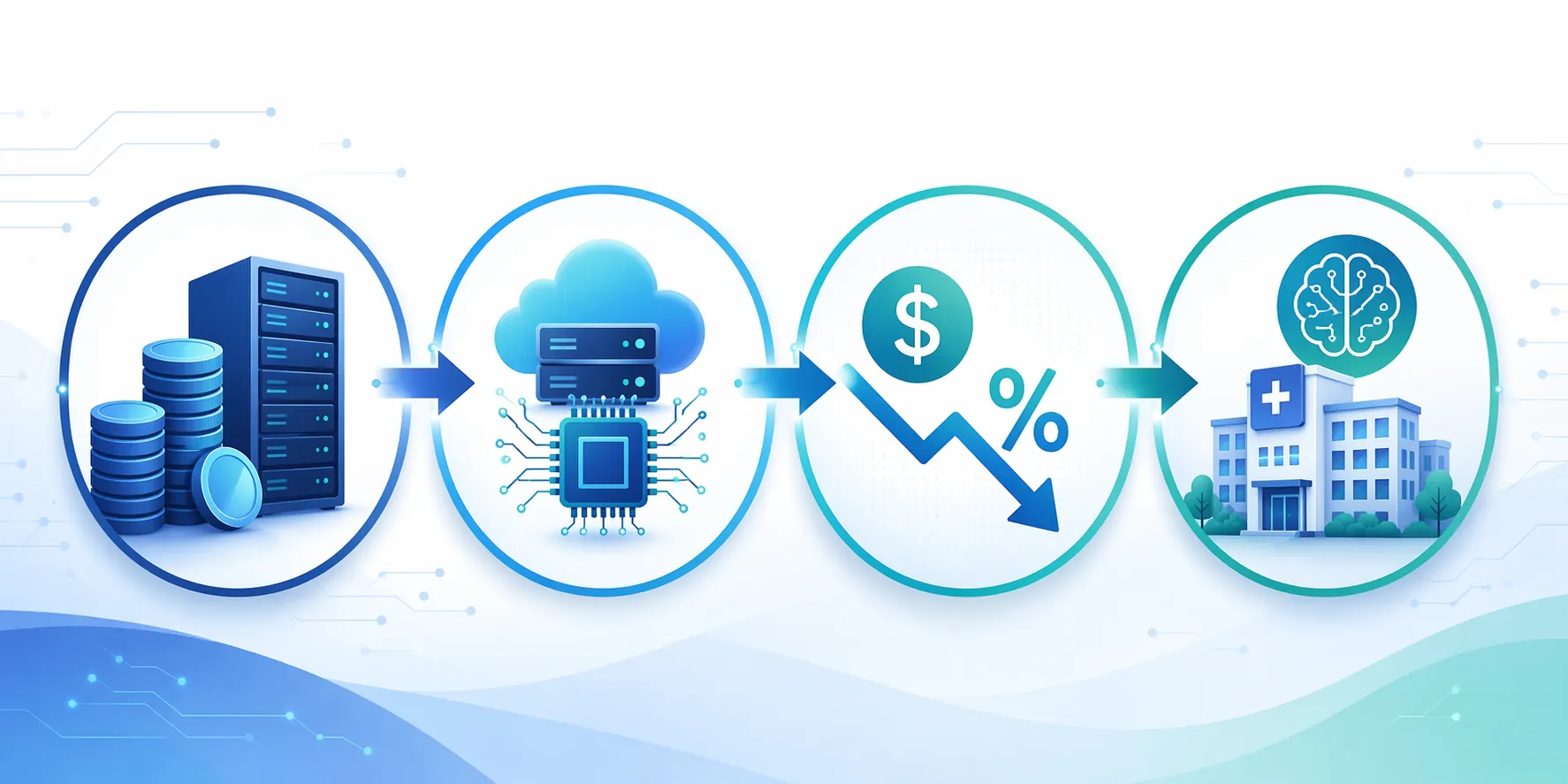
The causal chain is straightforward enough to be useful: capex funds servers, TPUs, and data centers; those assets expand capacity and improve the cost curve for model serving; lower and more predictable inference costs make scaled healthcare deployments easier to justify; and health systems then have a better chance of moving from bounded pilots to governed services.
The server-versus-data-center split is important. Servers and accelerators attack the immediate compute bottleneck. Data centers attack power, cooling, location, redundancy, and availability. Healthcare buyers feel both, even if they rarely see them itemized. A chatbot for member navigation, an ambient documentation workflow, or a clinical summarization service may look like software at the point of use, but at scale it becomes a stream of inference calls competing for capacity and budget.
Google has also been explicit that demand has not been the only limiting factor. CNBC reported that Alphabet’s cloud backlog exceeded $460 billion in early 2026, while coverage of Alphabet’s results described the company as supply-constrained rather than demand-constrained.[2][3] Backlog is not the same as healthcare adoption, and it should not be treated as a healthcare number. Still, for hospital and payer technology leaders, a supply-constrained cloud provider is not an abstraction. It affects queueing, regional availability, pricing leverage, implementation timing, and confidence that a pilot can be supported if usage rises.
| Infrastructure layer | What Google spending changes | Why healthcare buyers care |
|---|---|---|
| Servers and accelerators | More inference and training capacity | Fewer capacity-related delays when AI workloads move beyond pilot volume |
| Data centers | More physical availability, power, cooling, and regional footprint | Better support for resilient production services and location-sensitive workloads |
| TPU economics | Lower performance-per-dollar curve for inference | More realistic budgets for high-volume summarization, navigation, and administrative workflows |
| Distributed deployment options | More viable on-premise or controlled-environment AI | Better fit for data sovereignty, latency, and security requirements |
The Cost Curve Is the Part Health Systems Actually Feel
The most deployment-relevant number in the current Google AI story is not the $175 billion to $190 billion capex range. It is the reported 78% reduction in Gemini serving costs in 2025, cited in coverage of Google Cloud Next 2026.[4] That number sits much closer to the decisions CIOs and digital health leaders actually have to make.
Inference cost is the recurring cost of using the model after it has been built. In healthcare, that distinction matters more than many strategy decks admit. A model demo can be impressive at a few thousand calls. A member service assistant, claims workflow agent, prior authorization support tool, or clinician-facing summarizer may have to run across millions of interactions. At that point, the difference between a tolerable and intolerable cost-per-interaction can decide whether the program is funded, capped, or quietly left in pilot status.
This is where infrastructure spending can accelerate adoption without ever appearing on a hospital’s balance sheet. If Google’s own serving cost curve falls, and if some of that efficiency reaches customers through pricing, capacity, packaging, or workload optimization, then scaled AI services become easier to defend. The caveat is doing real work here: a vendor’s cost reduction is not automatically a customer’s savings. Procurement teams still need contract terms, usage thresholds, data-processing commitments, monitoring costs, integration costs, and exit risk on the table.
The reported TPU 8i improvement points in the same direction. Google Cloud Next 2026 coverage described TPU 8i as delivering 80% better inference performance per dollar.[4] In a consumer app, that might mainly mean cheaper personalization at higher scale. In healthcare, it can change which workloads are worth productionizing: long clinical notes, multi-document summarization, call-center transcripts, benefits navigation, coding support, and administrative exception handling all become more plausible when the cost of each inference step drops.

Highmark Shows What Adoption Looks Like When It Becomes Operational
Highmark Health’s Sidekick is useful because it is not presented as a clean-room benchmark. Google Cloud said Sidekick generated $27.9 million in AI-enabled value across more than 6 million interactions and 74 use cases in 2025.[5] Those are still vendor-disclosed figures, not an independent audit. But they are operational figures, and that makes them more informative than another model leaderboard.
The interaction count matters as much as the dollar figure. Six million-plus interactions means the system had to move beyond executive sponsorship and into the machinery of access, support, triage, service routing, or administrative work. At that scale, every extra inference call has a budget owner. Every handoff has an operational owner. Every unresolved exception has someone waiting on the other end.
This is the point at which cheaper compute becomes adoption pressure. A payer-provider organization does not need lower inference costs because lower costs are fashionable. It needs them because a useful AI system tends to create demand for more use: more members served, more questions handled, more workflows connected, more exception paths covered, and more monitoring required. If the unit economics are wrong, success creates its own ceiling.
Highmark also illustrates why healthcare AI adoption is broader than direct clinical decision-making. Much of the near-term adoption is likely to sit in member services, administrative workflows, care navigation, documentation support, and operational coordination. That may disappoint anyone waiting for a single dramatic diagnostic breakthrough, but it is exactly where infrastructure economics can show up first. These workflows have volume, measurable cycle-time pressure, and enough labor cost to make automation financially legible.
Distributed Cloud Matters Because Not Every Healthcare Workload Belongs in a Standard Cloud Pattern
Hackensack Meridian Health’s deployment of clinical summarization agents on Google Distributed Cloud is the other kind of evidence worth paying attention to.[4] It does not prove broad clinical effectiveness. It does show why hardware economics and deployment architecture matter for healthcare in a way that generic AI adoption commentary often misses.
Many healthcare organizations are not simply deciding whether to use AI. They are deciding where the workload can run, what data can move, who can access logs, which environment meets security requirements, and whether the deployment can survive scrutiny from privacy, compliance, legal, and clinical governance teams. On-premise, air-gapped, sovereign, or otherwise tightly controlled environments can be less forgiving than standard cloud deployments. If inference performance per dollar improves inside those architectures, the adoption frontier moves.
That does not make every health system ready to deploy summarization agents broadly. Clinical summarization has obvious appeal because documentation burden is real and because summaries can be embedded into existing review workflows. It also carries risks: omissions, misplaced emphasis, hallucinated context, alert fatigue in another form, and unclear accountability when a clinician relies on generated text. Better infrastructure lowers one barrier. It does not remove the need for validation, monitoring, and policy about how generated content is used.
The Market Context Supports Demand, but It Is Not the Proof
The broader healthcare AI market data is consistent with the infrastructure story, though it should be handled as context rather than proof. Menlo Ventures reported that healthcare AI spend tripled to $1.4 billion in 2025 and framed a $740 billion annual administrative-spend pool alongside $63 billion in healthcare IT spend.[6] Those figures help explain why vendors and investors are crowding into administrative and operational AI. They do not prove that Google’s capex caused any individual deployment.
The administrative-spend comparison is especially relevant because it points to where adoption may scale first. Healthcare organizations have enormous nonclinical friction: claims, scheduling, documentation, revenue cycle, call centers, benefits navigation, coding, compliance review, and internal support. These areas are not easy, but they are often easier to evaluate than autonomous clinical reasoning because the outcome measures are closer to cost, cycle time, queue length, denial rate, or staff workload.
Google Cloud-commissioned survey data adds another signal, but not an independent verdict. In a National Research Group survey of more than 700 healthcare and life sciences executives commissioned by Google Cloud, 73% reported positive generative AI ROI within the first year, with an average 3.2:1 return.[7] That is useful as an executive sentiment and self-reported ROI signal. It should not be read as neutral evidence that most healthcare AI deployments are succeeding, or that returns will translate across organizations with different data quality, integration maturity, and governance capacity.
Research Progress Is Not the Same as Adoption
Google’s healthcare AI work also includes research that may shape future products, but research systems should not be blended into today’s adoption evidence. DeepMind described an AI co-clinician research system tested in simulated diagnostic scenarios, including a reported result in which it had zero critical errors in 97 of 98 cases.[8] That is notable research. It is not the same thing as a deployed, FDA-cleared, reimbursed, clinician-trusted product running in routine care.
This boundary matters for buyers. A health system can be interested in frontier clinical reasoning research while still deciding that its 2026 deployment roadmap belongs in summarization, navigation, administrative automation, and human-reviewed workflow support. The former may influence the long-term product direction. The latter is where infrastructure economics can change timelines now.
What a 2026 Healthcare AI Buyer Can Reasonably Infer
A CIO or CMIO should not look at Google’s capex plan and conclude that adoption risk has disappeared. The more defensible conclusion is narrower: if Google’s AI infrastructure build expands available capacity and improves inference economics, then some healthcare AI deployments that were previously too expensive, capacity-constrained, or architecturally awkward may move faster.
That changes the questions worth asking in 2026 procurement and planning cycles. Instead of asking only whether a model can perform a task in a pilot, health systems need to ask what happens at production volume. How many interactions are expected? Which calls require the strongest model? Which can run on a smaller or cheaper model? Where will the data reside? Who reviews outputs? How are exceptions routed? What is the spend ceiling if usage doubles? Which team owns monitoring after go-live?
The better the infrastructure economics become, the less defensible it is to hide behind generic statements that healthcare AI is too expensive to scale. But the reverse is also true: cheaper inference makes weak governance more dangerous because it allows poorly designed workflows to spread faster. A summarization agent that saves time in one department can create downstream risk if the receiving clinician does not know what was generated, what was omitted, or what source material was used.
The Bottom Line for Healthcare AI Adoption
The impact of Google AI spending on healthcare AI adoption is real, but it is mediated through the stack. Alphabet’s 2026 capex plan builds the physical and computational base. Gemini serving-cost reductions and TPU performance-per-dollar improvements change the economics of repeated inference. Cloud backlog suggests demand has already been pressing against supply. Highmark and Hackensack show the mechanism surfacing in operational healthcare settings, from high-volume interaction platforms to controlled-environment clinical summarization.
What the evidence does not show is just as important. There is no public healthcare-specific allocation inside Google’s $175 billion to $190 billion spending plan. There is no direct attribution model proving that a particular hospital deployment happened because of that capex. There is no reason to treat infrastructure investment as a substitute for clinical evidence, governance, integration, or trust.
For health systems planning 2026 deployments, the practical conclusion is measured but meaningful: Google’s infrastructure build is likely to make scaled healthcare AI more feasible by reducing compute friction and easing capacity constraints. It will not decide which workflows deserve automation, which outputs are safe enough to use, or who is accountable when the model becomes part of daily operations.
References
- Google parent Alphabet forecasts sharp surge in 2026 capital spending, Reuters, February 4, 2026.
- Alphabet resets the bar for AI infrastructure spending, CNBC, February 4, 2026.
- Alphabet's Google AI spending supply constraints, Fortune, February 4, 2026.
- Healthcare AI at Google Cloud Next 2026, AllHealthTech.
- Helping healthcare move from data to agentic action, Google Cloud.
- 2025: The State of AI in Healthcare, Menlo Ventures.
- Healthcare and life sciences AI innovation: Gen AI agents, Google Cloud.
- AI co-clinician, DeepMind.
Comments
Join the discussion with an anonymous comment.