
Indoor farming is not categorically safer than traditional farming; it is differently vulnerable. A sealed room removes some contamination routes, but it also changes how contamination moves, where it hides, and who has to catch it before harvest. That is the real issue in indoor farming vs traditional farming food safety risks, not whether LEDs and stainless steel look cleaner than soil.
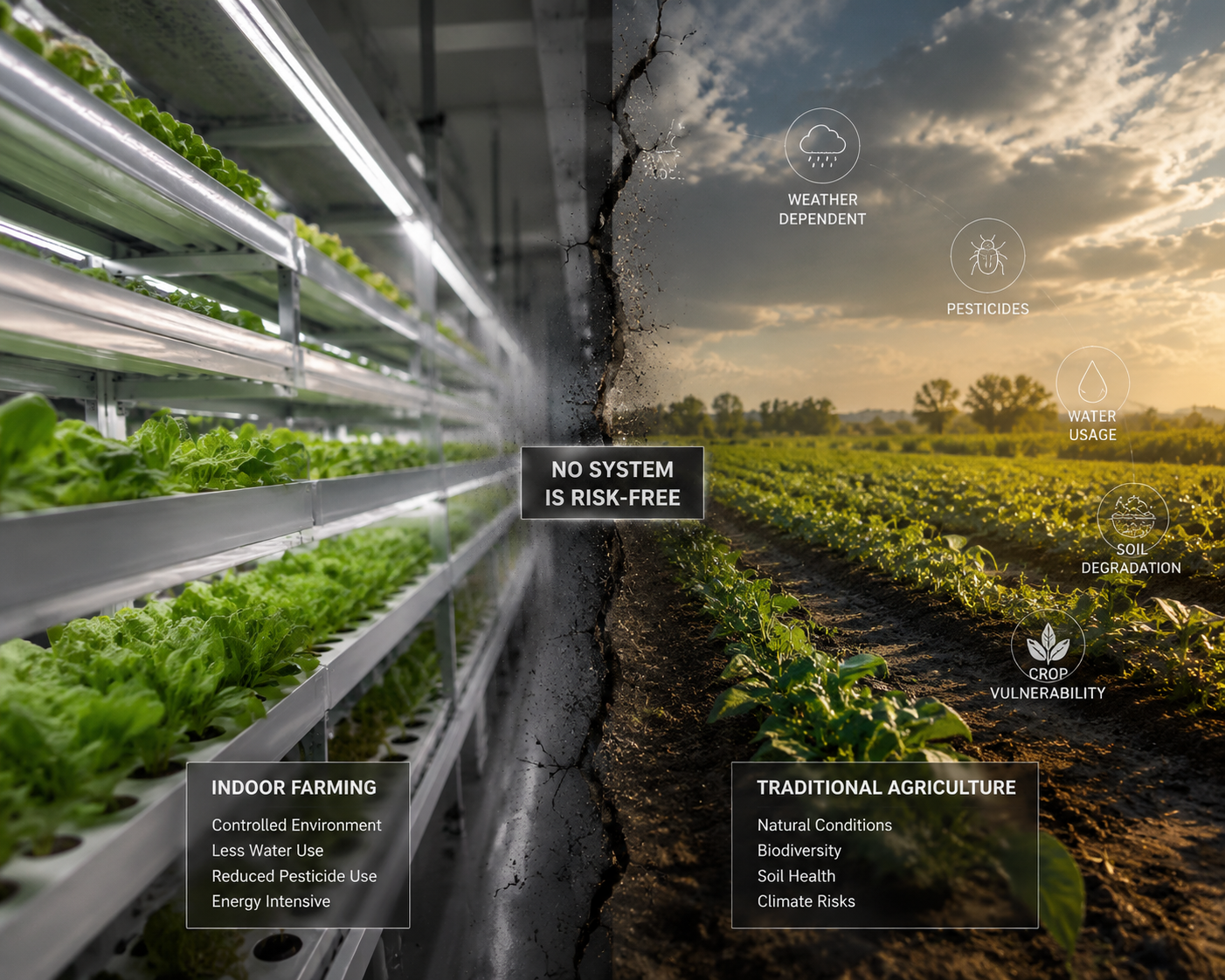
The FAO's 2025 review makes the comparison plain. Controlled environments are not immune from food safety risks, shared water recirculation in hydroponics can spread pathogens quickly if not carefully managed, and stable indoor conditions can let pathogens persist longer because there is less UV die-off and less microbial competition [1].
What Indoor Control Removes, and What It Introduces
That does not mean indoor farms are worse by default. They usually eliminate some obvious field routes: wildlife intrusion, dust, manure runoff, and irrigation water drawn from open canals. They can also make traceability easier when the system is run tightly. The problem is that control is not the same as immunity.
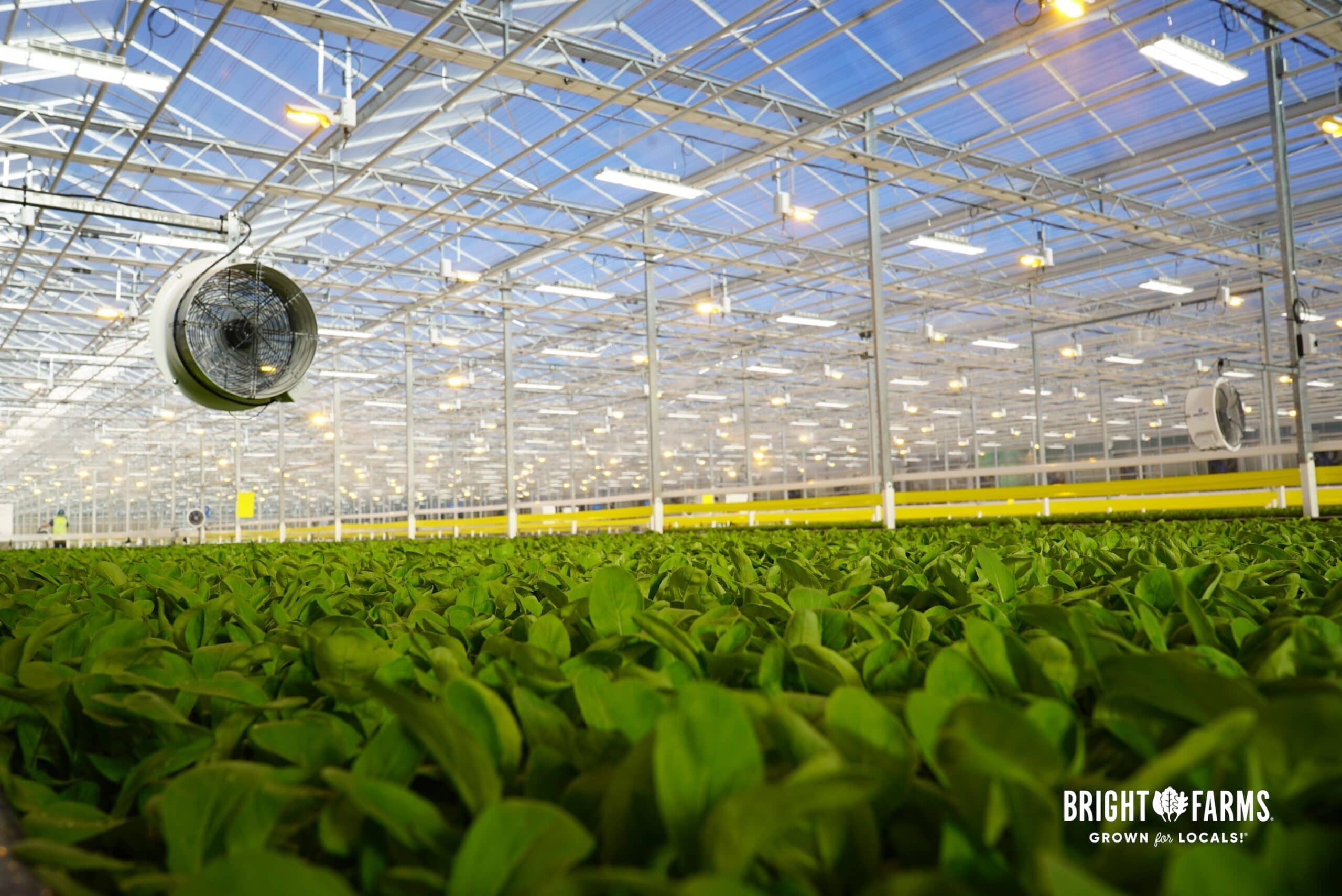
The BrightFarms Salmonella Typhimurium outbreak is the case that keeps this discussion honest. An indoor CEA facility was contaminated through an outdoor storm-water pond, and FDA investigators found conditions and practices that could result in contamination [2]. The point is not that every greenhouse is one pond away from failure. The point is that a controlled room still depends on the perimeter: water, maintenance, drainage, and people.
Lewis Ivey et al.'s 2025 systematic review of 131 hydroponic studies found only 32 intervention studies, half of the papers did not even specify the hydroponic system type, and no intervention eliminated pathogens entirely [3]. That matters because recirculating nutrient solutions do not just move water; they can move microbes, and plant exudates can feed bacterial growth and biofilm formation.
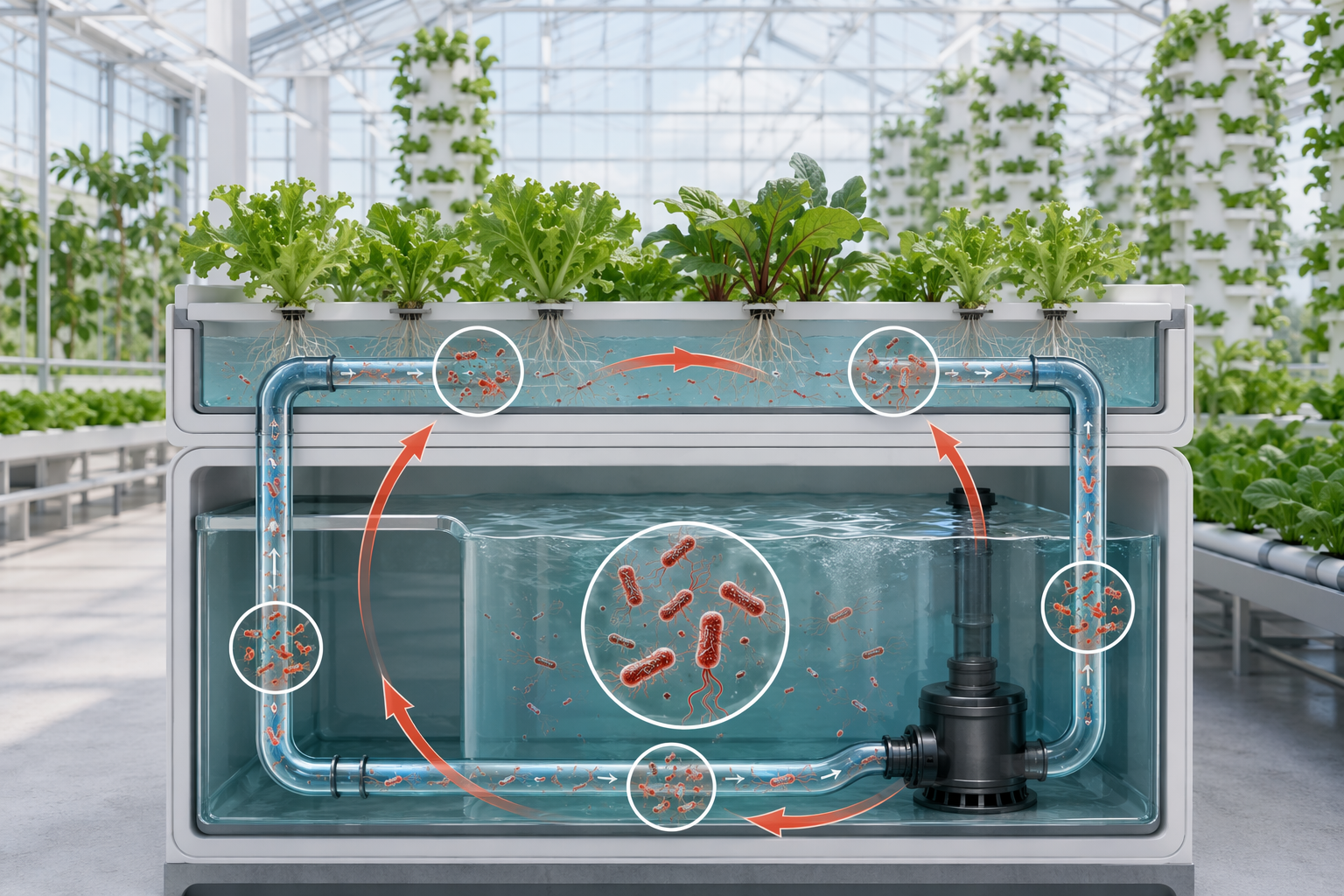
Once a biofilm establishes on a line, tank, or fitting, it is no longer just a water-quality issue. It becomes a persistence problem, because the same stable conditions that help plants can also help a contaminant survive long enough to keep circulating [1][3].
Traditional Fields Are Not the Safe Baseline
Open-field agriculture keeps different risks in play. The CDC has estimated 48 million foodborne illnesses a year in the U.S., so the baseline problem is large regardless of production system [5]. And the 2017-18 E. coli O157:H7 outbreak linked to Yuma irrigation water showed how a field system can turn water exposure into a crop contamination event [6].
Fields deal with exposure instead of recirculation. Rain, dust, wildlife, manure, and surface water can all enter the picture, and when they do, the contamination pathway can be broad and hard to isolate. That is a different problem from the one indoor farms face, but it is still a serious one.
The Comparison That Actually Matters
| System | What it tends to reduce | What still has to be managed |
|---|---|---|
| Indoor farming | Pesticide use, water use, and land use can be much lower in some systems [4]. | Recirculating pathogen spread, biofilm persistence, sealed-environment breaches, and seed-to-crop cross-contamination still need active control [1][2][3]. |
| Traditional farming | No shared nutrient loop to amplify a single contamination event. | Wildlife intrusion, dust, runoff, and irrigation-water exposure remain live pathways [1][6]. |
The 2020 resource-comparison review that gets cited so often does show large savings in pesticides, water, and land, but it also shows much higher energy use [4]. Those tradeoffs matter for operations and sustainability planning. They do not, by themselves, prove microbial safety.
So neither system wins on safety in the abstract. Indoor farming suppresses some hazards and creates others; traditional farming keeps exposure routes open but avoids some of the persistence problems that come with shared recirculation. The useful question is not which setting looks cleaner. It is which hazards are being suppressed, which are being introduced, and whether the controls are strong enough to break the pathway before harvest.
References
- Modern indoor farming and food safety: A review of hazards, controls and regulatory consideration — FAO, 2025
- BrightFarms 2021 Salmonella Typhimurium outbreak — Journal of Food Protection, 2023
- Food Safety in Hydroponic Food Crop Production: A Systematic Review of Intervention Studies — 2025
- How energy innovation in indoor vertical farming can improve food security, sustainability, and food safety — 2020
- Estimates of Foodborne Illness in the United States — CDC, 2013
- E. coli Outbreak Linked to Romaine Lettuce from Yuma Growing Region — CDC, 2018
Comments
Join the discussion with an anonymous comment.