
Keytruda’s patent cliff matters because the industry has already started budgeting around the end of old PD-1 economics. Merck’s pembrolizumab franchise generated $29.5 billion in 2024 and $31.7 billion in 2025, including Keytruda Qlex, putting the largest oncology revenue base on a path toward biosimilar exposure in 2028.[1] At roughly the same time, Opdivo faces its own 2028 expiry pressure on an annual revenue base of about $9 billion, creating not one product event but a class-level reset.[2]
The timing is unusually unforgiving. Keytruda is also selected for Medicare price negotiation under the Inflation Reduction Act, with negotiated prices scheduled to take effect in January 2028.[1][2] That means the usual biosimilar question — how fast do copycat biologics erode share and price? — arrives alongside a separate federal pricing mechanism. Historical oncology biosimilar curves are useful, but they are not a clean template for a mega-blockbuster facing both forces at once.
This is the practical impact of the Keytruda patent cliff on cancer drug development: PD-1 no longer looks like a scarce source of pricing power. It looks like infrastructure. That does not make pembrolizumab clinically unimportant. It makes late, undifferentiated PD-1/PD-L1 programs harder to justify when the reference molecule is moving toward biosimilar competition and when capital can be aimed at payloads, bispecific designs, delivery systems, and checkpoint biology that are harder to copy.

The biosimilar clock is no longer theoretical
The strongest evidence is not an analyst model. It is the queue of developers already in clinic. As of May 2026, at least 13 companies had pembrolizumab biosimilar programs in clinical trials, with Formycon/Zydus positioned as the likely first U.S. biologics license application filer after positive Phase 1 bioequivalence data reported in February 2026.[3] That is the market behaving as though 2028 is close enough to finance manufacturing, comparability, regulatory work, and launch preparation now.
There are already small but telling launch previews outside the core U.S. and European markets. Pembrolizumab biosimilars launched in Paraguay in August 2025, Vietnam in November 2025, and Jordan in February 2026.[3] These launches do not prove the future U.S. erosion curve. They do prove that the molecule is no longer protected by aura. Where legal, regulatory, and commercial conditions permit entry, biosimilar pembrolizumab is already a product category.
The class is large enough to attract a crowded biosimilar field. The global PD-1/PD-L1 inhibitor market was estimated at approximately $73.87 billion in 2026.[4] That figure should not be treated as a guaranteed accessible pool for biosimilars; indications, contracting, physician habits, patents, and formulations all matter. But it explains why the biosimilar pipeline is not thin. The prize is too large for a single follow-on entrant, and oncology payers have had years to learn how to manage biologic substitution without pretending the innovator brand is untouchable.
| Signal | What it changes for R&D strategy |
|---|---|
| Keytruda revenue reached $31.7B in 2025, including Keytruda Qlex | The exposed base is too large for Merck and competitors to treat as an ordinary loss-of-exclusivity event |
| At least 13 clinical-stage pembrolizumab biosimilar programs as of May 2026 | The post-2028 market is already being built by follow-on manufacturers, not merely forecast by analysts |
| Early launches in Paraguay, Vietnam, and Jordan from 2025 to 2026 | Biosimilar pembrolizumab has moved from development concept to launched product in selected markets |
| IRA negotiated pricing begins in January 2028 | U.S. price compression may not wait for a conventional biosimilar-only erosion curve |
The old analogs are useful only up to a point
Trastuzumab and bevacizumab biosimilars give a rough calibration for what oncology biologic erosion can look like. Historical analogs show innovators retaining about 40–60% share in year one and 30–40% by year three, with pricing drops of 20–40% in year one and 40–60% or more over five years.[1] Those ranges are not a forecast for pembrolizumab. They are a reminder that oncology biosimilars do not need to instantly erase an originator to change development behavior.
A sponsor deciding whether to fund another PD-1/PD-L1 antibody does not need perfect visibility into 2030 market share. It needs to know whether the category’s pricing umbrella is weakening. On that question, the evidence is already good enough. A crowded biosimilar field, early emerging-market launches, and negotiated U.S. pricing all make the late-entry PD-1 economics look increasingly narrow.
Merck is not relying on passivity. Keytruda Qlex, a subcutaneous formulation approved in September 2025 for 38 tumor indications, carries independent patent protection covering formulation, delivery device, and administration method.[1][2] That matters because a subcutaneous product can create a practical barrier to direct substitution even after the core intravenous patent window changes. The size of that barrier will depend on payer coverage, provider adoption, and whether biosimilar manufacturers can develop comparable subcutaneous options, but it is a real defensive move.
Fixed-dose combinations are another defensive layer, though they should not be mistaken for renewed molecule-level exclusivity. Patents filed after 2028 can protect specific pembrolizumab-containing regimens extending to at least 2042, but they cover the combined product rather than pembrolizumab itself.[1] That can preserve premium pockets around particular regimens. It does not restore the old simplicity of owning the backbone.
Merck’s ADC push is the clearest tell
The most revealing response to the Keytruda cliff is not Merck defending pembrolizumab. It is Merck buying and partnering its way into assets where the copy problem is structurally different. The company’s ADC push includes a $4 billion-plus partnership with Daiichi Sankyo around HER3-DXd and I-DXd, a partnership with Kelun around the TROP2 ADC MK-2870, and the VelosBio acquisition that brought in the ROR1-targeting ADC zilovertamab vedotin.[2][5]
Those are not decorative pipeline extensions. They are bets on a different form of oncology control. A PD-1 biosimilar competes on molecular comparability, manufacturing confidence, contracting, and substitution behavior. An antibody-drug conjugate competes through the target, antibody, linker, payload, drug-antibody ratio, release behavior, safety profile, and combination logic. A biosimilar can copy pembrolizumab; it cannot copy an ADC platform merely by arriving after loss of exclusivity.
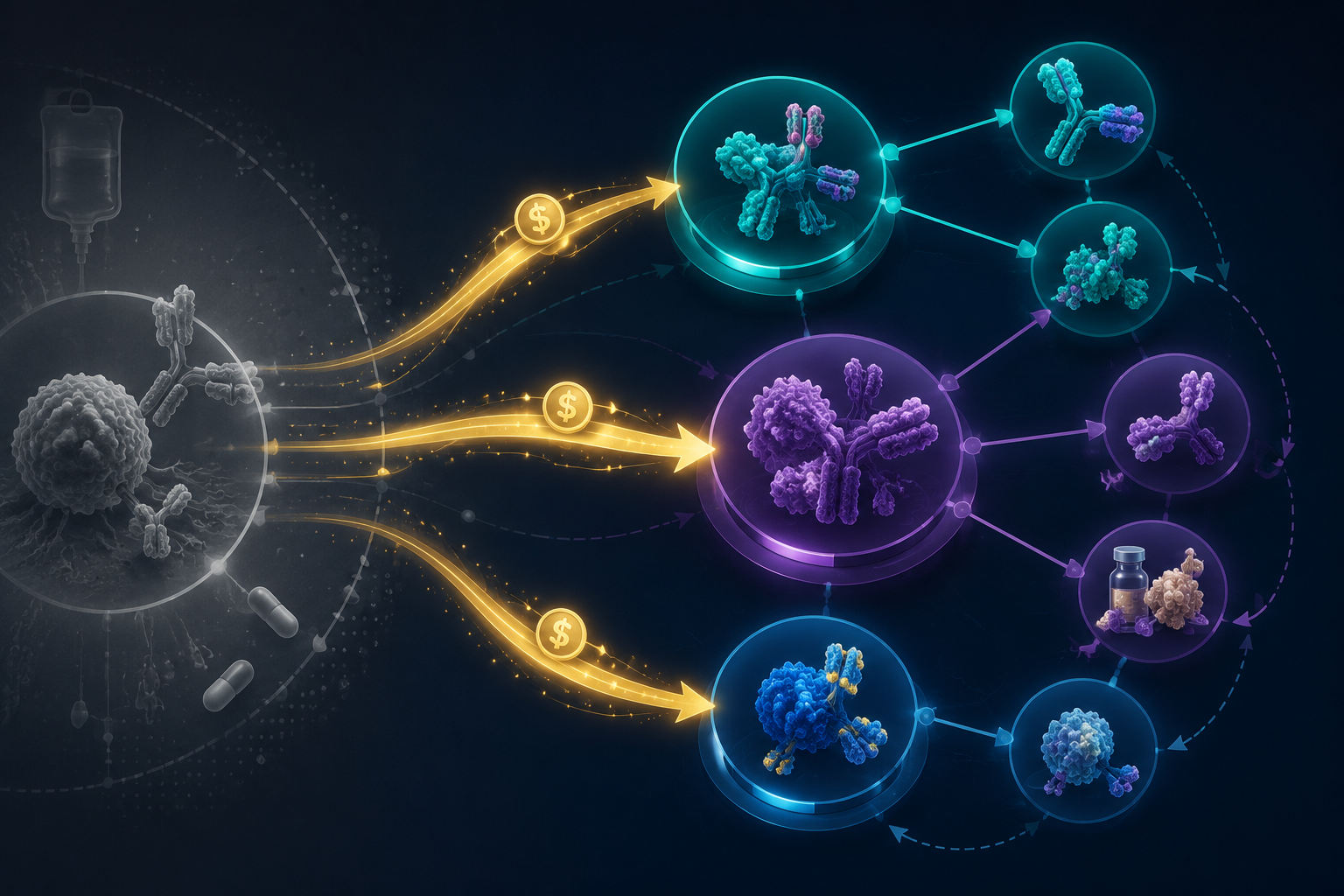
Merck’s late-stage ADC pipeline makes the defensive logic harder to dismiss. Zilovertamab vedotin, the ROR1 ADC, is in pivotal trials with a potential 2026–2027 launch window, while MK-2870, the TROP2 ADC, is in Phase 3.[2] Both are new chemical entities with independent composition-of-matter patent protection.[2] That is the part that matters for portfolio construction: these assets are not simply trying to sit on top of Keytruda’s old monopoly. They are intended to rebuild proprietary oncology revenue around mechanisms and product architectures outside the direct reach of pembrolizumab biosimilars.
Merck’s stated target is also large enough to show that this is not a side pocket. The company has targeted $25 billion from new oncology products by the mid-2030s and $50 billion from new launches across all therapeutic areas.[6] Those are management targets, not guaranteed outcomes. They still give a useful read on the scale of replacement Merck is attempting: the company is not trying to offset Keytruda with one successor drug. It is trying to construct a new revenue stack.
The ADC trade is crowded because the logic is obvious
Merck is not alone, which weakens any reading that this is merely company-specific hedging. Pfizer’s $43 billion acquisition of Seagen was a platform transaction, not a single-asset purchase, and it brought in an ADC portfolio including Padcev.[5] AstraZeneca and Daiichi Sankyo have expanded Enhertu across more than five oncology indications.[2] These moves differ in execution risk and target biology, but they point in the same direction: capital is moving toward modalities that create proprietary complexity after the PD-1 backbone becomes cheaper and more interchangeable.
The attraction is not that ADCs are safe bets. They are expensive to develop, difficult to manufacture, and clinically unforgiving when payload potency and normal-tissue toxicity collide. The attraction is that they can still justify differentiated pricing and development control if the therapeutic index is real. In a post-Keytruda world, that is a more coherent place to spend risk capital than a conventional PD-1 antibody arriving after the class has been economically reset.
This also changes how combination development is likely to be valued. A cheaper PD-1 backbone can make some trials easier to rationalize economically, especially where the investigational agent is the true source of differentiation. But it also strips away the lazy part of the old strategy. Pairing a weak novel agent with an expensive branded checkpoint inhibitor and hoping the regimen inherits the aura of the backbone becomes harder when the backbone itself is turning into oncology infrastructure.
That point matters beyond wet-lab pharmacology. Trial design, biomarker selection, real-world evidence generation, and companion diagnostic strategy will carry more of the burden when the market no longer pays simply for being near PD-1. For a broader view of how the development stack is changing, ClinicalMind’s analysis of AI in medical research entering its infrastructure phase is relevant context, but the Keytruda cliff is a narrower and more immediate forcing mechanism.
Bispecifics are the other route around commodity PD-1
ADCs are the most visible reallocation target, but they are not the only one. Bispecific antibodies are trying to make the checkpoint itself harder to commoditize by changing the binding logic. Ivonescimab, a PD-1 x VEGF bispecific, was approved in China in May 2024, while Merck’s LM-299, another PD-1 x VEGF bispecific, is in Phase 1.[2] The broader field includes PD-1 x CTLA-4 and PD-1 x LAG-3 approaches, with at least 200 PD-1-based bispecific candidates in clinical development globally.[2]
The strategic bet is straightforward. If a plain PD-1 antibody is vulnerable to biosimilar competition, a bispecific can attempt to preserve novelty by integrating checkpoint blockade with another biologic function in the same molecule. That does not guarantee superior efficacy, cleaner safety, or commercial success. It does mean the sponsor is no longer competing only on whether it can produce another PD-1 binder.
The risk is crowding. More than 200 PD-1-based bispecific candidates does not mean more than 200 differentiated drugs.[2] It means the industry has correctly identified the economic problem and is now trying many versions of a similar answer. The same skepticism applied to PD-1 me-too programs should follow this field: biology, indication choice, biomarker strategy, dosing convenience, and tolerability will decide whether a bispecific is a real product or merely a more complicated way to chase the same franchise.
What gets harder to fund
The programs most exposed are not necessarily all PD-1/PD-L1 assets. A differentiated checkpoint strategy can still deserve capital. The vulnerable programs are the ones whose commercial case depends on arriving late to a category whose reference economics are being compressed. If the development plan cannot explain why the antibody is clinically distinct, why the indication remains commercially protected, or why the regimen avoids direct substitution pressure, the patent cliff turns a marginal program into an expensive delay tactic.
That pressure should show up in portfolio reviews before it shows up in failed launches. A Phase 2 PD-1/PD-L1 program that once looked financeable because the class carried premium pricing now has to compete internally against ADCs, bispecifics, targeted combinations, and delivery improvements. The question for budget committees is no longer whether checkpoint inhibition remains central to oncology. It is whether owning another conventional checkpoint antibody is the best use of a development dollar.
There is also a subtler effect on small biotechs. In the past, a plausible PD-1/PD-L1 program could carry optionality: partner it, combine it, or position it for markets where access differed. As pembrolizumab biosimilars multiply, that optionality narrows. A biotech may still build value around a checkpoint mechanism, but the bar moves toward a clear mechanistic edge, a defined biomarker population, a differentiated format, or a combination where the non-PD-1 asset is the actual reason to care.
What gets cheaper is not necessarily what gets less important
Pembrolizumab biosimilars could make the PD-1 backbone more accessible in some settings, but that should not be confused with reduced clinical relevance. The drug’s centrality is precisely why the cliff matters. A commoditized backbone can remain medically important while losing the power to anchor an innovator’s growth story.
For developers of genuinely novel agents, a lower-cost PD-1 backbone may eventually be useful. Combination trials could become less distorted by the cost and contracting dynamics of a single dominant branded checkpoint inhibitor. Payers may be more willing to examine the incremental value of the new agent if the background therapy is no longer absorbing so much of the regimen cost. None of that is automatic, especially under IRA pressure and uneven biosimilar uptake, but it is a plausible secondary effect.
The companies that benefit will not simply be the ones that avoided PD-1. They will be the ones that use PD-1 as a lower-cost component while controlling something else: a payload, a dual-target antibody, a validated biomarker segment, a delivery advantage, or a novel checkpoint pathway. That is where the economics can separate from the biosimilar reference product.
The portfolio reset is already visible
Analyst estimates for Keytruda after 2028 should be kept in their lane. Consensus estimates cited by SyneticX point to a peak of roughly $33–34 billion and a decline to about $27.4 billion by 2029, but those are not Merck guidance and will depend on biosimilar timing, patent litigation, IRA implementation, contracting, and formulation uptake.[2] The more durable conclusion does not require a precise revenue curve.
The durable conclusion is visible in capital allocation. Merck is defending Keytruda with Qlex and regimen patents while also building ADC and bispecific options. Pfizer paid for Seagen’s ADC platform. AstraZeneca and Daiichi Sankyo keep expanding Enhertu. Pembrolizumab biosimilar developers are already moving through clinic and launching in selected emerging markets. These are different transactions and programs, but they are responding to the same structural fact: a backbone drug that can be copied no longer supports the same development logic as a protected franchise.
The Keytruda patent cliff is therefore not just a Merck revenue event. It is accelerating a reallocation of oncology R&D away from PD-1/PD-L1 rent extraction and toward modalities whose value depends on harder-to-replicate design: ADC architecture, bispecific binding logic, delivery barriers, and new checkpoint biology. The eventual winners are not yet knowable. The direction of the money already is.
References
- PatSnap analysis.
- SyneticX competitive intelligence.
- Pearce IP May 2026 clinical trial update.
- Coherent Market Insights via Access Infinity.
- BioPharma Dive dealmaking coverage.
- PharmExec JP Morgan 2026 preview.
Comments
Join the discussion with an anonymous comment.