
The notable thing about the Martha Stewart Hint app AI features is not that a home app can answer questions. It is that Hint appears to be assembling a home-specific operating model from several kinds of inputs: public property records, environmental data, uploaded household documents, expert-authored guidance, contractor knowledge, and proactive prompts that start before the homeowner asks for help. Public reporting describes a system that uses an address lookup to pull property deeds and tax assessments, combines that with weather, soil, flood risk, and air quality data, and lets users upload inspection reports, warranties, insurance policies, and utility bills to create a continuously updated home profile.[1]
That matters because it moves the product away from the familiar consumer AI pattern of a blank chat box. A chat interface starts with the user’s memory: the homeowner must know what to ask, when to ask it, and which document to find. Hint’s public pitch is closer to an agentic workflow: the system knows enough about the house, the season, the documents, and the risk context to initiate the next useful action.
There is a launch story behind the company, but it is secondary to the architecture. Hint was co-founded in May 2026 by Martha Stewart, CEO Yih-Han Ma, formerly of Red Ventures’ home services business, and CTO Kyle Rush, described in coverage as a former Casper AI engineer. The company raised a $10 million seed round led by Slow Ventures and was still targeting a summer 2026 launch on desktop and iOS as of the public reporting available in July 2026.[2][1] Its waitlist had more than 8,490 people at the time of the launch announcement, a useful signal of interest but not evidence of product effectiveness.[1]
Hint’s Apparent Architecture: Data, Knowledge, Action
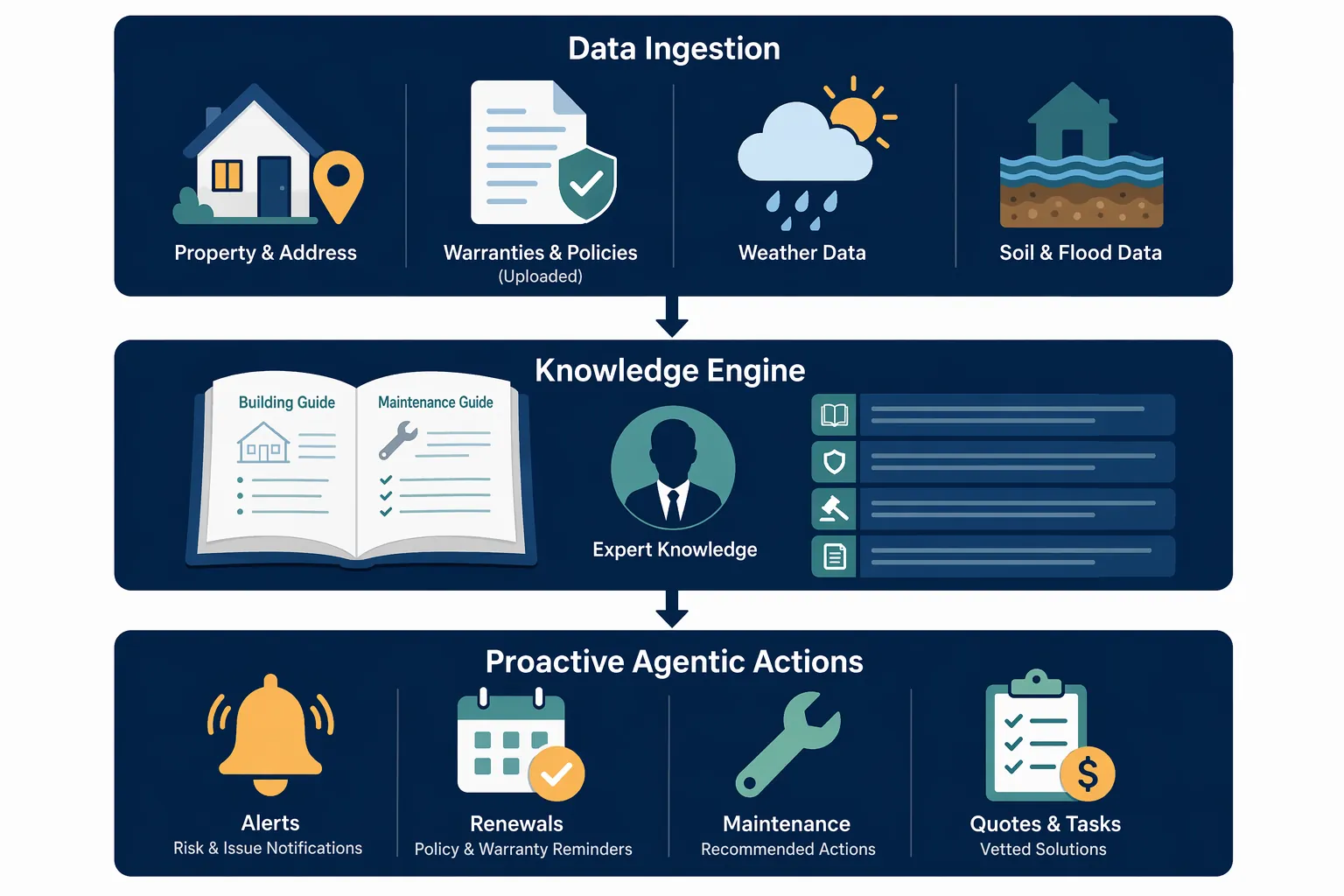
Based on public interviews and press coverage, Hint can be read as a three-layer system. The first layer builds a profile of the home. The second layer interprets that profile through written guidance and contractor-informed rules. The third layer turns the interpretation into actions such as alerts, renewal reminders, quote checks, seasonal maintenance prompts, and energy-plan suggestions.
| Layer | What enters the system | What the layer appears to produce |
|---|---|---|
| Multi-source data ingestion | Address-based public records, environmental data, uploaded warranties, inspection reports, policies, bills | A continuously updated home profile |
| Expert-authored knowledge engine | Martha Stewart-authored guides and contractor expertise described in interviews | Context-aware recommendations constrained by household guidance and cost/service knowledge |
| Proactive agentic logic | Home profile, documents, dates, risks, seasonal context, service needs | Alerts, monitoring, quote validation, maintenance prompts, and optimization suggestions |
That reconstruction should be held carefully. Hint has not published technical white papers, API documentation, model cards, evaluation reports, or system diagrams. The analysis here is therefore not a claim about how the code is implemented. It is a reading of the product pattern described by the company and reporters: data feeds plus documents, expert guidance plus service knowledge, proactive initiation rather than passive response.
The Data Layer Is Doing More Than Personalization
Most consumer AI products personalize after a user has typed, clicked, bought, or uploaded enough material. Hint’s more interesting move is earlier: it reportedly starts with the address. From that address, the system can pull public records such as deeds and tax assessments, then combine them with real-time or changing environmental inputs including weather, soil, flood risk, and air quality.[1]
That is a different starting point from a general assistant asking, “What can I help you with?” A home has a location, age, climate exposure, local hazards, systems, maintenance history, financing obligations, insurance terms, and installed equipment. A useful home AI has to know at least some of that context before it can judge whether an alert is trivial or urgent.
The uploaded-document piece is just as important. Public reporting says Hint will let users upload inspection reports, warranties, insurance policies, and utility bills.[1] Those are exactly the documents that become invisible until something breaks. The warranty is missing when the appliance fails. The policy language matters after the storm. The utility bill becomes relevant only when someone is trying to decide whether a new plan, repair, or retrofit is worth it.
If the system can parse those documents reliably, the home profile becomes more than a customer record. It becomes an operational memory. The homeowner no longer has to remember when the HVAC was serviced, whether a contractor’s proposed replacement conflicts with warranty terms, or whether the insurance renewal date is approaching. The system can, in principle, notice those relationships because the dates, assets, contracts, and external conditions sit in the same workspace.
The phrase “in principle” has to stay in the sentence. Document ingestion is easy to demo and hard to guarantee. A home inspection report may be long, inconsistent, and full of caveats. A warranty may depend on exclusions, proof of maintenance, installation conditions, or manufacturer-specific language. A utility bill may be easy to summarize but harder to use for a financially sound optimization recommendation. None of the public materials available by July 2026 establishes Hint’s extraction accuracy, error handling, confidence scoring, or escalation process.
Still, the architecture is worth noticing because the unit of intelligence is not a prompt. It is the household context assembled across sources. For clinical AI teams, that distinction is familiar. A care recommendation based only on a clinician’s question is a different system from one that has already reconciled EHR data, labs, imaging, medication lists, prior authorizations, care pathways, and patient-reported information. Hint is not a clinical system, but the data problem has a recognizable shape.
Expert Guidance Becomes Machine-Usable Advice
The Martha Stewart part of the product is easy to reduce to celebrity distribution. That misses the more technical question: what happens when a trusted human source writes guidance that an AI system then uses inside recommendation logic?
Realtor.com reported that Stewart personally wrote guides embedded in the app, and MarthaStewart.com described the app as drawing on her guidance for household tasks such as seasonal garden preparation and holiday planning timelines.[3][4] Public coverage also says contractor expertise informs cost benchmarks and service-quality recommendations.[1] The result is not merely a knowledge base in the old FAQ sense. It is presented as a source of context-aware recommendations: what to do, when to do it, and how to judge the advice or service offer in front of the homeowner.
That design choice is attractive for a reason. Open-ended generative systems can produce plausible, fluent, poorly constrained answers. An expert-authored corpus gives the system something more specific to draw from. In a household setting, that might mean a seasonal garden-prep sequence, a maintenance checklist, or a planning timeline that reflects a recognizable standard of care rather than whatever a model produces from generic web-scale patterns.
But “expert-authored” is not the same as validated, current, complete, or appropriate for every context. Stewart’s guides may be valuable household knowledge; contractor input may improve quote review; neither automatically resolves the problem of local building codes, regional climate variation, manufacturer requirements, insurance exclusions, or edge cases. The knowledge layer needs provenance, versioning, conflict resolution, and a way to tell the user when advice is general rather than specific to their property.
This is where the healthcare analogy becomes especially sharp. Clinical AI builders already know that guidelines are not self-executing. They must be translated into computable logic, mapped to patient context, updated over time, and constrained when evidence is weak or conditions differ. Hint’s expert-guidance layer is a consumer expression of the same architectural instinct: do not let the model improvise everything; give it a governed body of domain knowledge to work from.
The Agentic Layer Is Where the Product Becomes Operational
The most consequential Hint features are the ones that reduce the homeowner’s need to initiate. Public coverage describes alerts for insurance renewals, weather-related risk warnings, seasonal maintenance guidance such as winterizing pipes and changing HVAC filters, contractor quote validation against market rates, energy plan optimization, and maintenance-history tracking.[1][5]
Those actions are different in operational weight. A reminder to replace an HVAC filter is low risk if wrong, though still annoying if noisy. A warning about weather-related pipe risk has a different consequence profile: a missed alert may mean water damage; a false alert may mean unnecessary anxiety or expense. Contractor quote validation adds another dependency, because the system must compare the proposed work against the home’s context, market rates, scope, materials, and service quality signals. Insurance renewal monitoring touches financial continuity and coverage risk.
That variety matters. “Agentic AI” can sound as if the main question is whether the system acts autonomously. The better question is what kind of action it initiates and who absorbs the cost of a mistake. A prompt that says “your filter may be due for replacement” is not the same class of intervention as a recommendation to reject a contractor quote, change an energy plan, or rely on a particular insurance option.
The public savings claims should also be read with discipline. PYMNTS reported discussion of energy plan optimization claiming more than 40% savings, and coverage has described maintenance tracking as a way to extend HVAC lifespan by 5 to 10 years.[5][1] Those are vendor-side or interview-based claims in pre-launch coverage, not independently validated outcome data. They may be targets, examples, or expectations; they should not be treated as measured results from deployed users.
A practical way to evaluate the agentic layer is to follow a single household object through the system. Consider an HVAC unit. The home profile might contain the property age, regional climate, uploaded inspection notes, utility bills, warranty terms, and maintenance history. The knowledge layer might contain guidance about filter changes, seasonal servicing, and signs of inefficient operation. The agentic layer could then remind the homeowner to replace a filter, flag a utility-cost pattern, suggest service before a heat wave, or help evaluate whether a contractor’s replacement quote is in range. That hypothetical sequence is not a verified Hint workflow; it is the kind of workflow the publicly described ingredients make plausible.
The design challenge is that every step depends on earlier steps being right enough. If the document parser misses the warranty term, the quote recommendation may be wrong. If the environmental feed is stale, the risk alert may arrive late. If the market-rate comparison is too generic, the homeowner may challenge a fair contractor or accept a bad one. In a chat product, the user often catches the mismatch because they are actively steering. In a proactive product, the system may create confidence before the user has inspected the reasoning.
Why This Is Not Just a Better Chatbot
The distinction between reactive and proactive AI can be overstated, but in Hint’s case it is useful. A chatbot waits for a homeowner to ask, “Should I winterize my pipes?” or “Is this contractor quote too high?” Hint’s described architecture tries to notice that winterization is becoming relevant, that the home may face a weather-related risk, that a contractor quote has arrived, or that an insurance renewal is coming due.
That changes the burden on the user. The homeowner is no longer only the question-asker. They become the reviewer of system-initiated suggestions. In some cases that is a relief; in others it creates a new task. The system must decide when to interrupt, how much evidence to show, whether to rank options, and when to say that a human professional should review the situation.
This is also where product incentives become architecture, not just business strategy. Fortune reported that Slow Ventures’ Kevin Colleran acknowledged the structural pressure created by affiliate-fee models, saying, “the only way to get clarity around that is to be really transparent.”[1] That is an unusually direct way to state the problem: if a recommendation engine can earn money when a user selects a vendor, energy plan, insurer, or service provider, the user needs to know how ranking, exclusion, and disclosure work.
The issue is not that affiliate revenue makes useful recommendations impossible. It means unbiased recommendation cannot be assumed from the interface. A system can be helpful and still have incentive gradients that shape which options are shown, which are emphasized, and which are omitted. For a household AI product, that may affect cost and trust. For healthcare AI, the same pattern can become far more serious when recommendations touch care pathways, referrals, coverage, utilization management, or vendor selection.
The Healthcare Parallel Is Architectural, Not Literal
A home management app is not a hospital system. Deeds, weather feeds, warranties, and contractor quotes are not EHR notes, lab values, imaging reports, medication histories, and clinical guidelines. A burst pipe is not sepsis. A bad energy-plan recommendation is not a missed diagnosis. The analogy only works if it stays at the level of system design.
At that level, Hint makes a familiar clinical AI problem visible in a less regulated setting. The product’s apparent pattern is: ingest heterogeneous data, maintain a longitudinal profile, map that profile against expert knowledge, and initiate timely action. That is close to the pattern many clinical AI teams want for care-gap closure, chronic-disease management, imaging follow-up, medication safety, discharge planning, and prior-authorization support.
The downstream worker changes, but the workflow risk remains. In a home, the person cleaning up after a weak automation may be the homeowner searching for a warranty, calling the insurer, or arguing with a contractor. In healthcare, it may be a nurse, care manager, clinician, or IT analyst reconciling bad data, suppressing noisy alerts, explaining a flawed recommendation, or fixing a handoff the system made look complete.
The lesson is not that clinical AI should copy Hint. It is that proactive automation requires a different evidence standard than conversational assistance. A chat response can be inspected at the moment of use. An agentic workflow may act earlier, route work differently, suppress alternatives, or create the impression that something has already been handled. That calls for visible provenance, audit trails, confidence thresholds, escalation paths, and measurement against real outcomes rather than engagement metrics.
Hint’s pre-launch status keeps the conclusion narrow. The company has described a compelling consumer architecture, and the market pain is real enough: Americans spend more than $500 billion annually on home repairs, according to the Harvard Joint Center for Housing Studies figure cited in Fortune’s coverage, and Angi’s 2025 survey found that 62% of homeowners were more worried about maintenance costs than the year before.[1] Those facts explain why a proactive home AI would find an audience. They do not prove that Hint’s recommendations will be accurate, trusted, or financially aligned with users.
What to Watch as Hint Launches
The useful questions for Hint are not whether the app feels polished in a demo or whether Stewart gives it brand permission. The useful questions are operational.
- Data quality: how accurately the system extracts dates, exclusions, costs, asset details, and obligations from uploaded documents.
- Provenance: whether users can see which record, guide, bill, policy, or environmental signal caused a recommendation.
- Action boundaries: which tasks the system merely flags, which it ranks, and which it helps initiate with third parties.
- Evaluation: whether claimed savings, avoided repairs, or equipment-lifespan improvements are measured after launch with transparent methods.
- Incentive disclosure: how affiliate relationships affect recommendations, ranking, and available options.
For healthcare AI builders, those same questions translate cleanly. What data entered the system? What knowledge constrained the recommendation? What action did the agent initiate? Who reviewed it? Who paid for the error? Who benefited financially if the recommendation was accepted?
Hint is worth watching because it makes a consumer version of context-aware, agent-driven automation easier to see. Its promise is the architecture: a living profile, a governed knowledge layer, and proactive action. Its unresolved issues are just as instructive: no public technical documentation, no independently validated performance data, pre-launch uncertainty, and a recommendation model that must prove its alignment rather than ask users to infer it.
References
- Exclusive: Martha Stewart’s AI startup Hint raises seed funding from Slow Ventures, Fortune, May 13, 2026
- Martha Stewart’s AI Startup for Homeowners, Hint, Inc.
- Martha Stewart’s Hint App: Yih-Han Ma Interview, Realtor.com
- Martha Launches Home Management App, MarthaStewart.com
- Martha Stewart Wants AI to Run Your Home, PYMNTS
Comments
Join the discussion with an anonymous comment.