
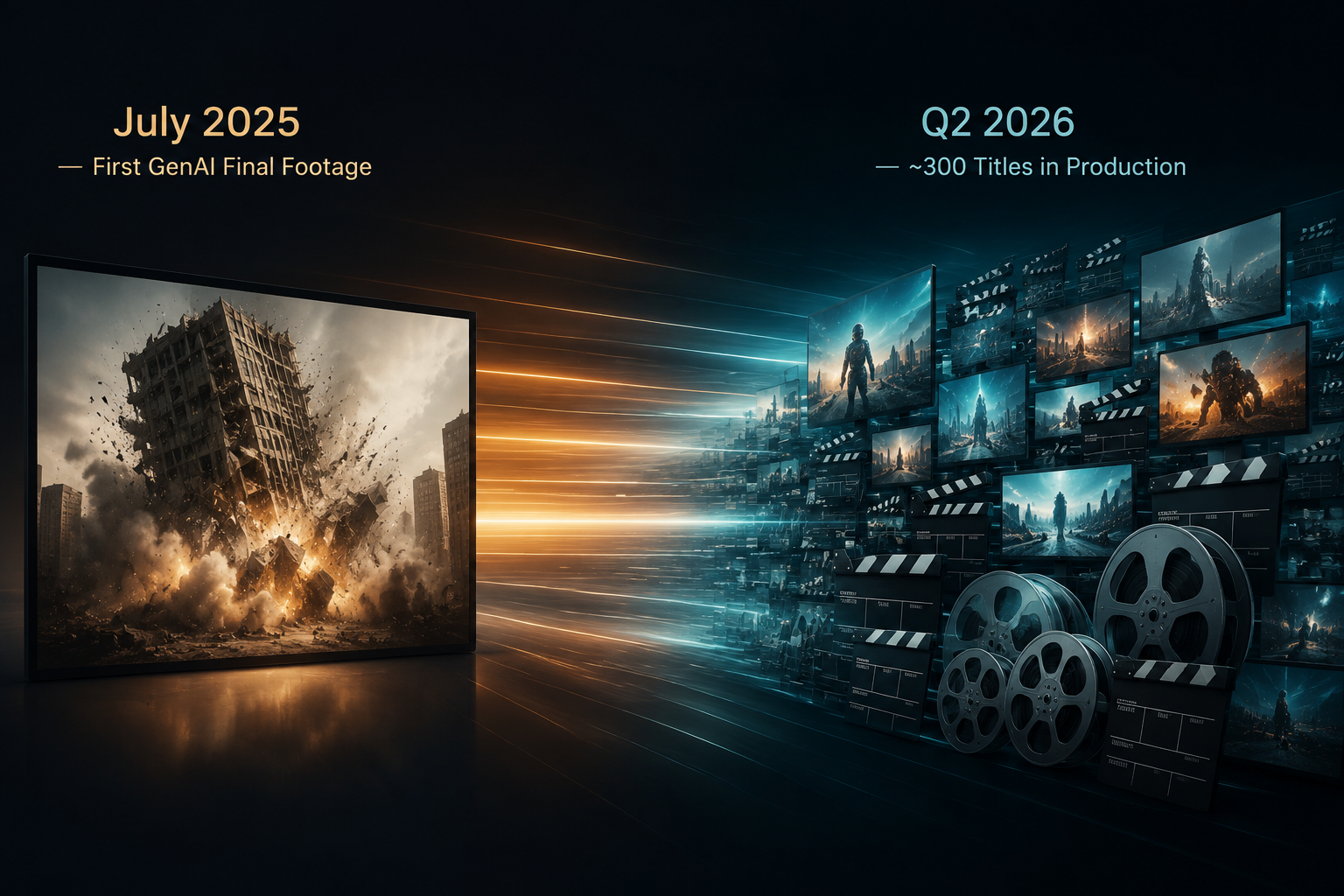
In July 2025, Netflix's first generative-AI final footage was a building-collapse scene in The Eternaut, and BBC reported that the shot finished 10x faster than traditional VFX and at a cost that kept it inside budget [1]. By Q2 2026, Netflix said roughly 300 titles had used GenAI in production [2]. The distance between those two points is the case: a single final-footage success became a production pattern in about a year.

From One Scene To Hundreds Of Titles
The sequence matters more than the headline number. The first use had to prove that GenAI could solve one concrete post-production problem. The later disclosure had to show that the solution could spread without every title becoming the same risk.
| Date | Production | What Netflix disclosed |
|---|---|---|
| July 2025 | The Eternaut | A building-collapse scene was completed 10x faster than traditional VFX, and the cost saving made the shot feasible within budget [1]. |
| Q2 2026 | The American Experiment | 17 minutes of AI-enhanced footage were produced 2x faster and at half the cost [2]. |
| Q2 2026 | Roughly 300 titles | Netflix said GenAI had been used across about 300 productions in 2026, a scale figure that covers very different kinds of work [2]. |
That 300-title figure is broad by design. It includes very different uses, from ideation and background elements to more sensitive creative work. The number signals reach, not uniformity, and Netflix has not disclosed how those uses are distributed across risk tiers.
The Cost Evidence Arrived In Stages
The American Experiment pushed the economics further. Netflix said 17 minutes of AI-enhanced footage were produced twice as fast and at half the cost [2]. Ted Sarandos also cautioned that faster and cheaper does not matter if the work is not better, which keeps the claim bounded: the evidence is enough to change how a studio thinks about what belongs in the production pipeline, not enough to prove that every sequence will clear quality review.
The broader market was already leaning that way. McKinsey's January 2026 analysis, based on interviews with more than 20 media leaders, estimated that about $10 billion of forecast U.S. original content spend in 2030 could be AI-addressable and said early use cases were already showing 5% to 10% productivity gains [3]. A separate 2026 industry compilation cited up to 60% lower transcription costs, 40% lower translation costs, 6.5 hours saved per episode on automated scene detection, 92% pass rates on AI-based QC checks, and 83% shot-classification accuracy, though its methodology is a secondary compilation rather than primary research [4].
Governance Moved With The Output
Netflix did not present scale without policy. It published Using Generative AI in Content Production with five guiding principles that make the approval boundary explicit [5].
- No copyright infringement [5]
- No training on production data [5]
- Enterprise-secured environments only [5]
- Temporary and final deliverables are treated differently [5]
- No replacement of union talent without consent [5]
The risk matrix turns those principles into workflow. Ideation sits at low risk, background elements are a judgment call, final character designs trigger escalation, and talent replication requires legal review and written approval [5]. That is the part many enterprise AI programs skip: not a headline policy, but a decision path that tells production teams when a choice stays local and when it moves upward.
Why Consent Is Not Decorative
The guidance fits the post-strike labor environment. SAG-AFTRA and WGA contracts require performer consent for digital replicas, and the DGA bars AI from making creative decisions without director consultation [6]. In that setting, consent and role boundaries are not soft language; they are the mechanism that keeps automation from quietly becoming delegation.
Infrastructure As A Control Layer
Netflix's March 2026 acquisition of InterPositive suggests a second layer of control. The startup trained models on a proprietary controlled soundstage dataset and described cinematic rules and restraints intended to protect creative intent [7]. Public details on financial terms, staffing, and integration are limited, but the direction matters: governance is easier to enforce when the tooling itself is built around the rules rather than patched afterward.
What Healthcare Leaders Should Take From The Timeline
For healthcare, the lesson is not that clinical AI should move at Hollywood speed. It is that enterprise adoption can stay quiet for months and then steepen quickly once cost evidence, approval pathways, secure infrastructure, and workforce guardrails line up. Netflix does not prove that clinical AI can or should scale at the same pace, but it does show why hospital AI committees should plan for adoption curves that can compress faster than a pilot calendar suggests.
References
- Netflix uses AI effects for first time to cut costs — BBC News
- About 300 Netflix Programs Have Used Generative AI This Year — Variety
- What AI Could Mean for Film and TV Production and the Industry's Future — McKinsey & Company, January 2026
- AI in the Movie Industry Statistics — Gitnux, 2026
- Using Generative AI in Content Production — Netflix Partner Help Center
- CES 2025: Hollywood Unions Battle To Contain AI Disruptions In Creative Industries — Forbes, January 10, 2025
- Why InterPositive Is Joining Netflix — Netflix About, March 2026
Comments
Join the discussion with an anonymous comment.