
By July 2026, Objection AI had stopped looking like a courtroom and started presenting itself like infrastructure. The company rebranded as The Primary Index, describing a public-facing system that had analyzed more than 2 million articles, scored more than 20,000 journalists, and processed more than 25 billion tokens, according to its own launch announcement.[1] Nieman Lab characterized the move as a pivot from an AI tribunal model to a scoreboard model.[2]
That shift matters. A tribunal invites argument; a scoreboard invites lookup. This is easy to read as a funding story about Peter Thiel, but the more consequential question is operational: what happens when a private company combines automated judgment, paid escalation, investigator access, and public reputational labels around working journalists?

The Primary Index is not just another media-bias chart. Its predecessor, Objection AI, was built around case challenges to journalism. A complainant could pay to have an article assessed, the system would evaluate evidence, and higher fee tiers could bring in former intelligence and law-enforcement investigators. The public-facing version now emphasizes scaled ranking, but the same basic governance problem remains: a score is only as trustworthy as the rules, evidence handling, validation, and remedy process behind it.
From Gawker Playbook to Scoring Infrastructure
Objection AI launched in April 2026 with seed funding from Peter Thiel, Balaji Srinivasan, Social Impact Capital, and Off Piste Capital.[3] Founder Charles D'Souza had previously helped Thiel's legal campaign against Gawker, and The Intercept reported that D'Souza framed Objection as a way to industrialize the Gawker litigation model by lowering the cost and time barriers for challenging journalism.[4]
That history does not prove the system is illegitimate. It does explain why its fee structure and escalation path deserve more attention than its marketing language. A tool designed by people who know how expensive litigation can discipline media behavior is different from a newsroom correction form with better software. It may be framed as accountability, but its practical force depends on who can afford to initiate a case, how visible the accusation becomes, and whether the journalist has a meaningful route to contest the result.
The company-reported scale figures attached to The Primary Index are large enough to move the discussion out of novelty territory. More than 2 million analyzed articles and more than 20,000 scored journalists, if independently verified, would make the system a reputational database rather than a boutique dispute-resolution service.[1] The available materials, however, do not show independent verification of those numbers, nor do they disclose who is paying for challenges, how many cases have been completed, or what proportion of scores have been appealed or corrected.
The Machine Is a Method and a Business Model
The most important facts about the system are not just technical. They sit at the seam between model design and incentive design.
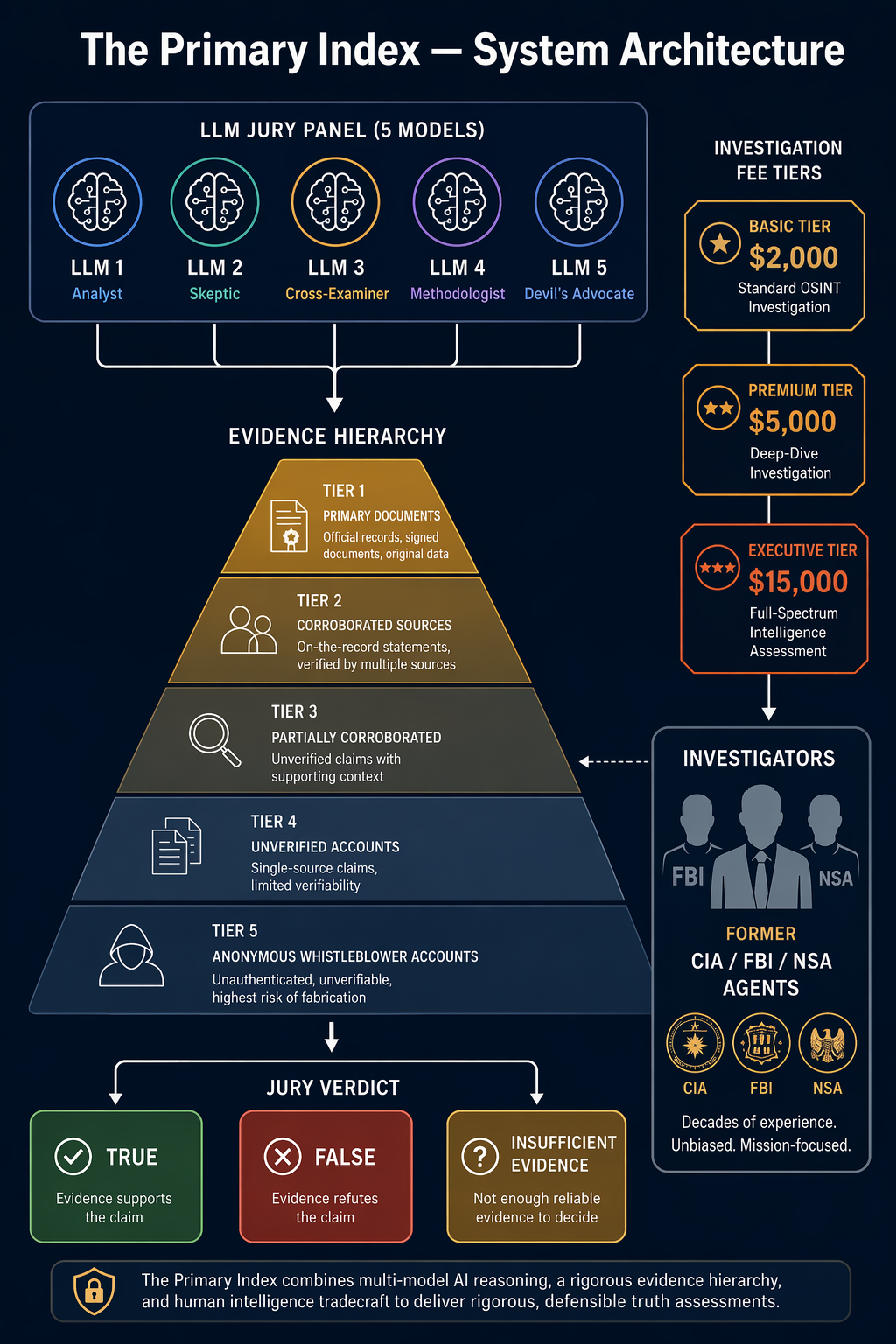
| System Element | Reported Design |
|---|---|
| Model jury | Five LLMs from OpenAI, Anthropic, xAI, Mistral, and Google are used as a jury, prompted to act as average readers.[3][5] |
| Evidence hierarchy | Primary documents such as regulatory filings, emails, and court filings rank highest; anonymous whistleblower accounts rank lowest.[3][5] |
| Verdicts | Each case receives a result of true, false, or insufficient evidence.[3] |
| Fees | Reported fee tiers range from $2,000 to $15,000.[3] |
| Escalation | Higher tiers reportedly provide access to former CIA, FBI, and NSA investigators.[3] |
A five-model jury is an interesting design choice. In principle, model diversity can reduce dependence on one vendor's behavior. It can also create a false impression of deliberation if the prompts, model versions, disagreement rules, weighting, and evidence extraction steps are not visible. Five systems can converge because the evidence is clear, because the prompt pushes them toward the same framing, or because they share similar training artifacts and failure modes. Without a reproducible protocol, the number five is a surface feature, not a validation result.
The evidence hierarchy is even more consequential. Ranking primary documents above anonymous accounts is defensible in many settings. A court filing, regulatory document, or authenticated email usually gives reviewers something stable to inspect. But journalism often depends on sources who cannot attach their names without risking dismissal, retaliation, legal exposure, or physical danger. A system that automatically discounts anonymity may look rigorous while quietly favoring the party with better document access, better lawyers, or better control over records.
That does not mean anonymous sourcing should be accepted uncritically. It means a credibility system needs a richer account of corroboration: whether multiple independent sources support the claim, whether documents partially confirm it, whether the reporter gave the subject a chance to respond, whether the newsroom has reviewed the source's identity, and whether later evidence confirmed or contradicted the reporting. The available descriptions of The Primary Index do not establish that this kind of nuance is available to the public reviewer of a score.
Verdicts Compress Uncertainty
The verdict options — true, false, and insufficient evidence — are tidy. They are also blunt. A reported article can contain a verified core claim, a disputed interpretation, an imprecise headline, and a source characterization that remains unknowable to outside reviewers. Compressing that mixture into a single public label may be useful for a docket, but it is a poor substitute for a visible audit trail.
The problem is not that classification exists. Medicine, law, credit, safety engineering, and editorial review all rely on classification. The problem is classification without the minimum equipment that makes it accountable: provenance, criteria, calibration, uncertainty intervals or their practical equivalent, conflict disclosure, external review, error logging, and a way for affected people to contest the result before reputational damage spreads.
Paid Challenges Change the Meaning of Accuracy
A paid challenge model does not automatically corrupt an evaluation system. Filing fees, expert reviews, arbitration panels, and commissioned audits can all be legitimate. But the fee tiers reported for Objection AI place the system inside an adversarial market, not a neutral public utility. When $2,000 to $15,000 buys different levels of process, including investigator access at higher tiers, the product has to answer a basic question: does more money buy more truth, or more pressure?[3]
The distinction matters because journalism disputes are asymmetric. A wealthy subject of coverage can repeatedly challenge stories, fund investigator time, and publicize "under investigation" status. A freelancer, local reporter, or whistleblower-backed investigation may lack equivalent resources. Even if the final verdict is fair, the process itself can become the punishment if interim labels circulate before a record is complete.
TechCrunch reported that the Fire Blanket feature could post "under investigation" labels on social media through X APIs in real time while claims were still being reviewed.[3] Coda Story also reported concern that journalists who refused to participate could receive "indeterminable" outcomes that cast doubt on their reporting.[5] Those are not cosmetic details. They define who carries the burden of uncertainty.
In a well-governed review system, interim status is handled carefully because readers infer more than the label says. "Under investigation" often reads as smoke. "Indeterminable" may read as evasive. If a journalist does not participate because the process is unclear, time-consuming, legally risky, or perceived as hostile, the resulting public ambiguity can still damage the work.
Chris Mattei, a First Amendment litigator, called the system "a high-tech protection racket for the rich and powerful." Jane Kirtley of the University of Minnesota said it was "one more chink in the armor to help destroy public confidence in independent journalism."[3] Those critiques are severe, but they point to a practical rather than metaphysical concern: the combination of money, accusation, automation, and public labeling can alter behavior even before any verdict is reached.
What the Early Docket Shows, and What It Does Not
The public record of Objection AI's early case activity is incomplete. Legal Funding Journal reported claimed cases involving the Sackler family and the opioid crisis, Joe Rogan and ivermectin, Candace Owens, and Jack Broughton, identified as an FBI whistleblower.[6] The case docket was reportedly partially visible before the Objection website was taken down in late May 2026, and later accounts reconstructed pieces of it from journalistic reporting.[6]
That is enough to show the company was not merely theorizing about contentious subjects. It is not enough to establish performance. A track record would require a complete docket, the original claims, the evidence submitted by each side, model outputs, human investigator contributions, final rationales, correction history, and independent review of whether the verdicts matched the underlying record.
The taken-down site also creates a preservation problem. Public accountability tools should be especially careful about their own auditability. If a system scores others but its own historical docket becomes difficult to inspect, the public is left relying on company claims and secondhand reconstructions. That is a weak foundation for a product that asks readers to treat its labels as trust signals.
There Is a Market for This Because Trust Is Already Broken
The Primary Index is entering a receptive market. Gallup reported in 2025 that 28% of Americans trusted the mass media to report the news fully, accurately, and fairly, the lowest level in its trend, down from 31% in 2024 and 40% five years earlier.[7] YouGov reported in 2026 that only 11% of Americans were very confident they could differentiate human-generated from AI-generated news.[8]
Those figures help explain the appetite for a scoreboard. They do not validate this scoreboard. Low trust creates demand for visible adjudicators, especially ones that promise scale and technical neutrality. It also creates a dangerous opening for systems that appear objective because their judgments are numeric, automated, or wrapped in institutional language.
Earlier journalism trust projects show how hard this category is. NewsTrust, The Factual, and Credder all attempted versions of journalism scoring or trust assessment and ceased operations. Their failures do not prove The Primary Index will fail. They do suggest that scoring journalism is not just a product-design problem. It is a legitimacy problem, and legitimacy is slower to build than a database.
The LLM-as-Judge Claim Needs More Than Analogy
D'Souza has cited a University of Chicago study in support of LLM-as-judge reasoning, but TechCrunch reported a narrower result: the study found that GPT made decisions like law students, and the authors explicitly declined to endorse AI superiority over human judges.[3] That distinction is not academic hair-splitting. Acting like a class of trained readers is different from being validated as an adjudicator for public reputational disputes.
A useful evaluation would ask different questions. How often do the models disagree? Are disagreements concentrated around anonymous sourcing, political topics, technical claims, or legal interpretations? Does the system behave differently when the complainant is wealthy, famous, or institutionally powerful? Are prompts stable over time? Are model updates frozen for active cases? Can an outside reviewer reproduce the verdict using the same record?
The public descriptions so far do not answer those questions. The absence of answers is not proof of bad faith, but it is evidence of immaturity for a system that has moved from experimental tribunal language into scoreboard infrastructure. If a score is meant to travel beyond the parties in a dispute, the method has to travel with it.
Why Healthcare Readers Should Pay Attention
There is no documented healthcare or medical journalism case in the materials reviewed here. The healthcare relevance is therefore an analogy, not an established deployment path. But it is a close analogy because clinical evidence appraisal faces the same temptation: use AI to read large bodies of material, rank evidentiary strength, flag weak claims, and accelerate review.
In healthcare and regulatory settings, a system that ranks evidence must show its work. A clinical claim may rest on randomized trials, observational studies, case reports, mechanistic reasoning, post-market surveillance, unpublished sponsor data, or patient reports. The hierarchy matters, but so do context and bias. A rigid ladder can make some evidence legible while making other evidence disappear.
The Primary Index highlights the governance problem in a more public and combustible arena. If anonymous accounts are discounted, whistleblower evidence may be weakened. If paying customers can trigger investigations, resource asymmetry can shape which claims receive scrutiny. If labels appear before final adjudication, interim uncertainty becomes a reputational event. If the prompt and scoring logic are not inspectable, users cannot tell whether the system is evaluating evidence or reproducing hidden assumptions.
Those are familiar questions for anyone who has watched AI move into evidence ranking, clinical decision support, payer review, regulatory triage, or trust scoring. The domain changes, but the control points remain recognizable: provenance, validation, conflict disclosure, external review, reproducibility, error handling, and remedy. A system can be technically impressive and still fail on those controls.
The Bounded Judgment
The Primary Index should not be dismissed merely because Peter Thiel funded its predecessor, or because D'Souza's history runs through the Gawker fight. Funding and origin are relevant because they illuminate incentives, not because they settle the evidence. A private media-accountability system could, in theory, expose sloppy reporting, clarify disputed claims, and give readers a better view of how evidence supports a story.
The present design, as publicly described, asks for more trust than it has earned. It combines LLM adjudication, a ranked evidence hierarchy, paid case initiation, premium investigator access, social labeling, and public journalist scores without enough visible process around validation, appeals, conflicts, or error correction. That combination is the issue. The individual parts may be defensible; together, they create an accountability machine whose own accountability remains underdeveloped.
Its importance is not limited to journalism. The Primary Index makes visible a governance problem that healthcare AI already faces in adjacent form: how to use automated systems to evaluate evidence without turning opaque scoring, hidden incentives, and weak appeal rights into infrastructure.
References
- Primary Launches World's First AI, Yahoo Finance, July 13, 2026
- Peter Thiel's AI tribunal pivots to scoreboard model, Nieman Lab
- Can AI judge journalism? A Thiel-backed startup says yes, even if it risks chilling whistleblowers, TechCrunch, April 2026
- Objection AI judges journalism, The Intercept, June 2026
- Can we trust an AI jury to judge journalism?, Coda Story
- Peter Thiel-backed Objection turns the Gawker playbook into an AI tribunal for journalists, Legal Funding Journal
- Trust in Media Falls to New Low, Gallup, 2025
- Trust in media 2026: Which news sources Americans use and trust, YouGov, 2026
Comments
Join the discussion with an anonymous comment.