Data center moratoriums are no longer a side dispute about zoning, transmission lines, or whether a county wants another windowless building near a highway interchange. The sharper question is whether the infrastructure now being built for AI is shifting health costs onto communities that did not choose the workload, the customer, or the clinical promise attached to it.
The most arresting estimate comes from a Caltech and UC Riverside team that modeled air pollution linked to AI data center growth. Their projection: by 2030, data center-related emissions could be associated with roughly 1,300 premature deaths each year in the United States, more than $20 billion in annual public health costs, and about 600,000 asthma symptom cases if current trajectories continue.[1] Those are not energy-sector abstractions. They are the units hospitals, Medicaid programs, emergency departments, school nurses, and respiratory clinics already know how to count.
They also need a careful label. The Caltech/UCR figures come from a preprint and statistical modeling that applies EPA methods to projected emissions pathways, not from prospective epidemiological follow-up of communities living near specific facilities. That makes the estimates serious enough to examine and too preliminary to treat as settled epidemiology. A recent review in the medical literature makes the same point more broadly: data center health impacts are plausible and increasingly measurable, but empirical research still lags behind the speed of construction.[2]
How Compute Becomes a Health Burden
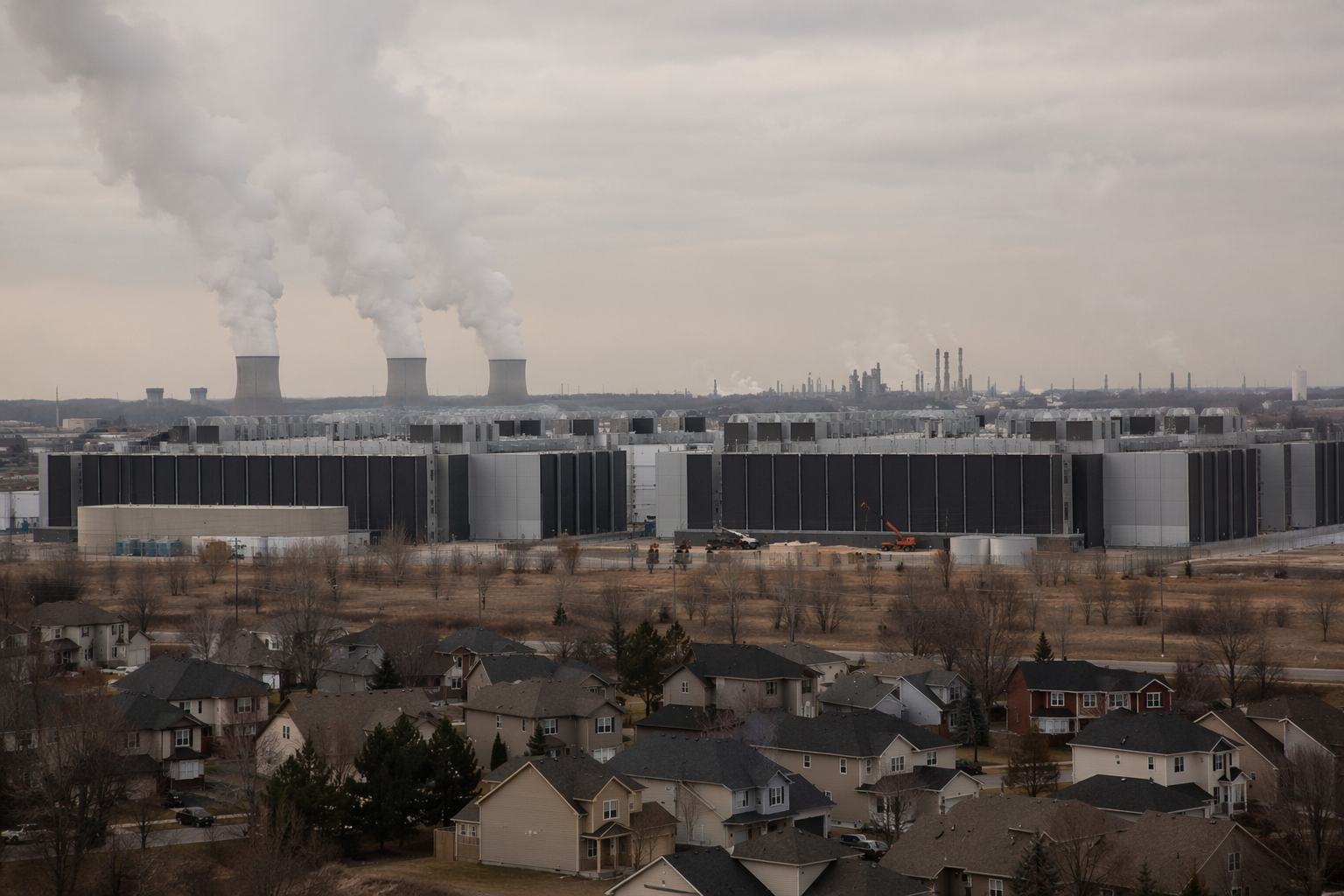
A data center does not have to emit smoke from its own stack to change someone’s air. It draws electricity from a grid that may still rely on gas or coal. It may require backup diesel generation. It may increase demand at the exact moment utilities are deciding whether to keep older fossil plants online. It may use millions of gallons of water a day for cooling, pull from potable supplies, add noise to nearby neighborhoods, and concentrate traffic, construction, and transmission infrastructure in places with limited political leverage.
The medical review estimates that data centers accounted for about 1.5% of global electricity consumption in 2024 and could approach 10% of demand growth from 2024 to 2030.[2] A hyperscale facility can use 3 million to 7 million gallons of water per day, and up to 57% of cooling water may come from potable sources.[2] The same review reports noise levels up to 96 dBA, a level that belongs in occupational health conversations, not in a hand-waved discussion of “the cloud.”[2]
| Infrastructure pathway | Public health relevance |
|---|---|
| Grid electricity demand | Can increase fossil-fuel generation or delay retirement of higher-emitting plants |
| Backup generation and local operations | Can add localized emissions and noise near surrounding communities |
| Cooling water demand | Can compete with potable water supplies or worsen stress in already constrained regions |
| Regional pollution drift | Can move health costs away from the facility host community and across state lines |
| Siting near lower-income areas | Can place incremental exposures on populations already carrying higher environmental burdens |
That last point matters because health burden is not distributed by the elegance of a model architecture. U.S. News, drawing on the same emerging evidence base, reported that data centers in just 10 states produced 70% of all pollution and health-related costs in 2025.[3] A national efficiency average can hide that kind of geography. The facility may sit in one county, the power plant in another, and the particulate burden somewhere downwind.
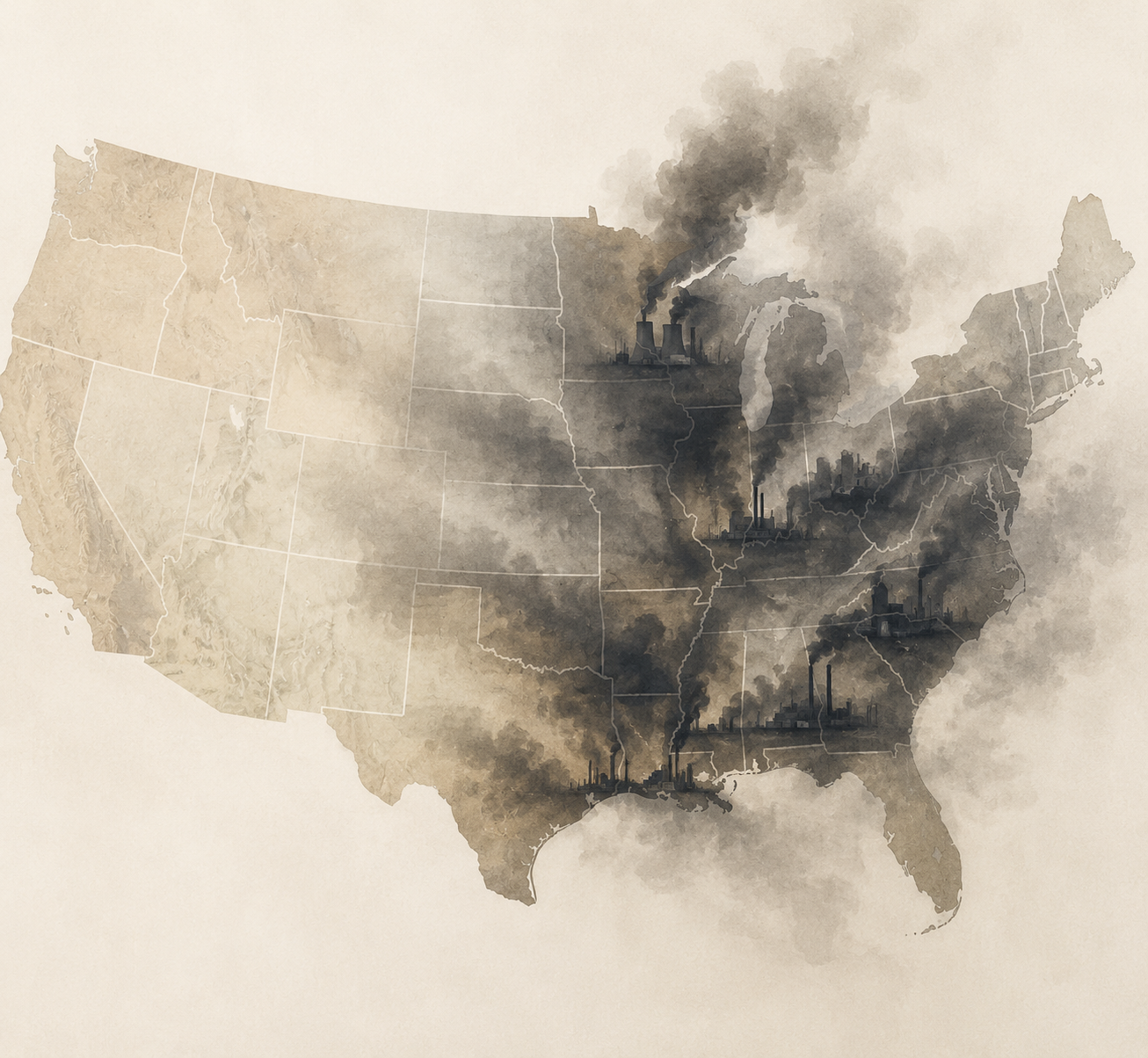
This is where healthcare readers should be especially wary of treating “renewable procurement” as a full answer. A company can buy clean power on paper and still increase local grid stress, require new transmission, or depend on fossil generation when supply and demand do not align hour by hour. Cornell reporting on a roadmap for AI data center impacts noted an estimate that 60% of new data center electricity demand would be met by fossil fuels, citing Goldman Sachs, and described delayed coal plant retirements in Indiana and Virginia as part of the concern.[4]
None of this proves that every data center produces the same harm. Location, grid mix, cooling design, water source, load flexibility, and air-permitting conditions all matter. A blanket statement that all AI compute is equally damaging would be as sloppy as a blanket statement that efficiency gains erase the burden. The public health question is narrower and more useful: who is exposed, what is preventable, and who gets to decide before the infrastructure is locked in?
Why Moratoriums Are Moving From Local Objection to Health Policy
Moratoriums have spread because communities and lawmakers are no longer being asked to approve a single building. They are being asked to accept a cumulative operating model: large power contracts, water withdrawals, new substations, diesel backup, around-the-clock cooling, and the promise that downstream economic or technological value will justify upstream exposure.
New York made that shift visible on July 14, 2026, when it became the first U.S. state to impose a moratorium on new AI data centers, restricting hyperscale facilities larger than 50 megawatts through executive action.[5] The important signal was not only the size threshold. It was the premise that AI infrastructure had become large enough, fast enough, and uncertain enough to justify a pause before ordinary permitting routines absorbed it.
The federal pressure is moving in the same direction. In June 2026, more than 500 organizations from 47 states called for a nationwide moratorium on new AI data centers, citing health, environmental, utility, and water impacts.[6] Senators Bernie Sanders and Representative Alexandria Ocasio-Cortez then announced the AI Data Center Moratorium Act, framing the issue around community protection, power use, water demand, and pollution rather than around technology competition alone.[7]
Counts vary because trackers classify restrictions differently. Reuters reported on July 14, 2026, that authorities were restricting data centers in multiple jurisdictions amid the AI boom, while other trackers count state bills, enacted state actions, local pauses, zoning bans, utility constraints, and project cancellations under different headings.[8] The precise total matters less than the pattern: the policy response is no longer isolated to one town that dislikes one developer.
Moratoriums are blunt instruments, but they have one virtue that ordinary environmental review often lacks: they create time. Time to ask whether a facility’s power demand depends on delayed fossil retirement. Time to ask whether cooling water is potable. Time to ask whether emergency generators are being permitted as minor details. Time to ask whether the health costs are being carried by the same people receiving the claimed benefits.
The Evidence Is Strong Enough to Act On, Not Strong Enough to Oversell
Public health often acts before perfect proof. Lead service lines, wildfire smoke protections, heat standards, diesel school bus replacement, and hospital infection control all involve decisions made under uncertainty. The relevant test is not whether every modeled death can be assigned to a named server rack. It is whether the exposure pathway is credible, the burden could be large, the affected population may have limited control, and delay would make prevention harder.
By that standard, the data center evidence deserves policy weight. The Caltech/UCR estimate translates emissions into premature mortality, asthma symptoms, and dollar-denominated health costs.[1] The medical review connects electricity, water, noise, and community exposure pathways in one place.[2] Geographic reporting shows that pollution-related costs are concentrated rather than evenly spread.[3] The fossil-fuel dependency evidence challenges the comforting assumption that new AI load is automatically decarbonized by corporate procurement.[4]
It also deserves humility. A modeled national estimate cannot tell a county health department exactly how many additional asthma attacks will occur beside a specific campus. A review can identify plausible pathways without proving the magnitude at every site. A state moratorium can prevent a bad project while also delaying a better-designed one. Public health loses credibility when uncertainty is used as an excuse for inaction; it also loses credibility when preliminary modeling is presented as if it were surveillance data.
Clinical AI Is Caught in the Same Infrastructure Problem
Healthcare cannot watch this debate from outside the fence. Clinical AI development, validation, deployment, monitoring, and documentation increasingly depend on cloud compute. Radiology triage tools, ambient documentation systems, risk prediction models, patient messaging assistants, operations forecasting, drug discovery workflows, and research pipelines all use infrastructure that may be physically located far from the hospital or clinic claiming the benefit.
That does not mean moratoriums will directly damage specific clinical AI programs. The evidence available here does not show that a particular hospital model was delayed because a local government paused data center approvals. Many clinical tools run on existing capacity, smaller models, vendor-hosted systems, or hybrid infrastructure. Some restrictions target only new hyperscale facilities above a defined power threshold, such as New York’s 50-megawatt line.[5]
The uncertainty is more structural. If AI demand keeps increasing and new data center capacity becomes harder to permit in certain states or counties, compute may become more expensive, more geographically concentrated, or rerouted to jurisdictions with weaker review. Large vendors may absorb that complexity. Smaller health systems, academic research groups, safety-net hospitals, and public health agencies may not. A moratorium can protect one community while pushing the next facility to a place with less organized resistance.
Healthcare leaders therefore need to stop treating infrastructure as a vendor footnote. A model that reduces diagnostic delay has one kind of health value. A data center that increases respiratory burden has another kind of health cost. They do not cancel each other out automatically, especially when the patients who benefit from a tool are not the same people living near the power plant, cooling system, or transmission buildout that supports it.
What a credible healthcare standard would have to ask
- Whether the AI use case has a plausible clinical or operational benefit that is more specific than “innovation.”
- Whether the compute provider can identify the facility locations, grid mix, water source, cooling approach, and backup generation strategy supporting the workload.
- Whether communities near the infrastructure have meaningful review before commitments are made, not only after construction begins.
- Whether health systems can compare lower-compute alternatives, smaller models, scheduling strategies, or shared infrastructure before defaulting to the largest available cloud option.
- Whether environmental health burdens are reported alongside model performance, safety, equity, and cost metrics.
Those questions are not a procurement checklist masquerading as ethics. They are the minimum needed to make healthcare’s AI claims legible to public health. If a hospital asks a community to trust that an algorithm will improve care, it should be able to say something credible about the infrastructure that makes the algorithm possible.
A Moratorium Is a Pause, Not a Diagnosis
The case for data center moratoriums is not that AI has no medical value. Some tools may reduce documentation burden, shorten time to diagnosis, improve scheduling, or support clinicians working under impossible administrative load. The stronger point is that possible downstream benefit does not justify invisible upstream exposure.
A weak argument against moratoriums is that the cloud is inevitable and therefore should be accommodated wherever developers can buy land and power. That posture asks communities to accept health uncertainty while companies and institutions preserve strategic flexibility. Public health has seen that pattern before, and it rarely ages well.
A weak argument for moratoriums is that every data center, workload, and healthcare use case is interchangeable. A facility powered by a cleaner grid, using non-potable water or less water-intensive cooling, built with enforceable noise and emissions controls, and tied to clearly beneficial public-interest workloads is not the same policy object as a speculative hyperscale campus that depends on fossil generation and strains local water supplies. Restrictions that cannot distinguish between those cases may prevent harm, but they may also avoid the harder work of governance.
Data center moratoriums have become healthcare policy because the burden estimates are now being expressed in healthcare terms: premature deaths, asthma symptoms, health costs, water stress, and community exposure. Clinical AI has not yet built a framework capable of weighing those infrastructure-related harms against its promised benefits. Until it does, the health sector is asking others to carry risks that it has not learned how to count.
References
- Air Pollution and the Public Health Costs of AI, Caltech
- Environmental and Public Health Impacts of Data Centers, PMC
- The $25 Billion Bill: The Hidden Environmental Cost of America’s Data Center Boom, U.S. News & World Report, 2026-05-01
- Roadmap shows environmental impact of AI data center boom, Cornell Chronicle, 2025-11
- New York becomes first US state to impose moratorium on AI data centers, The Guardian, 2026-07-14
- 500+ Groups From 47 States Call for Nationwide AI Data Center Moratorium, Food & Water Watch, 2026-06-11
- NEWS: Sanders, Ocasio-Cortez Announce AI Data Center Moratorium Act, Bernie Sanders
- Where authorities are restricting data centres amid AI boom, Reuters, 2026-07-14
Comments
Join the discussion with an anonymous comment.