
The investment question around Tesla autonomy has narrowed in 2026. It is no longer enough to ask whether Tesla has more driving data than anyone else, or whether its neural-net approach can eventually scale. The sharper question is whether that advantage can be converted into software and robotaxi revenue while the company is entering a much heavier spending cycle and facing a regulatory process that can still change the economics.
For investors analyzing AI in Tesla autonomous driving, the collision point is hard to miss: Tesla is preparing $20 billion to $25 billion of 2026 capital expenditures, more than double the $8.5 billion reported for 2025, while its CFO has signaled negative free cash flow for the remainder of 2026.[1] At the same time, NHTSA has upgraded a visibility-related Full Self-Driving investigation to Engineering Analysis EA26002, covering about 3.2 million vehicles, a procedural stage that can precede a mandatory recall.[2]
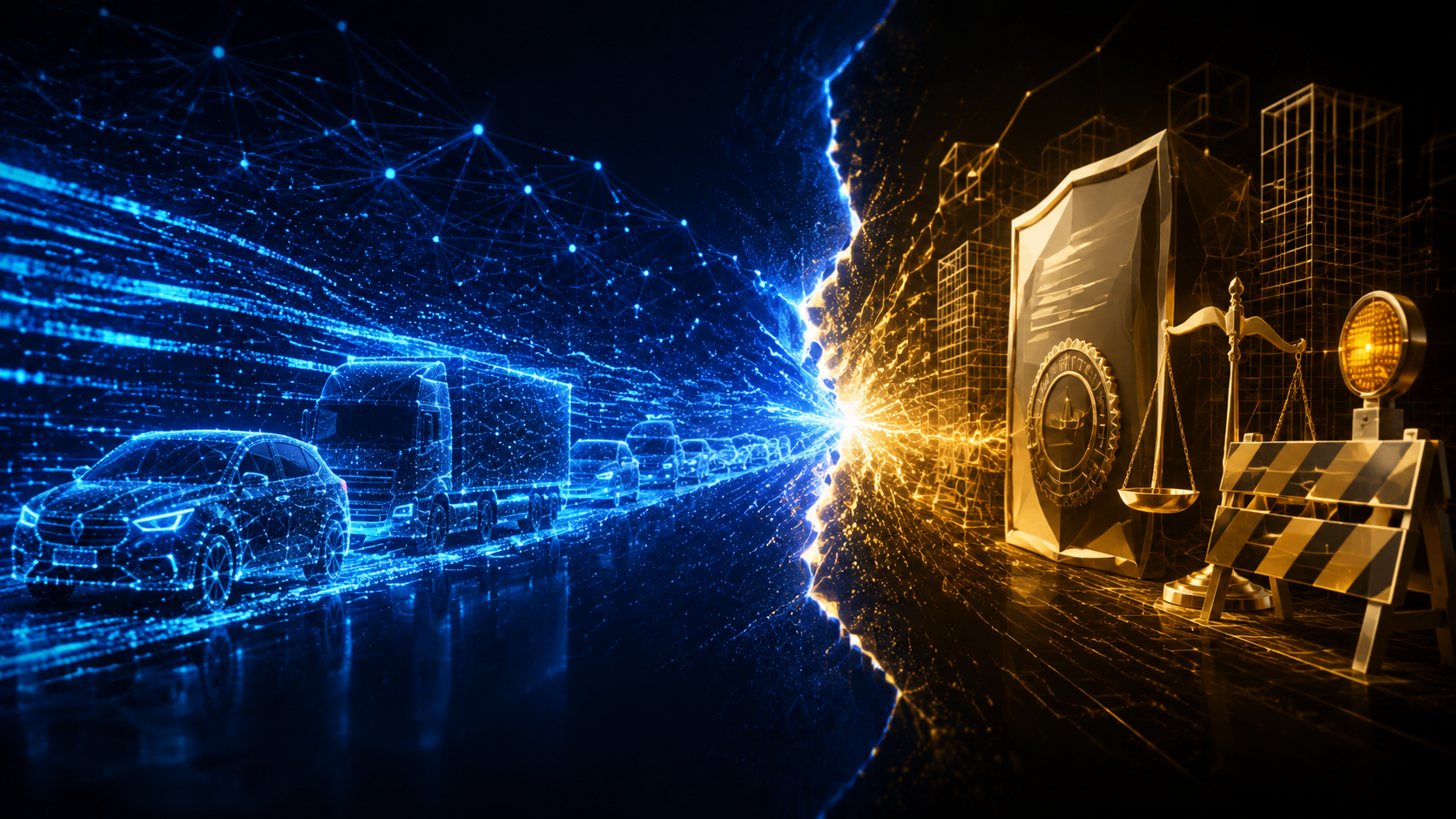
That is the vulnerability window. Tesla’s strongest asset is the scale of its deployed AI system. Its most immediate threat is that the same deployed system is now visible to investigators through crashes, reporting delays, environmental edge cases, and contested safety claims. If regulatory friction slows monetization during the CapEx surge, the long-range autonomy models may not arrive soon enough to support the current premium.
Why The Data Moat Still Matters
The bull case starts with a real asset, not a slogan. Tesla has roughly 7 million vehicles equipped with FSD hardware, a fleet that ARK Invest and Road to Autonomy describe as generating about 50 billion miles of driving per year, or roughly 100,000 miles per minute.[3][4] In an AI product category where rare situations matter, that kind of exposure is difficult to replicate with test fleets alone.
Scale matters in two ways. First, it expands the variety of driving scenes that can be captured: construction markings, unprotected turns, unusual driver behavior, awkward intersections, poor lighting, and messy weather. Second, it gives Tesla a distribution base for software monetization. If autonomy improves, Tesla does not need to place a new sensor suite on a small pilot fleet before it can sell features. The commercial surface already exists in millions of vehicles.
The hardware argument is part of that same story. ARK has characterized Tesla’s FSD computer as capable of 144 TOPS and positioned it as four years ahead of competitors at the time of its analysis.[5] That does not prove safety, and it certainly does not prove regulatory acceptability. But it helps explain why investors treat Tesla differently from an autonomy startup with promising demos and limited installed base. Tesla’s claim is not merely that it can train models; it is that it can deploy, observe, update, and re-deploy across a consumer fleet.
The cost argument also deserves a fair hearing. ARK has argued that Tesla’s vision-only system could produce a 30% to 50% lower cost per mile than Waymo.[3] The comparison should be handled carefully because robotaxi operating data, local deployment conditions, and fleet assumptions change quickly. Still, the strategic logic is clear: if Tesla can deliver acceptable autonomy without lidar-heavy vehicles and tightly mapped geofenced operations, the margin structure could look very different from a more expensive robotaxi stack.
That is the clean version of the autonomy premium: a massive data stream, widely deployed hardware, a software attach opportunity, and a lower-cost architecture. It is also why the regulatory question matters so much. A data moat is valuable only if it improves the product in the failure modes that regulators and users actually encounter.
The Subscription Signal Is Real, But It Is Not All Recurring Revenue
Tesla’s FSD adoption data adds another layer to the bull case, although the numbers need to be separated carefully. Basenor, citing Tesla Q1 2026 earnings-related commentary and third-party tracking accounts, reported 1.28 million total FSD users in Q1 2026. That figure included about 476,000 active subscriptions, up 44% quarter over quarter, and about 823,900 lifetime purchases.[6]
The distinction matters. A lifetime purchaser may be an engaged FSD user, but that user is not the same as a monthly subscriber producing recurring revenue. The reported $565 million annual recurring revenue figure is tied to the subscription base, not to the entire 1.28 million user count.[6] Treating all FSD users as if they were subscription revenue would overstate the current software engine.
The direction of travel is still important. Basenor reported 51% quarter-over-quarter subscriber growth compared with roughly 6% vehicle delivery growth, along with declining churn attributed to CFO commentary.[6] If those figures are confirmed against Tesla’s official filings, they support the idea that software adoption can grow faster than vehicle volume. That is exactly the kind of pattern an autonomy premium needs.
But adoption is not effectiveness. Subscriber growth shows that customers are willing to try or retain the product. It does not by itself answer whether the system performs safely in the difficult conditions that trigger investigations, lawsuits, or mandated changes. That gap between commercial uptake and demonstrated edge-case reliability is where the investment case becomes less comfortable.
EA26002 Is Not A Footnote
NHTSA’s Engineering Analysis EA26002 is the central regulatory fact in the 2026 Tesla autonomy debate. The probe covers about 3.2 million vehicles and focuses on whether FSD can adequately detect and respond when visibility is degraded by conditions such as sun glare, fog, or airborne dust.[2] These are not exotic corner cases in the way investors sometimes use that phrase. They are normal operating conditions that a mass-market driving system will repeatedly meet.
The incident base is also specific enough to matter. Electrek reported that NHTSA had identified nine incidents and was reviewing six additional incidents. The same report said Tesla’s post-crash fix “may have affected” only three of the nine identified incidents.[2] That formulation is important. It does not say the issue is fully resolved. It suggests investigators are still examining whether the remedy maps onto the observed failure pattern.
This is the point where more fleet miles do not automatically close the argument. A larger deployed base can generate more evidence, but it can also generate more incidents if the model struggles with a class of environmental degradation. The relevant question is not whether Tesla has seen more road scenes than competitors. It is whether its system knows when its perception is degraded and whether it takes an acceptably safe action when that happens.
NHTSA’s concern also strikes directly at the vision-only thesis. If a camera-based system is blinded or partially degraded by glare, fog, or dust, then the product needs reliable degradation detection and fallback behavior. The investment implication is not that vision-only autonomy is impossible. It is that the cost advantage becomes financeable only if the safety case holds under the specific conditions that regulators are now testing.
The reporting issue compounds the technical one. Electrek reported a seven-month delay in Tesla’s reporting of the fatal crash that triggered the probe.[2] For a deployed AI system, delayed reporting is not a clerical nuisance. It affects how quickly investigators reconstruct events, how quickly corrective actions can be assessed, and how much confidence outside stakeholders can place in the company’s post-market surveillance discipline.
Safety Statistics Now Carry A Credibility Discount
The credibility question is not confined to one NHTSA file. Kavout summarized a May 28, 2026 Reuters investigation reporting that former Tesla AI trainers said they did not trust the company’s self-driving safety statistics.[7] Because that claim is available here through secondary reporting rather than direct review of the Reuters article, it should be treated with appropriate caution. Even so, it is material because investor confidence in autonomy depends heavily on safety metrics that are difficult for outsiders to independently audit.
That is a familiar problem in regulated AI markets. Aggregate performance claims can be directionally useful while still failing to answer whether the product is safe for the exact subgroup, workflow, environment, or edge condition that creates harm. In Tesla’s case, broad mileage and intervention narratives are less persuasive if the open question is narrower: what happens when the system’s visual inputs degrade in common real-world conditions?
This is where the autonomy moat becomes two-sided. The fleet gives Tesla a powerful learning loop, but it also creates a large surface for post-market evidence. Once a regulator is examining millions of vehicles and named incident clusters, the company has to demonstrate more than iteration speed. It has to show that updates actually reduce the failure mode under review.
The 2026 Spending Cycle Leaves Less Room For Delay

Tesla’s autonomy story has always asked investors to value a future software business inside a car company. In 2026, that bargain is becoming more cash-sensitive. CBT News reported that Tesla planned $20 billion to $25 billion in 2026 CapEx, versus $8.5 billion in 2025, and that the CFO signaled negative free cash flow for the remainder of 2026.[1] The burden of proof rises when the spending line accelerates before the revenue line is secure.
The core financial risk is timing. A company can justify heavy AI infrastructure, manufacturing, and robotaxi-related investment if the software revenue curve arrives fast enough. If NHTSA forces a recall, restricts functionality, or extends uncertainty around FSD deployment, the investment case has to absorb the same spending with a slower monetization path.
Other operating signals make that timing risk harder to ignore. Kavout reported Tesla trading at about 375 times trailing earnings, with 2025 revenue down 3% to $94.8 billion, the company’s first annual revenue decline, and Q1 2026 deliveries trailing production by more than 50,000 vehicles.[7] Those figures do not prove that the autonomy thesis fails. They show that the legacy vehicle business is not providing unlimited cover while the AI thesis matures.
A high multiple can survive if investors believe the company is crossing from cyclical hardware margins into durable AI software economics. It is much harder to defend if the software product is still commercially promising but operationally constrained. That is the difference between a data moat that compounds and a data moat that remains trapped behind regulatory review.
| Autonomy Premium Input | Why Investors Care | What Could Break The Link |
|---|---|---|
| 7 million FSD-hardware vehicles | Large deployed base for learning and monetization | A recall or functional restriction affecting millions of vehicles |
| Roughly 50 billion miles per year | Broad exposure to real-world driving conditions | Evidence that common visibility conditions remain unresolved |
| 476,000 reported active subscriptions | Recurring revenue signal beyond vehicle sales | Churn, slower adoption, or safety limits reducing paid usage |
| $20 billion to $25 billion 2026 CapEx | Funds AI compute, manufacturing, and autonomy ambitions | Negative free cash flow lasting longer than expected |
| Robotaxi and licensing projections | Supports high long-term valuation scenarios | Revenue slipping beyond the period investors are financing now |
Analyst Models Show The Imagination, Not The Evidence
The long-range bull models explain why the stock can still attract aggressive support. ARK has framed robotaxi as the overwhelming driver of Tesla enterprise value by 2029.[3] RBC has projected $53 billion per year from FSD plus licensing by 2035, including $18 billion from licensing alone, according to the research materials summarized by Kavout.[7] Wolfe’s bull-case scenario, discussed by Motley Fool, projected $250 billion of robotaxi revenue by 2035, assuming 30% autonomous-vehicle penetration and 50% Tesla market share.[8]
Those forecasts are useful, but they are not evidence that the current product will clear the next regulatory gate. They are maps of what the business could be worth if deployment, adoption, pricing, safety, and regulatory acceptance all align. The weakest use of these models is to let a 2035 revenue number blur a 2026 cash-flow problem.
The target dispersion makes the same point from another angle. Kavout reported analyst consensus split across 21 Buy ratings, 19 Hold ratings, and 5 Sell ratings, with price targets ranging from $24.86 to $600.[7] That range is not normal disagreement over quarterly deliveries. It reflects unresolved disagreement over whether Tesla is primarily a car manufacturer under pressure, an AI platform at the beginning of a software curve, or both at once.
What Must Stay True Through 2026
Tesla does not need every autonomy skeptic to be wrong for the investment case to work. It needs several narrower conditions to hold during the period when spending is rising fastest.
- NHTSA must not impose a remedy that materially reduces FSD availability, usability, or consumer confidence across the affected fleet.
- Tesla must show that visibility-related degradation detection and fallback behavior improve in the specific conditions under review.
- FSD subscriptions must keep growing as recurring revenue, not merely as a larger blended count of subscribers and lifetime purchasers.
- Robotaxi commercialization must arrive early enough to matter against the 2026 CapEx burden, rather than remaining mostly a late-decade valuation input.
- Safety reporting and incident transparency must become credible enough for regulators and investors to trust the improvement curve.
The data moat can support Tesla’s autonomy premium if it keeps translating into safer performance, paid adoption, and deployable robotaxi economics. But the regulatory counterforce is no longer theoretical. EA26002 covers millions of vehicles, focuses on ordinary degraded-visibility conditions, and sits inside a year when Tesla is asking investors to finance a much larger AI and autonomy buildout.
That makes the 2026 case conditional rather than binary. If NHTSA’s process ends without a material constraint and FSD revenue continues to scale, Tesla’s fleet advantage remains one of the strongest AI deployment assets in any regulated consumer market. If a recall, delayed robotaxi rollout, or credibility shock slows monetization, the bull case becomes financially fragile before the 2029 and 2035 models have time to become real.
References
- Tesla ramps up AI spending to $25B, signals near-term cash pressure — CBT News
- Tesla is one step away from having to recall FSD in NHTSA visibility crash probe — Electrek, March 19, 2026
- Tesla Has Launched Its Robotaxi…Now What? — ARK Invest
- Tesla's Data Advantage in the Race to Develop Autonomous Driving — Road to Autonomy
- Tesla's Self Driving Computer Is Four Years Ahead of the Competition — ARK Invest
- Tesla FSD Hits 1.28M Subscribers in Q1 2026 — Record Growth — Basenor
- Tesla's Autopilot Under Fire: A $1.5 Trillion Bet on Unproven AI — Kavout
- One Analyst Thinks Tesla's Robotaxi Revenue Could Soar to $250 Billion by 2035 — Motley Fool, February 21, 2026
Comments
Join the discussion with an anonymous comment.