
State of Play: The FDA AI/ML SaMD Framework in June 2026
As of June 2026, the FDA’s regulatory framework for artificial intelligence and machine learning (AI/ML) software as a medical device (SaMD) is not a single monolithic document but a layered stack of guidance documents at different stages of finalization. The central finding for regulatory affairs teams, health system administrators, and compliance professionals is this: the cornerstone Total Product Life Cycle (TPLC) guidance for AI-enabled device software functions, issued as a draft in January 2025, remains unfinalized. Meanwhile, several other major guidances—covering Predetermined Change Control Plans (PCCPs), Clinical Decision Support (CDS) software, cybersecurity, and general wellness—are now operative and enforceable. This creates an unusual compliance landscape in which manufacturers must operationalize a lifecycle management framework that has not yet been formally adopted.
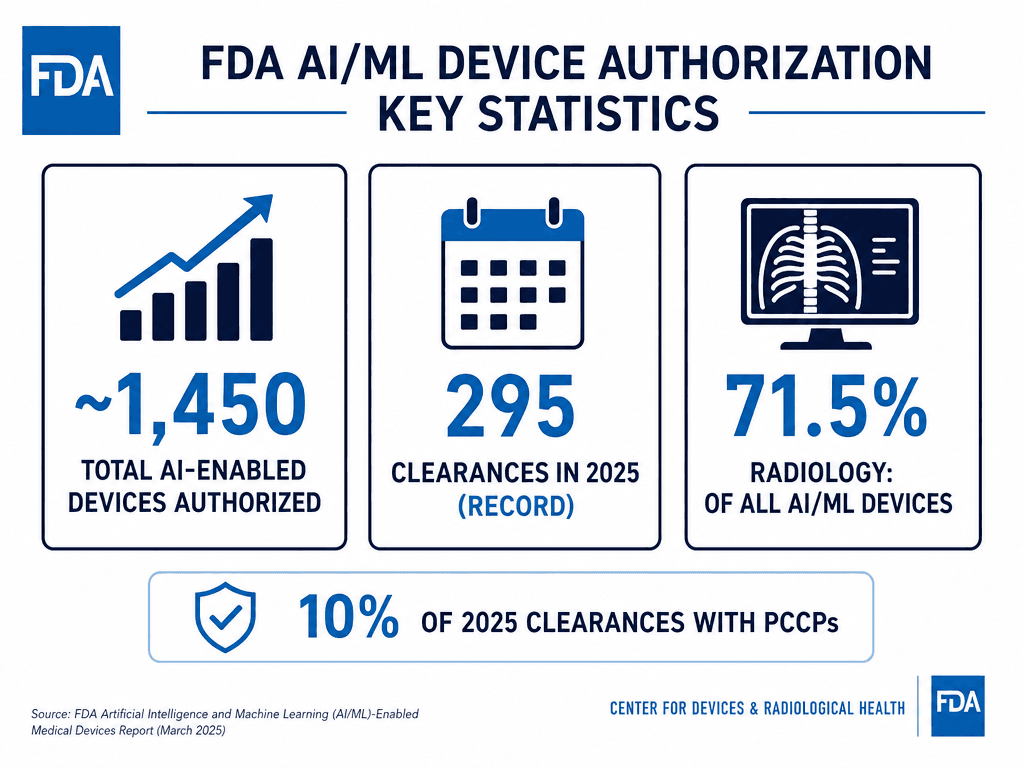
The FDA has authorized approximately 1,450 AI-enabled medical devices for marketing as of June 2026, with a record 295 new clearances in 2025 alone. Radiology continues to dominate, accounting for 71.5% of all AI/ML device authorizations. Yet no generative AI-enabled medical device has been authorized to date, signaling that the agency is still developing its approach to this emerging category. This briefing provides a definitive, source-attributed status map of where each guidance document stands, what it requires, and what comes next.
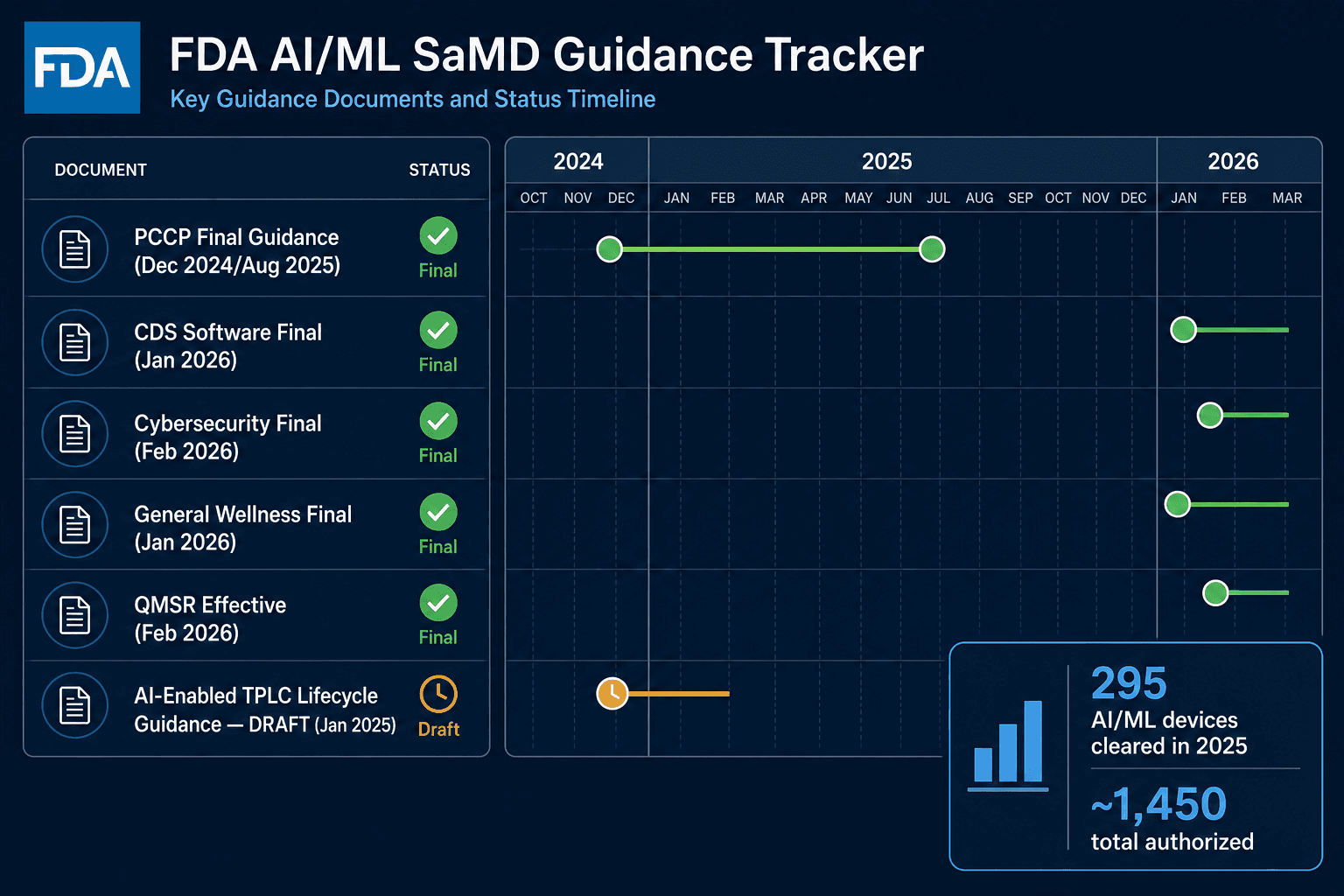
Timeline Map: Key FDA AI/ML SaMD Guidance Documents (2019–2026)
The following table maps the major FDA AI/ML SaMD guidance actions from the agency’s first discussion paper in 2019 through the most recent finalizations in early 2026. This chronological view is essential for understanding how the current layered framework evolved.
| Document Title | Type | Issue Date | Status as of June 2026 |
|---|---|---|---|
| Proposed Regulatory Framework for Modifications to AI/ML-Based SaMD | Discussion Paper | April 2019 | Historical |
| Good Machine Learning Practices (GMLP) Guiding Principles | Guiding Principles | October 2021 (updated) | Active |
| Marketing Submission Recommendations for a PCCP for AI-Enabled Device Software Functions | Final Guidance | December 2024 (updated August 2025) | Final |
| Artificial Intelligence-Enabled Device Software Functions: Lifecycle Management and Marketing Submission Recommendations | Draft Guidance | January 7, 2025 | Draft (not finalized) |
| Clinical Decision Support Software | Final Guidance | January 2026 | Final |
| General Wellness: Policy for Low Risk Devices | Final Guidance | January 2026 | Final |
| Cybersecurity in Medical Devices: Quality System Considerations and Content of Premarket Submissions | Final Guidance | February 2026 | Final |
| Quality Management System Regulation (QMSR) | Final Rule (effective) | February 2, 2026 | Effective |
What Is Final: Operative Guidance Documents and Their Key Requirements
Several major guidances are now final and enforceable. Manufacturers submitting AI/ML-enabled devices must comply with these requirements today.
Predetermined Change Control Plan (PCCP) Final Guidance
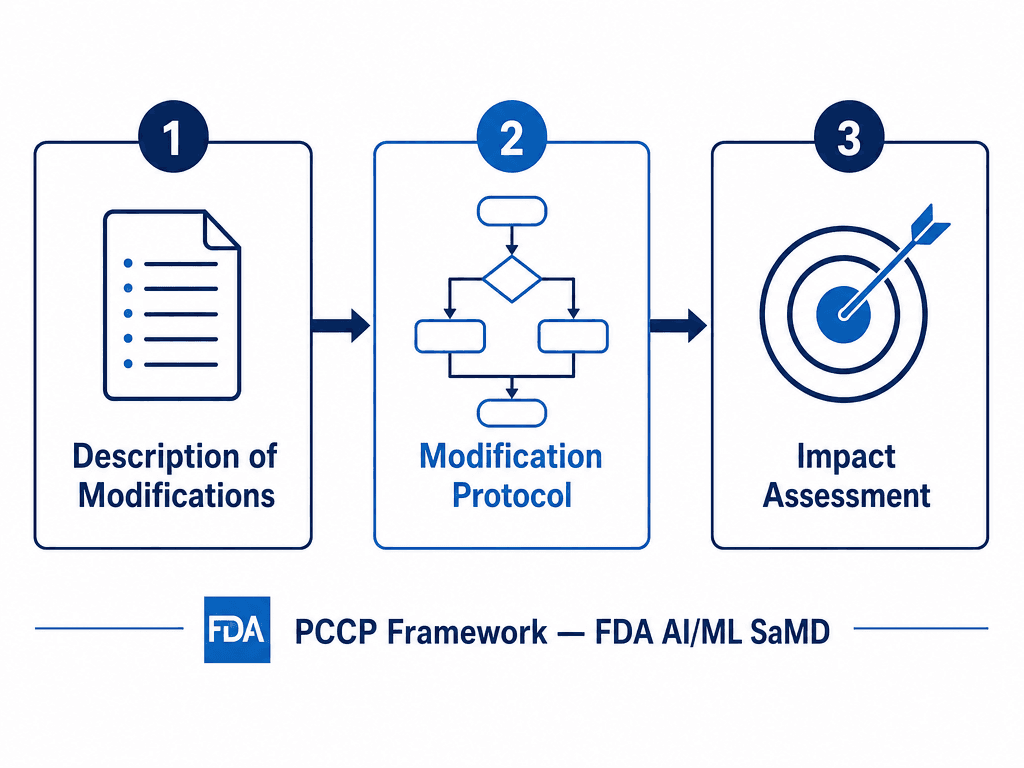
The PCCP final guidance, originally issued in December 2024 and updated in August 2025, is the most consequential finalized document for AI device manufacturers. It establishes the framework for iterative improvements to AI-enabled devices without requiring a new premarket submission for each change. The guidance requires a PCCP to include three mandatory components:
- Description of Modifications: A detailed specification of the planned changes to the device’s algorithm, performance, or intended use.
- Modification Protocol: The methodology for developing, validating, and implementing those modifications, including pre-specified acceptance criteria.
- Impact Assessment: An evaluation of the benefits and risks of the proposed modifications, including their effect on device safety and effectiveness.
The guidance applies to AI-enabled devices reviewed through 510(k), De Novo, and PMA pathways. Notably, the scope was expanded from ML-only to all AI-enabled devices, reflecting the agency’s recognition that the iterative update challenge extends beyond traditional machine learning.
Clinical Decision Support (CDS) Software Final Guidance
The CDS final guidance, issued in January 2026, clarifies which CDS software functions are excluded from the definition of a device under Section 520(o)(1)(E) of the FD&C Act, as amended by the 21st Century Cures Act. This guidance is critical for developers of AI-powered clinical decision support tools, as it determines whether a product requires FDA clearance or can be marketed as a non-device. The guidance emphasizes that CDS functions must meet four criteria for exclusion, including that the software provides time-critical information and that the healthcare professional can independently review the basis for the recommendations.
Cybersecurity Final Guidance and QMSR
The cybersecurity final guidance, issued in February 2026, strengthens requirements for all cyber devices, including AI-enabled ones. Key obligations include providing a Software Bill of Materials (SBOM), a Security and Privacy Disclosure Form (SPDF), and detailed labeling information about cybersecurity risks. For AI devices that rely on cloud-based inference or continuous data streaming, these requirements have significant implications for architecture and deployment planning.
The Quality Management System Regulation (QMSR) took effect on February 2, 2026, aligning FDA’s quality management requirements with ISO 13485. This transition affects all medical device manufacturers, including AI/ML SaMD developers, and introduces new requirements for design controls, risk management, and supplier oversight that directly apply to algorithm development and validation processes.
General Wellness Final Guidance
The General Wellness final guidance, also issued in January 2026, updates the policy for low-risk devices that promote general wellness. For AI-powered wellness applications—such as fitness trackers with AI coaching or sleep analysis tools—this guidance clarifies the boundary between regulated medical devices and consumer wellness products. The key criterion remains that the device cannot claim to diagnose, treat, or prevent a specific disease or condition.
What Is Still Draft: The TPLC Lifecycle Guidance for AI-Enabled Device Software Functions
The most significant gap in the current regulatory framework is the Artificial Intelligence-Enabled Device Software Functions: Lifecycle Management and Marketing Submission Recommendations draft guidance, issued on January 7, 2025. The comment period closed on April 7, 2025, but as of June 2026, the guidance has not been finalized. This draft represents the FDA’s most comprehensive attempt to articulate a total product life cycle (TPLC) approach to AI device regulation, and its unfinalized status creates significant compliance uncertainty.
The draft guidance proposes that marketing submissions for AI-enabled device software functions should include the following content elements:
- Model Description: Detailed documentation of the AI model architecture, training approach, and intended clinical use.
- Data Lineage and Splits: Comprehensive tracking of training, validation, and test datasets, including their sources, size, and demographic composition.
- Performance Tied to Claims: Evidence that the device’s performance directly supports its intended use and labeling claims.
- Bias Analysis and Mitigation: Assessment of algorithmic bias across demographic subgroups and documentation of mitigation strategies.
- Human-AI Workflow: Description of how the device integrates into clinical workflows, including user interface design and override mechanisms.
- Monitoring and Real-World Performance Management: Plans for ongoing performance monitoring, model drift detection, and post-market surveillance.
The challenge for manufacturers is that while the TPLC guidance remains in draft, the PCCP final guidance is already operative. This means companies must design their PCCPs—which are enforceable—in a way that anticipates the lifecycle management expectations of a guidance that has not yet been finalized. As the Maynard Nexsen analysis noted in April 2026, based on historical FDA timelines, final guidance “could emerge any time now,” but no final version has been published as of this writing.
The Authorization Landscape: ~1,450 AI-Enabled Devices and Counting
The FDA has authorized approximately 1,450 AI-enabled medical devices for marketing as of June 2026, according to the Congressional Research Service. The pace of authorizations accelerated significantly in 2025, which saw a record 295 new clearances. The following table summarizes key statistics from the 2025 clearance year, based on the Innolitics year-in-review analysis.
| Metric | Value |
|---|---|
| Total AI/ML 510(k) clearances in 2025 | 295 |
| Unique manufacturers | 221 |
| Manufacturers with a single clearance | 183 |
| Pure SaMD devices (62% of total) | 183 |
| Diagnostic devices (63% of total) | 186 |
| Median clearance time | 142 days |
| Devices cleared in under 90 days | 24% |
| Devices authorized with PCCPs | 30 (10.2%) |
| Radiology clearances (71.5% of total) | 211 |
| Top product code (QIH - Radiological CAD) | 75 clearances |
| Leading manufacturer (Shanghai United Imaging Healthcare) | 10 clearances |
Radiology’s dominance is even more pronounced when looking at the cumulative total. The Imaging Wire reported in March 2026 that of the 1,451 AI-enabled devices authorized since 1995, 1,104 are radiology devices, representing 76% of all authorizations. In 2025 alone, radiology secured 75% of AI authorizations. GE HealthCare leads with 120 radiology AI authorizations, followed by Siemens Healthineers (89), Philips (50), Canon (45), United Imaging (38), Aidoc (31), and DeepHealth (28).
The adoption of PCCPs is still in its early stages but growing. In 2025, 30 devices (10.2% of all AI/ML clearances) were authorized with PCCPs, signaling that manufacturers are beginning to operationalize the iterative update framework. This number is expected to rise as more companies gain experience with the PCCP submission process and as the TPLC guidance is finalized.
The Generative AI Frontier: No Authorizations Yet, But Signals Are Emerging
As of June 2026, the FDA has not authorized any generative AI-enabled medical device for marketing. This is a notable gap in the authorization landscape, given the rapid proliferation of large language models (LLMs) and other generative AI technologies in healthcare settings. The agency’s caution reflects the unique challenges posed by generative AI: the potential for hallucination, the difficulty of verifying output accuracy, and the lack of established evaluation frameworks for clinical applications.
However, early signals suggest the FDA is preparing to engage with this category. In March 2026, the agency granted breakthrough device designation to a patient-facing clinical generative AI application developed by RecovryAI. While breakthrough designation does not constitute authorization, it indicates that the FDA recognizes the potential clinical value of generative AI and is willing to provide expedited development and review pathways for promising technologies.
Additionally, the FDA’s Digital Health Advisory Committee (DHAC) held meetings in November 2025 specifically focused on generative AI in mental health, signaling that the agency is actively developing its thinking on how to evaluate these technologies. Manufacturers developing generative AI-enabled medical devices should monitor these developments closely and prepare for a regulatory pathway that may differ significantly from traditional AI/ML SaMD.
Strategic Implications for Manufacturers and Policy Teams
The current regulatory landscape presents several strategic imperatives for regulatory affairs professionals, health system administrators, and compliance teams.
- Operationalize PCCP frameworks now. The PCCP final guidance is operative and enforceable. Manufacturers should develop their Description of Modifications, Modification Protocol, and Impact Assessment templates immediately, even while awaiting the final TPLC guidance. Early adoption of PCCPs also provides a competitive advantage: only 10% of 2025 clearances included PCCPs, and the agency’s experience with these submissions is still developing.
- Prepare for bias analysis and transparency labeling as cross-cutting requirements. Both the PCCP final guidance and the draft TPLC guidance emphasize algorithmic bias assessment and demographic performance analysis. These are not optional add-ons but core submission requirements. Manufacturers should invest in bias detection tools, diverse dataset acquisition, and transparent labeling practices now.
- Align quality management systems with QMSR/ISO 13485. The February 2, 2026 effective date has passed. Manufacturers who have not completed the transition are out of compliance. This is particularly important for AI/ML developers who may have relied on more flexible software development processes.
- Monitor the TPLC guidance finalization timeline closely. The draft guidance’s content elements—Model Description, Data Lineage, Bias Analysis, Human-AI Workflow, Monitoring—are likely to become requirements in the final version. Manufacturers should begin preparing submissions that address these elements, even if the final guidance introduces modifications.
- Track the generative AI regulatory pathway. The RecovryAI breakthrough designation and the DHAC meetings on generative AI in mental health are early indicators of the FDA’s direction. Companies developing generative AI medical devices should engage with the FDA early, participate in public comment opportunities, and monitor the agency’s evolving thinking.
- Understand the radiology-dominated landscape. With 71.5% of all AI/ML clearances in radiology, the competitive dynamics in this specialty are fundamentally different from other fields. Manufacturers entering non-radiology specialties may face less crowded markets but also less established regulatory precedents.
For deeper analysis of specific aspects of this landscape, readers can explore the FDA-cleared radiology AI landscape for a detailed breakdown of radiology AI clearances and the evidence supporting them, and the structured industry reference on AI companies in healthcare for profiles of the 221 unique manufacturers active in this space.
Sources and Further Reading
The following primary sources were used in the preparation of this article. All data and claims are directly attributable to these documents.
- Congressional Research Service, “FDA Regulation of AI-Enabled Devices,” IF13245, June 10, 2026. Available at EveryCRSReport.com.
- Innolitics, “2025 Year in Review: AI/ML Medical Device 510(k) Clearances,” December 20, 2025. Available at Innolitics.com.
- FDA, “Marketing Submission Recommendations for a Predetermined Change Control Plan for Artificial Intelligence-Enabled Device Software Functions,” Final Guidance, August 2025. Available at FDA.gov.
- FDA, “Artificial Intelligence-Enabled Device Software Functions: Lifecycle Management and Marketing Submission Recommendations,” Draft Guidance, January 7, 2025. Available at FDA.gov.
- FDA, “Clinical Decision Support Software,” Final Guidance, January 2026. Available at FDA.gov.
- Maynard Nexsen, “The AI in SaMD Trifecta: What FDA’s Latest Moves Mean for Your AI-Enabled Product Roadmap,” April 30, 2026. Available at MaynardNexsen.com.
- The Imaging Wire, “Numbers from the FDA Show Radiology Is Maintaining Its Lead,” March 11, 2026. Available at TheImagingWire.com.
Comments
Join the discussion with an anonymous comment.