
The practical answer to “Can I keep drinking coffee?” is now easier to give, at least for most adults: moderate coffee intake—about 3–5 cups of 8-oz black coffee, or up to roughly 400 mg of caffeine per day—does not need to be discouraged and is associated with lower cardiovascular risk in the American Heart Association’s 2026 scientific statement on caffeine and cardiovascular disease.[1]
That sentence is useful in clinic only if it is immediately followed by three qualifications. Blood pressure severity matters. Brewing method matters. Caffeine source matters. A patient drinking two paper-filtered coffees with controlled hypertension is not the same counseling problem as a patient with persistent blood pressure at or above 160/100 mmHg, a daily French press habit, or multiple concentrated energy drinks.
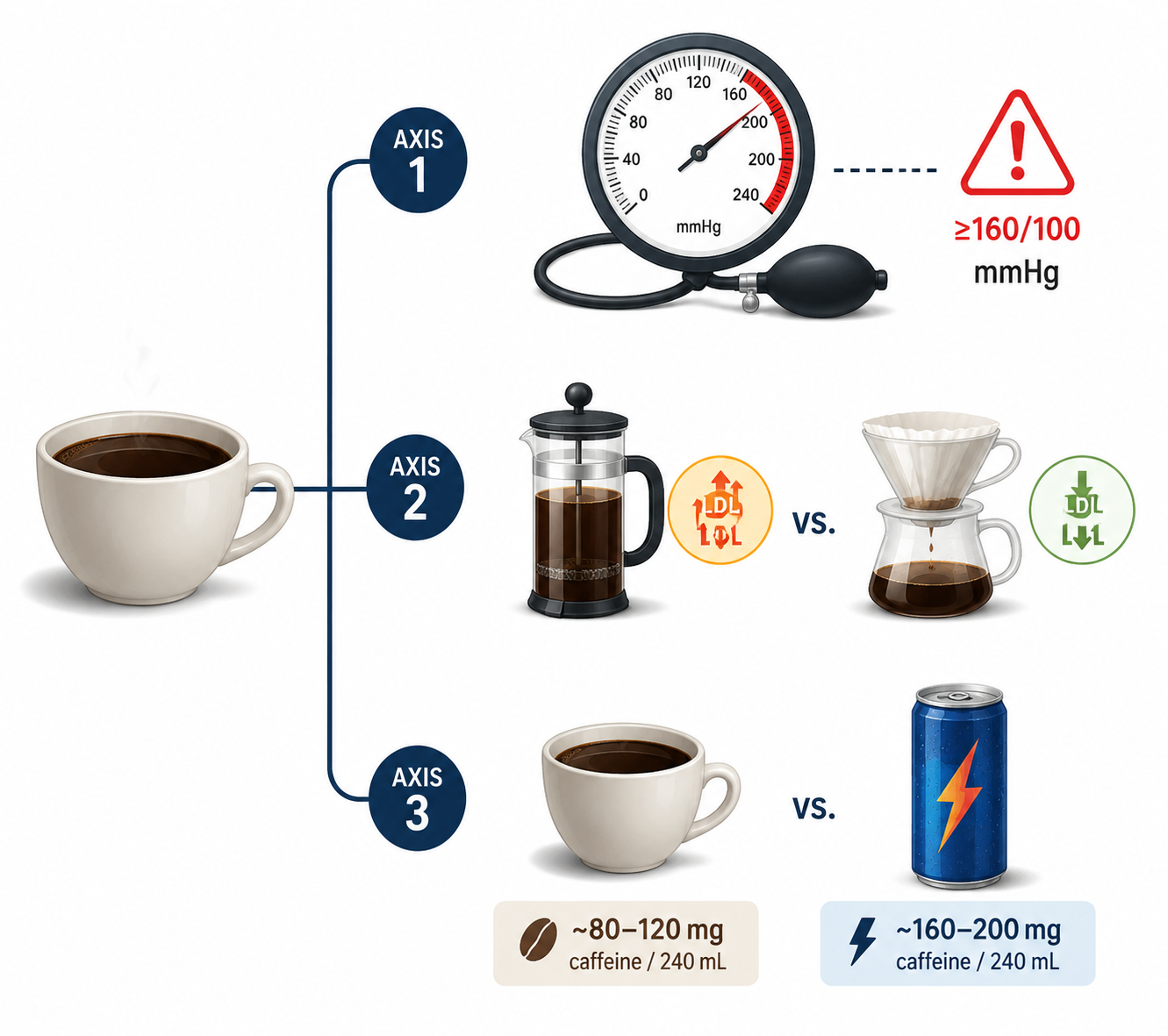
The statement is meaningful less because it gives coffee a clean bill of health than because it allows clinicians to stop giving broad, reflexive anti-caffeine advice where the evidence does not support it. It also identifies the places where a reassuring headline can become careless counseling.
A workable counseling frame, not a rigid algorithm
For patients with normal blood pressure and no obvious caffeine intolerance, the AHA statement supports allowing moderate coffee intake to remain part of the diet. The same is generally true for many patients with controlled or non-severe hypertension, provided intake is moderate and symptoms, sleep, palpitations, and home blood pressure patterns do not suggest a problem.
The cleaner way to document the advice is not “coffee is cardioprotective.” It is closer to: moderate coffee consumption is associated with lower risk across several cardiovascular outcomes in observational data, appears safe for most adults up to about 400 mg/day of caffeine, and does not need routine discontinuation in the absence of a patient-specific reason.[1]
| Clinical variable | What changes in counseling |
|---|---|
| Normal blood pressure | Moderate coffee intake can generally continue if tolerated. |
| Controlled or non-severe hypertension | Do not automatically prohibit coffee; review dose, timing, symptoms, and measured blood pressure response. |
| Severe hypertension at ≥160/100 mmHg | Avoid casual reassurance; discuss reducing or avoiding higher coffee intake, especially ≥2 cups/day, until blood pressure is better characterized and controlled. |
| Unfiltered brewing | Consider switching to paper-filtered or instant coffee when LDL-C is a concern. |
| Energy drinks or concentrated synthetic caffeine | Counsel separately from coffee; dose, concentration, co-ingredients, and harm signals differ. |
| Atrial fibrillation history | Do not advise caffeine discontinuation solely for rhythm control without an individualized reason. |
This frame leaves room for the patient in front of the clinician. Some patients reliably notice tremor, insomnia, reflux, anxiety, or palpitations after caffeine. Others drink coffee daily without any such signal. The AHA statement does not require clinicians to override individual intolerance in the name of population-level reassurance.
Blood pressure is the first place to slow down
Coffee counseling becomes different when hypertension is severe. The key subgroup warning comes from a 2022 JAHA study cited in the AHA statement: among people with blood pressure at or above 160/100 mmHg, drinking 2 or more cups of coffee daily was associated with a doubled risk of cardiovascular disease death.[2]
That finding should not be treated as a new analysis performed by the 2026 AHA writing group, and it should not be generalized to every patient with treated hypertension. Its value is narrower and clinically important: when blood pressure is in the severe range, coffee intake deserves direct attention rather than a blanket “up to 5 cups is fine.”
The statement also notes a blood pressure pattern that clinicians will recognize from practice: modest intake, roughly 1–2 cups, is described as neutral to slightly lower in relation to blood pressure, whereas higher intakes may produce transient pressor effects.[1] The counseling implication is not to chase a universal number for every hypertensive patient. It is to ask what the patient drinks, when they drink it, what their actual blood pressure looks like, and whether coffee is being layered onto other sympathomimetic exposures.
For a patient with controlled hypertension, the visit may only require confirming a moderate dose and discouraging escalation. For a patient repeatedly measuring in the severe range, the same coffee history becomes part of risk reduction: quantity, timing, other caffeine sources, and whether intake should be reduced while antihypertensive therapy and adherence are being addressed.
The AFib advice has changed more than many clinicians’ habits
The most practice-changing portion of the AHA statement may be its treatment of atrial fibrillation. Many patients with AFib have been told, often for years, to stop caffeine as if abstinence were a standard rhythm-control intervention. The 2026 statement moves in the opposite direction: it explicitly recommends against advising AFib patients to avoid caffeine, aligning with the 2023 ACC/AHA/ACCP/HRS AFib guideline’s Class 3 recommendation against caffeine discontinuation for rhythm control.[1][3]
That does not mean every patient with AFib should be encouraged to drink coffee. It means the default instruction should no longer be abstinence unless the patient has a reproducible symptom trigger, another contraindicating condition, or a pattern of high-dose intake that changes the risk discussion.
The DECAF randomized trial is the reason this point now feels harder to ignore. In that trial summary, caffeinated coffee consumption was associated with a hazard ratio of 0.61 for AFib recurrence, corresponding to a 39% relative risk reduction compared with abstinence.[4] The AHA newsroom described the trial as showing that a cup of coffee a day may not be harmful for some adults with AFib and could lower episodes.[5]
For clinicians, DECAF is striking because it is randomized evidence in a space that has long been dominated by assumption and patient anecdotes. It is still one trial. It should not be inflated into a promise that coffee prevents AFib recurrence, nor should it erase individualized trigger assessment. But it does give more support to a counseling shift already embedded in the 2023 AFib guideline: caffeine avoidance should not be prescribed as rhythm control by habit.
A reasonable exam-room version is brief: “If coffee clearly triggers your episodes, we should respect that. But for most AFib patients, stopping caffeine has not been shown to improve rhythm control, and current cardiology guidance recommends against telling everyone with AFib to discontinue it.”
Filtered coffee is a practical LDL intervention
Brewing method is one of the more satisfying parts of the statement because it leads to a concrete, low-friction intervention. Unfiltered coffee—including French press, Turkish coffee, and espresso—contains cafestol, and double-blind randomized trials show that unfiltered coffee raises LDL-C. Paper-filtered and instant coffee do not show the same LDL-raising effect.[1]
This is not a reason to interrogate every coffee ritual in a low-risk patient with excellent lipids. It is a useful adjustment when LDL-C is already part of the problem. A patient who drinks several cups of French press coffee daily and is struggling to reach an LDL-C goal may not need to give up coffee; switching to paper-filtered coffee may address the relevant exposure while preserving the habit.
That distinction matters because many patients hear dietary advice as subtraction. The brewing-method data allow a substitution: keep the morning coffee, change the filter.
Energy drinks are not just coffee in a can
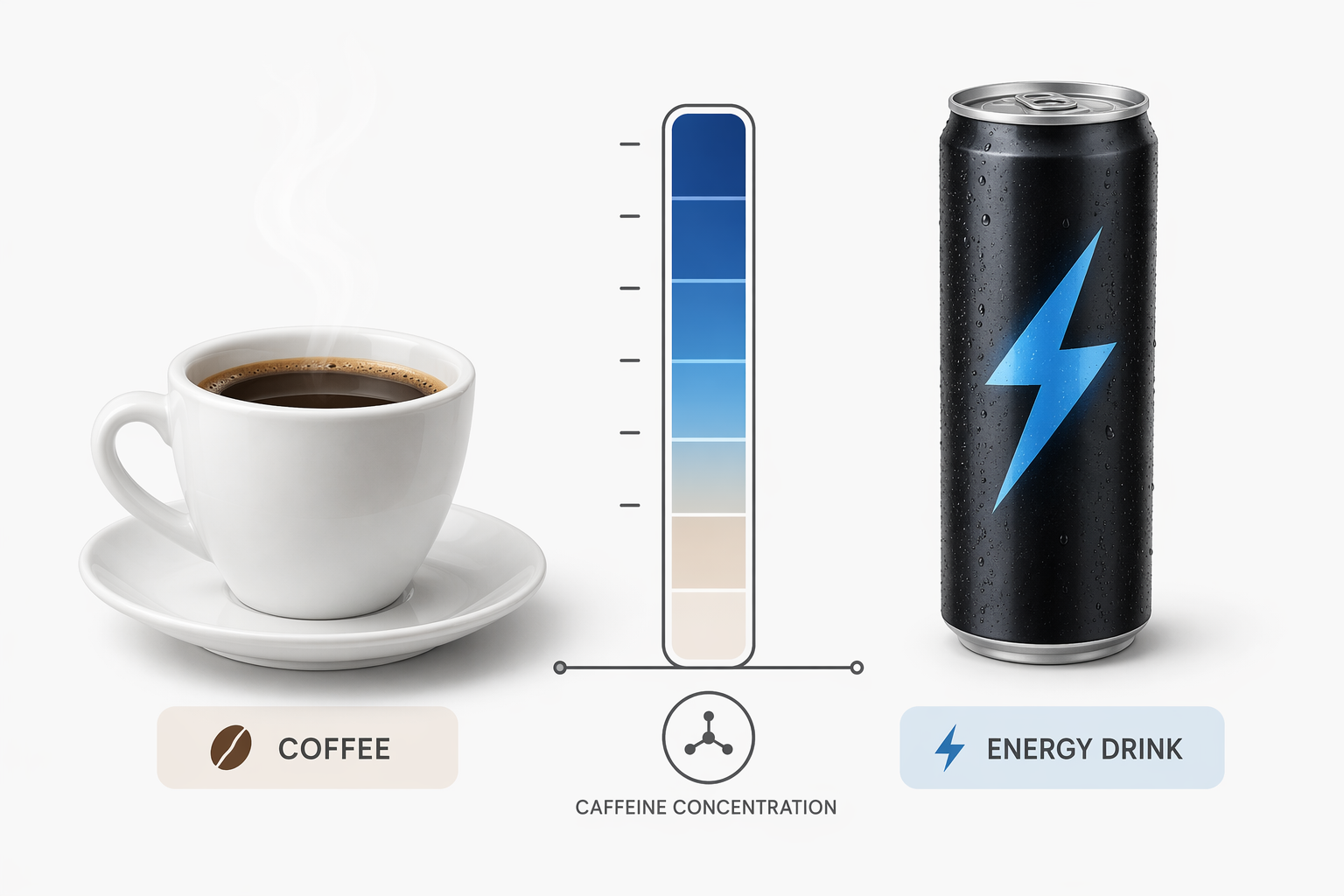
The AHA statement separates coffee from concentrated synthetic caffeine sources for good reason. Energy drinks are reported to contain 40–69 mg of caffeine per ounce, compared with 9.4–20.6 mg per ounce in coffee.[1] The delivery system changes the exposure: concentration, speed of consumption, serving size, co-ingredients, and consumer expectations all differ.
The harm signals are also different. The statement describes energy drink associations with elevated blood pressure, including mean systolic increases of about 6–9 mmHg in acute interventional studies, and cites case reports of ventricular fibrillation in young adults.[1] This evidence base is not the same as a large cardiovascular outcomes trial; it relies heavily on observational data, acute studies, and case reports. But it is strong enough to keep clinicians from treating all caffeine sources as interchangeable.
In practice, the question should not be “How many cups of coffee?” alone. It should include energy drinks, pre-workout products, caffeine pills, and other concentrated products, especially in patients with palpitations, hypertension, syncope, arrhythmia history, or stimulant co-exposures.
Coffee is not reducible to caffeine
One reason the statement cannot be translated into “caffeine is good for the heart” is that coffee contains more than caffeine. Observational cohorts link regular coffee consumption with lower incident type 2 diabetes, while acute interventional studies show caffeine can transiently reduce insulin sensitivity.[1] That mismatch points toward non-caffeine compounds—such as chlorogenic acids, magnesium, and chromium—as possible contributors, although the mechanisms are not proven as clinical endpoints in randomized trials.[1]
This is another reason to resist simplistic substitutions. A patient replacing moderate coffee with high-dose synthetic caffeine has not necessarily preserved the same exposure. Conversely, a patient who tolerates coffee well is not automatically required to abandon it because caffeine has acute physiologic effects.
Genetics explains tolerance better than it changes management
Caffeine metabolism varies substantially. The AHA statement describes a caffeine half-life range of about 2–12 hours and estimates heritability of caffeine metabolism at 30%–50%.[1] That helps explain why one patient can drink coffee after dinner and sleep, while another has palpitations after a morning cup.
The clinical temptation is to turn CYP1A2 biology into personalization. Current evidence does not justify that leap. The AHA statement notes insufficient evidence that genetic variants modify chronic cardiovascular outcomes from coffee consumption, and a 2019 AJCN study examined long-term coffee consumption, caffeine metabolism genetics, and cardiovascular disease risk without establishing a basis for routine clinical genotyping.[1][6]
For now, tolerance history, sleep, symptoms, medication interactions, pregnancy status when relevant, and measured blood pressure response are more useful than a consumer genotype report. Genetics may explain why patients differ; it does not yet provide a management threshold for chronic cardiovascular risk from coffee.
How strong is the evidence behind the new reassurance?
The AHA statement’s clinical usefulness should not obscure the limits of the evidence base. Much of the cardiovascular benefit signal for moderate coffee intake comes from observational nutrition studies. Those data are valuable, especially when consistent across large cohorts and endpoints, but they do not prove causality in the way a randomized outcomes trial would.[1]
The strongest practice shift is in AFib counseling because it has guideline alignment and randomized reinforcement from DECAF, though still from a single trial.[3][4] The LDL advice is practical because brewing method changes a known cafestol exposure. The severe hypertension warning is important because the potential consequence is serious, but it rests on a subgroup signal from the 2022 study rather than a new randomized trial.[2] The energy drink concern is clinically plausible and supported by acute physiologic data and case reports, while the statement itself recognizes the need for stronger evidence.[1]
There is also a useful institutional contrast. The separate 2026 AHA Dietary Guidance excluded caffeine from its recommendations because that writing group found the evidence insufficiently rigorous to set intake thresholds.[7] That does not negate the caffeine scientific statement. It does remind clinicians that different AHA documents can answer different questions under different evidentiary standards.
The position clinicians can safely take
For professional counseling, the most defensible position is conditional reassurance. Moderate coffee intake can generally stay on the table for most adults. Patients with AFib should not be reflexively told to abstain from caffeine for rhythm control. Severe hypertension, unfiltered brewing, and concentrated synthetic caffeine sources require different questions and different advice.
The language matters. Coffee is associated with lower cardiovascular risk; it is not proven as a cardiovascular therapy. Caffeine tolerance varies; genotype testing does not yet direct routine care. Energy drinks are not coffee-equivalent simply because both contain caffeine. Those distinctions are what make the AHA’s 2026 statement clinically useful rather than just another nutrition headline.
This article is intended as a professional evidence review and does not replace individualized medical advice or clinician judgment for a specific patient.
References
- Caffeine and Cardiovascular Disease: A Scientific Statement From the American Heart Association — Circulation, July 20, 2026.
- Drinking 2 or more cups of coffee daily may double risk of heart death in people with severe hypertension — AHA Newsroom.
- 2023 ACC/AHA/ACCP/HRS Guideline for the Diagnosis and Management of Atrial Fibrillation — Circulation.
- Caffeinated Coffee Consumption or Abstinence to Reduce Atrial Fibrillation: The DECAF Randomized Clinical Trial — ACC.
- Cup of coffee a day may not be harmful for some adults with AFib and could lower episodes — AHA Newsroom.
- Long-term coffee consumption, caffeine metabolism genetics, and risk of cardiovascular disease — AJCN, 2019.
- 2026 Dietary Guidance to Improve Cardiovascular Health: A Scientific Statement From the AHA — Circulation.
Comments
Join the discussion with an anonymous comment.