
Air quality alerts already arrive dressed as health guidance. They tell people to reduce outdoor activity, reschedule exertion, close windows, use filtration, or watch symptoms. The problem is that the signal often remains broad: a regional AQI category is converted into a population-level instruction, and the patient is left to decide whether the warning is meant for them, whether today is different from yesterday, and whether the suggested precaution is worth the disruption.
That baseline matters before any discussion of AI. In Toronto, a regression discontinuity analysis found that air quality alerts were associated with reduced asthma emergency room visits, but did not find a cardiovascular mortality benefit.[1] In a separate modeling study of U.S. EPA AQI activity recommendations, the estimated number needed to treat to prevent one serious event exceeded 5 million for patients with atherosclerotic cardiovascular disease and 18 million for the general population on most action days.[2] And awareness is not the same as use: among U.S. adults with heart or lung disease, only about one-third reported checking the AQI, and AQI awareness did not reliably translate into protective behavior.[3]
Those findings do not make air quality alerts useless. They make the current translation problem visible. If a warning has to pass through attention, trust, feasibility, and clinical relevance before it can prevent an ED visit, then better forecasting is only one component. The sharper question is whether AI-powered air quality alerts can identify the right person, in the right place, at the right time, with a precaution that is specific enough to act on.
What AI Actually Changes
The most useful shift is not that an algorithm can put a cleaner interface on an AQI forecast. It is that machine learning can combine streams that older alert systems usually handle separately: pollutant readings, meteorology, satellite observations, local sensor networks, land-use context, and population vulnerability. Instead of one citywide banner, the system can estimate how risk varies across neighborhoods, time windows, and patient groups.
A 2025 systematic review in Environmental Modelling & Software describes rapid growth in AI and machine learning approaches for air pollution monitoring and forecasting since 2021. Within the reviewed literature, Random Forest models achieved up to 98.2% accuracy in pollutant concentration prediction, while LSTM networks were used to capture more complex spatiotemporal patterns.[4] These are material technical gains. A patient with asthma does not breathe a daily city average; they move through changing microenvironments, and temporal resolution matters when an exposure peak overlaps with a commute, school pickup, exercise, or shift work.
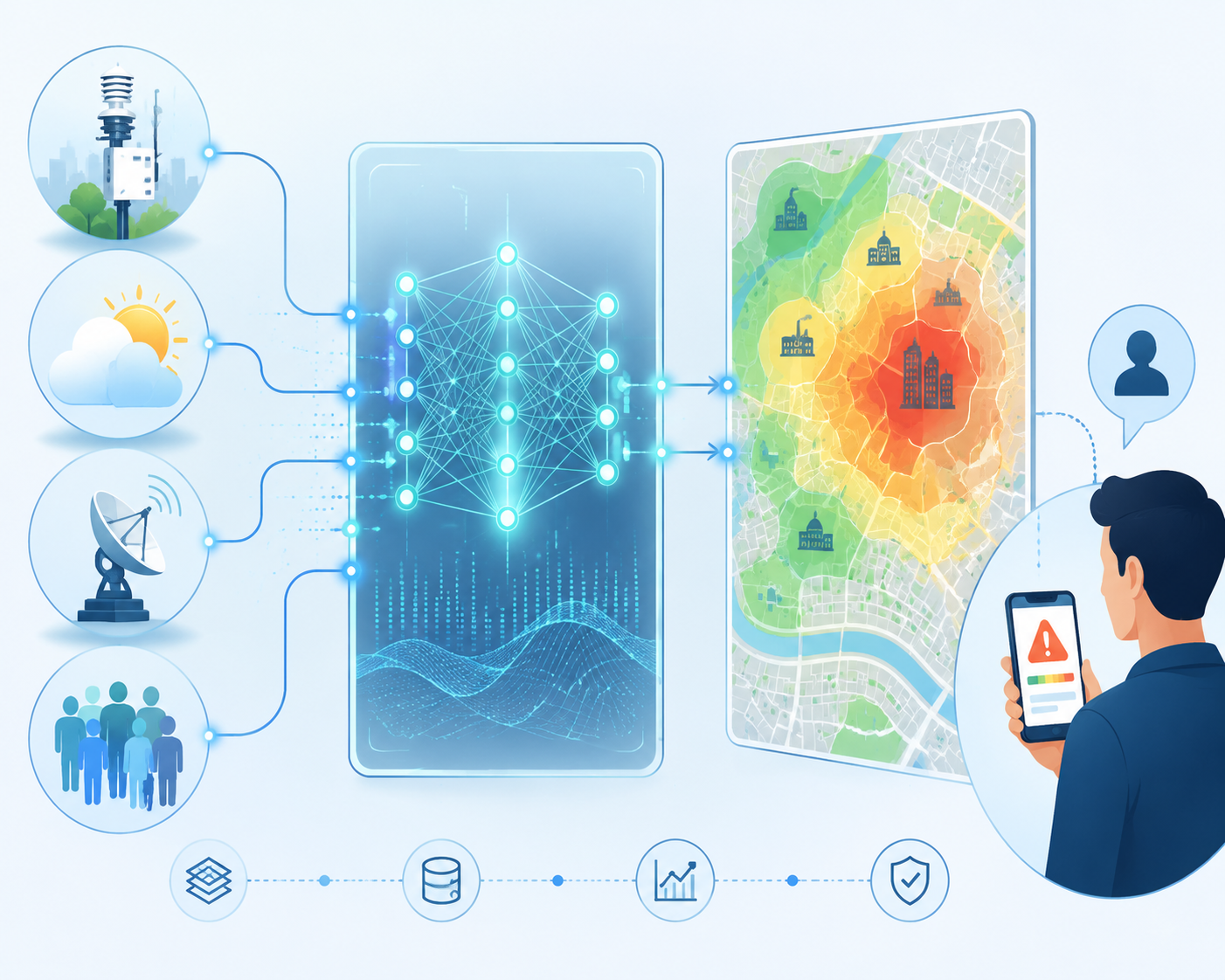
The 2025 Scientific Reports framework pushes this idea further by integrating sensor, meteorological, satellite, and demographic data into real-time air quality assessment and predictive environmental health risk mapping. The framework reports 5-minute update cycles and uses SHAP-based interpretability to explain which features are contributing to an individual risk estimate.[5] That interpretability point is not cosmetic. If a clinician, public health nurse, or asthma program is asked to trust a risk alert, knowing whether the model is responding to a local PM2.5 spike, a meteorological inversion, satellite-derived exposure context, or a demographic vulnerability layer changes how the alert can be reviewed and governed.
| Conventional alerting | AI-enabled alerting |
|---|---|
| Often tied to regional AQI categories | Can estimate risk at finer spatial and temporal resolution |
| Usually broadcasts the same advice to large populations | Can segment alerts by exposure patterns and vulnerability |
| Typically explains risk through pollutant category thresholds | Can expose model drivers through tools such as SHAP |
| Clinical relevance is inferred from general guidance | Clinical relevance can be designed into targeting, but still has to be validated |
Operationally, this is the difference between telling an entire metropolitan area to “take precautions” and telling a smaller group that a short-term exposure pattern is likely to matter for them. The latter is more plausible as a health intervention. It is also harder to evaluate, because it requires more than checking whether the pollutant forecast was close to the observed value.
Personalization Is a Targeting Claim, Not Yet a Clinical Claim
The appeal of personalization is strongest where broad guidance looks inefficient. The JAMA Network Open modeling study is a useful irritant here: if millions of people may need to follow AQI recommendations on most action days to prevent one serious event under the study’s assumptions, then a more targeted system is not just a convenience feature.[2] It is a way to ask whether the intervention can be concentrated where baseline risk, exposure, and feasible action overlap.
But the same study is also a warning against overclaiming. Its estimates come from cross-sectional modeling, not from a randomized trial of alert delivery.[2] A high number needed to treat may motivate better targeting, but it does not prove that AI targeting will reduce events. It only clarifies the size of the translation burden that a personalized system would need to overcome.
The Toronto analysis gives a different kind of baseline. It suggests that population-level alerts can have measurable health effects for asthma emergency visits in one setting, while showing no clear cardiovascular mortality benefit.[1] That mixed result is more useful than a simple success story. It implies that the endpoint, population, clinical pathway, local pollution profile, healthcare access, and alert design all matter. A system optimized for asthma rescue behavior may not have the same relationship to cardiovascular mortality, and an effect observed in Toronto may not generalize cleanly to regions with higher pollution levels or different healthcare systems.
The awareness data add another constraint. If only about one-third of U.S. adults with heart or lung disease check the AQI, then an alert system cannot be evaluated as though the intended audience is already waiting for the signal.[3] Delivery design becomes part of the intervention: who sends the alert, which device receives it, whether the message is understandable, whether it interrupts at the right time, and whether the recommended action is realistic for the recipient.
The Last Mile Is Behavioral and Clinical
A technically strong AI alert still has to survive a mundane sequence. The model predicts elevated risk. The system selects a recipient. The message arrives before the exposure or early enough to change it. The recipient believes the alert. The recommended precaution fits the person’s housing, job, caregiving duties, medications, transportation, and access to filtration or indoor alternatives. Only then can the intervention plausibly change symptoms, rescue medication use, ED visits, admissions, or mortality.
That sequence is where much of the current evidence thins out. The AI literature can show better pollutant prediction and more granular risk mapping.[4][5] It can show that models are becoming more capable of combining environmental and demographic inputs. It does not yet show, in the materials reviewed here, that AI-driven personalized air quality alerts reduce emergency department visits, hospitalizations, or deaths.
For healthcare technology teams, that distinction should be familiar. A risk score with good discrimination is not automatically a clinical intervention. An alert with a plausible target is not automatically behavior change. A dashboard that updates every 5 minutes is not automatically safer patients. The validation standard has to move from model performance to patient-facing outcomes if these tools are going to be embedded in clinical or public health workflows.
Indoor Sensors and Wearables Expand the Signal, With Caveats
Indoor air monitoring and wearables make the personalization story more compelling because outdoor AQI is only part of exposure. A patient may spend most of a high-risk day inside a poorly ventilated apartment, in a workplace with combustion exposure, or moving between transit corridors and indoor spaces. A 2022 review in Tuberculosis and Respiratory Diseases describes the convergence of Internet of Things systems and AI for real-time indoor air quality and health effect monitoring.[6]
Wearable and community sensors also make exposure data less institutionally centralized. The Clean Air Fund describes wearable sensors such as AirBeam and IoT platforms as tools that can democratize personal exposure data, while noting persistent accuracy and calibration challenges.[7] That caveat deserves more than a footnote. A personalized alert based on a poorly calibrated sensor can create false reassurance, unnecessary anxiety, or noisy clinical documentation. Low-cost sensing is useful only if the uncertainty is measured, disclosed, and managed.
This is especially important when personal data are merged with clinical risk. A device-level error that might be acceptable for community awareness may be less acceptable if it drives an alert to a child with severe asthma, an older adult with cardiovascular disease, or a public health registry. Calibration, drift, interference, missingness, and device placement are not minor engineering dust; they shape who gets warned and who does not.
What Would Count as Better Evidence
The next evidence step is not another demonstration that a machine learning model can forecast pollutants more accurately. That work remains necessary, but it is not decisive for health precautions. The missing studies are prospective or real-world evaluations that connect AI-driven alerting to clinical and behavioral endpoints.
- Randomized or quasi-experimental studies comparing AI-personalized alerts with standard AQI alerts or usual information.
- Endpoints that include ED visits, hospitalizations, symptom exacerbations, rescue medication use, missed work or school, and mortality where appropriate.
- Measurement of intermediate behavior, including whether recipients opened alerts, understood them, trusted them, and changed activities or indoor exposure.
- Subgroup analyses for patients with asthma, COPD, cardiovascular disease, older age, pediatric vulnerability, occupational exposure, or limited ability to avoid exposure.
- Transparent reporting of sensor calibration, model drift, missing data, false alerts, and missed high-risk windows.
Those studies do not have to treat every alert as a medical order. They do have to show where the intervention acts. If the main effect is increased AQI checking, that is an awareness outcome. If the main effect is fewer outdoor runs during high-risk windows, that is a behavior outcome. If the main effect is fewer asthma ED visits, that is a clinical outcome. Mixing those categories is how promising environmental health tools become harder to judge than they need to be.
AI-powered air quality alerts may be a credible next step for personalized environmental health precautions. The technical direction is plausible: finer time windows, hyperlocal exposure estimates, demographic overlays, interpretable risk mapping, and eventually indoor and wearable data streams. But in the evidence category that matters for healthcare adoption, the current evidence still stops short of clinical outcome validation. The decisive evidence would show that AI-driven alerts reduce clinical events, not only that they predict polluted air with greater precision.
References
- Effect of air quality alerts on human health: a regression discontinuity analysis in Toronto, Canada. The Lancet Planetary Health, 2018.
- Public Health Relevance of US EPA Air Quality Index Activity Recommendations. JAMA Network Open, 2024.
- Air Quality Index and air quality awareness among adults in the United States. Environmental Research, 2020.
- Application of AI in air pollution monitoring and forecasting: A systematic review. Environmental Modelling & Software, 2025.
- Machine learning-driven framework for realtime air quality assessment and predictive environmental health risk mapping. Scientific Reports, 2025.
- Review of Internet of Things-Based Artificial Intelligence Analysis Method through Real-Time Indoor Air Quality and Health Effect Monitoring. Tuberculosis and Respiratory Diseases, 2022.
- AI and wearables: innovative tech for fighting air pollution. Clean Air Fund.
Comments
Join the discussion with an anonymous comment.