
The uncomfortable accounting problem around AI, air quality, and health risks is no longer theoretical: the same infrastructure being sold as a healthcare accelerator is projected to become a measurable source of air-pollution harm. UC Riverside and Caltech researchers estimated that AI data center expansion could contribute roughly 1,300 premature deaths per year in the United States by 2030, with an uncertainty range of 940 to 1,590 deaths and annual public health costs approaching $20 billion.[1][2]
The striking part is not only the size of the estimate. It is what drives it. Fine particulate matter, or PM2.5, accounts for about 90% of the modeled health impact, yet the same research notes that PM2.5 is systematically absent from many technology-company sustainability disclosures.[1][2] A carbon ledger can look serious while still leaving out the pollutant most directly tied to respiratory and cardiovascular harm.
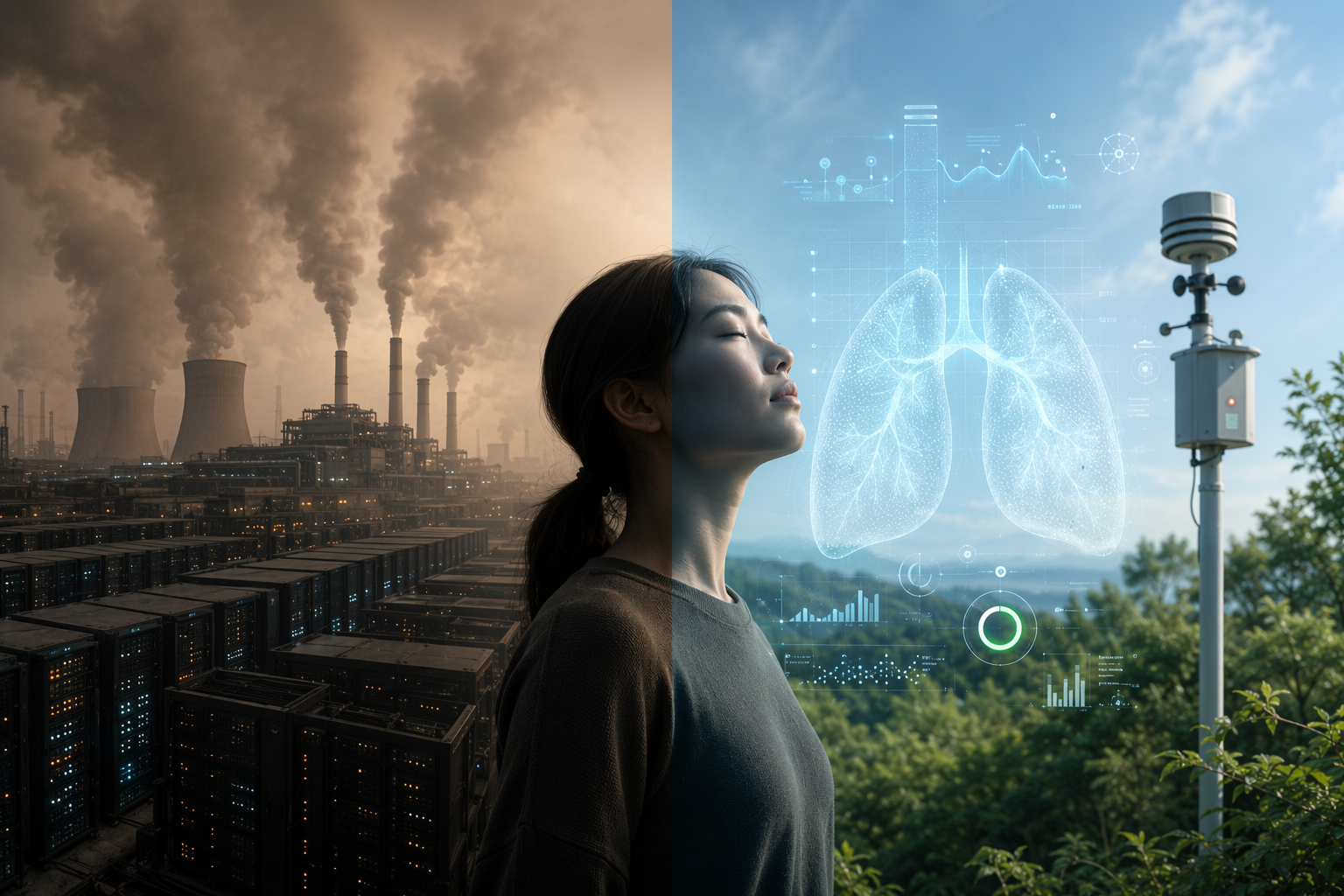
That omission matters because the exposure pathway is not obscure. Data centers draw electricity from grids that may still depend on fossil fuel generation. Backup power systems can add local diesel emissions. The resulting pollution does not politely remain inside a procurement spreadsheet; it travels through airsheds, across state lines, and into lungs.
Harvard T.H. Chan School of Public Health researchers estimated that one Virginia data center was associated with $53 million to $99 million in annual health damages.[3] In Northern Virginia, backup diesel generator pollution from data center operations was estimated to impose $190 million to $260 million in annual regional health costs, with transported pollution disproportionately affecting low-income communities.[3] Those are not clinical trial endpoints, and they are not direct epidemiological counts of actual patients harmed by a named facility. They are modeled damage estimates. But they translate infrastructure siting and energy choices into premature mortality, hospital admissions, and regional health costs in a way that carbon-only reporting does not.
The Health Burden Is Being Modeled Before It Is Being Managed
The evidence on AI data center pollution is still largely prospective and model-based. That should make readers cautious, not dismissive. Air pollution policy and health impact assessment often rely on modeled exposure, concentration-response functions, and economic valuation before every attributable case can be observed in a hospital record. The proper question is whether the assumptions are transparent enough to guide decisions, not whether the model produces a photograph of harm.
For hospital sustainability committees, PM2.5 deserves a different kind of attention from electricity use alone. A megawatt-hour is an operational input. PM2.5 is an exposure with known clinical consequences. When AI deployment plans count gains from faster imaging reads, automated documentation, trial matching, or bed-flow prediction, the air-pollution costs of the compute layer should not be placed outside the health system's moral and analytical boundary.
That does not mean every AI system carries the same pollution burden. A small model used locally for scheduling is not equivalent to training or serving large-scale foundation models. Nor does it mean a health system can infer its own attributable PM2.5 burden from national projections. The current evidence is better at identifying a public health exposure pathway than at assigning precise responsibility to each clinical use case.
Prediction Is Where AI Becomes More Useful Than the Usual Sustainability Debate
The same AI methods that create additional electricity demand are also among the strongest tools for making air-pollution risk less abstract. Machine learning can combine monitor readings, meteorology, satellite observations, traffic patterns, historical admissions, wearable signals, and demographic information in ways that conventional threshold-based alerts often cannot.
A 2025 Nature Scientific Reports study tested a machine learning framework using Random Forest, Gradient Boosting, and LSTM models for pollutant prediction and air quality classification. The reported results exceeded 95% R² for pollutant prediction and achieved more than 91% AQI classification accuracy.[4] Those numbers are technically impressive, especially for environmental monitoring work where missingness, weather shifts, and local emission patterns can degrade performance.
But pollutant prediction is not the same as clinical benefit. A model can forecast PM2.5, ozone, or AQI accurately and still fail to change staffing, medication access, school exposure decisions, or emergency department demand. The practical health question begins after the air-quality forecast: who is likely to be harmed, how soon, by which exposure mixture, and what decision can be taken before symptoms worsen?
For readers who want the methodological bridge between air-quality signals and health-risk estimates, ClinicalMind's deeper explanation of how AI translates air quality data into health risk estimates is a useful companion. The central issue here is narrower and more awkward: the same AI ecosystem is improving risk prediction while adding a modeled pollution burden of its own.
When Air Quality Forecasting Meets the Pediatric ED
The Sabará Children's Hospital study in São Paulo is a more clinically recognizable example because it linked environmental and weather inputs to pediatric respiratory emergency department outcomes. Researchers analyzed 24,366 ED visits and 2,973 admissions from 2022, using an XGBoost platform with PM10, ozone, humidity, and temperature to predict admission versus discharge. The model reported an AUC of 0.81.[5]
An AUC of 0.81 does not mean the model is ready to replace triage judgment. It means that, in this single-institution dataset, the model showed meaningful discrimination between children who were admitted and those discharged. That is exactly the sort of intermediate evidence that can interest a pediatric ED director without pretending that software has become a validated clinical device.
| Question | What the Sabará Study Supports | What It Does Not Yet Prove |
|---|---|---|
| Can environmental data help predict pediatric respiratory admission risk? | Yes, in a 2022 single-hospital São Paulo dataset using PM10, ozone, humidity, and temperature. | It does not prove general performance across other cities, health systems, seasons, or patient populations. |
| Is the model clinically interesting? | Yes, an AUC of 0.81 suggests useful discrimination. | It does not establish that deployment improves outcomes, reduces crowding, or changes treatment safely. |
| Can administrators act on this kind of evidence? | Potentially, for planning, surveillance, and research design. | Not as a stand-alone admission decision tool without prospective validation. |
The operational appeal is obvious. If respiratory demand rises after particular pollutant and weather patterns, a hospital could prepare staffing, respiratory therapy coverage, inhaler and nebulizer supplies, and community messaging earlier. The harder part is proving that prediction changes care rather than merely describing the same surge a few hours or days in advance.
Source Matters, Not Just Concentration
Air quality alerts usually talk about pollutant levels. Public health intervention often needs to know sources. The Mount Sinai exposomics study moved in that direction by using machine learning-based PM2.5 source apportionment across more than 65 million US Medicare beneficiaries. The researchers linked oil combustion and coal or biomass burning PM2.5 sources to a 4% to 6% increased risk of atherosclerotic cardiovascular disease mortality, even at levels below regulatory standards.[6]
That distinction is important for health systems and public agencies because equal mass does not necessarily imply equal policy leverage. A hospital located near traffic, freight, backup generators, or fossil power generation may see the same PM2.5 concentration number as another community but face a different source profile. AI-assisted source apportionment can make the exposure more actionable, especially when regulators, planners, and clinicians need to decide whether the problem is regional transport, local combustion, or both.
The Medicare scale gives the Mount Sinai work particular weight. It is not a boutique wearable study or a laboratory simulation. Still, the conclusion remains observational: it links modeled source-specific exposure to mortality risk. It should sharpen public health suspicion around combustion sources, not be misread as proof that a single intervention at a single facility would reduce mortality by a fixed percentage.

Personalized Risk Is Promising, But Still Early
The next frontier is not simply predicting tomorrow's AQI. It is estimating how a particular person may respond to a pollution episode. AI-Respire, an Imperial College London framework described in a May 2025 arXiv preprint, used an adversarial autoencoder with transfer learning to predict individual physiological responses to pollution. In simulations of 100% pollution spikes, the model predicted a 2.5% increase in heart rate and a 3.5% increase in breathing rate, and it reported a mean squared error of 4.24×10⁻⁵ on held-out smartwatch data.[7]
That is the sort of work clinicians should watch, especially for asthma, COPD, cardiovascular disease, pregnancy, pediatrics, and occupational exposure. A generic AQI alert tells everyone in a region the same thing. A personalized physiology model could eventually tell a patient, clinician, school nurse, or care manager that a predicted exposure is likely to matter more for one person than another.
The evidence status matters here. AI-Respire is preprint-stage, not a fully peer-reviewed, prospectively deployed clinical tool.[7] It builds on established cohort resources, but that does not erase the gap between retrospective or simulated validation and routine care. Wearable data quality varies. Baseline physiology varies. Medication use, housing, indoor filtration, occupational exposure, and comorbidities complicate prediction. The clinical promise is real enough to follow; it is not mature enough to operationalize as a medical safety net.
What Evidence Is Mature Enough to Use Now?
The evidence base is uneven in a way that should shape how health institutions use it. Pollutant forecasting models are technically strong in controlled study settings. Clinical outcome models are encouraging but often local. Personalized physiological models are scientifically interesting but generally earlier. Health-damage estimates from AI infrastructure are modeled, yet they quantify an exposure pathway that sustainability reports too often avoid.
| Evidence Area | Current Strength | Main Limitation |
|---|---|---|
| AI data center PM2.5 health burden | Quantified modeling estimates for premature deaths and health costs by 2030. | Not direct epidemiological measurement of observed deaths from AI infrastructure. |
| Pollutant and AQI prediction | High reported predictive performance in machine learning studies. | Accuracy does not automatically translate into clinical or public health benefit. |
| Pediatric respiratory admission prediction | Single-institution clinical outcome modeling with AUC 0.81. | Limited generalizability and no proof of improved care after deployment. |
| PM2.5 source apportionment and mortality | Large-scale Medicare-linked analysis connecting source types to ASCVD mortality risk. | Observational and dependent on modeled source-specific exposure. |
| Personalized physiology prediction | Promising preprint-stage modeling using wearable and cohort-linked signals. | Not yet peer-reviewed to the same level or cleared for clinical use. |
A 2026 epidemiological review in Environmental Sciences Europe described AI health risk assessment from air pollution as an expanding research area, not as settled clinical infrastructure.[8] That distinction should be kept intact. Reviews can map methods and opportunities; they do not substitute for prospective trials, implementation studies, regulatory review, or evidence that alerts changed patient outcomes.
No FDA-cleared AI devices specifically for air pollution health risk prediction were identified in the provided evidence. That absence does not make the research irrelevant. It means hospitals, payers, and public health departments should treat these models differently depending on use: surveillance and planning require one standard; patient-specific clinical recommendations require another.
The Dual Burden Cannot Be Split Between Different Committees
A hospital AI committee may ask whether a model improves workflow, accuracy, or access. A sustainability committee may ask whether a vendor reports emissions and renewable energy purchasing. Air quality health risk sits between those questions. If PM2.5 is left out, the health system can end up evaluating AI's benefits with clinical specificity and its harms with environmental vagueness.
The better framing is not anti-AI. It is evidence accounting. AI infrastructure is already associated with modeled, quantifiable air-pollution health risks, including a projected national burden of roughly 1,300 premature deaths per year by 2030 and nearly $20 billion in annual health costs.[1][2] AI models are also becoming powerful tools for pollutant forecasting, respiratory surge prediction, source-specific exposure analysis, and personalized risk estimation.[4][5][6][7]
Those two realities should be held together. Counting only the downstream clinical upside makes the power plant, backup generator, and PM2.5 burden disappear from view. Counting only the pollution burden ignores tools that could help pediatric EDs, epidemiologists, and public health planners act earlier. The evidence does not support either simplification. It supports a more demanding conclusion: AI is already part of the air-pollution health problem, and some AI systems may become part of the health response, but the strongest claims on both sides still depend on careful modeling, transparent assumptions, and validation in the settings where people will actually breathe the consequences.
References
- AI's deadly air pollution toll, UC Riverside, December 9, 2024.
- Air Pollution and the Public Health Costs of AI, Caltech.
- Analyzing air pollution, health, economic risks from AI data centers, Harvard T.H. Chan School of Public Health.
- Machine learning framework for air pollutant prediction and AQI classification, Scientific Reports, 2025.
- Prediction of pediatric respiratory emergency department admissions using air pollution and weather data, Journal of Global Health.
- New study using machine learning links air pollution exposure to increased risk for atherosclerotic cardiovascular disease, Mount Sinai Exposomics.
- AI-Respire: Personalized physiological response prediction to air pollution exposure, arXiv, May 2025.
- Epidemiological review of AI health risk assessment from air pollution, Environmental Sciences Europe, 2026.
Comments
Join the discussion with an anonymous comment.