
The useful question about AI in air quality monitoring and health impact is not whether a model can make a pollutant curve look smoother. It is what a healthcare researcher or public health analyst can safely do after the model predicts tomorrow’s PM2.5, NO2, ozone, or AQI category. Current peer-reviewed evidence gives a fairly strong answer for localized pollutant forecasting and a much narrower answer for health-risk prediction: several AI models perform well in single-city or otherwise bounded settings, but the evidence still thins out at the point where exposure estimates become generalized population health claims.
The strongest synthesis is a 2025 PRISMA-guided systematic review of 65 Q1 journal articles on AI in air pollution monitoring and forecasting. It reports Random Forest accuracy as high as 98.2%, and it shows how concentrated the literature remains around PM2.5: 53 of 83 reviewed studies focused on that pollutant.[1] Those are meaningful signals. They also need to be read as model-and-context results, not as portable promises that the same approach will perform equally well in another city, data stream, season, or exposure regime.
What the Accuracy Numbers Actually Measure
Accuracy in this literature usually means that a model predicted pollutant concentrations or AQI categories well against a held-out portion of an environmental dataset. It does not usually mean that the model predicted asthma exacerbations, cardiovascular admissions, mortality, or individual clinical risk. That distinction is not a technical footnote; it decides whether the output belongs in an air-quality operations dashboard, a population exposure model, or a clinical decision workflow.
The 2025 systematic review is useful because it pulls the model-performance discussion out of isolated claims. Across the reviewed literature, ensemble and machine-learning approaches appear repeatedly, with Random Forest standing out for reported accuracy up to 98.2%.[1] The review also makes the pollutant imbalance visible. PM2.5 dominates the evidence base, while a complete health-relevant exposure picture would also need robust handling of other pollutants and mixtures.[1]
| Evidence signal | Reported finding | What it supports | What it does not prove |
|---|---|---|---|
| 2025 systematic review | 65 Q1 journal articles; Random Forest accuracy up to 98.2%; 53 of 83 studies focused on PM2.5 [1] | AI models can predict selected pollutants strongly in reviewed monitoring and forecasting studies | Generalized health-risk prediction across regions or populations |
| 2026 hybrid CNN-LSTM study | About 91% F1-score for short-term AQI forecasting; LSTM 87.9%; CNN 86.7% [2] | Hybrid deep learning can outperform standalone architectures in a specific AQI forecasting task | Validated disease incidence, individual prognosis, or global transferability |
| 2026 epidemiological review | AI/ML is being used to augment GEMM, IER, AirQ+, and BenMAP for spatial resolution, non-linear associations, and real-time mapping [3] | AI can strengthen population-level health impact assessment workflows | That AI-derived maps are automatically clinically actionable |
| 2026 realtime mapping framework | Sensor-to-risk pipeline using interpretability methods including SHAP and LIME [4] | End-to-end environmental health mapping is technically feasible | Prospective validation across diverse geographies or EHR-linked individual prediction |
That table is deliberately conservative. A high F1-score or high accuracy can justify confidence in a local forecasting task, especially when the data source, pollutant, training window, and validation procedure are clear. It cannot, by itself, justify a claim that the model estimates disease risk for a different population. The unit of validation has changed.
The CNN-LSTM Result Is Impressive, but Its Health Claim Needs Containment
The 2026 Scientific Reports study gives the clearest side-by-side model comparison in the current evidence set. Its hybrid CNN-LSTM model achieved about a 91% F1-score for short-term AQI forecasting, compared with 87.9% for standalone LSTM and 86.7% for standalone CNN.[2] That comparison matters because it suggests the hybrid architecture is not merely decorative. The CNN component can extract local spatial or feature patterns, while the LSTM component can retain temporal dependencies; in this task, combining them improved classification performance.
For monitoring, that is a practical result. A public agency or hospital preparedness team does not need a metaphysical explanation of deep learning to understand the operational value of a better short-term AQI forecast. If the next-day or near-term category is more reliable, staffing decisions, public advisories, school guidance, and outreach to high-risk groups can be timed with less guesswork.
The same study also mapped AQI categories to a 49.43% population disease-risk estimate in Gurugram.[2] That number should not travel without its baggage. It is useful as a case-specific illustration of how a forecasting model can be connected to a health-facing output. It is not a validated epidemiological estimate of disease probability for individuals in Gurugram, and it is not a transferable risk rate for another city. The mapping step is doing a different kind of work than the AQI forecast itself.
This is where many AI air-quality articles become too loose. AQI categories are regulatory and communication tools. They summarize ambient conditions into public-facing bands. A disease-risk estimate requires an exposure-response relationship, a population denominator, baseline disease rates, demographic or subgroup structure, and assumptions about lag, duration, and counterfactual exposure. Moving from one to the other is possible, but it is not automatic.
From Concentration Forecasts to Health Impact Assessment
The more defensible bridge from AI forecasting to health impact is through established epidemiological frameworks. A 2026 epidemiological review describes how GEMM, IER, AirQ+, and BenMAP are being augmented by AI and machine learning to improve spatial resolution, capture non-linear associations, and support more timely risk mapping.[3] This is a better direction than treating a pollutant forecast as a clinical-risk score.
In that workflow, the AI model’s first responsibility is exposure estimation: filling spatial gaps, forecasting short-term concentrations, detecting patterns in sensor networks, or refining surfaces where fixed monitors are sparse. The health impact model then applies exposure-response functions, baseline rates, and population data. The distinction protects both sides. The environmental model is not asked to infer disease outcomes it has not been trained or validated to predict, and the epidemiological model is not forced to accept coarse exposure inputs when better ones are available.
AI can help most where traditional health impact assessment is spatially blunt or temporally slow. If a model improves neighborhood-level PM2.5 estimates, BenMAP-style analysis can become more geographically precise. If machine learning detects non-linear exposure patterns that simpler models miss, GEMM- or IER-informed estimates can be explored with finer inputs. If sensor streams update quickly enough, AirQ+-type analysis can move closer to near-real-time public health surveillance.[3]
None of that removes the need for epidemiological discipline. A sharper exposure map can still be paired with weak assumptions. A real-time dashboard can still hide uncertainty. A non-linear model can still learn local artifacts. The health claim becomes stronger only when the full chain is validated: sensor quality, pollutant model, exposure surface, population linkage, risk function, subgroup assumptions, and outcome comparison.
What an End-to-End Pipeline Can Show
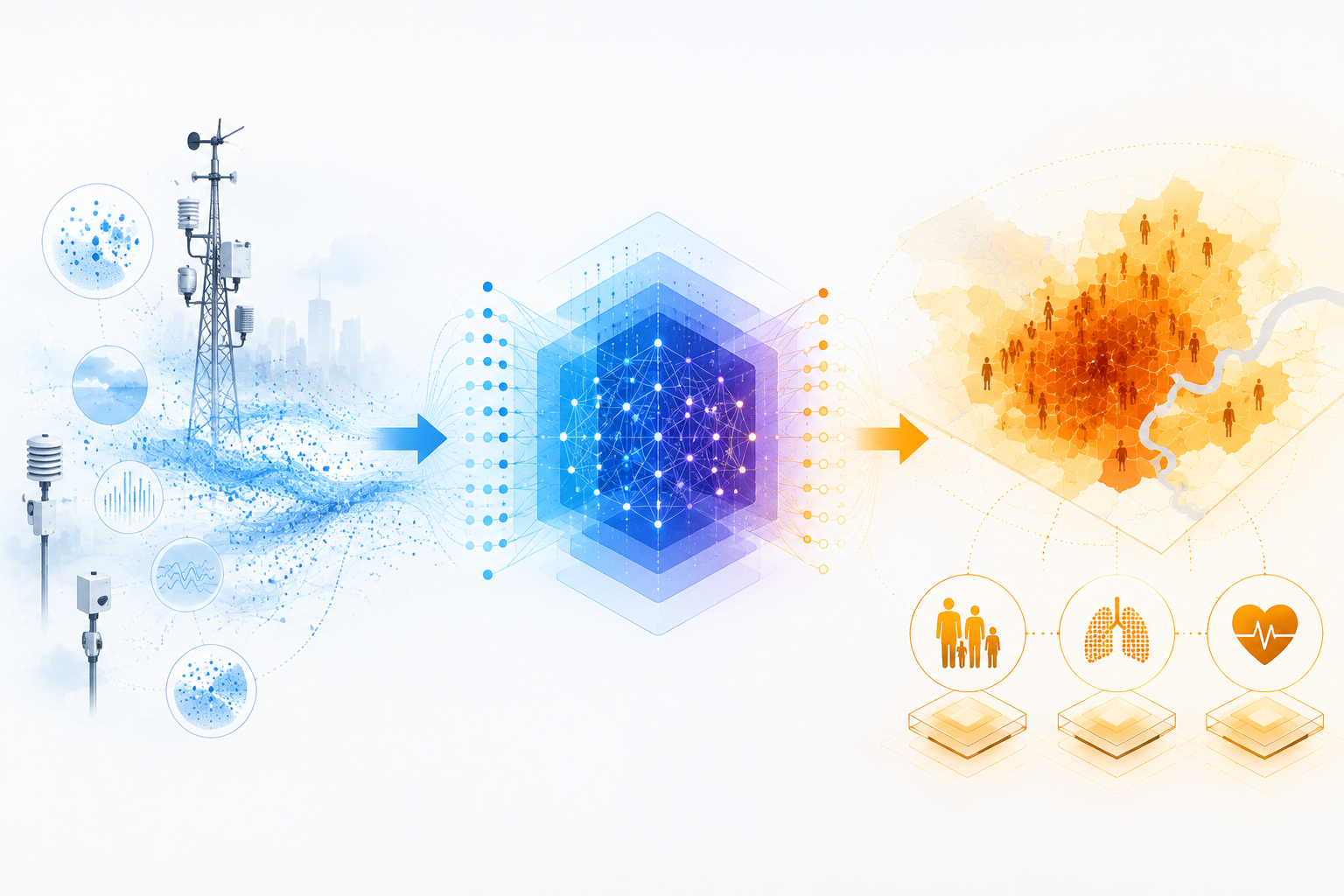
The 2026 machine learning-driven framework for realtime air quality assessment and predictive environmental health risk mapping is valuable because it treats the problem as a chain rather than a leaderboard. It demonstrates a pipeline from sensor data through air-quality assessment to health-risk mapping, with interpretability methods including SHAP and LIME used to examine model behavior.[4]
That kind of architecture is closer to what public health teams actually need. A pollutant forecast alone leaves the analyst to decide what population is affected, how the uncertainty should be communicated, and which neighborhoods or subgroups deserve attention. A risk-mapping pipeline at least makes those joins explicit: environmental inputs enter, model processing occurs, health-risk layers are generated, and interpretability tools help identify which variables pushed the output.
- Sensor layer: fixed monitors, low-cost sensors, or other air-quality inputs feed the environmental model.
- Prediction layer: machine learning estimates pollutant concentrations, AQI categories, or near-term exposure patterns.
- Risk layer: health impact methods translate modeled exposure into population-level burden or risk surfaces.
- Interpretability layer: SHAP, LIME, or similar tools help analysts inspect which inputs influenced the model output.
Interpretability does not make a model correct. It can, however, make a model auditable enough for environmental health work. If a model’s predicted risk map is driven mainly by a suspicious sensor, a proxy variable, or a seasonal artifact, the analyst has a chance to notice before the output becomes a public-facing map or policy input.
Where the Evidence Is Still Narrow
The current studies are strongest when they stay close to the data they actually tested. Gurugram, Chennai, and Selangor are useful settings for model development and comparison, but they do not represent a global validation base. The studies discussed here point to single-city studies, short-duration datasets, and in some cases synthetic data as recurring constraints. Those choices may be reasonable for early model development. They are not enough for generalized population health risk assessment.
Geography is not a cosmetic variable in air pollution epidemiology. Emission sources differ. Meteorology differs. Housing, occupational exposure, indoor infiltration, healthcare access, baseline disease prevalence, and age structure differ. A model trained in one urban context may be learning patterns that are partly local infrastructure, partly climate, and partly monitor placement. Strong internal validation does not answer whether the same model survives contact with another exposure regime.
The underrepresentation problem is especially important for Sub-Saharan Africa, South America, rural areas, and Eastern Europe. If the evidence base is thin in those regions, then global claims about AI-assisted health risk prediction are premature. The absence is not merely an equity concern, although it is that. It is also a validity problem: models cannot be assumed to generalize to data environments and population structures they have barely seen.
Pollutant coverage is another constraint. PM2.5 deserves its central place because it is strongly tied to disease burden and appears most often in the reviewed studies, but health impact assessment cannot stop there.[1] NO2, ozone, coarse particles, mixtures, and source-specific exposures may matter differently across populations and outcomes. A literature concentrated around one pollutant can produce mature PM2.5 tools while leaving other clinically relevant exposure questions less developed.
Personalized Health Prediction Remains Ahead of the Evidence
The tempting next step is to connect air-quality forecasts to individual EHRs and generate personalized risk warnings. That is not where the evidence currently lands. The reviewed material supports localized pollutant forecasting and increasingly refined population risk mapping. It does not show prospective, large-scale integration with individual-level health outcomes across diverse healthcare systems.
A credible personalized model would need more than ambient exposure. It would need address history or mobility-informed exposure estimates, baseline diagnoses, medication use, age, pregnancy status where relevant, occupational exposures, housing characteristics, healthcare access, and outcome follow-up. It would also need governance that prevents sensitive location and health data from becoming a secondary risk. Federated learning is often proposed as a privacy-preserving path, but in this evidence set it remains a proposed solution rather than a demonstrated answer at scale.
For now, the more defensible use case is population and subgroup planning. A health department can use refined exposure maps to identify areas where older adults, children, or people with cardiopulmonary disease may face higher aggregate risk during pollution episodes. A hospital system can use local forecasts as one input into preparedness planning. Those uses still require uncertainty ranges and local validation, but they do not pretend that an AQI forecast is an individualized diagnosis.
A Cautious Readiness Judgment
AI-assisted air quality monitoring is credible for localized pollutant forecasting. The systematic review’s Random Forest benchmark, the concentration of PM2.5 studies, and the 2026 CNN-LSTM comparison all support that conclusion within the limits of their datasets and geographies.[1][2] Hybrid deep learning and ensemble methods are no longer speculative tools in this area; they are serious forecasting methods that can outperform simpler baselines in bounded settings.
AI-assisted health impact assessment is also becoming more useful when it is paired with established frameworks such as GEMM, IER, AirQ+, and BenMAP.[3] The strongest version of the workflow is not an AI model that announces disease risk from an AQI category. It is a transparent chain in which AI improves exposure estimation, epidemiological tools translate exposure into population impact, and analysts can inspect uncertainty, assumptions, and subgroup effects.
The evidence does not yet support generalized population health risk assessment across diverse geographies. It also does not support personalized health prediction using individual EHR data at scale. The next research step is not another isolated accuracy record. It is prospective multi-geography validation, better representation of undercovered regions, transparent handling of synthetic or short-duration datasets, and stronger linkage between environmental exposure estimates and measured health outcomes.
References
- Application of artificial intelligence in air pollution monitoring and forecasting: A systematic review — ScienceDirect, 2025.
- Hybrid deep learning model for air quality prediction and its impact on healthcare — Nature Scientific Reports, 2026.
- AI Assessment of Health Risk Based on Air Pollution: An Epidemiological Review — Springer, 2026.
- Machine learning-driven framework for realtime air quality assessment and predictive environmental health risk mapping — PMC, 2026.
Comments
Join the discussion with an anonymous comment.