
Will Roberts gained access to an experimental gene therapy through an AI-informed precision oncology pathway, and he still died at 15. That is the factual center of this story. The Alabama teenager had osteosarcoma diagnosed at age 12, received standard MAP chemotherapy, underwent amputation, and later progressed to stage 4 metastatic disease, according to news accounts and family-reported details carried by local and national outlets.[1][2] He died on July 23, 2026, at a San Diego hospital.[3]
Calling this an inspirational cancer journey risks doing too much work. There was courage here, and family persistence, and an extraordinary push to find one more credible option. But the harder question is clinical: how did molecular profiling make an investigational therapy pathway visible in a pediatric solid tumor where the usual treatment sequence had run out?
Metastatic osteosarcoma gives clinicians very little margin. The American Cancer Society lists 5-year relative survival for distant-stage osteosarcoma at roughly 5% to 30%, depending on the tumor site and other factors.[4] A review of recent and ongoing metastatic osteosarcoma research described more than 30 clinical trials across chemotherapy, tyrosine kinase inhibitors, immunotherapy, and stem cell rescue approaches without meaningful improvement for metastatic disease.[5] That is the background against which an AI molecular profile matters: not because it turns a fatal cancer into a solved problem, but because it may change which investigational door can be opened.
| What can be stated | Evidence boundary |
|---|---|
| Will Roberts’ diagnosis trajectory, viral plea, fundraising, relocation, political attention, and death | Reported by national and local news outlets, often drawing on family accounts rather than published clinical records |
| CCNG1 overexpression as a sarcoma biomarker identified through BostonGene Tumor Portrait profiling at Sarcoma Oncology Center | Described in a BostonGene/Sarcoma Oncology Center company release; the release explains the platform mechanism but does not name Will Roberts |
| DeltaRex-G’s regulatory and clinical evidence status | Supported by FDA framework materials, peer-reviewed expanded-access data, and reporting on the therapy’s development history |
| Whether the treatment produced durable benefit for Will | Not established in published clinical literature; his death makes clear that access did not translate into durable survival |
The pathway began with a biomarker, not with AI in the abstract
The relevant AI claim is narrower than most public narratives suggest. BostonGene and Sarcoma Oncology Center announced in December 2023 that BostonGene’s AI-driven Tumor Portrait platform had identified elevated CCNG1 expression as a universal feature across tested sarcomas, a finding used to support DeltaRex-G as a platform therapy for tumors positive for the CCNG1 biomarker.[6] That is not the same as saying AI treated the cancer. It means a molecular and immune profiling system helped identify a biomarker that could connect a patient’s tumor biology to an investigational therapy.
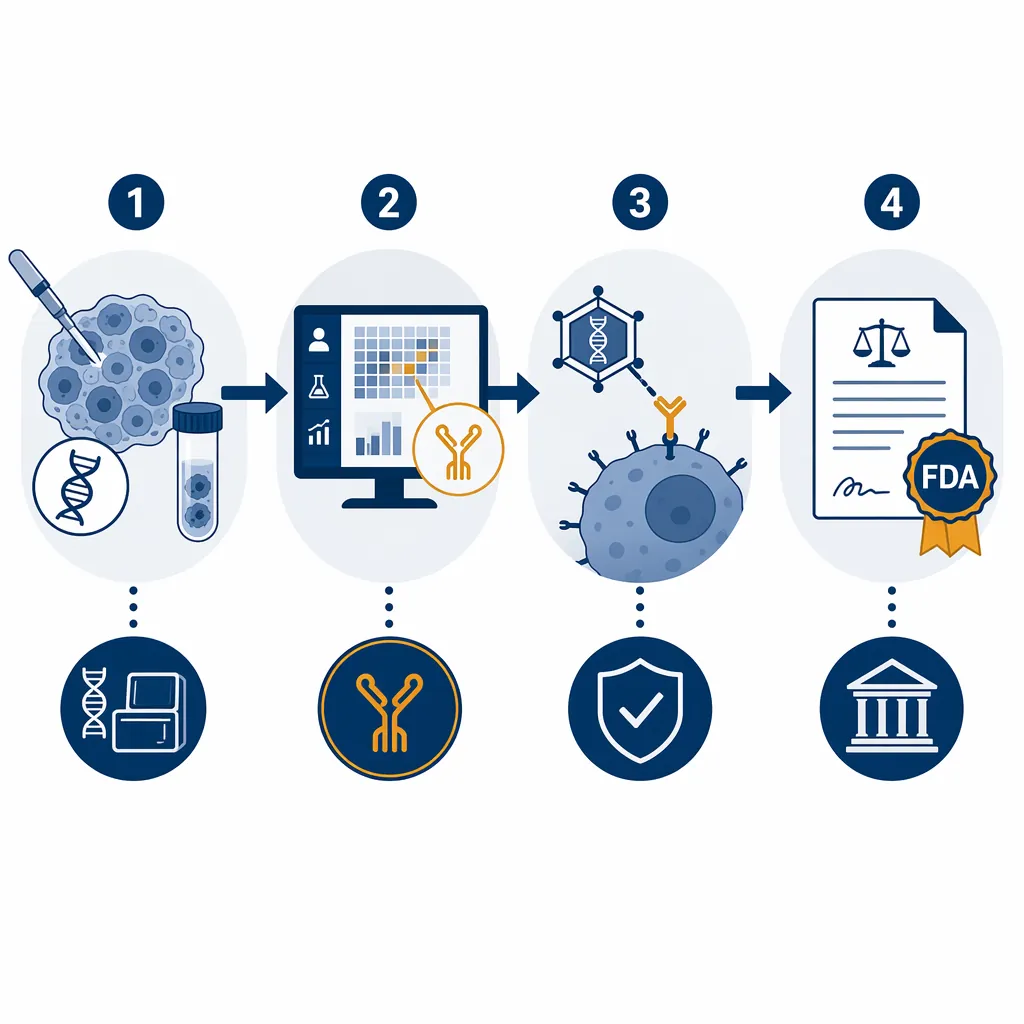
The chain is important because each link does a different job. Tumor profiling looks for molecular features. CCNG1 overexpression provides a proposed biomarker. DeltaRex-G supplies the investigational therapeutic platform. The regulatory access route determines whether the patient can receive it outside an ordinary trial.
The BostonGene release describes the CCNG1/DeltaRex-G mechanism at Sarcoma Oncology Center, the treatment site connected in public reporting to Will’s care, but it does not document his individual test report, dose, treatment schedule, or response. Those details remain outside peer-reviewed case-report territory. The most defensible conclusion is that his case publicly illustrates how an AI-informed molecular profile can make a Right to Try therapy match legible; it does not prove that the match was clinically effective for him.
Why CCNG1 mattered for DeltaRex-G eligibility
CCNG1 matters here because DeltaRex-G is not framed as a conventional histology-specific drug. In the BostonGene/Sarcoma Oncology Center description, the therapy could be considered for any patient whose tumor tests positive for the CCNG1 biomarker, regardless of histology, under an FDA Center for Biologics Evaluation and Research platform-therapy designation.[6] That shifts the access logic from “this is an osteosarcoma drug” to “this tumor expresses the biomarker connected to the platform.”
That distinction is not semantic. Pediatric solid tumors are often too rare, heterogeneous, and under-enrolled to generate the kind of clean evidence base that supports common adult oncology indications. A platform approach, if it is accepted by regulators and made operationally available, can group patients by a molecular feature rather than by tumor name alone. It is a plausible way to create an investigational access route for diseases that do not attract large, neatly powered trials.
For a patient like Will, the apparent clinical sequence was therefore not “AI found a cure.” It was closer to this: standard therapy was exhausted; molecular profiling identified a tumor feature; that feature aligned with a platform-therapy rationale; and an investigational access mechanism made treatment possible. The outcome remained uncertain at every step.
Right to Try made access possible, but not simple
The federal Right to Try Act, enacted in 2018, allows eligible patients with life-threatening diseases to seek access to certain investigational drugs that have completed a Phase I trial, without FDA individual-case review.[7] The law is often discussed as if it removes the gate. In practice, it removes one gate. A manufacturer must still be willing to provide the product, a clinician must be willing to treat, the patient must meet eligibility criteria, and the costs around care, travel, monitoring, and complications may remain formidable.
This is where Will’s case stops looking like a clean technology story. News reports described a secret Facebook video that drew more than 6 million views, a GoFundMe campaign that raised more than $700,000, and attention from President Donald Trump, HHS Secretary Robert F. Kennedy Jr., CMS Administrator Dr. Mehmet Oz, and Alabama senators Katie Britt and Tommy Tuberville.[1][2] Those facts show the force of advocacy. They also show how much nonclinical machinery was needed around the clinical idea.
A biomarker match may be scientifically elegant and still operationally fragile. If treatment requires relocation to California, extraordinary fundraising, and national political amplification, then the pathway exists but is not reproducible for most families. That matters for health systems evaluating AI precision oncology tools. The tool may identify an option; it does not automatically pay for it, transport the patient, persuade the manufacturer, or create a local treatment infrastructure.
What is known about DeltaRex-G
DeltaRex-G, formerly known as Rexin-G, is a tumor-targeted gene therapy that has been tested in more than 280 cancer patients worldwide, according to reporting on the therapy’s development history.[8] It has had FDA orphan drug designation since 2008.[8] These facts matter because they place the therapy in a category different from a newly improvised intervention. It is investigational, but it is not an idea appearing for the first time in response to one viral case.
The most relevant peer-reviewed signal in the supplied materials comes from the BLESSED expanded-access study. In advanced pancreatic cancer and sarcoma patients treated with DeltaRex-G, investigators reported median overall survival of 11.5 months and 1-year survival of 38.5%, with a mild toxicity profile.[9] Those data support continued interest in the therapy. They do not establish efficacy for pediatric metastatic osteosarcoma, and they do not predict an individual patient’s outcome.
Expanded-access evidence is inherently difficult to interpret. Patients are often heavily pretreated, heterogeneous, and treated outside the controlled structure of randomized trials. Survival can be influenced by selection, baseline performance status, tumor burden, concomitant care, and referral patterns. The BLESSED results are therefore best read as a clinical signal and safety experience, not as proof that a CCNG1-positive sarcoma patient will benefit.
That distinction is especially important after Will’s death. Access to DeltaRex-G may have represented a rational investigational choice after standard options failed. It did not become, by virtue of that rationality, a validated rescue therapy.
The national AI policy context is real, but it did not treat this patient
The timing of Will Roberts’ story intersects with a larger federal push toward AI in pediatric cancer. In September 2025, Executive Order 14355, “Unlocking Cures for Pediatric Cancer with Artificial Intelligence,” directed an expansion of AI-backed pediatric cancer data work and doubled Childhood Cancer Data Initiative funding to $100 million, according to White House and NIH announcements.[10][11] That policy context helps explain why AI-enabled pediatric oncology is receiving attention at the national level.
But policy enthusiasm should not be confused with bedside evidence. A national data initiative may improve discovery, harmonize datasets, and support future model development. It does not by itself validate a therapy, guarantee access, or solve the logistics of compassionate use. The Will Roberts case sits at the junction between those ambitions and the current reality: a single family trying to move from molecular data to an actual infusion while time is collapsing.
What this case should and should not be used to claim
There are at least three claims that need to stay separate.
- AI molecular profiling helped identify a plausible therapy match: supported by the CCNG1/Tumor Portrait platform description, though not by a published Will Roberts case report.[6]
- A regulatory access route made investigational treatment possible: supported by the Right to Try framework and the reported treatment pathway.[1][7]
- The treatment produced durable clinical benefit: not supported by the available public evidence; Will’s death on July 23, 2026, underscores that no durable survival outcome is documented.[3]
Right to Try also has limitations that become more visible in a case like this. Academic analysis of the law has noted persistent concerns around manufacturer participation, cost, informed consent, safety oversight, and the reduced role of FDA review compared with expanded access.[12] Those are not bureaucratic quibbles. They determine whether a molecularly matched investigational therapy is a pathway, a privilege, or a mirage.
For clinicians and health IT leaders, the lesson is not to discount AI biomarker discovery because one patient died. Late-stage metastatic osteosarcoma remains biologically and clinically brutal. The more precise lesson is that prediction and access must be evaluated together. A model that identifies CCNG1 overexpression may expand the menu of options; an access system that requires viral attention and six-figure fundraising narrows who can act on that information.
For researchers, Will’s case argues for better documentation. If AI-informed profiling leads to investigational therapy selection in rare pediatric cancers, those cases need structured reporting: tumor biology, assay method, eligibility rationale, dosing, adverse events, radiographic response, progression, and survival. Without that, the public is left with two inadequate stories: miracle access or heartbreaking failure.
Will Roberts’ case documents a real emerging pathway: molecular profiling can identify a biomarker, the biomarker can connect to a platform therapy, and Right to Try can create a route after standard care has been exhausted. It also documents the unresolved problem underneath that promise. The science may be moving toward more individualized options for rare pediatric cancers, but the access model remains uneven, expensive, and too dependent on public attention.
References
- Alabama boy battling cancer lands experimental drug after posting secret viral video that drew Trump response, Fox News, link
- Alabama teen battling cancer gets life-saving medicine after viral Facebook video, WVTM13, link
- Boy who went viral by going on mother’s Facebook in plea for bone cancer drug dies at 15, KKTV, July 23, 2026, link
- Survival Rates for Osteosarcoma, American Cancer Society, link
- Recent and Ongoing Research into Metastatic Osteosarcoma Treatments, PMC, link
- Sarcoma Oncology Center Leverages BostonGene’s AI-Driven Molecular and Immune Profiling Platform to Identify Novel Treatment Options for Patients with Advanced Cancers, BostonGene, December 2023, link
- Right to Try, FDA, link
- Forgotten Cancer Gene Therapy Set for Revival With Off-the-Shelf Potential, Cancer Therapy Advisor, link
- BLESSED: A Phase 1/2 Expanded Access Clinical Study of DeltaRex-G, PMC, link
- Unlocking Cures for Pediatric Cancer with Artificial Intelligence, The White House, September 2025, link
- HHS doubles AI-backed childhood cancer research funding, NIH, link
- Right-to-Try Laws: Hope, Hype, and Unintended Consequences, PMC, link
Comments
Join the discussion with an anonymous comment.