
Patients are no longer waiting for nutrition software to be formally adopted by clinics before using it. An Academy of Nutrition and Dietetics survey found that about 1 in 3 people have used ChatGPT for nutrition or weight-loss advice. They are asking general-purpose AI systems for weight-loss menus, diabetes-friendly meals, high-protein plans, grocery lists, and substitutions. That usage alone would not be alarming if the output were obviously rough. The more uncomfortable problem is that an AI-generated diet plan can look organized, specific, and professionally credible while still missing the nutritional targets that make a plan clinically usable.
That is the current tension around AI in weight loss and nutrition science: the tools are accessible and fluent, but the evidence on plan validity is much less reassuring than the presentation layer. The question is not whether a model can write a seven-day meal plan. It plainly can. The question is whether the plan’s energy prescription, macronutrient distribution, and micronutrient coverage are close enough to professional targets that a clinician could safely rely on it without checking the work.
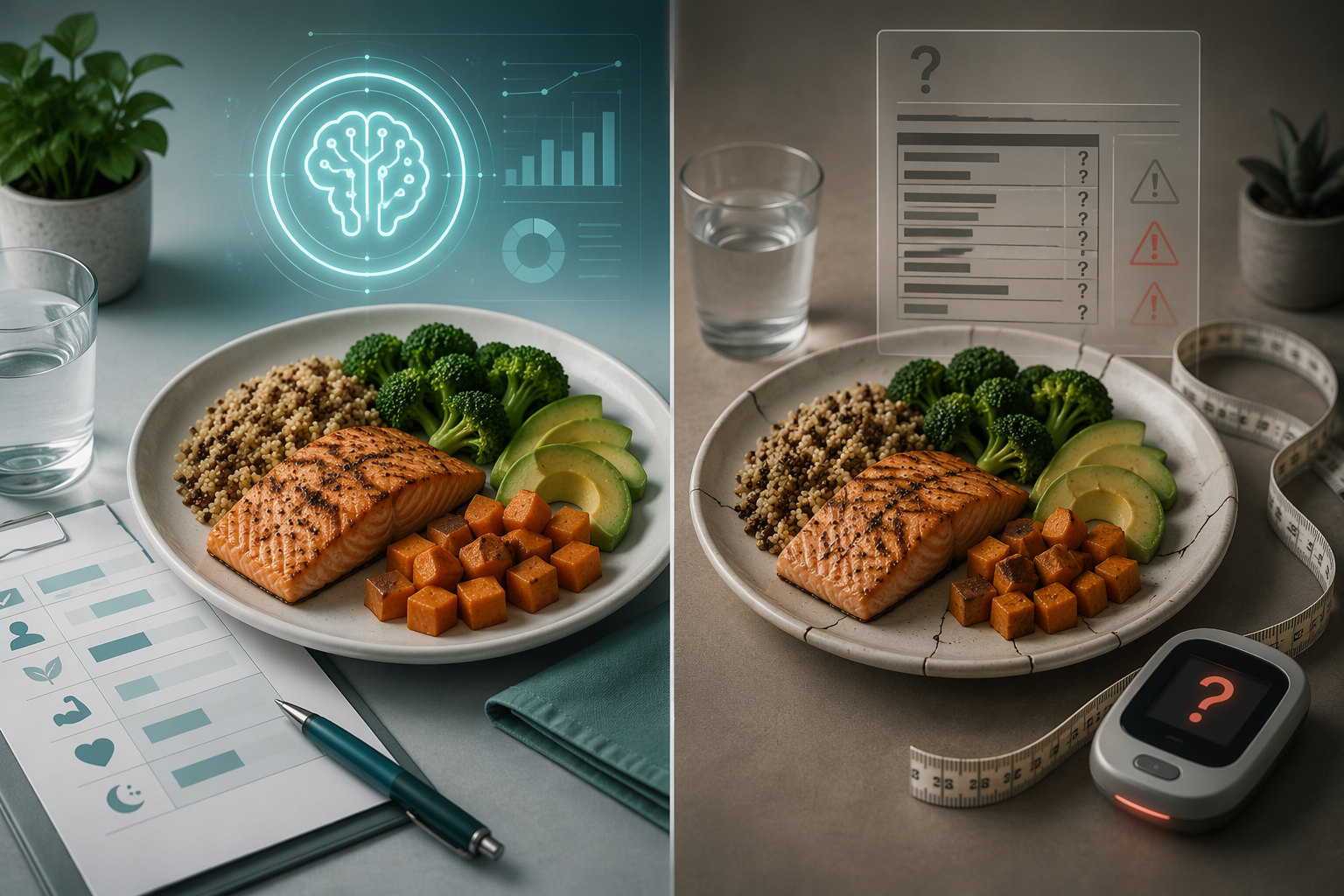
The surface quality is part of the risk
A weak diet plan usually announces itself. Portions are vague, meals are repetitive, the food pattern looks unrealistic, or the total intake is so clearly mismatched to the patient that it invites review. AI plans can be more difficult to triage because they often borrow the language and structure of clinical counseling: balanced meals, hydration reminders, behavioral tips, substitutions, and reassuring disclaimers.
Kim et al. tested that problem directly in a blinded evaluation involving 67 obesity medicine experts. Experts rated AI-generated weight-management plans above neutral for safety, with a mean score of 6.53 out of 10, but gave the lowest score to intention to use clinically, at 5.40 out of 10. The concerns they identified were not exotic AI failures; they were ordinary clinical problems, including affordability, conflicting dietary considerations, and insufficient portion specificity. Most strikingly, experts could not distinguish AI-generated plans from tertiary-care medical center plans in 79% of cases.[1]
That finding should not be read as proof that the AI plans were equivalent to professional care. It says something narrower and more clinically awkward: on appearance alone, even trained obesity medicine experts often could not tell which plan came from a medical center and which came from AI. If hidden nutritional errors are present, polish makes them harder to catch, not less important.
Measured against dietitian reference plans, the calorie math was not close
The clearest quantitative signal comes from Bilen et al., who compared 60 AI-generated diet plans from five models with dietitian reference plans. The models included ChatGPT-4o, Gemini, Claude, Bing Chat, and Perplexity, using Turkish-language prompts and free versions of the tools. Across those plans, AI outputs systematically underestimated energy needs compared with dietitian calculations, with a mean bias of +695 kcal and 95% limits of agreement from -81.8 to +1,472.6 kcal. The reported effect size was large, at d=1.79.[2]
The sign of the bias matters because this was not merely random noise around a professional estimate. A plan that is hundreds of kilocalories below the intended prescription is not just a less generous version of the same diet. In practice, it can change the therapeutic strategy: it may turn a moderate deficit into an aggressive one, distort hunger and adherence, and require the clinician to undo a plan the patient has already started to trust.
The study design also matters. These were not patient outcome trials, and the results should not be stretched into claims about actual weight loss, adverse events, or long-term adherence. The finding is more specific: when asked to generate diet plans, current AI systems in this evaluation did not reliably reproduce the energy targets used in dietitian reference planning.[2]
The macronutrient pattern drifted low-carbohydrate and high-protein
Energy underestimation was not the only deviation. Bilen et al. found that AI-generated plans clustered toward a lower-carbohydrate and higher-protein pattern than recommended macronutrient ranges. Carbohydrate contribution was reported at 32.4% to 36.3% of energy, below the Institute of Medicine Acceptable Macronutrient Distribution Range of 45% to 65%. Protein contribution was reported at 21.5% to 23.7% of energy.[2]
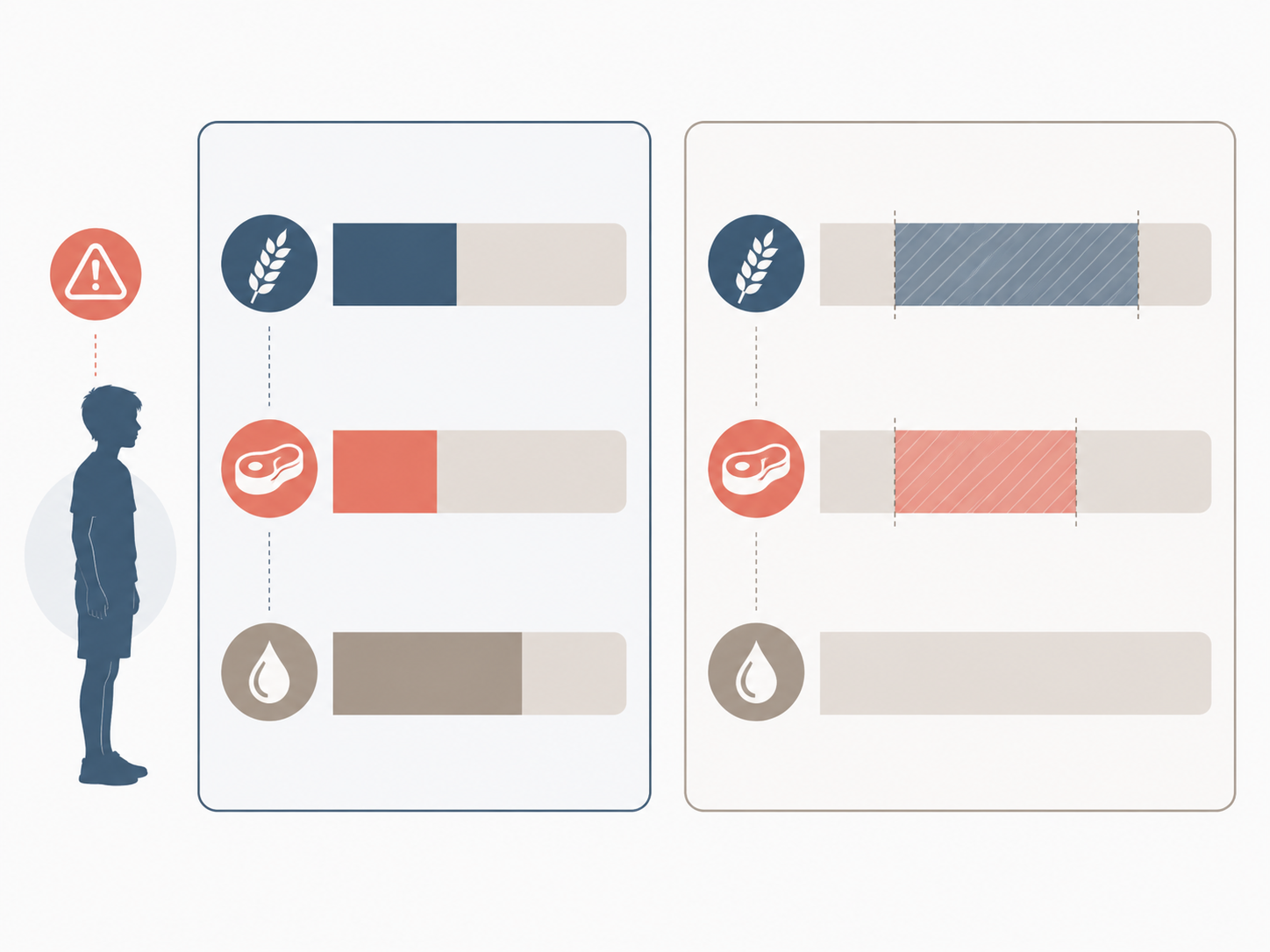
A low-carbohydrate, high-protein tilt may sound familiar because it resembles a large amount of popular weight-loss content. That familiarity is precisely why it deserves attention. A model trained on broad text patterns can reproduce the dominant style of diet culture while still presenting it as individualized medical nutrition planning. The result is a plan that may feel contemporary and decisive, yet depart from guideline-based ranges before the patient or clinician has discussed whether such a pattern is appropriate.
The concern is sharper in adolescents and in patients with comorbidities, where energy adequacy, carbohydrate availability, renal considerations, medication interactions, growth, and eating-disorder risk cannot be handled by a generic high-protein template. The study does not prove harm in these groups, but it does show why apparent customization is not the same as clinical suitability.
Micronutrients were inconsistent, and no model solved the problem
Micronutrient adequacy is where a polished menu can be especially misleading. A plan can contain vegetables, lean proteins, dairy substitutes, whole grains, and nuts and still fail to provide enough of the nutrients that matter for a specific patient. Bilen et al. examined nutrients including vitamin D, folate, calcium, iron, and magnesium, and found substantial variability across models. No single AI model showed consistent proximity to dietitian reference plans across all measured parameters.[2]
That point argues against a common workaround: choosing whichever model appears most sophisticated and treating it as the safer option. In the Bilen evaluation, performance was model-dependent, but not in a way that produced a clear clinical winner. One model could be closer on one parameter and less reliable on another. For a clinician, that is not a meaningful substitute for validation; it is another reason the output has to be checked.
| Validity issue | What the evidence showed | Clinical implication |
|---|---|---|
| Energy prescription | AI plans underestimated energy compared with dietitian reference plans, with a mean bias of +695 kcal. | A fluent meal plan may create a larger-than-intended deficit. |
| Macronutrient distribution | Carbohydrates clustered at 32.4% to 36.3% of energy, below the 45% to 65% recommended range; protein clustered at 21.5% to 23.7%. | The plan may embed a low-carbohydrate, high-protein pattern without a clinical rationale. |
| Micronutrient coverage | Vitamin D, folate, calcium, iron, and magnesium varied substantially across models. | Nutrient adequacy cannot be inferred from a healthy-looking menu. |
| Model selection | No model was consistently closest to dietitian plans across all parameters. | Switching models is not the same as clinical validation. |
What the evidence does and does not prove
The evidence is strong enough to reject casual confidence in standalone AI meal plans. It is not strong enough to answer every downstream clinical question. Bilen et al. evaluated generated diet plans, not patients following those plans over time. The study used Turkish-language prompts and free AI model versions, so the findings may not transfer perfectly to paid tiers, different languages, newer releases, or tightly engineered clinical prompts.[2]
Those limitations should narrow the conclusion, not erase it. The appropriate reading is not that every AI-generated diet plan will underfeed every patient by the same amount. It is that, under tested conditions, multiple widely available models produced systematic nutritional deviations from dietitian reference plans, including errors large enough to matter clinically.[2]
The broader obesity-management literature is also still immature. In a 2026 review of ChatGPT in obesity management, Motevalli et al. reported that only 27% of 37 included studies were rated high confidence, and much of the evidence remained prompt-based rather than grounded in clinical outcomes.[3]
That distinction is essential. Prompt-based evaluation can tell us whether a model gives a plausible answer, follows instructions, or approximates a guideline in a simulated case. It cannot tell us whether patients use the advice as intended, whether clinicians can safely integrate it into workflow, whether vulnerable groups experience more errors, or whether outcomes improve compared with usual nutrition care.
Where AI may still fit
None of this makes AI useless in nutrition work. A tool that can draft meal ideas, translate dietary advice into a grocery list, generate culturally familiar examples, or help a patient prepare questions for a dietitian may have real access value. For patients who cannot easily obtain an appointment, even a rough educational starting point can feel better than no guidance at all.
But access value is not the same as clinical validity. The safest role for current AI-generated diet plans is as draft material or discussion support, not as an autonomous prescription. Before a plan is used clinically, someone has to verify the energy target, macronutrient distribution, portion specificity, medical compatibility, and micronutrient adequacy. That work is not cosmetic editing. It is the nutrition intervention.
The uncomfortable lesson from the current evidence is that the plans most likely to be adopted are not necessarily the plans most likely to be correct. They may be well formatted, compassionate in tone, and hard to distinguish from professional material. That makes professional oversight more important, not less.
The clinical boundary
Current AI-generated diet plans should not be treated as clinically valid alternatives to dietitian-guided nutrition care. The evidence shows measurable energy underestimation, macronutrient distortion, inconsistent micronutrient coverage, and model-dependent variability. The blind-evaluation evidence adds a second problem: clinicians and experts may not reliably detect AI origin from surface quality alone.
AI may help organize information and start conversations, but standalone use is not supported by the evidence. If an AI diet plan reaches a patient, a dietitian or appropriately trained clinician still has to do the clinical work of deciding whether it is nutritionally adequate and medically safe.
References
- Artificial intelligence-generated obesity treatment plans: a blind evaluation by obesity medicine experts, Frontiers in Nutrition, 2024.
- Evaluation of artificial intelligence-generated diet plans: comparison with dietitian reference plans, Frontiers in Nutrition, 2026.
- ChatGPT in obesity management, The Lancet Digital Health, 2026.
Comments
Join the discussion with an anonymous comment.