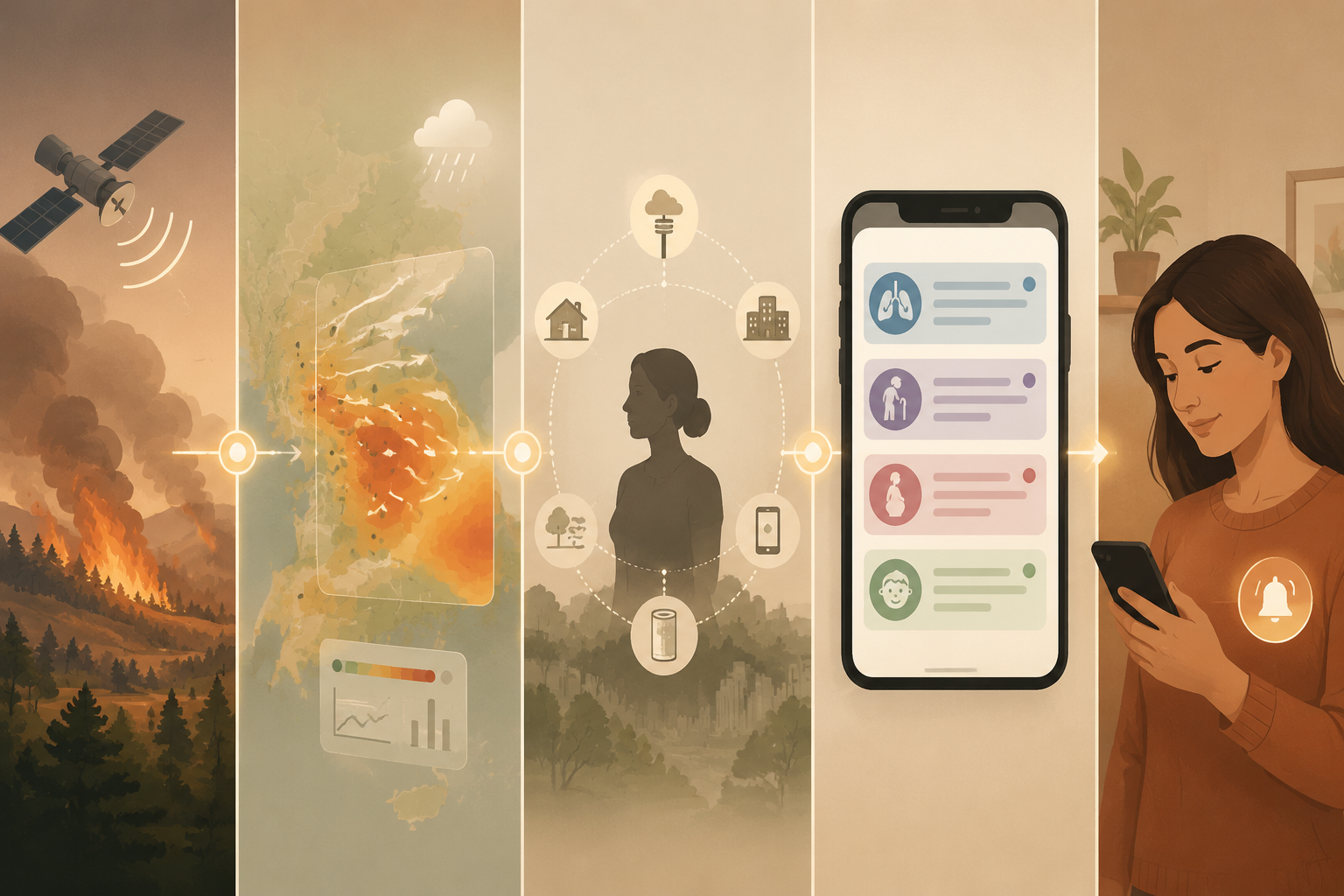
The promise behind AI-driven safety tips for wildfire smoke is not that a phone can repeat “stay indoors” faster than a public health department. The more serious claim is that AI can shorten the whole chain between an ignition, a smoke plume, a local exposure forecast, a person’s risk profile, and a behavior that actually changes before symptoms worsen.
That chain is improving, but unevenly. Some systems now detect fires in about a minute, reduce particulate-matter forecast bias, or estimate county-level mortality burden. Those are useful upstream advances. They are not, by themselves, evidence that a patient with asthma, COPD, pregnancy-related risk, dementia risk, limited housing control, or no access to filtered indoor air received a better recommendation and acted on it.
Where AI Enters The Smoke-Safety Workflow
A clinically useful smoke-advisory system has to do more than see smoke. It has to move information through several handoffs: detect a fire early, forecast where smoke and PM2.5 will go, estimate who is likely to be harmed, translate that risk into a message people can understand, and give different people different next steps when their constraints differ.
| Workflow link | What current AI evidence supports | What it does not yet prove |
|---|---|---|
| Fire detection | AI can accelerate alerts from satellite and environmental data. | Earlier detection is not the same as validated patient-level guidance. |
| Smoke and PM2.5 forecasting | Models can improve forecast accuracy and extend local planning windows. | Forecast accuracy does not show that high-risk patients changed behavior. |
| Health-burden estimation | Dashboards can estimate smoke-attributed mortality or excess deaths at population scale. | Mortality estimation is not individualized prevention. |
| Segmented communication | Mobile-health platforms can group users by traits and tailor messages. | Evidence for improved clinical outcomes remains limited. |
| Personalized recommendations | Explainable models can identify indoor exposure drivers in controlled settings. | No peer-reviewed system has shown EHR-integrated proactive outreach. |
NOAA’s Next-Generation Fire System is a good example of a meaningful upstream improvement: it uses AI to provide fire-detection alerts in about 1 minute.[1] That matters for emergency response, plume modeling, and public communication timing. It still leaves the hardest health-system questions untouched: which patients should receive outreach, what the message should say, and who is responsible for follow-up.
The forecasting layer is also getting stronger. A Penn State deep-learning model reportedly reduced PM2.5 forecasting bias from -6.872 to 0.160 ug/m3, a technical improvement large enough to interest anyone who has watched smoke forecasts understate a bad exposure day.[2] The University of Utah’s Trace AQ tool offers 4-day AI-driven smoke forecasts, which could give schools, clinics, local agencies, and households more time to prepare than a same-day alert.[3]
Those tools help answer “what is coming?” They do not automatically answer “what should this person do?” A 4-day forecast may support staffing, pharmacy refill reminders, clean-air shelter planning, or advice about portable filtration. But unless the forecast is connected to roles, thresholds, and communication pathways, it remains situational awareness rather than personalized safety guidance.
Risk Estimation Is Becoming More Local, But Still Mostly Population-Level
County-level mortality dashboards bring smoke risk closer to public health action. Cornell’s Mortality Estimation Tool generates near-real-time, county-by-county smoke-attributed mortality predictions using EPA AirNow data, NOAA satellite data, CDC mortality data, and Census data.[4] That is the kind of integration local officials can use when deciding where to intensify warnings or allocate clean-air resources.
Harvard’s SMRT-Flames model works at a different scale, estimating that 36,400 excess deaths were attributable to 2020 wildfire smoke.[5] This kind of modeling helps correct a persistent undercounting problem: wildfire response often tracks flames and acreage more visibly than delayed cardiopulmonary, neurologic, or all-cause mortality burden.
The distinction matters. Mortality modeling can justify investment and sharpen public health surveillance, but it is not a safety tip. A county with elevated smoke-attributed mortality risk still contains people with very different exposures, housing conditions, comorbidities, medications, literacy levels, work obligations, and access to filtration. A dashboard may tell a health department where to look; it does not yet tell a clinician whom to call.
For background on smoke exposure and AI monitoring more generally, ClinicalMind’s review of wildfire smoke health risks and AI air quality monitoring covers the broader health-risk context. The more specific question here is whether AI has crossed from monitoring into actionable, personalized communication.
Message Design Is Not A Cosmetic Layer
Smoke communication fails when technical accuracy is treated as the final step. During the 2007 San Diego wildfires, non-technical messages such as “stay indoors” had recall above 88%, while technical messages involving HEPA filters or N95 respirators had recall below 5%, according to a scoping review by Vien and colleagues.[6] The result is uncomfortable because the lower-recall messages may be exactly the ones that matter for people whose indoor air is not actually safe.
The same review found that only 6 of 21 studies addressed vulnerable populations, and none explicitly evaluated health literacy principles.[6] That is not a minor communications footnote. If an advisory is written for a generic resident with a sealed home, flexible work, money for filtration, and no respiratory disease, it is already personalized for the wrong person.
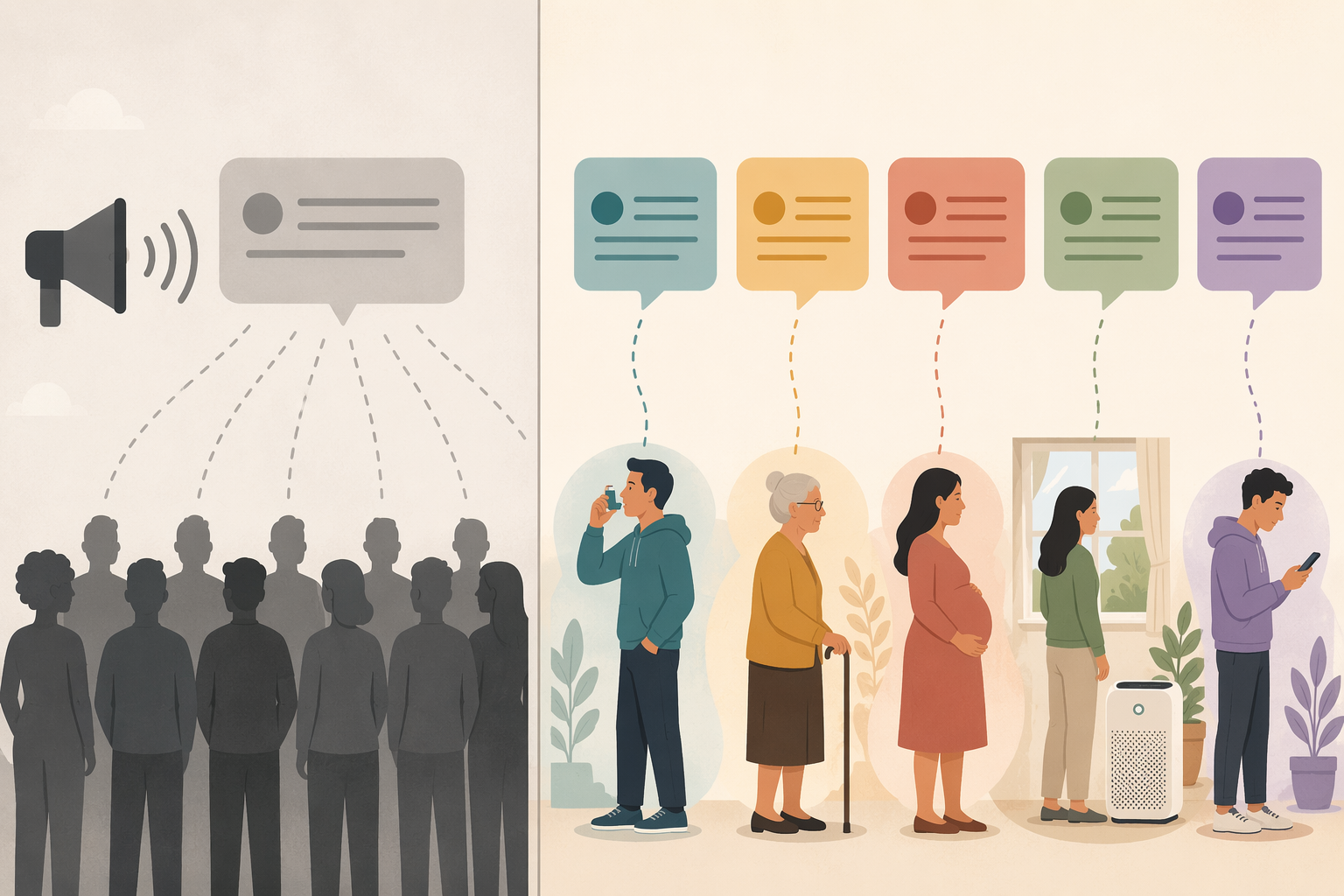
This is where AI personalization becomes more plausible. A model does not need to diagnose anyone to improve a smoke advisory. It may first help a public health team separate audiences by exposure likelihood, respiratory history, protective resources, risk perception, or preferred information channel. That is still not clinical decision support, but it is more actionable than broadcasting the same message to everyone inside a plume polygon.
Smoke Sense Is The Most Relevant Proof-Of-Concept
The EPA’s Smoke Sense app deserves more attention than most smoke-alert tools because it tries to connect information, user traits, behavior, and health-related outcomes. In one segmentation study, researchers identified 5 trait clusters among 5,018 Smoke Sense participants.[7] That sample does not prove health benefit, but it does show a practical route away from one-size-fits-all messaging: people differ in how they perceive smoke risk, what they already do, and what kind of message may be worth sending.
A separate randomized controlled trial tested Smoke Sense in young adults with asthma over 8 weeks. The study reported an improvement in Asthma Control Test scores from 20.0 to 21.5, with p=0.0008, in a trial of 60 participants.[8] That is the most directly health-related evidence in this set of materials, and it is encouraging precisely because it measures something downstream of an alert.
The limits need to stay close to the finding. The RCT was small and unblinded, and the population was young adults with asthma.[8] It should not be stretched into proof that AI-driven smoke advice improves outcomes across older adults, pregnant people, people with COPD, people with dementia risk, outdoor workers, or households without control over indoor air quality. The result supports proof-of-concept, not broad clinical adoption.
Even so, Smoke Sense points to the right evaluation target. The relevant endpoint is not whether an app can display air quality. It is whether a person at risk receives a message that fits their situation closely enough to change exposure-reducing behavior, medication planning, care-seeking, or symptom monitoring.
What Personalization Could Look Like Before EHR Integration
Near-term AI smoke advice may be useful even without medical-record access. A public health agency could segment messages by neighborhood forecast, self-reported asthma, household filtration, outdoor work, transportation access, or prior response to alerts. The operational question is then concrete: who receives a filter-focused message, who receives a medication-readiness prompt, who receives a clean-air-center notice, and who receives a reminder to check on a dependent adult?
This kind of segmentation does not require pretending that the app knows everything about the patient. It requires transparent categories, a reason for each message, and a feedback loop showing whether the message was understood or acted on. In many jurisdictions, that would already be an improvement over a generic alert that assumes “indoors” means “protected.”
Indoor-Exposure AI Gets Closer To Behavioral Advice
The most interesting personalization work may come from indoor exposure modeling, because smoke safety often depends on what happens after the door is closed. Sarkar and colleagues described an explainable AI framework that achieved 99.8% Decision Tree accuracy in a controlled indoor setting in India, using LIME and SHAP to attribute indoor PM2.5 patterns to specific activities; VOC was reported as the most influential feature.[9]
The appeal is obvious. If a model can say that a household’s indoor particulate spikes are more strongly associated with cooking, ventilation patterns, window opening, or other activities, the advisory can become less generic. Instead of “stay indoors,” the message might focus on when to run filtration, when not to ventilate, or which indoor activity is undermining the sheltering strategy.
But this is still mechanism-level evidence, not wildfire clinical validation. The Sarkar study was conducted in a controlled indoor environment in India, and its generalizability to outdoor wildfire smoke events, mixed indoor-outdoor exposure, different housing stock, and Western clinical populations is unconfirmed.[9] High classification accuracy in that setting should not be converted into a claim that the model prevents asthma exacerbations or smoke-related hospital visits.
Explainability is still valuable here. LIME and SHAP are not magic, but attribution can turn sensor data into a discussable action: this feature mattered, this activity coincided with exposure, this recommendation follows. For public health communication, that is better than an opaque risk score that tells people they are in danger without telling them what they can change.
The Clinical Workflow Gap Is Still Wide
In a health-system setting, “personalized” eventually has to mean more than location-aware air quality. It has to connect risk status, care teams, outreach permissions, medication lists, prior exacerbations, pregnancy status, mobility limits, and the practical ability to reduce exposure. As of Q3 2026, the evidence reviewed here does not show a peer-reviewed AI smoke-advisory system integrated with EHR data for proactive clinical outreach.
That absence changes the adoption question. A hospital or clinic may reasonably use AI-enhanced forecasts for preparedness: staffing, patient portal notices, respiratory clinic capacity, or coordination with public health agencies. It should be much more cautious about treating these tools as validated clinical decision support for individual patients.
The missing workflow is not hard to imagine. A forecast crosses a threshold. The system identifies patients with recent asthma exacerbations, COPD, pregnancy-related risk, or home oxygen use. A care team approves outreach language. Patients receive tailored instructions based on risk and resources. The EHR records the outreach, and outcomes are tracked against exacerbations, urgent visits, medication use, and patient-reported exposure-reduction behavior. The problem is not imagination; it is evidence.
Existing reviews of AI prediction for wildfire-smoke health effects also raise risk-of-bias concerns, a related issue covered in ClinicalMind’s analysis of AI wildfire smoke health predictions. Prediction alone rarely solves the implementation problem; it often exposes how little infrastructure exists after the score is generated.
Commercial Detection Claims Need A Different Evidence Standard
Commercial AI fire-detection and smoke-monitoring platforms may be useful to emergency managers, utilities, or land agencies. The problem for a healthcare evidence review is that many claims rely on company communications rather than independent peer-reviewed validation. A vendor’s ability to detect smoke, classify imagery, or notify a client should not be described as validated personalized health advice unless patient-facing outcomes have been tested.
This distinction is not anti-technology. It is the same distinction clinicians make everywhere else: analytic performance, operational performance, behavior change, and health outcomes are different endpoints. A model can perform well on the first two and still have no demonstrated effect on the last two.
What The Evidence Supports Now
The most defensible use of AI-driven smoke tools today is to improve preparedness and communication specificity. Fire-detection AI can accelerate awareness. Forecasting models can improve the timing and geography of alerts. Mortality and burden models can help public health leaders decide where smoke is likely to do the most harm. Segmentation tools can help avoid sending the same advice to people with very different risks and resources.
The weakest claim is that AI already delivers clinically validated, individualized wildfire-smoke safety tips. The Smoke Sense RCT provides a small, unblinded signal in young adults with asthma, and the segmentation study shows a plausible communication pathway.[7][8] The indoor explainable-AI work suggests how recommendations might become more behavior-specific, but it remains far from clinical outcome validation in wildfire settings.[9]
There is also a geography and language boundary. The available evidence reviewed here is English-language and U.S.-heavy, with one controlled indoor study from India. Community-led smoke communication, Indigenous fire knowledge, non-English alerting systems, and non-U.S. public health workflows may be underrepresented by this evidence base.
As of Q3 2026, AI is becoming credible at detecting fires, forecasting smoke, estimating population risk, and segmenting messages. It may already support more actionable public health communication than one-size-fits-all advisories. The clinical evidence remains thin, outcome validation is limited, and no peer-reviewed system has shown EHR-integrated proactive outreach. That places AI-personalized wildfire smoke advice in research evidence, not clinical guidance or product recommendation.
References
- NOAA unveils powerful convergence of AI and science with revolutionary Next Generation Fire System, NOAA, 2024.
- Deep learning model improves wildfire smoke forecasts, ScienceDaily, May 2024.
- U scientists develop AI-powered tool to forecast wildfire smoke, University of Utah, Aug. 18, 2025.
- Cornell dashboard estimates mortality risk of wildfire smoke, Cornell Chronicle, July 2024.
- Where there’s fire, there’s smoke, Harvard SEAS.
- Health Risk Communication for Wildfire Smoke: A Scoping Review, PMC.
- Characterizing Individual Engagement, Perception, and Attitudes Toward the Smoke Sense Citizen Science Project, PMC.
- Smoke Sense randomized controlled trial in young adults with asthma, PMC.
- Explainable AI framework for indoor PM2.5 exposure attribution, arXiv, 2025.
Comments
Join the discussion with an anonymous comment.