
Rare disease research and advocacy lives with an ugly arithmetic problem: more than 7,000 rare diseases are recognized, fewer than 6% have approved treatments, and roughly 300 million people worldwide are affected by rare diseases.[1][2] That gap is usually described as a pipeline problem, as if the only answer is to invent new medicines one disease at a time. But there is another, less glamorous question worth asking first: among the drugs already approved for human use, how many plausible second uses are sitting unmapped?

Drug repurposing is not a shortcut around evidence. It does not make a weak biologic hypothesis strong, and it does not turn a signal into access. What it can change is the starting point. A compound with established manufacturing, pharmacology, and human safety experience can sometimes move faster into disease-specific testing than a new chemical entity. For rare diseases, where commercial incentives are thin and patient groups often hold the most coherent disease histories, that matters.
The strongest current case for AI in this area is not that a model can sound fluent about disease biology. It is that platforms can compare approved drugs against thousands of diseases at a scale that no clinical team, foundation, or literature review group could manually sustain. The central question is whether that comparison can become a repeatable research system rather than a collection of lucky rescues.
The Important Shift Is From Anecdote To Search Infrastructure
Rare disease medicine has always had stranded clues. A clinician notices an unexpected response. A caregiver tracks a symptom change that never reaches a journal. A small cohort study points toward a mechanism but cannot attract a full development program. A decades-old drug has a relevant pathway effect, but no one has the resources to compare it across the long tail of rare conditions.
AI drug repurposing is useful only if it makes those clues easier to organize, test, and challenge. The point is not to replace rare disease expertise with pattern matching. The point is to give researchers, clinicians, and advocacy groups a way to ask a larger set of structured questions: Which approved drugs touch mechanisms relevant to this disease? Which disease-drug pairs have literature support, molecular plausibility, patient-reported signals, or prior clinical evidence? Which candidates are worth moving into validation, and which are merely computational noise?

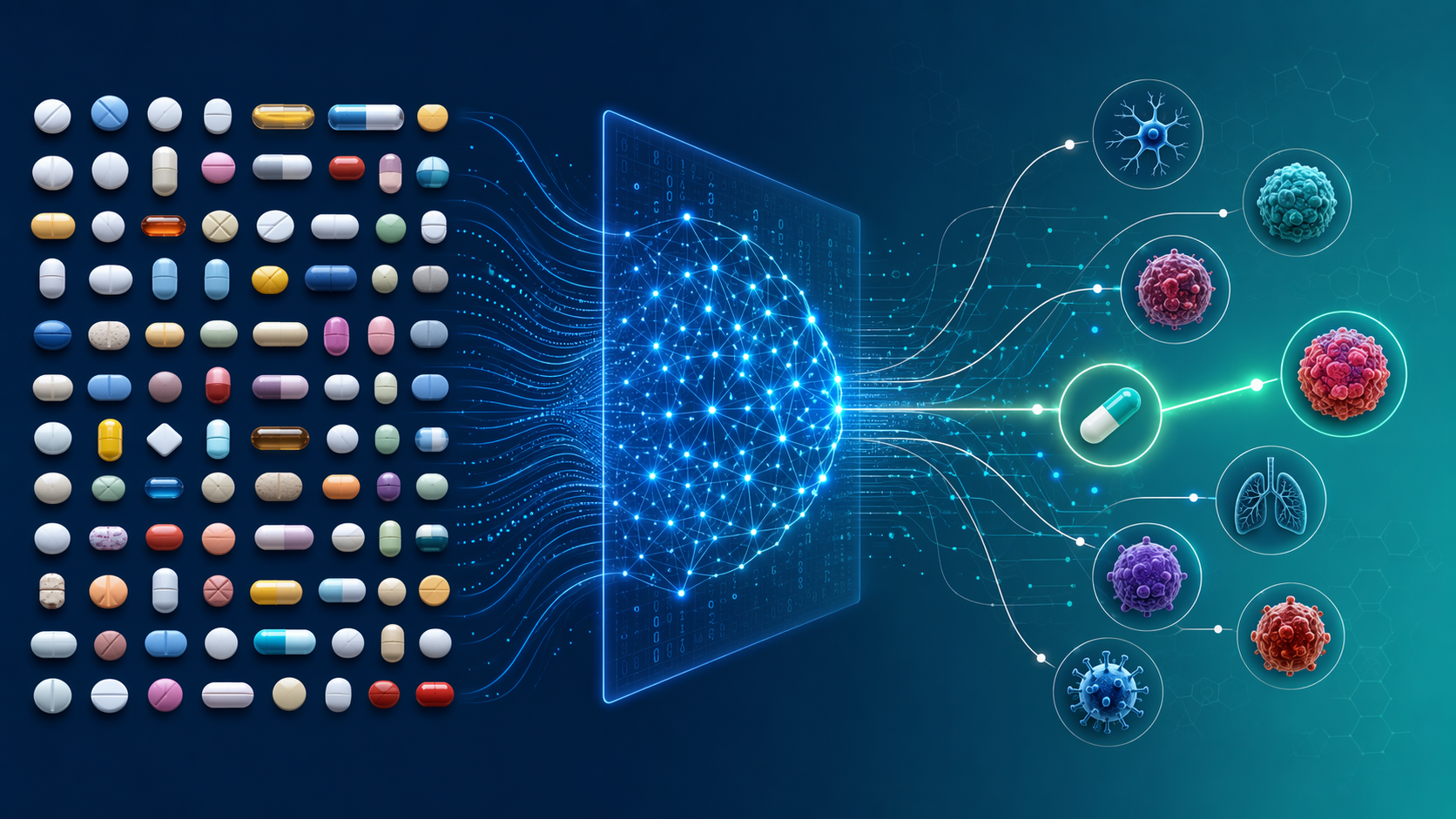
That is where Every Cure’s MATRIX system has become unusually important. The platform is designed to screen roughly 3,000 FDA-approved drugs against about 12,000 recognized diseases, producing predictive efficacy scores for drug-disease pairs and supporting an open-source database, a community-contribution portal, and public-facing repurposing infrastructure.[3][4] The Advanced Research Projects Agency for Health awarded Every Cure $48.3 million to develop the AI-driven platform, a funding signal that places this work closer to public health infrastructure than to a narrow product launch.[3][4]
MATRIX was also named one of TIME’s Best Inventions of 2025, but the award is less interesting than the design choice behind the system: make drug-disease scoring visible enough that researchers and communities can use it, contest it, and contribute to it.[5] For rare diseases, opacity is not a minor inconvenience. When a family foundation has collected natural history data, when a physician has seen a pattern across a few patients, or when a researcher has a mechanistic lead without funding for a traditional program, the ability to plug those signals into a broader repurposing search can change what becomes testable.
What MATRIX Is Actually Comparing
The useful way to understand MATRIX is not as a single prediction engine that declares a cure. It is better understood as a screening and prioritization layer. It compares existing drugs and diseases across multiple forms of evidence, then ranks pairings that may deserve deeper investigation. In rare disease work, that ranking step is not trivial. There are too many diseases, too few specialists, too little commercial attention, and too much scattered evidence for manual review to be enough.
| Signal | What It Can Help Answer | What It Does Not Prove |
|---|---|---|
| Known drug activity | Whether an approved drug affects a pathway plausibly connected to a disease | That the drug will improve patient outcomes in that disease |
| Disease biology | Whether the disease mechanism makes a repurposing hypothesis coherent | That the mechanism is dominant enough to be clinically useful |
| Published literature and case signals | Whether prior observations deserve systematic review | That scattered reports represent generalizable benefit |
| Community and advocacy contributions | Whether patient-held or foundation-held clues can enter the search process | That contributed signals are validated clinical evidence |
| Predictive efficacy score | Which drug-disease pairs may deserve validation first | That a candidate is available, approved for that indication, or reimbursed |
This distinction matters because rare disease families are often handed candidate language as if it were treatment language. A computational score can justify attention; it cannot prescribe itself. A plausible drug still has to survive wet-lab work, dose reasoning, safety review in the relevant population, regulatory interaction, clinical trial execution, and the mundane but decisive question of whether patients can actually get it.
Every Cure reports that MATRIX has identified or advanced 14 repurposed drugs yielding effective treatments for five rare diseases.[3] That is a meaningful result. It is also a small result against the scale of the untreated landscape. The correct reaction is neither a victory lap nor a shrug. Five rare diseases with effective treatments or advanced candidates can be life-changing for the affected communities; five also shows how early the infrastructure remains.
Why Repurposing Changes The Workload Without Removing The Hard Part
Repurposing changes the economics of asking the first question. If the compound is already approved, some safety, formulation, and manufacturing knowledge exists before the rare disease program begins. That can reduce friction compared with discovering and developing a new molecule from scratch. For diseases with small populations, weak market incentives, and limited trial networks, avoiding unnecessary early development work can be the difference between a hypothesis that is examined and one that remains an internal slide.
But it does not remove the middle of the story. A drug approved for one condition may have a different risk-benefit profile in a rare pediatric disorder, a neurodevelopmental condition, or a multisystem disease with fragile patients. Dose, timing, endpoints, disease stage, comedications, and heterogeneity still matter. The fact that a drug is known does not mean its new use is known.
That is why the public scoring and community-contribution pieces of MATRIX are more than nice language. Rare disease advocacy organizations often become de facto data stewards. They assemble registries, recruit families, fund natural history studies, preserve clinical anecdotes, and keep researchers connected after the first grant cycle ends. A repurposing platform that can accept community signals treats advocacy as part of the research apparatus, not as a human-interest sidebar.
The caution is that contribution is not validation. Patient organizations can help surface patterns and accelerate prioritization, but disease-specific claims still need appropriate evidentiary handling. The better version of AI-enabled advocacy is not louder anecdote; it is a cleaner path from observed clue to ranked hypothesis to testable protocol.
Other Programs Show The Pattern Is Broader Than One Platform
Every Cure is the main example because MATRIX connects screening scale, public funding, open-source ambition, and reported rare disease outputs in one program. It is not the only signal that AI-assisted repurposing is moving from concept to regulatory-facing work.
Healx has reported FDA clearance of an Investigational New Drug application for a Phase 2a trial of sulindac in Fragile X syndrome, as well as Orphan Drug Designation for nitroxoline in neurofibromatosis type 1.[6] Those milestones do not prove eventual efficacy or adoption. They do show that AI-supported candidate selection can move into the formal development pathway, where hypotheses are exposed to regulatory and clinical standards.
The DREAMS consortium adds a different kind of evidence: coordinated scale around a defined rare disease domain. The initiative is funded at €8 million and targets five neuromuscular diseases, according to a 2024 mini-review in Frontiers in Medicine.[1] That is not a universal rare disease solution, and it should not be presented as one. Its relevance is narrower and more useful: AI repurposing is being organized around disease-specific consortia, not only individual company pipelines.
Taken together, these examples suggest a pattern: computational repurposing is beginning to produce candidates that can enter validation, regulatory, and consortium settings. That is a much stronger claim than saying AI will cure rare diseases. It is also a much weaker claim than saying the treatment gap is closing at population scale.
The Data Problem Is Not A Footnote
The obvious risk in AI drug repurposing is that the technology sounds most confident where the underlying data are thinnest. Rare diseases are rare not only in clinics but also in datasets. There may be few patients, few longitudinal records, few standardized endpoints, few omics datasets, and few published studies. Even when patient communities are highly organized, the available evidence can be fragmented across registries, case reports, lab models, clinician notes, and caregiver observations.
A 2024 scoping review found that 47.37% of AI-in-rare-disease studies cited insufficient data as the primary barrier.[2] That number deserves more attention than market-size forecasts because it identifies the constraint most likely to determine whether the field scales responsibly. A model can only prioritize from what it can learn, and rare disease data often arrive with bias, missingness, inconsistent labels, and ascertainment problems.
The literature itself is also uneven. A 2024 Frontiers in Medicine review reported that only about 2.63% of published AI-for-drug-repurposing literature targets rare diseases.[1] That means rare disease applications are still underrepresented within a field that is already young. The imbalance is not surprising; common diseases generate larger datasets, larger markets, and more conventional validation pathways. But it does mean rare disease claims should be read with attention to sample size, disease specificity, and the distance between computational ranking and patient benefit.
This is also where advocacy can either strengthen or distort the evidence base. Patient groups can help gather natural history data, standardize outcomes that matter to families, and identify real-world disease burden that a model would otherwise miss. They can also face enormous pressure to treat any ranked candidate as urgent hope. The infrastructure has to protect both truths: patient-held knowledge is indispensable, and desperate need is not a substitute for validation.
What Counts As Progress In Q3 2026
By Q3 2026, the most defensible conclusion is that AI drug repurposing has begun to narrow the rare disease treatment gap by making the search more systematic. It has not closed the gap. The difference matters for researchers deciding where to invest effort, for health IT leaders building data infrastructure, and for advocacy organizations deciding how to turn small datasets into leverage.
Progress should be measured in layers. A public drug-disease score database is progress if it lets communities and investigators inspect a wider candidate universe. A validated treatment in a rare disease is progress if patients can benefit and the evidence is disease-specific. An IND is progress because it moves a candidate into regulated clinical testing. Orphan Drug Designation is progress because it recognizes development intent in a rare condition. None of these, alone, equals broad clinical availability.
The most promising version of this field is practical rather than miraculous. It screens approved-drug libraries against disease biology. It allows patient and advocacy data to be contributed without pretending that contribution is proof. It exposes ranked candidates to laboratory and clinical validation. It keeps regulatory milestones separate from efficacy claims. And it accepts that infrastructure can be a rare disease intervention even before it looks like a drug launch.
That is enough to justify attention. It is not enough to justify triumphalism. Five rare diseases with effective treatments or advanced repurposed candidates matter, especially to the people living with those conditions.[3] Against more than 7,000 rare diseases and fewer than 6% with approved therapies, they also show the size of the work still untouched.[1][2] AI can make the search less accidental. The cure research and advocacy task now is to make the strongest signals testable, reviewable, and reachable.
References
- Artificial intelligence in drug repurposing for rare diseases: a mini-review, Frontiers in Medicine, 2024.
- Artificial intelligence in rare diseases: a scoping review, PubMed Central, 2024.
- Every Cure to receive $48.3M from ARPA-H to develop AI-driven platform to revolutionize future of drug development and repurposing, Every Cure.
- ARPA-H awards AI-driven project to repurpose approved medications, ARPA-H.
- Every Cure MATRIX, TIME, 2025.
- AI Models Take on Medicine’s Rarest Challenges, Orphan Drug Summit.
Comments
Join the discussion with an anonymous comment.