
The useful question for ai in hurricane forecasting for health preparedness is not whether a model can draw a better cone. It is whether a health system can act while the forecast is still probabilistic: move dialysis appointments before roads close, decide which clinics need sandbags or closure notices, stage oxygen and generator fuel, open overtime before the labor pool is already caring for its own families, and identify which medically fragile patients cannot safely ride out a long outage at home.
That is where the recent AI forecasting gains matter. NOAA’s National Hurricane Center has described AI weather prediction as moving hurricane guidance into a faster, increasingly useful operational space, and noted that Google DeepMind was the most accurate model for storm track and intensity during the 2025 hurricane season.[1] Rice University’s 2026 review of AI weather models highlights the practical speed difference: systems such as Aurora and Pangu-Weather can generate global forecasts in roughly 1–2 minutes, compared with hours for traditional physics-based models.[2] Georgia Tech’s 2026 physics-informed flood model pushes the change closer to hospital operations, reporting more than 90% accuracy in building-level flood-depth prediction 3–5 days before landfall in a Hurricane Sandy test case.[3]
Those numbers do not evacuate a nursing home, authorize an ambulance contract, or decide whether a coastal ambulatory surgery center should cancel tomorrow’s cases. They do something narrower and more valuable: they create an earlier conditional window. The bottleneck shifts from “we do not know enough yet” toward “we have not preassigned what to do when this kind of forecast appears.”
From forecast speed to command decisions
A traditional emergency posture is not obsolete. Physics-based numerical weather prediction, forecaster judgment, emergency management briefings, and National Weather Service products remain the backbone of hurricane planning. AI forecasting is better understood as another tool in the incident command room: fast enough to rerun assumptions, granular enough to flag individual facilities, and cheap enough computationally to support many possible storm scenarios rather than one slow update cycle.
For a health system, the speed matters less as a technical achievement than as a calendar change. If a forecast update arrives while the planning team is still in the room, leaders can test a second staffing assumption, look again at a threatened clinic cluster, or compare evacuation staging times before the next operational period. Faster ensembles are especially useful because preparedness decisions rarely depend on one deterministic line. They depend on whether enough plausible storm paths create the same operational problem: a flooded access road, a threatened utility substation, a stranded home oxygen patient, a hospital with limited generator margin.
| Forecast layer | Operational question it can answer | Preparedness action that should already be defined |
|---|---|---|
| Track and arrival timing | Which facilities may be inside the impact window, and when do staffing changes need to begin? | Activate call trees, adjust shift lengths, release nonessential staff early, and set deadlines for ride-out teams. |
| Storm surge and coastal flooding | Which evacuation routes, EMS staging sites, and low-lying facilities may lose access? | Trigger transport contracts, alternate routing, ambulance staging, and early discharge planning. |
| Building-level flood depth | Which specific hospitals, clinics, pharmacies, or patient residences may face water at the structure? | Move supplies above grade, close or relocate services, contact at-risk patients, and protect generators and oxygen storage. |
| Power-outage and vulnerable-patient overlays | Who may lose life-sustaining equipment support at home? | Prioritize wellness checks, charging plans, shelter placement, and durable medical equipment coordination. |
The table is deliberately operational rather than meteorological. A health system does not need every administrator to understand neural network architecture. It does need a written rule for who receives the forecast, who interprets it, who is allowed to spend money before certainty arrives, and what threshold changes the hospital’s posture from monitoring to action.
The real breakthrough is building-level consequence
Regional warnings are necessary, but they can be too blunt for healthcare. “The county may flood” does not tell an emergency manager whether the outpatient dialysis unit is cut off, whether the loading dock at the main hospital is usable, whether a clinic pharmacy should move refrigerated inventory, or whether home health nurses can reach a neighborhood after landfall.
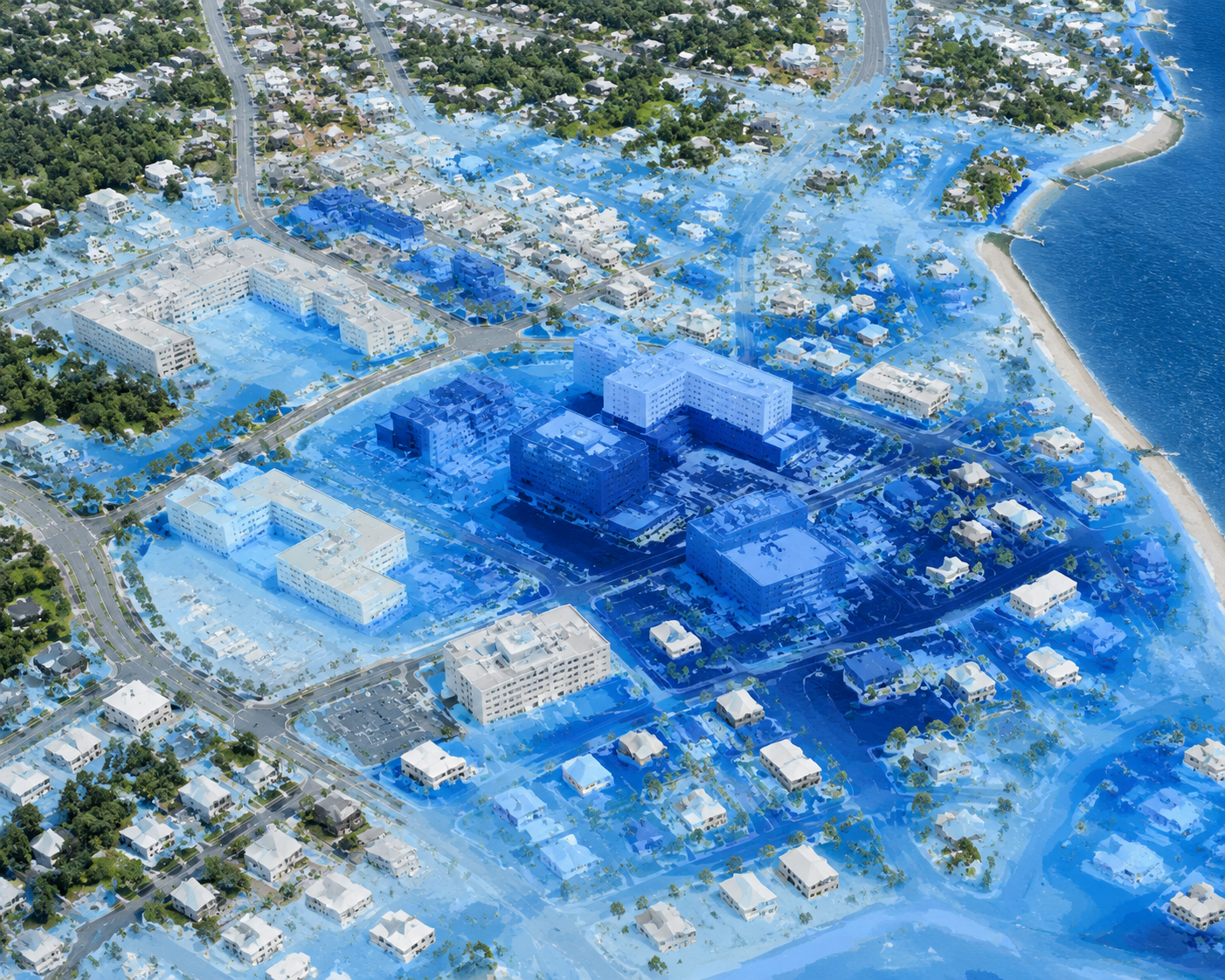
That is why the Georgia Tech result is important. The reported model did not merely classify a broad area as likely to flood. It estimated flood depth at the building level 3–5 days before landfall and achieved more than 90% accuracy in a Hurricane Sandy test case.[3] The limitation belongs in the same sentence as the promise: Sandy is one storm, and performance across other coastlines, storm structures, and built environments still needs validation. But even with that caution, the operational shift is obvious. A flood-depth forecast attached to specific buildings can become a work order, a closure plan, a transport list, or a generator-protection task.
In a health system, this should feed a facility-risk board before landfall. Each hospital, freestanding emergency department, ambulatory site, dialysis partner, pharmacy, warehouse, and administrative hub should already have basic attributes attached: elevation, flood history, generator location, fuel dependency, oxygen storage, patient volume, isolation capacity, and road access. AI flood output becomes useful when it can land on that asset map without a scramble.
A 3–5 day building-level warning does not require an immediate full evacuation. It can support staged, reversible action: cancel elective cases at the most exposed site first, relocate portable imaging equipment, move pharmaceutical inventory, raise critical supplies off the ground floor, shift appointments to inland clinics, and reserve transport capacity before every other institution makes the same calls. These are not dramatic decisions, but they are exactly the decisions that become harder when the forecast is finally certain.
Storm surge is where early routing decisions become life-safety decisions
Storm surge deserves separate attention because it is not just another flood layer. FIU’s 2025 work on AI storm-surge forecasting notes that storm surge is the leading cause of hurricane deaths and that AI methods can generate surge forecasts faster than traditional hydrodynamic models, supporting earlier evacuation decisions.[4] For hospitals, the phrase “earlier evacuation” should not be heard only as moving inpatients out of a tower. It includes whether ambulances can reach the tower, whether staff can get home safely before returning for ride-out, whether a receiving facility has beds, and whether oxygen-dependent patients outside the hospital can reach a shelter with power.
The surge forecast should therefore be paired with route intelligence. If the model flags a low-lying corridor that connects a coastal hospital to its inland transfer partner, the decision is not simply “evacuate” or “do not evacuate.” It may be to move high-acuity transfers earlier, pre-stage ambulances on the inland side, discharge stable patients before transport resources tighten, or relocate a mobile command post. A forecast that arrives days earlier is wasted if the first transport call happens after the road is already under a warning.
This is also where executive hesitation can erase technical lead time. Overtime, ambulance reservations, fuel deliveries, and patient relocation all cost money before the storm proves the model right. A useful protocol names the financial authority attached to each threshold. Otherwise, the system owns a faster forecast but still waits for a slower governance process.
Patient vulnerability has to be joined before the storm, not discovered afterward
The HHS emPOWER Program makes the patient side concrete. It identifies more than 4 million Medicare beneficiaries who rely on electricity-dependent durable medical equipment.[5] In a hurricane, that figure is not a background statistic. It is a reminder that power failure turns geography into triage. A patient with an oxygen concentrator, ventilator, powered wheelchair, or home dialysis support may be clinically stable on Monday and unsafe by Thursday if the grid, road access, and caregiver support fail together.
AI forecasting becomes more useful when those vulnerable-patient lists are overlaid with flood depth, surge, outage risk, and access routes. The right question changes from “which neighborhoods are threatened?” to “which patients in threatened places need a call today, a ride tomorrow, or a powered shelter assignment before landfall?” That work cannot be improvised from a static spreadsheet during a watch call. It requires data-sharing agreements with public health agencies, payers, home health organizations, dialysis providers, durable medical equipment vendors, and emergency management partners before hurricane season.
- For electricity-dependent patients, define who checks backup power status, who verifies caregiver availability, and who escalates when no one answers.
- For dialysis patients, identify which treatments can be advanced, which sites are exposed, and which transportation routes may fail.
- For home health and hospice patients, separate those who need a phone check from those who need an in-person visit before conditions deteriorate.
- For discharged inpatients, include storm risk in discharge timing, medication supply, equipment needs, and destination safety.
- For staff, map ride-out assignments against home evacuation zones, childcare constraints, and likely road closures.
The staff line belongs on the same list as patients because health systems sometimes treat workforce availability as if it were separate from the disaster. It is not. A nurse whose family is under an evacuation order, a respiratory therapist whose road floods early, or a facilities engineer waiting for fuel delivery is part of the preparedness picture. More lead time helps only if the staffing protocol allows earlier relief, earlier lodging, and earlier family-support decisions.
What an AI-enabled preparedness workflow looks like
A workable workflow starts before the storm exists. The health system decides which forecast products it will monitor, which internal datasets are allowed to be joined, which partners receive outputs, and which thresholds trigger action. During a storm watch, the team should not be debating whether a model is interesting. It should be comparing current outputs against a playbook.
| Time before potential landfall | Forecast-informed task | Decision owner |
|---|---|---|
| 5 days | Review track ensembles, exposed facilities, patient clusters, and potential staffing constraints. | Emergency preparedness lead with incident command leadership. |
| 4 days | Run facility flood and access-road overlays; identify sites needing service reduction, supply movement, or early closure planning. | Operations, facilities, ambulatory leadership, and logistics. |
| 3 days | Start vulnerable-patient outreach, dialysis schedule adjustments, home oxygen checks, and preliminary transport reservations. | Population health, care management, public health liaison, and transport coordinator. |
| 2 days | Finalize ride-out staffing, receiving-facility capacity, fuel and generator checks, ambulance staging, and elective procedure cancellations. | Incident commander, chief nursing officer, facilities, and finance authority. |
| 1 day | Shift from planning to execution: close sites, move patients, lock staffing, publish internal routes, and preserve command bandwidth. | Incident command and departmental leads. |
The exact timing will vary by geography, storm speed, facility type, and local emergency management guidance. The principle is stable: each forecast window should already have a decision attached. If the 5-day output only produces another meeting, the system has not yet converted forecast capability into preparedness.
One practical way to make the workflow usable is to separate reversible actions from hard-to-reverse actions. Reversible actions include refreshing call trees, validating bed availability, confirming generator fuel, drafting patient messages, checking vendor status, and preparing clinic closure notices. Harder-to-reverse actions include full facility evacuation, large-scale cancellation of procedures, patient transfers, and staff lodging activation. AI forecast output should move the first category earlier and give command leaders a cleaner basis for deciding when the second category is justified.
The evidence is strong enough for planning, not strong enough for overclaiming
There is a real evidence gap on the health-outcome side. A 2024 PLOS Climate scoping review found only seven peer-reviewed studies worldwide using machine learning to predict health outcomes from climate-sensitive extreme weather; six addressed heatwaves, one addressed flooding, and none addressed hurricanes. The review searched literature through October 2022.[6] That does not invalidate operational use. It does mean health systems should be careful about claiming that AI hurricane forecasts have already been shown to reduce mortality, prevent admissions, or prevent hospital disruption.
Adjacent health applications show why the translation is plausible but still not proven for hurricanes. Harvard Medicine described work by John Brownstein and colleagues using machine learning to predict pediatric respiratory surge timing during the tripledemic, a different hazard but a relevant example of using predictive models to anticipate clinical demand.[7] Texas A&M’s UrbanResilience.AI Lab has field-tested AI tools for evacuation, damage, and power-outage prediction during Hurricanes Beryl, Milton, and Helene in 2024–2025, which points toward operational disaster applications rather than completed health-outcome proof.[8]
The forecasting models themselves also have limitations. Rice University’s 2026 study evaluated AI models across about 200 storms from 2020–2025 and found strong track accuracy but physical windfield inconsistencies near storm centers.[2] CIRA has also cautioned that hurricane intensity prediction remains challenging even as AI becomes a valuable new tool.[9] Those are not academic footnotes when hospitals are deciding whether to move patients. Windfield structure affects damage expectations, power outage risk, and the safety of keeping staff and patients in place.
The black-box issue belongs in the command room as well. If an AI model influences evacuation timing, facility closure, or patient outreach priority, leaders need to know what the model is being used for, what it is not being used for, and who remains accountable for the decision. The safest posture is not blind trust or blanket rejection. It is bounded use: AI outputs inform predefined thresholds, and incident command owns the action.
Preparedness protocols need thresholds, not enthusiasm
For health systems, the next step is not to wait for a perfect model. It is to write the protocol that says what happens when granular, probabilistic warning arrives. A mature protocol should define forecast sources, minimum confidence thresholds, facility-risk overlays, patient-list governance, executive spending authority, documentation requirements, and fallback procedures when models disagree.
- Assign one role to monitor AI-enhanced hurricane guidance and one role to translate it into facility and patient-risk briefs.
- Preload facility data so flood-depth, surge, access-road, generator, and service-line risks can be viewed together.
- Create patient outreach tiers for electricity-dependent equipment, dialysis, home health, hospice, and recently discharged patients.
- Set finance and operations thresholds for overtime, lodging, fuel, transport reservations, supply movement, and elective procedure changes.
- Exercise the workflow in tabletop drills using conflicting forecast scenarios, not only clear worst-case cases.
The tabletop point is important. Real storms rarely provide one clean answer. A useful exercise should include a track shift, a model disagreement, an exposed outpatient site, a generator concern, a dialysis schedule conflict, and an administrator reluctant to spend early. That is where the system learns whether its AI-enabled plan is operational or merely decorative.
AI hurricane forecasting is now mature enough to be incorporated into health preparedness protocols. It is not mature enough to replace accountable command judgment, and the health-outcome evidence is not yet strong enough to promise measured reductions in mortality or disruption. The practical advantage is still substantial. Health systems that wait for certainty at landfall will waste the lead time these tools create. Health systems that predefine what to do with 3–5 days of probabilistic, granular warning can turn better forecasts into earlier protection for facilities, staff, and vulnerable patients.
References
- AI Hurricane Forecasting, NOAA National Weather Service.
- AI weather models show promise for hurricane forecasts, but new Rice study finds key physical inconsistencies, Rice University News, 2026.
- How AI-Powered Flood Forecasts Could Transform Hurricane Resilience, Georgia Tech Research, June 30, 2026.
- How AI can improve storm surge forecasts to help save lives, FIU News, 2025.
- HHS emPOWER Program, U.S. Department of Health and Human Services.
- Machine learning approaches to predicting health outcomes from climate-sensitive extreme weather events: A scoping review, PLOS Climate, 2024.
- Machine Learning Can Predict Weather and Human Health, Harvard Medicine, 2024.
- How AI Tools Are Transforming Disaster Response Preparedness, Texas A&M Today, October 1, 2025.
- AI Hurricane Forecasting: A New Hammer in the Toolbox for Saving Lives and Property, CIRA.
Comments
Join the discussion with an anonymous comment.