
The real 2025–2026 breakthrough in AI for pancreatic cancer early detection is not a promise that everyone will soon be screened by an algorithm. It is narrower, and more useful: several systems now report preclinical pancreatic cancer signals from materials already close to clinical workflow, especially routine CT scans and small serum samples. The strongest studies move the question from “Can AI classify obvious cancer?” to “Can it find a clinically meaningful signal before conventional diagnosis, in a population where acting on that signal would make sense?”
That distinction matters. Pancreatic cancer remains too uncommon in the general population for even attractive test characteristics to automatically translate into population screening. The current evidence is more compelling in enriched groups: people already in high-risk pathways, patients with new-onset metabolic change, or individuals undergoing CT for other clinical reasons. In those settings, a months-to-years lead time is not a decorative metric. It is the difference between a suspicious output that can trigger surveillance and a diagnosis made after the window for curative treatment has narrowed.
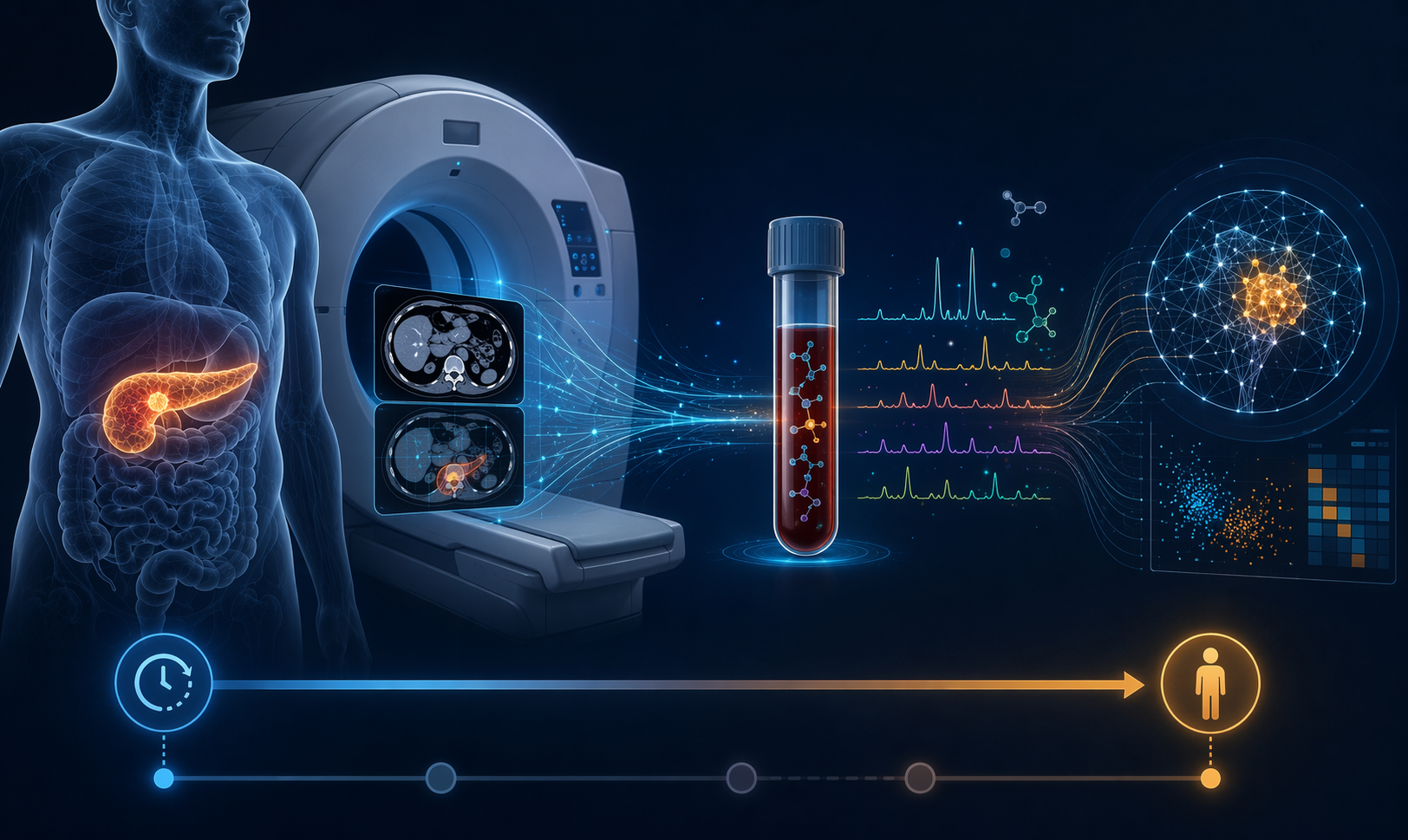
The most consequential change is preclinical detection from ordinary CT
REDMOD, reported by Mayo Clinic investigators in Gut in April 2026, is the imaging study that most directly changes the conversation. The model is fully automated and combines nnU-Net pancreatic segmentation, wavelet-filtered radiomics, and ensemble classification. Its target was not just visible pancreatic ductal adenocarcinoma. It was visually occult disease on routine CT performed before clinical diagnosis, the kind of scan that already exists in health records and is often read for another reason.[1]
The result that deserves attention is not only discrimination. REDMOD detected visually occult pancreatic ductal adenocarcinoma with 73% sensitivity, compared with 38.9% for expert radiologists, with p<0.001. Its AUC was 0.82 versus 0.69 for radiologists, also with p<0.001. The median lead time before clinical diagnosis was 475 days, and sensitivity remained 68% even more than 24 months before diagnosis.[1]
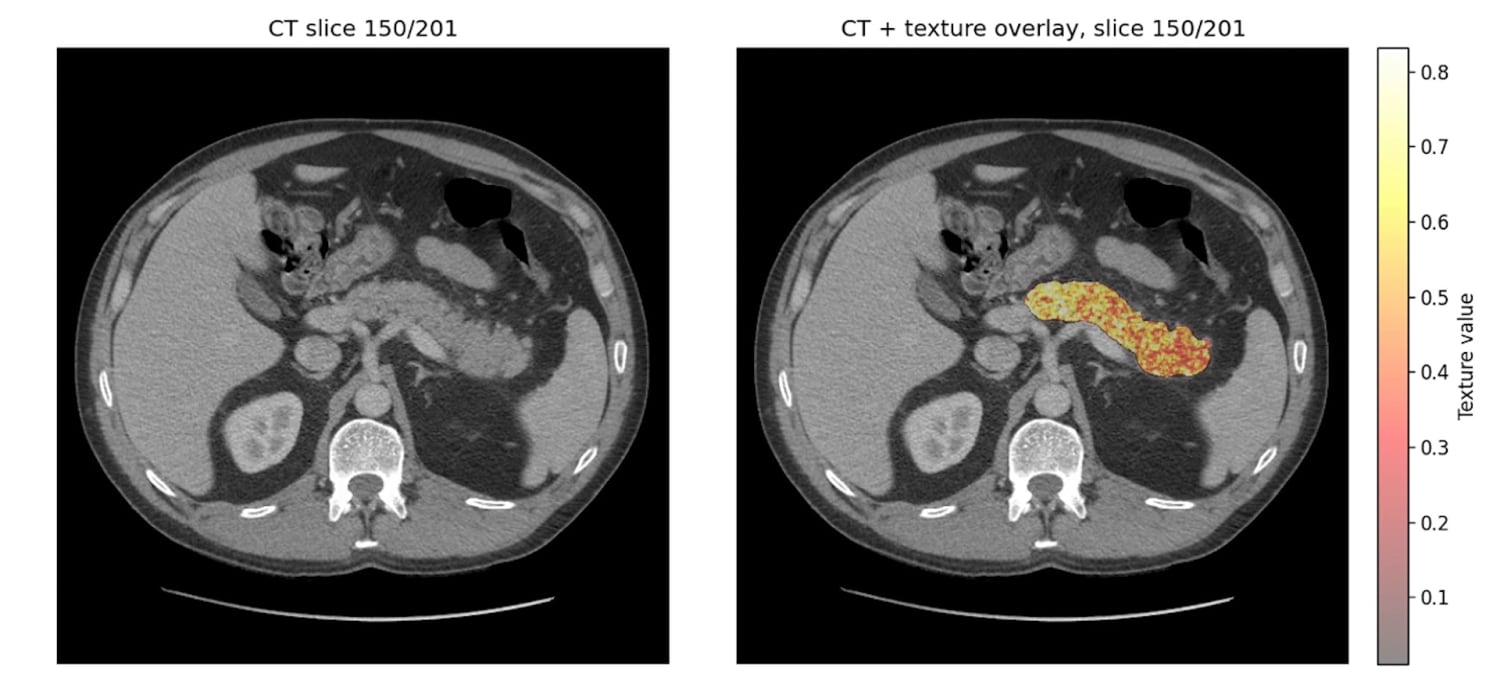
A 475-day median lead time is clinically provocative because it is long enough to imagine a different pathway: not immediate surgery from an AI score, but targeted review, comparison imaging, biomarker testing, pancreas-protocol imaging, or structured surveillance in a patient whose baseline risk is already elevated. The study also reported longitudinal test-retest concordance of 90–92%, which matters because a model that flickers unpredictably across serial scans would be difficult to use in practice.[1]
Specificity is where early-detection enthusiasm often becomes clinically expensive. REDMOD’s external specificity was 81.3% in a multi-institutional setting and 87.5% in the NIH-PCT cohort. Those figures are not sufficient to justify indiscriminate general-population screening, but they are not trivial either. In a high-risk referral context, the reported 36.2% precision exceeds NICE’s 3% precision benchmark at the first step of UK cancer referral, which is a more relevant comparison than pretending the tool is ready for everyone with a pancreas.[1]
The workflow is also unusually important. REDMOD does not require a new scanner, a novel contrast agent, or a patient to enter an experimental imaging suite. It works on routine CT, automatically segments the pancreas, extracts radiomic features, and classifies risk. That does not make implementation easy. It does make implementation imaginable: the scan is already acquired, the radiologist is already reading, and the question becomes how to insert a calibrated alert without overwhelming downstream services.
PANORAMA adds a reader-study signal, not a duplicate claim
The PANORAMA study, reported in The Lancet Oncology in November 2025, strengthens the imaging side from a different angle. It was an international paired non-inferiority study across 12 countries that compared AI with 68 radiologists. The AI achieved an AUROC of 0.92 versus 0.88 for radiologists and produced 38% fewer false positives.[2]
PANORAMA is useful here because it tests performance against human readers in a multinational, multi-site design. It does not replace REDMOD’s lead-time finding, and it should not be made to carry that claim. Its contribution is different: it suggests that AI can improve imaging interpretation under reader-study conditions rather than merely producing attractive retrospective metrics in isolation.[2]
Together, REDMOD and PANORAMA make a limited but meaningful imaging argument. AI can identify pancreatic cancer signals in CT data that are missed or undercalled by expert humans, and it can do so with performance characteristics that now deserve prospective testing in defined clinical pathways.
Blood-based AI is no longer just an adjacent idea
If CT-based detection feels closer to current workflow, PanMETAI is the study that makes the blood-based route harder to dismiss. Published in Nature Communications in February 2026 by investigators from National Taiwan University Hospital and Academia Sinica, PanMETAI uses 110 µL of serum, nuclear magnetic resonance metabolomics, and a TabPFN AI foundation model to analyze approximately 260,000 metabolic signals.[3]
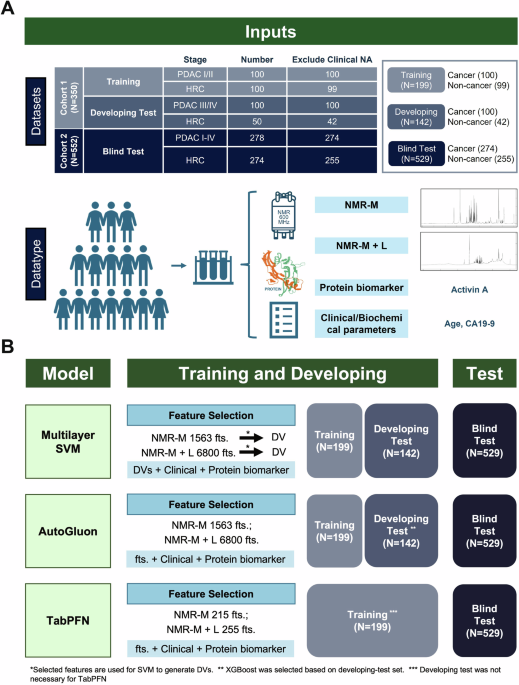
The headline performance is striking: in independent blind testing, PanMETAI achieved an AUC of 0.99, 93% sensitivity, and 94% specificity, with stage I/II cancers included. The model was trained on a Taiwanese cohort of 902 participants and validated in a Lithuanian cohort of 322 participants, giving the study a cross-population element that many early biomarker papers lack.[3]
The caution is equally important. The AUC 0.99 figure refers to the NTUH independent blind test set; it should not be casually transferred to every population, every laboratory, or every screening context. NMR metabolomics is sensitive to pre-analytic handling, cohort composition, and the clinical question being asked. A test that separates cancer cases from selected controls can still behave differently when deployed among patients with pancreatitis, diabetes, weight loss, biliary disease, or vague abdominal symptoms.
Still, PanMETAI changes the field’s shape. It suggests that the metabolic disturbance around pancreatic cancer may be detectable from a small serum sample when interpreted across a high-dimensional signal space. That is not the same clinical pathway as CT triage. It could become complementary: a blood-based classifier might select patients for pancreas-protocol imaging, intensify surveillance in high-risk clinics, or help decide which indeterminate findings deserve escalation.
A four-biomarker panel addresses a more familiar diagnostic problem
The NIH-reported four-biomarker panel from UPenn and Mayo Clinic is less technologically theatrical than PanMETAI, but clinically relevant. The panel combines CA19-9 with THBS2, ANPEP, and PIGR. In the reported results, it detected pancreatic cancer overall at 91.9%, detected stage I/II disease at 87.5%, and operated at a 5% false-positive rate.[4]
Its practical appeal is that it tackles a known weakness of CA19-9: distinguishing cancer from benign pancreatitis. A biomarker advance that reduces confusion between malignancy and inflammatory pancreatic disease may be more useful than a nominally higher AUC in a cleaner case-control setting. The current evidence supports this as an adjacent advance in early detection and differential diagnosis, not as a stand-alone population screen.[4]
What the evidence supports in 2026
| Approach | Most important 2025–2026 signal | What it does not yet prove |
|---|---|---|
| REDMOD routine CT AI | Visually occult pancreatic ductal adenocarcinoma detected before conventional diagnosis, with 73% sensitivity and 475-day median lead time | General-population screening readiness or FDA-cleared clinical use |
| PANORAMA CT reader-study AI | AUROC 0.92 versus 0.88 for radiologists across a 12-country paired study, with fewer false positives | Longitudinal prediagnostic interception by itself |
| PanMETAI serum metabolomics AI | AUC 0.99, 93% sensitivity, and 94% specificity in independent blind testing, with cross-population validation design | Universal portability of the same performance across all clinical settings |
| CA19-9 + THBS2 + ANPEP + PIGR panel | Stage I/II detection at 87.5% and improved distinction from benign pancreatitis | A complete AI screening pathway |
The pattern across these studies is more persuasive than any single metric. Imaging AI is moving toward detection from scans patients already receive. Blood-based AI and biomarker panels are moving toward earlier triage from small samples. Both routes are beginning to report the details that matter clinically: study population, external validation, sensitivity, specificity, stage distribution, and lead time.
The same pattern also explains why broad screening claims remain premature. Pancreatic cancer has an approximately 1% lifetime risk. In an unselected population, false positives can consume clinic time, trigger anxiety, expose patients to additional imaging or procedures, and still leave clinicians uncertain about what threshold should prompt intervention. High specificity is necessary, but prevalence decides how much harm a screening program can create.
Translation is beginning, but the regulatory story is uneven
DAMO PANDA is the most visible regulatory milestone. Alibaba DAMO Academy received FDA Breakthrough Device Designation in April 2025 for a non-contrast CT screening approach. Secondary reports describe a pilot screening effort of approximately 40,000 individuals in China that identified 2 early-stage cases.[5]
That designation should be read accurately. FDA Breakthrough Device Designation is not FDA clearance or approval, and the reported pilot finding is not equivalent to a peer-reviewed screening trial with fully auditable denominators, adjudication, follow-up, and harm accounting. It is important because it shows regulatory motion; it is not strong enough to anchor the evidence base.
AI-PACED, a Mayo Clinic prospective trial, is closer to the kind of study the field needs next. The trial is enrolling individuals aged 50–85 with glycemically defined new-onset diabetes and an ENDPAC score of at least 3 for serial AI-augmented CT imaging. Its design includes attention to automation bias and override criteria, which are not peripheral concerns. They determine whether clinicians treat AI as a second reader, a triage gatekeeper, or a command.[6]
Most of the major tools discussed here remain investigational research systems. With the exception of DAMO PANDA’s Breakthrough Device Designation, they should not be described as FDA-cleared clinical screening tools. The next evidence layer has to be prospective and operational: who receives the test, what output is returned, who reviews it, what follow-up is triggered, how often clinicians override it, and what cancers or harms appear downstream.
The breakthrough is real, but it belongs in defined pathways
By Q3 2026, the responsible conclusion is neither fatalism nor triumphalism. The evidence does not establish population-wide AI screening for pancreatic cancer. It does establish that AI systems can detect preclinical pancreatic cancer signals from routine CT and serum-based molecular data with enough performance, lead-time, and validation detail to justify serious clinical translation work.
The highest-value use cases are likely to be enriched cohorts first: patients with new-onset diabetes and elevated risk scores, people in familial or genetic surveillance programs, individuals with concerning but nonspecific clinical changes, and patients whose routine CT scans already contain subtle pancreatic information no human reader can reliably act on alone. In those settings, the question is no longer whether AI can “see” pancreatic cancer. The question is whether the health system can respond to an early signal with enough precision to help the patient waiting behind it.
References
- Fully automated artificial intelligence for prediagnostic detection of pancreatic ductal adenocarcinoma on routine CT, Gut, April 2026, link
- PANORAMA study, PubMed, November 2025, link
- PanMETAI: metabolomics-based artificial intelligence for pancreatic cancer detection, Nature Communications, February 2026, link
- New blood test detects early-stage pancreatic cancer with high accuracy, ScienceDaily, March 23, 2026, link
- DAMO PANDA FDA Breakthrough Device Designation report, Targeted Oncology, April 2025, link
- AI-PACED prospective trial listing, Mayo Clinic, link
Comments
Join the discussion with an anonymous comment.