
An air quality alert can tell a city that outdoor conditions are unsafe. It cannot tell whether one person’s breathing rate has already begun to drift upward, whether another person’s heart rate is responding more strongly than expected, or whether an asthma patient’s airway inflammation makes a small physiologic change more meaningful. That gap is where the most interesting AI tools for health protection during poor air quality are beginning to work: not by replacing public AQI alerts, but by asking whether the same pollution exposure is producing a measurable response in a specific body.
The evidence is still early, and the clinical endpoint is still missing. But a few recent studies are no longer just classifying pollution levels. They are linking environmental measurements, wearable vital signs, model-predicted deviations, and asthma-related clinical markers. That is a more demanding chain of evidence than a dashboard that says the air is bad.
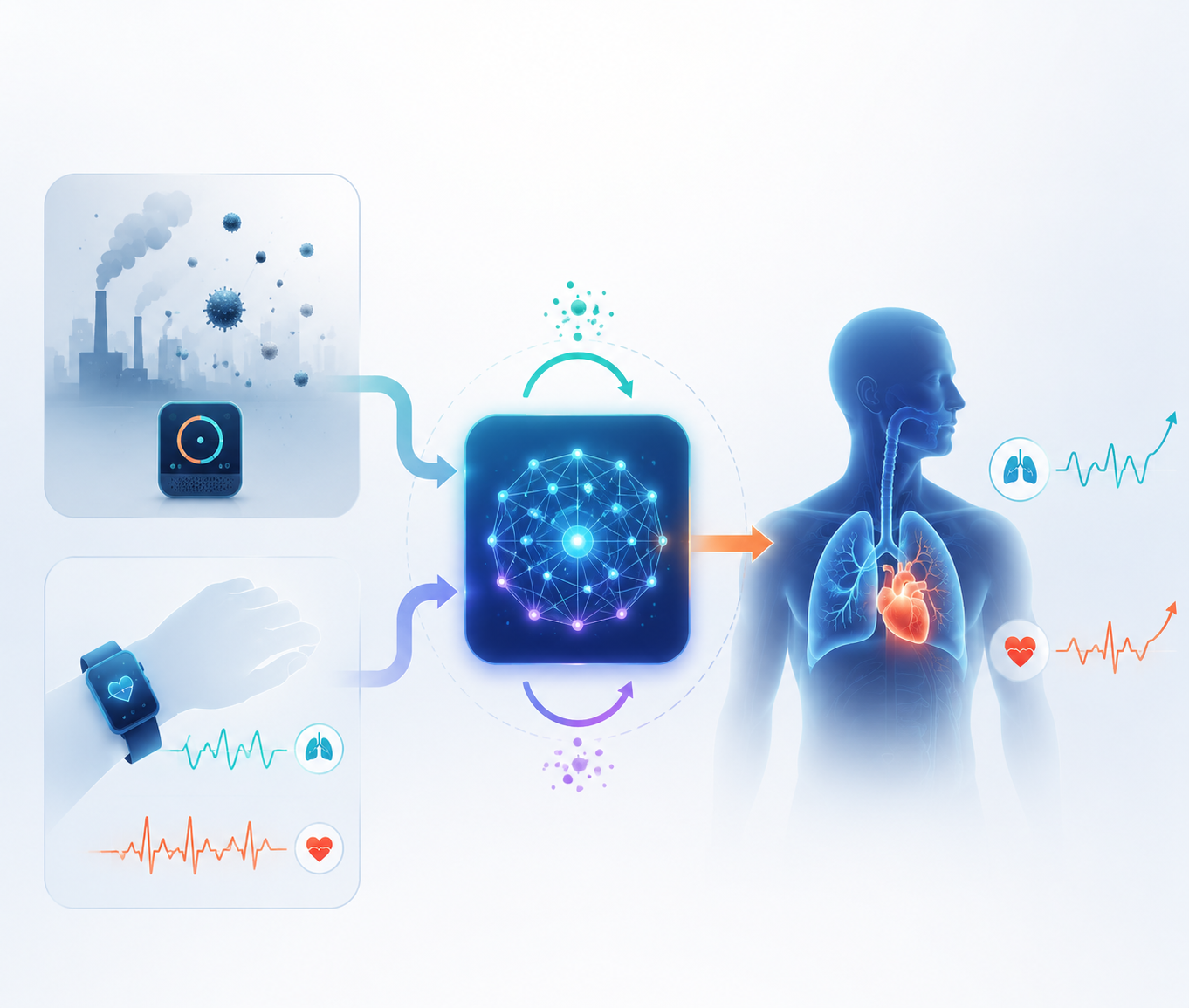
From ambient exposure to individual response
The AI-Respire framework is the strongest example in the current evidence base because it tries to model the sequence that matters clinically: pollution exposure occurs, wearable sensors capture physiology, the model learns what is normal for an individual, and deviations are reconstructed or predicted against that baseline. The framework used an adversarial autoencoder with a long short-term memory component, trained on wearable and environmental data from the INHALE cohort and then fine-tuned with personal smartwatch data over an 8-month period.[1]
In plain terms, the model was not only asking whether particulate matter was high. It was asking what a person’s breathing or heart-rate signal should look like under changing exposure conditions, and whether the observed or simulated response departed from that learned pattern. That distinction matters. Population alerts average risk across many bodies; a personal physiologic model tries to identify the body that is reacting before the reaction is obvious enough to prompt a clinical encounter.
The reported performance is encouraging, though it should be read with the cohort size in view. AI-Respire was trained on 59 INHALE participants’ wearable sensor data, including AIRSpeck measurements for PM2.5 and RESpeck measurements for respiratory rate. In the reported reconstruction task, the model achieved a mean squared error of 0.0029 for normalized breathing rate, and transfer learning on personal smartwatch data reduced the reported MSE to 4.24×10⁻⁵.[1]
Those numbers are useful mainly because they support the next question: when pollution worsens, does the model predict a plausible physiologic change? In simulated 100% pollution spikes, AI-Respire predicted breathing rate increases of about 3.5% and heart rate increases of about 2.5%.[1] These are not dramatic changes, and that is part of why they are interesting. A small elevation may be easy to ignore in routine life, especially when symptoms are absent or nonspecific. It may also be exactly the kind of signal a clinician would hesitate to act on unless it were tied to something more biologically credible.
| What the model used | What it tried to learn | Why it matters clinically |
|---|---|---|
| Environmental exposure and wearable respiratory signals | A reconstructed personal breathing-rate pattern | A person’s response may differ from the citywide AQI category |
| Personal smartwatch data | A fine-tuned individual baseline | Generic alerts become more plausible as personalized risk signals |
| Simulated pollution increases | Predicted breathing-rate and heart-rate elevations | Small physiologic shifts can be tested against asthma burden and inflammation markers |
The signal becomes harder to dismiss when asthma burden and FeNO move with it
A model that reconstructs breathing rate well is not automatically a health-protection tool. The clinically relevant step is whether its predicted response corresponds to recognizable disease burden or airway biology. AI-Respire’s validation against the U-BIOPRED asthma cohort is therefore more important than another decimal place in reconstruction error.
In that validation, individuals whose AI-predicted vital-sign elevations were subtle nevertheless showed statistically higher asthma burden scores and elevated fractional exhaled nitric oxide, a biomarker associated with airway inflammation.[1] This does not prove that the model can prevent an asthma attack. It does make the predicted signal harder to treat as a purely technical artifact. A small predicted increase in breathing rate or heart rate is more meaningful if it appears in people whose clinical profile already suggests greater respiratory burden.
That is the point at which personalized pollution-risk modeling begins to look medically plausible. The model is not just detecting exposure, and it is not merely forecasting a wearable signal in isolation. It is connecting exposure-linked physiologic deviations with asthma-related markers that clinicians already recognize. The link is still cross-sectional, not interventional, but it is a stronger form of evidence than a generic claim that AI can personalize air quality advice.
A 2024 review in the Journal of Allergy and Clinical Immunology places this type of work in a broader allergy and respiratory-health context, emphasizing opportunities for AI to integrate pollution exposure, clinical phenotypes, and health risk estimation.[2] The review helps explain why these tools are attracting attention in asthma research: pollution exposure is uneven, susceptibility is uneven, and the clinical consequences do not map neatly onto a single outdoor measurement.
What AI-Respire still does not show
The current evidence should not be stretched into clinical readiness. AI-Respire used wearable data from the INHALE cohort, but the core model development remained small, including only 10 healthy participants, with U-BIOPRED used for cross-sectional validation rather than a prospective trial.[1] That limits what can be inferred about children, older adults, people with multiple comorbidities, or patients whose medication changes alter physiologic signals.
Transfer learning is a sensible way to move from group data toward personal baselines, but it also raises the ordinary clinical questions that matter before deployment. How much personal data is enough before a warning can be trusted? How stable is the baseline after an infection, an inhaler change, a new exercise routine, or a heat wave? If a model predicts a small heart-rate increase during a pollution spike, who decides whether that should trigger staying indoors, changing medication timing, contacting a clinician, or doing nothing?
Sensor reliability also remains part of the evidence chain. Wearable and portable air monitors do not measure in a vacuum; humidity, temperature, placement, calibration drift, and device-to-device variability can alter PM2.5 readings. The research brief notes that an SCAQMD evaluation of Atmotube PRO reported PM2.5 performance in the R² 0.79–0.94 range under real-world humidity and temperature conditions.[3] That level of performance may be useful, but it is not the same thing as a clinical-grade exposure standard.
These limitations do not make the signal unimportant. They define the distance between a credible physiologic model and a tool that clinicians should use to change patient management. The model can suggest that a body is responding to pollution; the evidence has not yet shown what action should follow.
Exposure-awareness AI is useful, but it is a different kind of evidence
A separate line of work uses AI not to predict physiologic response, but to identify modifiable exposure sources. The NIT Durgapur explainable-AI study focused on indoor activities and pollutant profiles. Using a Decision Tree model, the study reported 99.8% accuracy in identifying which indoor activities produced the most harmful pollutant patterns under controlled conditions.[4]
The study’s interpretability layer is the part most relevant to behavior. LIME and SHAP ranked volatile organic compounds as the dominant risk factor, with a SHAP value greater than 0.025, followed by nitrogen dioxide at about 0.016 and PM10 in the 0.010–0.015 range.[4] That kind of output can turn a vague indoor-air warning into a more specific signal: the problem may not simply be “bad air,” but a particular activity or pollutant mixture inside the home.
The awareness gap is large enough to make that feedback potentially useful. In a supporting survey of 143 participants, only 3% were aware that indoor activities affect air quality.[4] For health protection, that matters because many people respond to poor outdoor air by going indoors, while indoor sources may continue to drive exposure. An AI system that identifies the activity contributing most to indoor pollutant load could support practical decisions such as ventilation timing, avoiding certain products, or changing cooking and cleaning routines.
But this evidence should remain in its lane. The study used a single Plume Labs Flow device in controlled conditions, and it did not show that activity classification predicts asthma burden, FeNO, symptoms, medication use, or exacerbations.[4] It is an exposure-awareness tool, not yet a clinical physiologic risk model. That distinction is not pedantic; it determines whether the output is best treated as environmental feedback or as a possible health-risk warning.
What would make these tools clinically useful?
For clinicians, the next evidence step is not another demonstration that AI can combine more inputs. It is a prospective test of whether acting on the prediction changes a patient-relevant outcome. A useful trial would need to specify what the model alert recommends, who receives it, how quickly the recommendation is acted on, and which outcome is expected to improve. Without that, prediction remains suspended between measurement and care.
The endpoint should also match the claim. If the claim is health protection during poor air quality, then the outcome cannot be only reconstruction error or activity-classification accuracy. It needs to include events or decisions that patients and clinicians recognize: fewer exacerbations, fewer symptoms, changed rescue medication use, avoided high-risk exposure, improved asthma control, or a clearer threshold for contacting care.
There is also a trust problem that technical performance alone cannot solve. A clinician asked to trust a model-generated warning will need to know whether the warning reflects pollution exposure, baseline physiology, device noise, acute illness, medication effects, anxiety, exertion, or some mixture of all of them. Explainability methods can help with exposure sources, as in the indoor activity study, but physiologic prediction in asthma will require validation that is closer to clinical workflow.
The most defensible position is therefore narrow but meaningful. AI frameworks can detect personalized physiologic responses to pollution exposure with encouraging accuracy, and AI-Respire’s association with asthma burden and FeNO gives the signal biologic plausibility. Separate explainable-AI work suggests that indoor exposure feedback may help people identify modifiable sources. No cited study has yet shown that acting on these predictions reduces asthma exacerbations, prevents symptoms, changes medication use, or improves health outcomes.
References
- AI-Respire framework, Imperial College London / UKRI, arXiv 2505.10556v2.
- Artificial intelligence opportunities in air pollution and health, Journal of Allergy and Clinical Immunology, 2024.
- Atmotube PRO evaluation, South Coast AQMD.
- NIT Durgapur explainable AI indoor activity study, arXiv 2501.06222v1.
Comments
Join the discussion with an anonymous comment.