
The practical question behind AI predictions for smoke clearing and health safety is usually asked in the morning, not in a modeling lab. A clinic has intake staff at the front entrance. A school nurse is deciding whether recess should move indoors. An older adult with heart disease sees a forecast that smoke may clear by afternoon and wants to know whether opening windows later is reasonable. The forecast may be fast, visually convincing, and built with sophisticated AI. The health question is narrower: can it safely change what someone does today?
That distinction matters because smoke is not a minor nuisance sitting at the edge of weather forecasting. One 2024 PNAS analysis estimated that wildland-fire-smoke PM2.5 contributes to about 11,415 nonaccidental deaths per year in the contiguous United States, with a 95% confidence interval of 6,754 to 16,075, and about 16.8% of all PM2.5-related deaths; the same analysis reported the highest risk among adults 65 and older and found positive interaction with extreme heat days.[1] A separate MIT Climate Portal summary, citing Nature-linked work, described more than 40,000 annual excess deaths averaged over 2011–2020 from short-term wildfire-smoke exposure.[2] Those two figures should not be blended into one larger burden estimate: they use different exposure windows and methods.
The exposure side has also changed. Stanford researchers reported that the number of Americans experiencing at least one day with smoke PM2.5 at or above 100 µg/m³ grew 27-fold, from fewer than 0.5 million to more than 8 million annually, in their 2006–2020 analysis.[3] More people are now being asked to make short-notice decisions under smoke conditions that used to be rare for them.
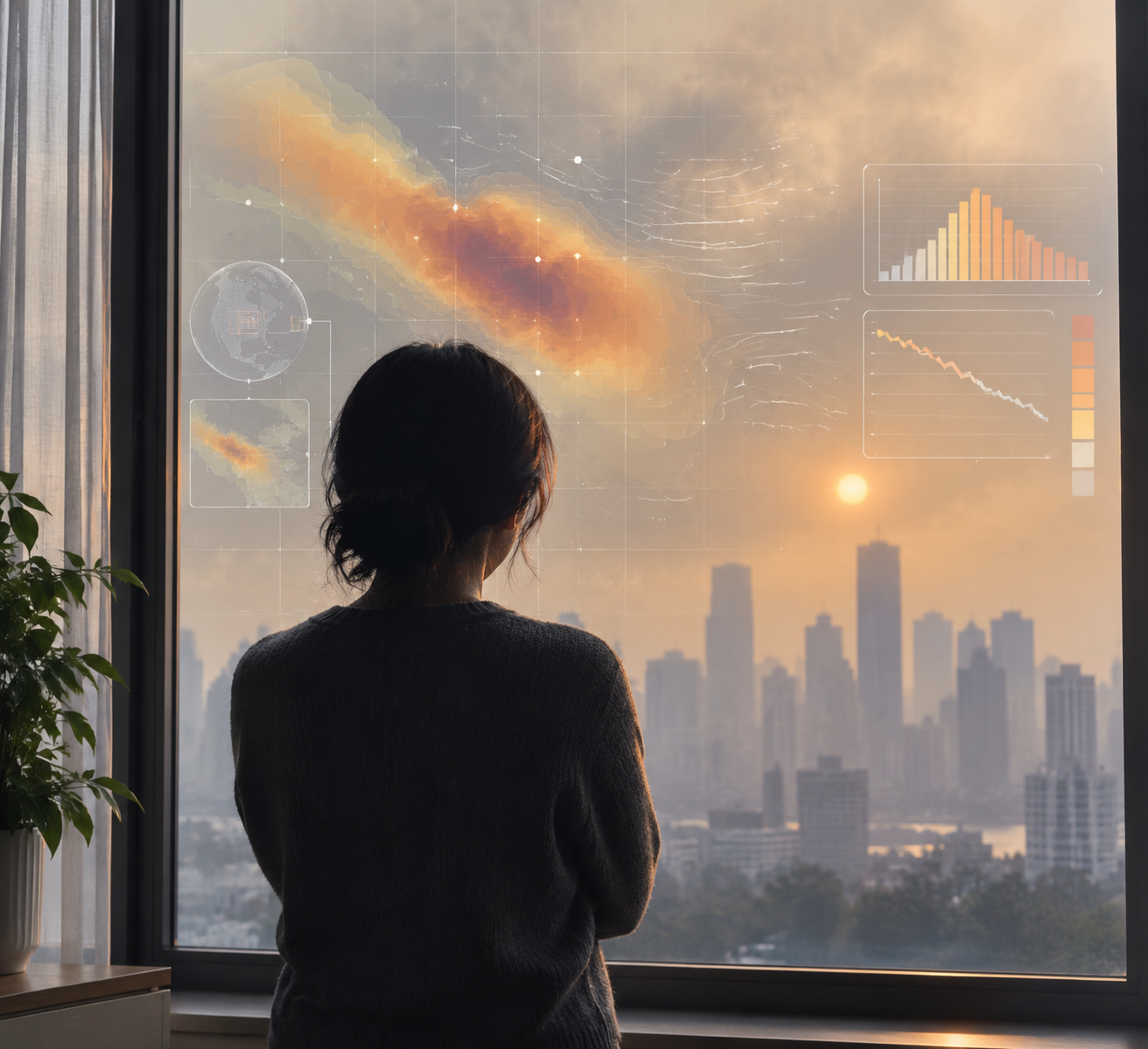
The Morning Persistence Problem
The most important 2026 evidence for individual decision-making is not the fastest detector or the most elegant AI architecture. It is a forecast evaluation from MIT, published in BAMS/preprint form, that tested six air-quality forecast products, including an AI foundation model, against the kind of decision a person actually faces: should I take precautions today?[4]
The uncomfortable result was that none of the six products meaningfully beat a simple “morning persistence” baseline for that binary same-day precaution question.[4] Morning persistence means assuming that the air quality observed in the morning will continue through the day. It is not a clever model. It is the rule a cautious facilities manager, clinician, or patient might use when the cost of being wrong is borne by someone’s lungs rather than by a forecast score.

That baseline is meaningful because it matches the decision window. A same-day health precaution is not the same as a 10-day atmospheric forecast, a fire-detection alert, or a map that looks better in aggregate. The user is deciding whether to keep filtration running, cancel outdoor activity, advise a vulnerable patient to avoid exposure, or delay reopening a smoky entrance. For that decision, a model must do more than describe smoke movement plausibly. It must outperform the conservative assumption that current bad conditions may persist.
The MIT evaluation did not say forecast models are useless. It found that some products did better than the baseline for timing decisions, where the question is closer to “when is the better or worse part of the day?” rather than “should I take precautions at all?”[4] That distinction is where many smoke tools may have their practical value. A hospital operations team may still use forecasts to stage staffing, sequence HVAC adjustments, or plan which entrances to monitor more closely. But that is different from telling an individual that precautions are no longer needed because a model expects clearing later.
What Current AI Smoke Systems Are Actually Improving
AI is making smoke forecasting better in several real ways. The problem is that “better” often refers to a different layer of the chain than the health decision at hand. Detecting a fire quickly, estimating emissions, forecasting transport, predicting local PM2.5, and deciding whether a susceptible person should change behavior are connected tasks, but they are not interchangeable.
| Decision Layer | What AI Can Improve | What It Does Not Automatically Solve |
|---|---|---|
| Fire detection | Find new fires faster from satellite data | Whether smoke at a clinic, school, or home will clear safely today |
| Emission estimation | Estimate how much smoke a fire may produce | How much PM2.5 a specific person will inhale |
| Transport and chemistry forecasting | Model where smoke and pollutants may move | Whether the forecast beats a conservative same-day precaution baseline |
| Operational timing | Help plan when conditions may improve or worsen | A reliable all-clear for individual health protection |
NOAA’s Next Generation Fire System is a good example of a genuine advance at the detection layer. It uses GOES geostationary satellite data to detect fires as small as a quarter acre and can issue alerts in about one minute; since February 2025, 90% of National Weather Service weather forecast offices have subscribed.[5] That speed can matter for incident awareness and early coordination. It does not, by itself, answer whether outdoor work can restart after lunch.
The Johns Hopkins Applied Physics Laboratory deep-learning emulator addresses a different bottleneck: computational time. Using NASA’s GEOS-CF system, the emulator produced accurate 10-day air-quality forecasts while needing only seven timesteps, or 21 hours, of input data, compared with the months required for traditional ensemble runs.[6] That kind of compression can make more frequent scenario testing practical. It is an operationally important improvement even if it still needs decision-specific validation before being treated as a same-day health safety tool.

Why Hybrid Physics-ML Models Deserve Attention
Among the AI approaches in the evidence base, hybrid systems are the most persuasive technically because they do not ask machine learning to replace atmospheric science. They use physics-based chemical transport modeling to represent emissions, transport, chemistry, and deposition, then use machine learning to improve the fusion of model output with measurements.
A 2023 University of Tennessee-linked measurement-model fusion approach, reported as ML-MMF, achieved more than 90% accuracy, described as 66% more accurate than chemical transport models alone and 12% more accurate than machine learning alone.[7] That result is exactly the kind of technical gain worth taking seriously. It suggests that the strongest path is not pure AI novelty but disciplined combination: let physical models carry the structure of the atmosphere, and let machine learning correct, fuse, and update where observations reveal gaps.
Still, an accuracy figure is only as useful as the outcome it measures. A model can improve point predictions or spatial estimates and still fail to improve a specific health-protective decision over a plausible baseline. The MIT result is therefore not a contradiction of the hybrid-model result. It is a reminder that technical validation and clinical-style decision validation are different tests.[4][7]
Forecasting Clearing Is Harder Than Showing Smoke
For health safety, the hard part is often not seeing that smoke exists. It is knowing when enough of the exposure has passed, at the relevant location, for the relevant person, with enough confidence to relax controls. Clearing is a threshold decision. It depends on pollutant concentration, time of day, local meteorology, indoor infiltration, individual susceptibility, and the cost of a false reassurance.
Trace AQ, a University of Utah spinout, illustrates the move toward more directly usable smoke forecasts. Its commercial tool forecasts smoke from one day, available free, to four days, available by subscription, using EPA’s CMAQ modeling augmented with machine learning and predictive analytics; the company has reported $1.25 million in seed funding.[8] That is a plausible operational niche: short-range smoke intelligence for planners who need more than a static map.
The same boundary applies. A one- to four-day smoke forecast can help a public health department plan messaging, a hospital anticipate filtration demand, or an event organizer prepare contingencies. It does not become a reliable personal all-clear unless it has been tested against the actual choice to stop precautions, and against a conservative baseline that a cautious user would otherwise apply.
Longer-Range Systems Are Planning Tools, Not Same-Day Safety Signals
Some of the most interesting AI work sits even farther upstream. CIRES/NOAA described an AI system aimed at predicting wildfire emissions 35 to 45 days in advance, trained on seven global fire-emission inventories, but the system remains in research and development rather than operational use.[9] The planning value is obvious: health systems and agencies could prepare for smoke seasons earlier if sub-seasonal emissions forecasts mature. The health-safety value for an individual deciding what to do this afternoon is minimal.
A 2026 Australian and New Zealand machine-learning wildfire risk model updates risk every 30 minutes rather than once daily and was reported as 10% to 30% more accurate across three fire-climate regimes.[10] That is relevant to fire-risk situational awareness, especially where once-daily systems lag rapidly changing conditions. It should not be mistaken for validation of smoke-clearing predictions at the level of a patient, school, or clinic.
The Evaluation Standard Should Follow the Consequence
For public health use, the right question is not whether an AI smoke model is impressive. It is whether the model improves the decision someone must make, at the time they must make it, compared with what they would reasonably do without it. Morning persistence is not an elegant comparator, but it is clinically recognizable: if the air is bad now and the person is vulnerable, keep precautions in place unless there is strong evidence to do otherwise.
This is why aggregate model performance can feel disconnected from health operations. A forecast may reduce average error across many hours or locations while still missing the few hours that matter for a school dismissal, an outdoor shift, or a clinic entrance reopening. A model may predict the broad plume correctly while underestimating a local pocket of PM2.5. A dashboard may show improving conditions while indoor exposures remain elevated because a building pulled in smoke earlier in the day.
The consequence of a false positive and a false negative is also asymmetric. If a forecast says smoke will persist and it clears sooner, an institution may keep precautions longer than necessary. That has costs. If a forecast says smoke will clear and it does not, a vulnerable person may receive avoidable exposure. Health-protective forecasting should be judged with that asymmetry in mind, not only by whether the map looks closer to observations after the fact.
Where AI Smoke Forecasts Are Useful Now
The evidence supports using AI smoke prediction as part of monitoring and planning. Fast satellite detection can shorten awareness time for new fires. Emulators can make previously expensive forecast workflows more practical. Hybrid physics-ML systems can improve measurement-model fusion. Short-range commercial tools can help operations teams prepare for likely smoke windows. Sub-seasonal research may eventually help agencies prepare staffing, supplies, communications, and filtration needs before the worst periods arrive.
The evidence is weaker for replacing conservative same-day precaution logic at the individual level. As of Q3 2026, the strongest decision-level evaluation available found that six forecast products, including an AI foundation model, did not meaningfully outperform assuming morning conditions would persist when the question was whether to take precautions that day.[4] That should set the current boundary: AI smoke forecasts are increasingly useful for monitoring, planning, and some operational timing decisions, but they are not accurate enough to serve as a stand-alone all-clear for individual health-safety choices.
References
- Wildland fire smoke PM2.5 and mortality in the contiguous United States, PNAS, 2024
- Wildfire smoke is causing more than 40,000 deaths a year in the U.S., MIT Climate Portal
- Daily local-level estimates of ambient wildfire smoke PM2.5 for the contiguous US, Stanford / Childs et al., 2022
- Evaluation of air quality forecast products for individual precaution decisions, BAMS / MIT, 2026
- Next Generation Fire System, NOAA
- Deep-learning emulator for GEOS-CF air quality forecasts, Johns Hopkins Applied Physics Laboratory
- Machine-learning measurement-model fusion improves wildfire smoke prediction, University of Tennessee / Popular Science, 2023
- Trace AQ smoke forecasting tool, University of Utah / Trace AQ
- AI system to predict wildfire emissions 35–45 days in advance, CIRES / NOAA AMS, 2026
- Machine learning model for wildfire risk in Australia and New Zealand, International Journal of Wildland Fire, 2026
Comments
Join the discussion with an anonymous comment.