
When a celebrity speaks publicly about addiction or mental health, awareness becomes measurable at public scale. The first visible artifact is usually volume: search volume, tweet volume, news volume, the sudden bright flare of attention around one person’s pain. The harder question comes immediately after. Where did that attention go next?
The best evidence we have does not support a simple dismissal of celebrity disclosure. Public disclosure can give people vocabulary, reduce shame, and open conversations that would otherwise stay private. But the strongest computational public health study in this area shows a much colder transition from attention to action. After Demi Lovato’s 2018 overdose, researchers analyzed 42,500 news stories, 972,500 tweets, and Google search behavior. The public response was enormous. Yet only 0.5% of news articles and 0.03% of tweets mentioned the SAMHSA addiction helpline, and among roughly 14.7 million Google searches referencing Lovato, only about 8,000 referenced the helpline, a conversion rate of 0.05%.[1]

That 0.05% is not a moral verdict on Lovato, her audience, or the people who wrote about the overdose. It is a measurement of an infrastructure gap. The public knew how to look. The media knew how to cover. Social platforms knew how to amplify. But the addiction care pathway barely appeared in the stream.
The Measurable Gap Between Attention and Care
The Lovato study matters because it does not stop at counting publicity. It follows several public signals in parallel: news coverage, Twitter conversation, Google searches, and references to treatment resources. That design lets researchers separate awareness from a more clinically relevant behavior: looking for help.
For public health teams, this distinction is not academic. A search for a celebrity’s name after an overdose may reflect concern, curiosity, identification, gossip, fear, or a private recognition of one’s own substance use. A search for an addiction helpline is a narrower signal. It does not prove treatment entry, but it is closer to an actionable pathway than a general celebrity query.
| Measured Signal | What It Can Show | What It Cannot Prove |
|---|---|---|
| News story volume | How strongly media outlets amplified the event | Whether readers sought care |
| Tweets and social posts | Conversation scale, sentiment, stigma, and resource mentions | Whether posters changed behavior offline |
| Google search patterns | Population-level interest in names, conditions, and resources | Who searched or whether they received treatment |
| Helpline-related searches or mentions | Movement toward a public care resource | Completed contact, appointment attendance, or recovery outcome |
This is where AI and NLP become useful, if they are kept in their proper place. They do not reveal interior motivation. They do not diagnose the audience. They do, however, make it possible to inspect the path from public disclosure to public reaction at a scale that manual review cannot handle.
Why Suicide Response Looked Different
The most useful comparison in the Lovato analysis is not another addiction story. It is the public response after Anthony Bourdain’s suicide. In the same study, searches for the National Suicide Prevention Lifeline reached 29,000 after Bourdain’s death, 3.6 times higher than addiction helpline searches after Lovato’s overdose. News coverage of suicide crisis resources was 22.9 times greater, and tweets mentioning suicide crisis resources were 81 times greater than addiction treatment resource mentions after Lovato.[1]
The comparison exposes an asymmetry in response protocols. Suicide prevention has had more standardized media guidance, more familiar crisis-language patterns, and more visible platform-level resource routing. Addiction coverage has not benefited from the same level of automatic public health choreography. In practical terms, a person distressed by suicide-related news is more likely to encounter a crisis resource in the surrounding information environment than a person distressed by addiction-related news.
That does not mean suicide prevention systems are complete or uniformly effective. It means the public communication layer is more developed. The person searching after a celebrity overdose may be standing at a similar moment of vulnerability, but the resource architecture around them is thinner.

What NLP Actually Measures in a Celebrity Disclosure
A credible NLP pipeline for this problem usually begins with a corpus: posts, comments, headlines, search phrases, or article text collected within a defined time window. Researchers then label a subset of that material or use existing annotation schemes to train models that classify sentiment, topics, stigma, disclosure, resource sharing, or other categories of interest. The output is not “public opinion” in some total sense. It is a structured reading of observed digital traces.
For example, an Instagram corpus built from responses to influencer or celebrity mental health posts can be used to train models that identify supportive comments, negative reactions, personal identification, or calls for help. Search surveillance works differently: it tracks query patterns over time and can compare condition-related searches with resource-related searches. Topic modeling and sentiment classification can then show whether public language became more accepting, more clinical, more stigmatizing, or more action-oriented.
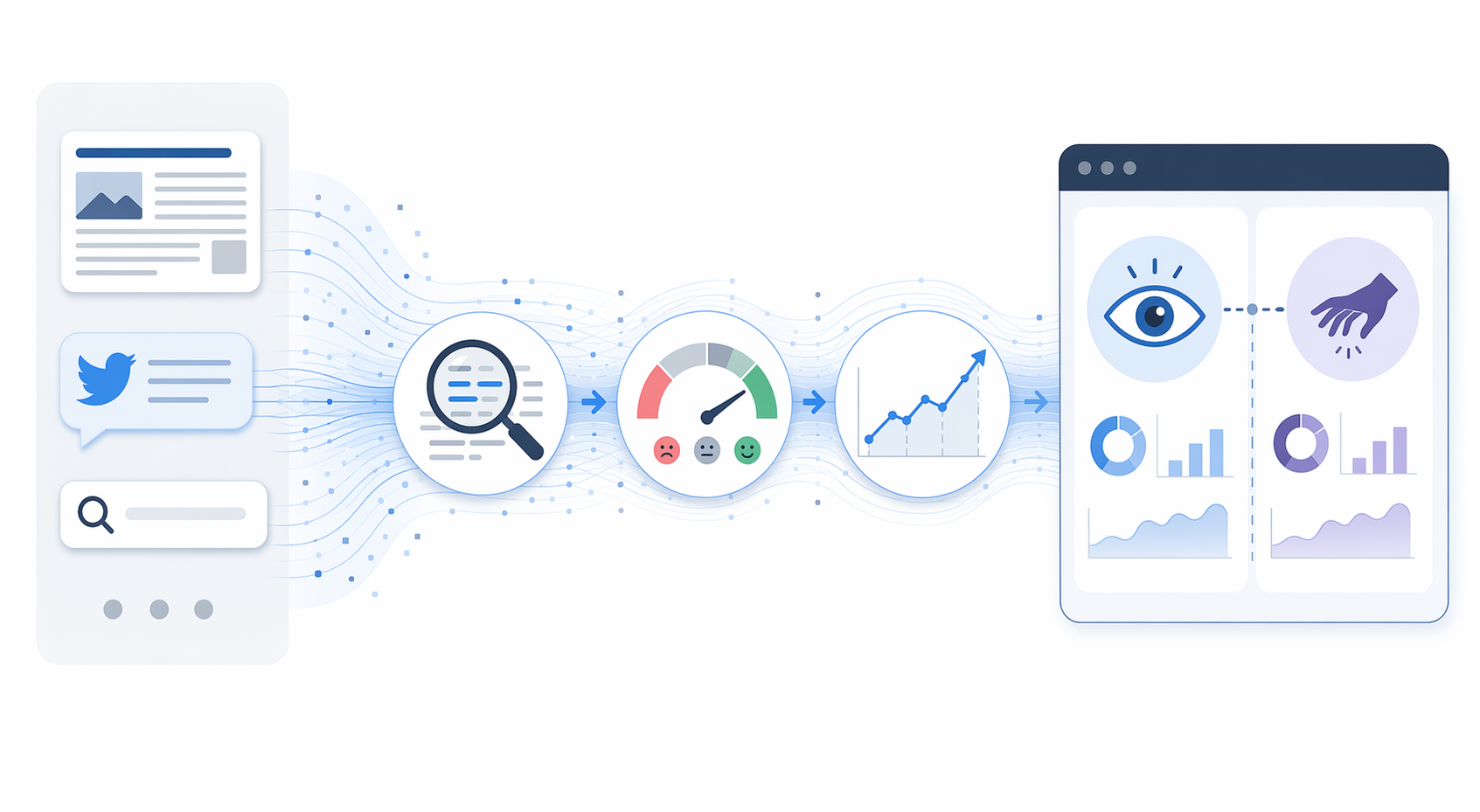
The useful separation is between attitude signals and behavior signals. A positive shift in sentiment may show that a disclosure made people more willing to speak kindly about depression, addiction, or recovery. A rise in personal storytelling may suggest that people felt permitted to name their own experience. Those are real public health gains. But they are not the same as helpline contact, treatment initiation, medication access, or a visit with a clinician.
This is why the Lovato data are so uncomfortable. The study found attention, but not much visible routing toward addiction support. It measured a crowd gathering around a health crisis and then found very few signs pointing out of the crowd toward care.[1]
Stigma Can Move Even When Treatment Entry Does Not
The low conversion data should not flatten the rest of the evidence. Celebrity mental health disclosure can matter culturally before it matters clinically. Work on Twitter conversations after Kid Cudi’s depression disclosure, for instance, has been used to show how celebrity talk can normalize open discussion, especially among groups that have often had fewer safe public scripts for mental distress. That kind of normalization is not a treatment endpoint, but it can change what people feel allowed to say.
Controlled research also complicates the assumption that fame is always the most powerful stigma-reduction vehicle. Corrigan and colleagues found that non-celebrity disclosure stories produced greater stigma reduction than celebrity stories in experimental conditions.[2] That finding fits an old problem in public communication: a famous person can be admired as an exception without changing what people believe about ordinary patients, neighbors, co-workers, or relatives.
Other findings point in a different direction. Research on opioid narratives has suggested that celebrity stories may be more persuasive for people with low personal relevance to the issue. That makes intuitive sense. A person who has never had to think seriously about opioid addiction may need a familiar public figure to hold their attention long enough for the topic to become legible. A person already living close to addiction may need something else: a believable pathway, a nonjudgmental service, a clinician, a navigator, or a peer whose life feels closer to their own.
The Audience Is Not One Audience
Parasocial attachment helps explain why the same disclosure can land differently across groups. Research on public response after Robin Williams’s death found that stronger parasocial bonds were associated with less stigma and greater willingness to seek help. The mechanism is plausible: people listen differently when the person disclosing distress already feels familiar, trusted, or emotionally close.
But parasocial influence has limits. If a celebrity is treated as unusually gifted, unusually tragic, or unlike ordinary people with the same condition, the disclosure may not generalize. The audience can mourn the exception and leave the stereotype intact. NLP systems that only measure sympathy toward the celebrity may miss that distinction unless the coding scheme separates compassion for one person from changed beliefs about people with addiction or mental illness more broadly.
The historical case most often used to show a stronger treatment-seeking effect is Princess Diana’s 1993 disclosure of bulimia, which was followed by a reported doubling of treatment-seeking among women. It is an important reminder that public disclosure can sometimes move behavior. It is also a poor benchmark for the current platform environment: a uniquely trusted figure, a different media system, and a condition whose public recognition was shaped by that moment in ways that are hard to reproduce.
The Map Has Blind Spots
AI-based public health surveillance is often described as if it simply makes hidden patterns visible. It does, but only for the populations and language patterns it can read well. Social platforms overrepresent people who are digitally connected, publicly expressive, and comfortable leaving searchable traces. Search data are broader in some ways, but still do not explain who searched, what they understood, or whether they found usable help.
The bias problem is not theoretical. An NIH-described study found that AI models analyzing social media language could predict depression severity more accurately for white Americans than for Black Americans. That kind of performance gap matters directly here. If the model reads one group’s distress more reliably than another’s, the resulting dashboard can make inequity look like lower need, lower response, or weaker public impact.
This limitation should change how results are interpreted. A model that detects increased supportive sentiment after a celebrity disclosure is not necessarily measuring the full public. It is measuring the accessible, classifiable public. A helpline search rate may undercount people who seek help through family, clergy, mutual aid, primary care, local clinics, or no formal channel at all. The absence of a digital trace is not the absence of distress.
What the Evidence Now Makes Hard to Ignore
The useful conclusion is narrower than the usual argument about whether celebrity disclosure “works.” It can work for attention. It can work for language. It can work for some forms of stigma reduction, for some audiences, under some conditions. It does not reliably create treatment entry on its own, and the best large-scale measurement we have shows that addiction-related resource routing can be almost absent during the exact moments when the public is most attentive.
For health IT researchers and digital epidemiologists, the next measurement problem is not simply larger scraping or better sentiment classification. It is linkage across the pathway: media event, public reaction, resource exposure, help-seeking intent, service contact, and care access. Some of those steps can be observed through public data. Others require partnerships with helplines, treatment navigators, health systems, and community organizations. The people operating those systems are the ones who meet the audience after the celebrity moment has already passed.
AI has made the awareness-action gap visible. It has not closed it. Celebrity disclosure can open attention; public health systems still have to decide whether that attention has somewhere clinically useful to go.
Comments
Join the discussion with an anonymous comment.