
The surgery at Carleton Place and District Memorial Hospital had already reached the point where cancellation feels less like scheduling and more like reversal. The patient was prepped. The operating room was ready in the ordinary sense. Then the June 2023 wildfire smoke made the hospital’s ventilation problem unavoidable: the OR system required 100% fresh outdoor air, and the air outside was no longer suitable to bring directly into that clinical environment. The case was cancelled, and the hospital said it would assess surgeries day by day based on external air quality.[1]

That sequence is the practical center of smoke-related health event cancellation decisions. The issue is not whether a hospital can recognize bad air once it arrives. It usually can. The harder question is whether the warning arrives early enough to change who is called in, which rooms are protected, which patients are told not to fast, and which anesthesiologist is asked to make a risk decision with only hours of runway.
A same-day cancellation is not operationally neutral. A patient may have stopped medications, arranged transportation, lost wages, or fasted for a case that will not happen. A perioperative team loses a room it cannot easily refill. The scheduler must decide whether postponement means tomorrow, next week, or after the smoke moves. Facilities staff are left trying to make a building behave like a sealed clinical instrument when its air-handling assumptions were built around ordinary outdoor air.
The Cancellation Problem Is Really a Lead-Time Problem
Carleton Place is not useful because it proves that every hospital must cancel surgery at a particular air-quality threshold. It does not. It is useful because it shows how wildfire smoke turns a building-design detail into a perioperative decision. A hospital that depends on outdoor air for an OR ventilation pathway cannot treat smoke as only an outdoor public-health advisory. The air outside becomes part of the surgical environment.
Other hospital cases show the same vulnerability at different scales. During the 2008 Sesnon and Sayre fires in California, Providence Holy Cross Medical Center cancelled all elective surgeries, received more than 200 transferred patients, and deployed HEPA filters that had originally been purchased for pandemic preparedness.[2] That is a different operating picture from Carleton Place: not one prepped case and one ventilation constraint, but a facility absorbing regional surge while trying to preserve indoor air quality.
In Alaska in 2014, Central Peninsula Hospital announced that smoke had forced it to shut down air handlers entirely and cancel all scheduled surgeries for the day.[3] That is a blunt but sometimes necessary facilities move. Once air handlers are off, the scheduling question has already lost much of its flexibility. The day’s OR plan has to be unwound instead of modified.
The January 2025 Los Angeles County wildfire experience widened the problem again. A Chartis analysis reported that Kaiser, Providence, Cedars-Sinai, and UCLA Health shut facilities and postponed non-urgent procedures as wildfires disrupted healthcare operations.[4] At that scale, cancellation is no longer only an OR-board issue. It touches ambulatory sites, patient communications, staff availability, transfer pathways, and the question of which services can safely remain open.
These examples do not prove that AI forecasting would have prevented the cancellations. Several predate today’s commercial AI smoke tools, and the available reports do not compare forecast-informed decisions with usual operations. They do show where earlier information could plausibly matter: before a patient is prepped, before staff are assigned to a room that will go dark, before HEPA units are hunted down, before the facility team has to choose between outdoor smoke intake and shutting down ventilation.
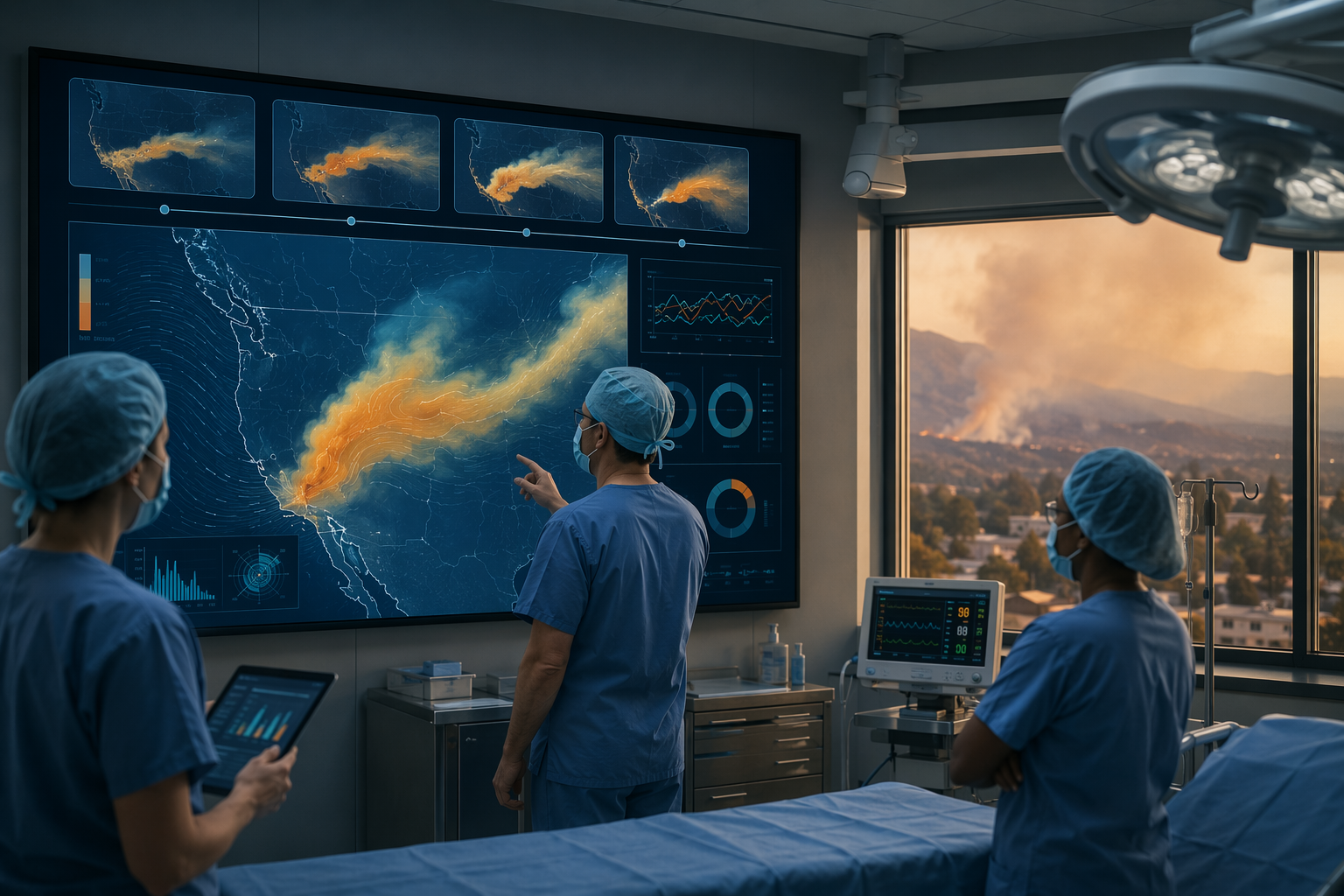
What AI Smoke Forecasting Adds to the OR Calendar
The useful unit for hospital operations is not “AI.” It is the forecast horizon. A 24-hour warning can support day-ahead cancellation calls. A 48-to-96-hour signal can support block-time adjustments, staffing expectations, filtration staging, and patient communication. A 35-to-45-day seasonal signal belongs in a different conversation: contingency planning, supply readiness, staffing assumptions, and regional coordination.
Trace AQ is the closest example in the current evidence to a tactical perioperative tool. The University of Utah described it as an AI-powered wildfire smoke forecasting tool from a university spinout with $1.25 million in seed funding, designed to provide 4-day hyper-local forecasts across the continental United States.[5] The company’s Aero product page describes an enterprise API, which is the kind of interface a health system would need if forecast data were to flow into dashboards, command centers, scheduling systems, or facilities operations rather than sit in a separate browser tab.[6]
The attraction is straightforward. A perioperative director does not need a model to be metaphysically certain. She needs it to be early enough and specific enough to trigger a governed decision. If tomorrow morning’s smoke risk is high for a campus whose OR ventilation depends heavily on outdoor intake, the decision is not simply “cancel” or “do not cancel.” It may be: move higher-risk elective cases, protect urgent cases, call anesthesia leadership earlier, stage portable filtration where appropriate, and tell patients before they begin fasting.
| Forecast window | Operational use | What it should not be mistaken for |
|---|---|---|
| Same day | Confirm current conditions, protect active rooms, make final go/no-go decisions | A proactive scheduling strategy |
| 24 hours | Make day-ahead patient calls, anesthesia reviews, staffing changes, and room adjustments | Proof that cancellation will improve outcomes |
| 1 to 4 days | Adjust block plans, prepare filtration and facilities responses, coordinate communications | A validated perioperative cancellation guideline |
| 35 to 45 days | Seasonal readiness, staffing assumptions, supply planning, regional contingency discussions | A trigger for tomorrow’s surgical schedule |
The accuracy claims need careful handling. Trace AQ’s reported mean absolute error figures of ±12 AQI points at 24 hours and ±18 AQI points at 4 days come from product-adjacent or market-facing materials, not from a peer-reviewed evaluation of hospital use.[5][6] Those numbers may still be operationally interesting, but they should not be promoted as evidence that the tool prevents harm, preserves OR capacity, or reduces unnecessary cancellations.
The stronger peer-reviewed performance evidence comes from Fu et al., whose 2023 Environment International paper evaluated a combined machine-learning and model-output framework. The study reported more than 90% forecast accuracy, with the combined approach 66% more accurate than chemical transport models alone and 12% more accurate than machine learning alone.[7] That is model-performance evidence. It is not clinical-outcomes evidence.
This distinction matters. A model can forecast smoke well and still fail to improve hospital operations if the alert arrives in the wrong channel, lacks campus-level relevance, conflicts with local engineering constraints, or is not tied to an authority structure. Conversely, a forecast with known uncertainty may still be useful if it arrives early enough for a hospital to run a structured review rather than improvise in the morning huddle.
Different Forecasts Belong to Different Decisions
CIRES and NOAA are working at a different time scale. Their AI-driven system predicts wildfire emissions 35 to 45 days in advance on a sub-seasonal-to-seasonal basis, with the work presented at the 2026 American Meteorological Society meeting.[8] That kind of signal may help a health system think about smoke-season readiness: whether portable filtration inventory is adequate, whether command-center playbooks need updating, whether high-risk service lines need prebuilt communication templates.
It should not be treated as a substitute for a near-term surgical scheduling trigger. A 45-day emissions outlook and a 24-hour campus AQI forecast answer different operational questions. Blurring them is how a promising planning tool becomes a bad cancellation tool.
Consumer-facing products sit elsewhere again. Flow AQ is described as an app with smart calendar integration and personalized health profiles.[9] That may be useful for individual behavior, and it signals where public expectations are heading. But a hospital cancellation process needs more than a personalized alert. It needs governance, auditability, escalation rules, local engineering inputs, and agreement on who has authority to change the schedule.
Where the Forecast Has to Enter Operations
A forecast becomes operational only when it is mapped to a decision that already exists. Hospitals do not need another dashboard that everyone respects and nobody owns. For wildfire smoke, the likely entry points are familiar: daily OR huddles, anesthesia review, bed meetings, facilities briefings, incident command, ambulatory closure protocols, and patient-notification processes.
The most plausible near-term use is not automatic cancellation. It is earlier review. A hospital could define a smoke forecast threshold that does not cancel cases by itself but does require the perioperative nurse manager, anesthesia lead, facilities engineer, and administrator on call to review the next day’s schedule. The forecast would start the conversation while time remains to do something other than apologize.
- Day-ahead review: identify elective cases most sensitive to smoke-related anesthesia risk or facility constraints.
- Block adjustment: move cases that can safely shift and protect rooms needed for urgent or time-sensitive work.
- Facilities readiness: check air-handler strategy, filtration availability, pressure relationships, and campus-specific vulnerabilities.
- Staffing communication: avoid calling in teams for rooms likely to be closed or delayed.
- Patient communication: notify patients before fasting, travel, medication holds, or childcare arrangements become wasted effort.
None of these uses requires pretending that a forecast is a clinical guideline. They require acknowledging the narrower point: earlier probability can be operationally valuable even before it is clinically validated as an outcomes intervention.
The weakest version of implementation would be a single AQI number forwarded to the OR desk. AQI may be part of the picture, but cancellation decisions also depend on procedure urgency, patient vulnerability, anesthesia plan, building intake design, filtration capacity, local indoor measurements, staffing, transfer load, and whether the facility can safely maintain required room conditions. The Carleton Place case turned on a ventilation design detail; the Providence case included transfers and HEPA deployment; the Central Peninsula case involved shutting down air handlers. A generic alert would not capture those differences.
Why Smoke Belongs in Perioperative Risk Review
Cancellation is sometimes discussed as though it is mainly a patient-service failure. It can be. But wildfire smoke also belongs in perioperative risk thinking. An August 2024 American Society of Anesthesiologists special article highlighted increased rates of adverse outcomes from anesthesia and surgery among patients exposed to wildfire smoke and described mechanisms by which PM2.5 can enter the bloodstream, trigger inflammation, injure endothelium, and activate platelets.[10]
Pediatric anesthesia evidence adds a more specific concern. A 2022 Anesthesiology study found that children with asthma-like conditions faced increased risk of adverse respiratory events under anesthesia during poor air-quality days associated with wildfire smoke.[11] That does not create a universal cancellation rule. It does explain why anesthesia may need more than a same-morning AQI reading when reviewing vulnerable patients.
The toxicology signal is also uncomfortable. Stanford research reported in 2025 that wildfire smoke is approximately 10 times more toxic than standard ambient air pollution per unit of PM2.5.[12] For hospital leaders, the operational implication is not that every smoky day requires closure. It is that smoke should not be treated as interchangeable with routine urban air pollution when perioperative risk, staff exposure, and building operations are being weighed.
The Threshold Problem Has Not Been Solved
The American Society of Anesthesiologists has explicitly noted that management guidelines do not exist for surgical cancellation based on wildfire smoke AQI levels.[10] That is the hard stop. AI forecasting may improve lead time, but it does not by itself tell a hospital what AQI, AQHI, PM2.5 level, exposure duration, patient profile, or building condition should trigger postponement.
Other sectors are already turning air-quality thresholds into financial decision rules. HDI Global Specialty said in April 2026 that Canada’s Air Quality Health Index had become a core underwriting factor for outdoor event cancellation insurance, with thresholds of 7 for strenuous sports and 10 for concerts.[13] That is not a surgical standard, and it should not be imported into perioperative policy as though a marathon, a concert, and an anesthetized patient carry the same risk structure. It does show that smoke-related cancellation is becoming a formal decision problem rather than an exceptional judgment call.
Hospitals need their own version of that formalization, built around clinical risk and facility constraints rather than ticket revenue or event liability. A useful policy would probably distinguish outpatient clinics from ORs, adults from children, high-risk pulmonary patients from low-risk patients, mechanically ventilated spaces from naturally leaky ones, and postponable cases from time-sensitive procedures. The evidence in the current literature does not yet supply validated cutoffs for those categories.
Forecast Uncertainty Still Has to Be Managed
Machine-learning air-quality models have a known weakness: unusual events outside their training experience can expose blind spots. Commentary after the 2023 Canadian wildfire smoke episode that reached New York City warned that AI can help forecast air quality, but freak events may still require traditional methods because models may not have learned from comparable scenarios.[14] Hospitals should take that seriously. Extreme smoke events are exactly when cancellation decisions become most consequential.
That limitation argues for layered decision support rather than model rejection. A forecast could be paired with government air-quality feeds, satellite smoke products, local sensors, facilities data, and clinical review. The point is not to find one perfect number. It is to move from surprise to structured uncertainty.
A hospital using AI smoke forecasts would also need to record what happened after the alert: whether cases were moved, whether rooms were closed, whether patients were notified earlier, whether cancellations were avoided or added, what indoor air readings showed, and whether any adverse events occurred. Without that audit trail, the institution may feel more prepared without knowing whether it has actually improved decisions.
What Can Be Claimed Now
The current evidence supports a modest but important claim: AI-enhanced smoke forecasting can provide earlier, more localized information that is plausibly useful for health event cancellation and perioperative scheduling decisions. It can give operations teams time to review elective cases, prepare filtration responses, adjust staffing, and communicate with patients before the day’s schedule collapses.
The evidence does not yet support stronger claims. No peer-reviewed study shows that using AI smoke forecasts reduces unnecessary surgical cancellations, preserves OR capacity in measured terms, improves perioperative outcomes, or lowers patient harm. The hospital cases document the disruption; the forecasting studies and products document emerging capability; the anesthesia and toxicology literature explains why the risk deserves attention. The bridge between those domains has not been clinically validated.
For now, the most defensible posture is governed experimentation. Treat AI smoke forecasts as decision-support inputs, not cancellation authorities. Separate vendor-reported accuracy from peer-reviewed model evidence. Match forecast horizon to decision horizon. Build policies that require human review and local facilities context. Measure the operational and clinical consequences before claiming success.
Wildfire smoke is already forcing hospitals to cancel surgeries, close facilities, shut down air handlers, deploy filtration, and postpone non-urgent care. AI forecasting may help move those decisions upstream. What hospitals still lack are validated perioperative thresholds, formal cancellation guidelines, and outcome studies showing when earlier smoke intelligence changes more than the timing of the scramble.
References
- Poor air quality forces Carleton Place hospital to cancel surgeries, CBC
- Health care facilities maintain indoor air quality through smoke and wildfires, NOAA Climate.gov
- Smoke Causes Temporary Cancellation of Surgical Services, CPGH.org
- How the California wildfires are impacting healthcare, Chartis
- U scientists develop AI-powered tool to forecast wildfire smoke, University of Utah
- Trace AQ Aero product page, Trace AQ
- Combined machine learning and model output framework for air quality forecasting, Environment International, 2023
- Artificial intelligence takes on wildfire emissions, CIRES
- Flow AQ, Flow AQ
- Wildfire smoke and anesthesia special article, American Society of Anesthesiologists, August 2024
- Children with asthma-like conditions face increased risk of adverse respiratory events under anesthesia during poor air quality days due to wildfire smoke, Anesthesiology, 2022
- Stanford research on wildfire smoke toxicity, Stanford, 2025
- Wildfire smoke tests Canada's event market as cancellation cover lags, Insurance Business Magazine, April 2026
- AI can help forecast air quality, but freak events like 2023's summer of wildfire smoke require traditional methods too, The Conversation
Comments
Join the discussion with an anonymous comment.