
The evidence for AI in sports injury diagnosis and prevention splits almost immediately into two different clinical problems. One is diagnostic: a patient already has pain, instability, loss of function, or a suspicious examination, and the question is whether imaging shows a structural injury. The other is predictive: an athlete, runner, recruit, or service member is still training, and the question is whether a model can identify elevated injury risk before symptoms become obvious.
Those two uses should not be judged by the same standard of enthusiasm. Imaging-based deep learning for selected orthopedic injuries has a clearer task, a clearer comparator, and stronger published support. Injury prediction models, especially those built from training load, wearable, biomechanical, or longitudinal health data, show promising signals but highly variable performance and thin external validation. In practice, that difference decides whether an AI output can reasonably assist a clinician today or whether it remains a research finding that could become fragile once it leaves the cohort that trained it.
Diagnosis Has the Cleaner Evidence Problem
For MRI-based diagnosis, the model is usually being asked a constrained question: does this scan show an ACL tear, a meniscal tear, a rotator cuff tear, or another visible structural abnormality? The ground truth may still be imperfect, but the clinical workflow is familiar. Radiologists, orthopedic surgeons, and sports medicine clinicians already know what kind of evidence they want: sensitivity, specificity, comparison with expert readers, and performance across scanners, institutions, and patient groups.
That is where the strongest evidence sits. AOSSM's 2024 review of orthopedic AI describes deep learning convolutional neural networks for ACL tear detection on MRI as matching or exceeding musculoskeletal fellowship-trained radiologists, and the same evidence direction is reported for rotator cuff tear detection.[1] This does not make the software a replacement for clinical judgment. It does mean the task has reached a level where AI can be evaluated against a recognizable professional standard rather than a vague promise of faster care.
The reason that matters is not merely that the AUC or accuracy is high. It is that the clinical moment is narrower. The patient is already in the diagnostic pathway. A false negative may delay treatment or rehabilitation planning; a false positive may push unnecessary consultation, repeat imaging, or anxiety. Those harms are concrete enough to test. A model that helps triage, flags subtle findings, or standardizes second reads can be studied in relation to the people already responsible for the decision.
This is also why imaging evidence should not be casually generalized to prevention. A CNN that identifies an ACL tear on MRI has not solved the problem of predicting which athlete will rupture an ACL next month. Diagnosis begins after the injury has declared itself. Prevention asks the model to infer risk from incomplete, shifting, often noisy signals before the injury exists as a structural finding.
Prediction Evidence Looks Coherent Until the Numbers Are Separated
The broadest map of sports injury prediction evidence comes from a 2025 British Journal of Sports Medicine scoping review of 38 studies. Its headline is not that machine learning fails. The more useful conclusion is that the field is inconsistent: Random Forest and XGBoost were the strongest performers across the reviewed literature, with XGBoost reported as the top-performing model in every study where it was applied, but AUC values ranged from 0.57 to 0.95.[2]
That range is wide enough to change the clinical meaning of the category. An AUC near 0.95 suggests strong discrimination in the tested dataset. An AUC near 0.57 is close to a weak signal. The review found that only 3 of 27 studies reporting AUC exceeded 0.9, while one-third fell in the poor range of 0.50 to 0.69.[2] Lumping those results together under 'AI injury prediction' makes the field sound more mature than it is.
| Evidence Feature | Imaging-Based Diagnosis | Injury Risk Prediction |
|---|---|---|
| Typical clinical question | Is a visible structural injury present on imaging? | Who is likely to become injured before symptoms or diagnosis? |
| Comparator | Radiologist or specialist interpretation | Future injury events in a changing training population |
| Evidence maturity | Stronger for selected ACL and rotator cuff tasks | Variable across sports, cohorts, model types, and outcomes |
| Main adoption barrier | Workflow integration and real-world diagnostic impact | Independent external validation in the intended population |
The methodological details explain why the spread is not a minor statistical footnote. In the BJSM review, 42% of studies applied only one machine learning model, limiting meaningful comparison; only 29% declared a study hypothesis, raising concerns about HARKing; the median cohort size was 122 participants with a median of 57 injury events; and only 18% used explainability methods such as SHAP or LIME.[2] Small event counts matter because injury prediction models can learn patterns that look persuasive inside one dataset but collapse when the athlete mix, training environment, injury definition, or follow-up process changes.
The finding on Random Forest and XGBoost is still worth reporting. It tells clinicians and researchers which model families have performed well in the published sports injury literature so far. It should not be treated as a settled rule for choosing a model. A method can look best because it is genuinely better suited to tabular, nonlinear risk data; it can also look best because the studies that used it, reported it, or reached publication were not representative of deployment conditions.
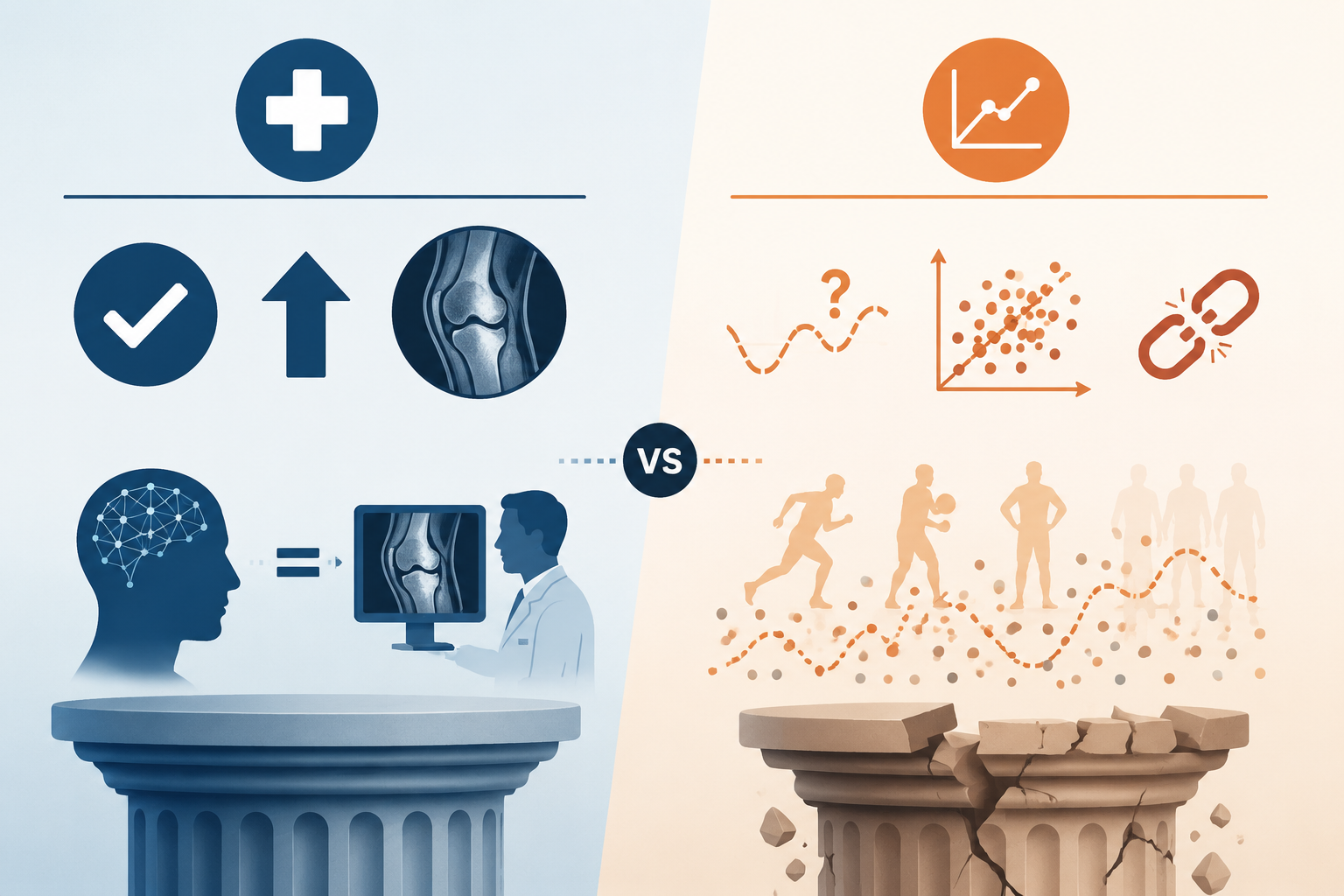
A Better Prevention Study Still Shows the Adoption Gap
The 2026 npj Digital Medicine runner study is a useful example because it resembles the real prevention problem more closely than a retrospective model built from a few convenient variables. The investigators followed 142 endurance runners for 12 months and analyzed 6,181 weekly samples. Their multidisciplinary feature set included genetics, strength, biomechanics, and nutrition, and Random Forest achieved an AUC of 0.784 +/- 0.014 for weekly injury prediction.[3]
That design deserves attention. Weekly prediction forces the model to operate in time, not merely sort injured and uninjured people after the fact. Multidisciplinary inputs also better reflect how overuse and running-related injuries emerge: load, tissue capacity, recovery, mechanics, and individual susceptibility can interact rather than behave as isolated risk factors.
But the adoption claim still has to stay narrow. A cohort of 142 runners is modest for machine learning, particularly when the intended use could involve different training levels, surfaces, injury definitions, climates, coaching practices, and reporting behavior. The study authors noted the lack of external validation on independent cohorts.[3] That limitation is not a technicality; it is the difference between a promising prospective model and a tool that a sports medicine program should rely on to change training, restrict participation, or allocate clinical attention.
A reasonable next research step is not simply a larger leaderboard of models. It is replication in a cohort that the development team did not tune against, with pre-specified outcomes and a clear plan for how the output would be used. If a weekly risk score tells a coach to reduce load, an athletic trainer to screen an athlete, or a clinician to intervene, the study should measure the consequences of those actions as well as the discrimination metric.
External Validation Is Where Prediction Tools Become Clinically Serious
The sharpest warning comes from military injury prediction. A June 2026 Newswise report on UVA researchers' work in Medicine & Science in Sports & Exercise stated that several AI-driven injury prediction systems used in military settings showed poor predictive performance in large service-member cohorts, with some tools performing no better than chance.[4] Because this accessible account is a secondary report rather than the full paywalled article, the claim should be attributed with that limitation. It is still a serious signal, because the deployment setting is exactly where weak validation can produce system-level harm.
Injury prediction in military cohorts is not a sports sideline with a different uniform. Service members may train under standardized demands, but they also differ in job role, prior injury, sleep, load carriage, access to care, reporting incentives, and command pressure. A model that performs well in one development environment can fail when those conditions shift. If the tool is then used to decide who receives prevention resources, who is flagged as high risk, or who is considered ready, the burden moves from the developer to health teams and the people being classified.
This is the same evaluation problem clinicians face with AI in other areas of care: technical performance inside a paper is not the same as clinical usefulness in practice. A practical clinician AI evaluation framework starts with the same questions that matter here: what population trained the model, what population tested it, what comparator was used, what decision changes, and who is accountable when the output is wrong?
For sports injury prevention, external validation should be treated as an adoption requirement, not a desirable extra. A model trained on collegiate soccer players should not be assumed to work in professional basketball. A runner model should not be assumed to work in military recruits. A tool trained during one season should not be assumed to survive a different injury surveillance system, coaching philosophy, or wearable device pipeline.
Wearables and Time-Series Methods Are Useful, But They Do Not Remove the Validation Problem
Technically, the field is moving in sensible directions. A 2026 Annals of Medicine review described multi-sensor fusion combining IMU, EMG, and HRV data as a dominant trend, with Transformer-based architectures showing promise for long-range temporal dependencies in physiological time series.[5] That direction fits the biology better than one-off screening, because injury risk changes as training, fatigue, recovery, and tissue tolerance change over time.
Other methods try to make time-series data more legible to deep learning systems. A 2023 Frontiers in Physiology study used Gramian Angular Summation Field encoding with deep convolutional auto-encoders for runner injury prediction and reported an AUC of 0.891 +/- 0.026, a 23.9% improvement over an XGBoost baseline.[6] That is an interesting methodological signal, especially because it treats sequential training data as more than a flat table of variables.
Still, better architecture does not by itself answer the adoption question. Wearables can capture more data than a clinic visit, but they also introduce device differences, missingness, adherence problems, changes in placement, firmware updates, and behavioral feedback loops. If an athlete sees a risk score and changes training, the future data distribution changes. If a coach selectively records certain sessions, the model learns the documentation pattern as well as the physiology.
That is why market momentum should be kept in its proper lane. Commercial interest in sports injury prediction is real, and market estimates can describe vendor attention or purchasing appetite. They do not establish that a tool prevents injury, reduces unnecessary restriction, or improves return-to-play decisions. Independent validation and clinical impact studies have to do that work.
What Clinicians Should Ask Before Using a Prediction Output
The most useful questions are not abstract objections to AI. They are the questions that decide whether a risk score can be acted on safely.
- Was the model externally validated in the same type of athlete, sport, training environment, and injury surveillance system?
- How many injury events supported the model, not just how many participants or sensor samples?
- Was the prediction window clinically usable, such as a weekly risk estimate that gives staff time to act?
- What happens after a high-risk label: load reduction, clinical screening, strength work, imaging, or simple monitoring?
- What harm follows a false positive or false negative, and who reviews those cases?
- Does the system explain which factors drove the output well enough for a clinician or performance team to challenge it?
These questions also connect to the regulatory debate. The UVA report described calls for FDA-like standards for sports-science software.[4] Whether a given tool falls under medical device oversight depends on its claims and use, but the direction of travel is familiar from AI clinical decision support. A 2026 CDS guidance discussion is relevant because injury prediction tools can drift from performance support into health decision-making once their outputs influence clinical review, training restriction, or readiness decisions.
The parallel with the broader primary care AI evidence gap is straightforward: a model can be technically impressive and still lack proof that it improves outcomes after it is inserted into a messy clinical workflow. In sports medicine, that workflow includes clinicians, athletic trainers, strength staff, coaches, athletes, and sometimes command structures. The output does not act by itself; people act on it.
The Current Evidence Supports Narrow Use, Not Broad Preventive Deployment
AI has credible support in selected imaging-based sports injury diagnosis, especially where CNNs are evaluated against expert radiology comparators for MRI findings such as ACL and rotator cuff tears.[1] That is the most mature part of the evidence base.
AI injury prediction is a different evidentiary problem. The BJSM review shows real model development activity and some strong reported discrimination, but also wide AUC variability, small median cohorts, limited hypothesis declaration, incomplete model comparison, and sparse explainability.[2] Prospective multimodal work in runners shows what better prevention evidence can look like, but it remains short of broad readiness without independent validation.[3] Military validation concerns underline the risk of moving prediction tools into high-stakes populations before they have proved they survive the setting where they will be used.[4]
For now, the evidence supports cautious, domain-specific adoption: AI can assist selected imaging-based diagnosis when tested against appropriate clinical comparators, while prevention models should be treated as promising but unproven unless they have independent validation in the athletes, runners, recruits, or service members whose care they are meant to guide.
References
- The AI Revolution is Already Here: Transforming Orthopedics in 2024 and Beyond, AOSSM Sports Medicine Update, Fall 2024
- Machine learning approaches to injury risk prediction in sport: a scoping review with evidence synthesis, British Journal of Sports Medicine, 2025
- Multidisciplinary prediction of running-related injuries using machine learning, npj Digital Medicine, 2026
- UVA Researchers Warn Unvalidated AI Tools Could Undermine Athlete Health, Military Readiness, Newswise, June 2026
- Artificial intelligence and wearable sensors in sports injury risk prediction, Annals of Medicine, 2026
- Frontiers in Physiology time-series image encoding study, Frontiers in Physiology, 2023
Comments
Join the discussion with an anonymous comment.